Ad Network in Tier 1
Tier 1 is not a universal country list or a guarantee of premium customers. It is useful only as an advertiser-owned portfolio definition with named markets, comparable evidence, protected margin and a written reason for every member.
Reviewed and materially updated 2026-07-15. Tier labels are planning shorthand, not a promise of market access, inventory volume, price or results.
Publish the membership rule before calling any market Tier 1
Advertising teams use Tier 1 as shorthand, but different networks, agencies and buyers can mean different countries or commercial qualities. Start the file with the exact markets included, the date, the business reason and the owner who can revise membership. Possible criteria include customer value, service capacity, language readiness, source transparency, auction competition and the cost of qualification. None should be inferred from the label alone.
Do not present World Bank income groups as an advertising-tier definition. The World Bank publishes a formal and dated economic classification with its own methodology; that source is cited here to show that official classifications have explicit boundaries, not to map them onto media tiers. A Tier 1 portfolio remains the advertiser's planning construct. Readers should be able to reproduce its membership from the documented rule and understand why a market would be removed.
| Portfolio field | Required entry | Invalid shortcut |
|---|---|---|
| Named market | Country or separately governed territory plus review date | Tier 1 worldwide or premium GEOs |
| Commercial reason | Accepted customer value, margin and service evidence | High income therefore profitable |
| Operating readiness | Language, support, fulfilment and rule owner | Large audience therefore ready |
| Removal condition | Specific deterioration or unresolved evidence gap | Keep membership indefinitely |
Protect contribution when mature-market bids are expensive
A higher auction price can be rational when accepted customer value, source accountability and operational reliability support it. Build the bid ceiling backward from the advertiser's retained outcome rather than forward from a public CPM claim. Include media, verification, sales workload, payment loss, returns or cancellations and fulfilment costs that apply to the offer. Keep assumptions separate from observations so a model does not masquerade as a measured market fact.
Compare placements within one named market before blending countries. A portfolio average can make an expensive, strong source look weak beside cheap, poor-quality delivery, or let one exceptional market subsidize another that has no margin. Store native spend and customer value, then add dated treasury conversions for consolidated reporting. The decision record should show both local economics and the common comparison method.
Demand evidence for the environment, not a premium inventory badge
Retain publisher or app identity, seller relationship, placement, format, device and observable context for each material source. A 'premium' label is a vendor description until the buyer can inspect what was delivered. Ads.txt may support a declared seller check where applicable, but it does not certify viewability, audience relevance or customer value. Unknown bundles require their own conservative limit.
Create specimens for the largest spend cells and for unexpected outcomes. Review the creative beside the content, page geometry or app action that surrounded it. Then follow the identifier into the advertiser's accepted result. This joins brand-safety review, source provenance and commercial evidence without pretending any single quality score can replace them.
| Layer | Question answered | Portfolio action |
|---|---|---|
| Seller provenance | Who declared the right to sell this inventory? | Hold or cap an unattributable path |
| Placement specimen | What did the user see and where did interaction occur? | Separate context or geometry problems |
| Journey continuity | Did price, qualification and service survive the click? | Repair the advertiser-controlled route |
| Retained economics | Did the accepted event preserve contribution after maturity? | Adjust bid or membership with business evidence |
Use one denominator only after local outcomes mean the same thing
A form completion in one market may represent a verified appointment, while another market's event may be an uncontacted enquiry. Define the accepted state in operational terms and audit its implementation in every member before ranking them. The same applies to attribution windows, duplicate rules, cancellation maturity and service exclusions. Superficially identical dashboard columns are not comparable when the underlying business state differs.
Keep local diagnostic measures alongside the shared denominator. Response time, device mix, payment method, language route and rejection reason often explain why a market changes. Standardization should make the portfolio interpretable, not erase meaningful local conditions. If an outcome cannot yet be reconciled, leave that market outside the comparative table rather than filling the gap with an estimate.
Treat sales and fulfilment capacity as part of the Tier 1 bid
High-cost demand becomes wasteful when the response team is saturated or the promised service is unavailable. Set daily and weekly admission limits from contact, inventory, appointment or fulfilment capacity. Monitor queue age and rejection caused by operational shortage separately from media quality. A source should not be penalized because the advertiser knowingly bought more qualified demand than it could handle.
Pacing can prioritize the hours or areas where the complete route is staffed, but the reason must be documented. Maintain a recovery rule for backlog and a stop for promises that can no longer be met. Capacity evidence belongs in the portfolio review because it can change the value of the same source without any alteration in audience or auction.
Promote a Tier 1 cell only after equal-maturity review
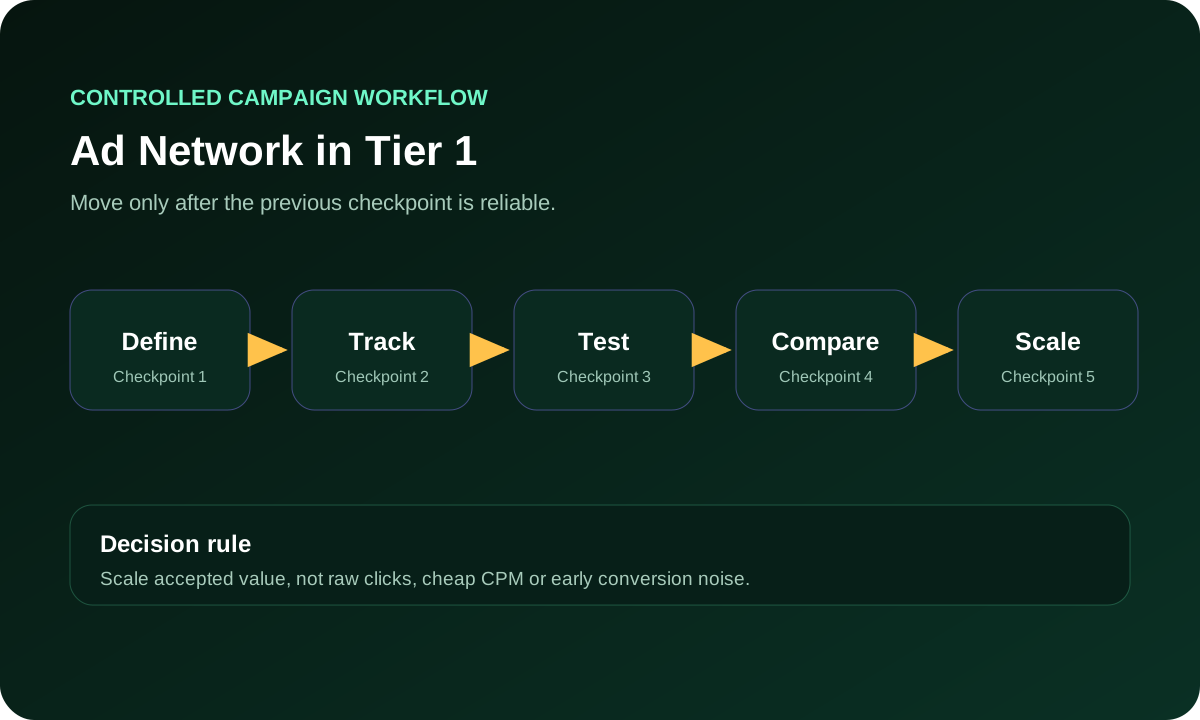
Before a new market or source receives more budget, compare it with the portfolio baseline at the same customer maturity. Specify the single changed dimension, evidence window, maximum loss and rollback owner. Keep the membership rule fixed during the test; otherwise a result can be rescued by redefining Tier 1 after the fact.
A promotion memo states why the cell remains commercially eligible, which source and journey evidence passed, and how much additional exposure is authorized. A reduction memo is equally useful: it may remove a market temporarily because service capacity, provenance or comparability is unresolved. Neither outcome becomes a universal claim about that country. It is a dated decision for this advertiser and offer.
Challenge a Tier 1 ranking when volume, margin and capacity point in different directions
Suppose Market A produces the largest number of accepted customers but requires expensive sales handling, Market B has lower volume and stronger retained contribution, and Market C appears efficient only because cancellations have not matured. A single cost-per-lead ranking cannot resolve the allocation. Rebuild the view with equal customer maturity, native amounts, dated conversions, service workload and source provenance. Market C remains provisional, while A and B can be compared on the business measure chosen before the test.
Next inspect capacity. If Market A's response queue is already beyond the promised contact window, more media may reduce value even when the source is excellent. The appropriate action could be a cap, different pacing or additional operational capacity rather than a lower bid. Record this as a constraint on the advertiser, not a downgrade of the country. Market B may receive a controlled increase because it preserves margin and the route can absorb demand.
Finally test whether the membership rule still explains all three markets. If Tier 1 was defined by high retained value and reliable service, C may not yet qualify and A may need conditional status. Changing membership is acceptable when the evidence and date are retained. What is not acceptable is redefining the label solely to make the quarterly result look consistent.
Show the board why a mature-market allocation changed
A useful allocation memo includes the named market and source cell, the prior and proposed exposure, native and converted economics, accepted-customer maturity, sales or fulfilment load, and the evidence that remained comparable. It also names what was deliberately excluded from the conclusion: an immature cohort, an opaque placement or a currency swing. This allows a reviewer to challenge the decision without reopening every dashboard.
Keep one dissent field. If finance, sales, policy and media owners disagree, record the unresolved assumption and cap the change accordingly. A decision can proceed as a bounded experiment without pretending the organization has certainty. The next review date and rollback trigger turn that disagreement into a test rather than a permanent argument.
Questions that turn a Tier 1 label into a testable portfolio
Is there one official list of Tier 1 advertising countries?
No. The term is used differently across media businesses. This page requires the advertiser to publish its own named membership, criteria, date and revision owner rather than presenting an informal label as a universal classification.
Does a high-income economy automatically belong in Tier 1?
No. The World Bank's income groups have a separate formal purpose and methodology. Advertising membership also depends on the offer, service, source evidence, customer economics and operational capacity.
Why can a higher CPM still be acceptable?
Because the relevant comparison is retained business value after media and operating costs. A more expensive placement may support better contribution, while a cheap one may produce rejection, workload or loss. Measure rather than assume either outcome.
How should currencies be compared across Tier 1 markets?
Keep native spend and customer amounts, then add a dated conversion for the portfolio view. Do not overwrite local records or let exchange-rate movement appear as a media-quality change.
What makes premium inventory verifiable?
Publisher or app identity, seller declaration where applicable, placement context, device evidence and a trace to the mature customer result. The word premium by itself supplies none of those observations.
Can lead volume be used as the shared denominator?
Only when every market applies the same acceptance state. If one column contains raw forms and another contains verified prospects, the portfolio ranking is misleading even when the event names match.
How does capacity affect Tier 1 performance?
Slow contact, unavailable appointments or constrained fulfilment can destroy the value of qualified demand. Preserve capacity and queue evidence so those operational losses are not attributed to the source.
When should a market leave the portfolio?
Use the documented removal condition: for example unresolved seller provenance, insufficient margin at maturity, lost service capability or outcome definitions that cannot be reconciled. Record the decision date and evidence.
Should Tier 1 campaigns share identical creative?
No. Keep the business promise comparable, but language, qualification and context should fit each market. Copying one asset can create false standardization and hide local misunderstanding.
What is required before expanding a Tier 1 cell?
Name the one changed dimension, fixed baseline, bid or loss boundary, maturity window, source and journey checks, and rollback owner. Increase only the tested cell after the comparable result closes.
Classification and media sources behind this Tier 1 method
The World Bank page is used only as an example of a formal, dated classification; it does not define advertising tiers. Google's help material is consulted for the configuration limits of its location tool, while the IAB document narrows the declared-seller check. FroggyAds supplies the factual description of features it publishes for buyers. None of these records establishes universal Tier 1 membership, inventory price or expected performance.