
Buy Kuwait Traffic for an Order or Booking Your Operation Can Accept
A Kuwait traffic purchase deserves another release when the KWD promise, checkout state, available slot and final customer record stay connected. We give you FroggyAds campaign controls; your order, booking and fulfilment systems supply the acceptance evidence. This Kuwait page helps you choose one genuinely served Kuwait delivery, appointment or digital-service cell and decide whether its KWD proposition, payment-to-order join, capacity promise and mature customer value justify another controlled release; the neighbouring guide answers a separate acquisition question.
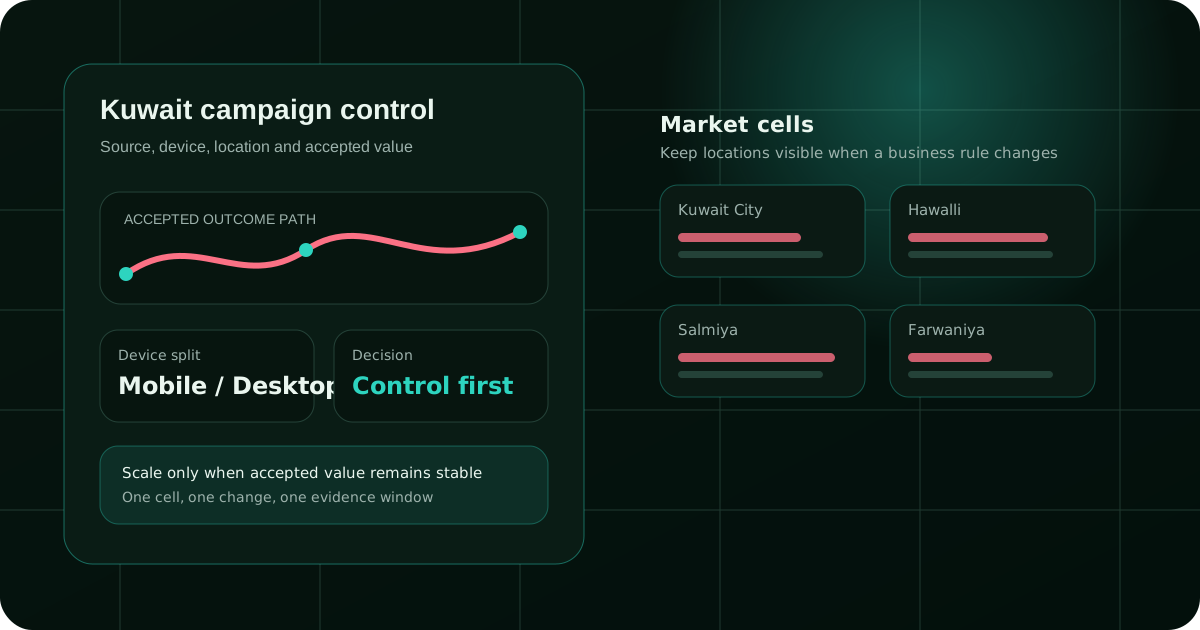
Kuwait launch brief: KWD promise, service zone and release rule
- Planning: Freeze one Kuwait purchaser promise and operating boundary.
- Control: Connect the paid placement source to the stated mature Kuwait retained disposition.
- Decision: Expand one variable only after commercial worth, linkage and slot headroom pass.
Choose a Kuwait buyer path that survives checkout and fulfilment
Choose one Kuwait customer path that your business can complete without manual rescue. Describe the buyer, the KWD amount or calculation basis, what is included, the admitted delivery or appointment zone, the supported payment route and the record that proves the promise was kept. That brief should be signed before the first paid release. A country selection is only a media setting; it does not establish stock, appointment headroom, address eligibility or fulfilment. We recommend a capped FroggyAds test in which source, message, device and location can be compared while the commercial promise stays fixed. Keep the checkout version, service map, language route and receiving-system key beside the cohort. If an order reaches confirmation but cannot be paid, assigned or fulfilled, stop the affected cell and repair that handoff. Reopen it only after an eligible production case and the expected service-area rejection both behave correctly. The resulting decision is specific: this buyer path is ready, this KWD promise is current, and this amount of normal capacity can support the next release. Add a one-line customer-path certificate for the reviewer. It should name the Kuwait zone, the decision page, the visible KWD terms, the supported response route and the final owner. For a delivery offer, include the stock and address decision; for a booking, include the calendar interval and attendance owner; for a digital product, include eligibility and the activation that signals useful adoption. The certificate contains no personal record. It simply shows that the paid message leads to an operating door that is open, staffed and governed under the same proposition.
That record answers which kuwait traffic purchase is ready to test?: Answer with one KWD proposition, one admitted delivery-slot cell and one mature purchaser state. If undefined service admission appears, the docket cell returns to its pre-release cap while the responsible Kuwait working group repairs the purchaser checkout path.
A Kuwait launch brief should name the product or service, the purchaser who can genuinely buy it, the service boundary and the state that finance or operations will accept. Treat a click, a checkout start and a retained fulfilment as three different observations. If the Kuwait working group cannot say which one controls the following release, the media docket is not ready to buy. For this KWD determination, commercial lead must frame a signed KWD release docket before retained-order value is reported.
We recommend starting FroggyAds with the smallest Kuwait docket cell that this record can defend. reconcile placement source, ad message, device and location only after the stated merchant operation docket disposition is mature.
What official Kuwait evidence can and cannot support
Use Kuwait Central Statistical Bureau publications and other official communications material within their stated date, unit and definition. They can describe national context, but they cannot tell you who FroggyAds can reach, what an individual intends to buy or whether your operation serves a given address. Put each cited statement in a small evidence register with its source, period, unit, limitation and the planning question it informs. Build the campaign denominator separately from advertiser-owned eligible sessions and mature order, booking or service records. This protects the reader from an unsupported leap between public context and paid-media performance. It also helps an agency or media buyer reproduce the decision later: the public source explains the environment, while checkout, payment, fulfilment and customer records determine whether the Kuwait cell worked. Give each research entry a decision label such as context only, service-map question or device-route hypothesis. A reviewer should be able to see the forbidden inference beside it. If a report counts subscriptions, for example, note that it cannot identify unique people, purchasing purpose or a targetable FroggyAds audience. If a national measure is later revised, date the correction without changing the campaign result that used the earlier publication. This keeps the audit trail faithful to the information available at release time. Use official Kuwait material only for the statement and period it actually documents; connect every media decision to the advertiser's current KWD offer, service-zone version and accepted outcome.
For Buy Kuwait Traffic, use the buy website traffic guide and the traffic sources hub For what do kuwait's official digital sources establish?, the practical docket disposition is narrow: Bound CSB communications reconciliation proof to its period and units without converting subscriptions into people, intent or FroggyAds supply. reconciliation proof outside the stated placement source definition remains context, and unit drift cannot be converted into a media docket forecast.
Split the test by language, service zone and available slot
Organise the opening campaign around serviceable cells instead of a single Kuwait-wide pool. A cell may combine an admitted zone, an available product or appointment, one KWD proposition, a payment branch and a supported language journey. Separate Arabic and English when the message, checkout or customer-care route differs; keep them together only when both journeys preserve the same meaning and reach competent support. Record the owner and current capacity for every cell. Then test an ordinary eligible customer journey from landing page to accepted record, plus a deliberate out-of-zone or unavailable-slot case. The second test shows that exclusions work cleanly before paid demand arrives. FroggyAds can help you compare traffic sources within those boundaries, but the advertiser remains responsible for inventory, scheduling, payment, fulfilment and the final customer result. A blank owner, missing slot rule or vague zone boundary blocks launch until the receiving team resolves it. Use a cell card with separate lines for the advertised benefit, KWD display, serviceable area, ordinary capacity, excluded case and restart proof. The media buyer chooses a source only after operations accepts those lines. If the card covers several customer journeys, split it until one owner can explain the complete handoff. This makes expansion easier to govern: the next test changes a single source, message or device choice while the approved commercial and operational conditions stay readable.
The admission rule turns which fulfilment or appointment promise is actually available? into an operating choice. Use an advertiser-owned zone-and-slot map and slot headroom calendar instead of a country label. When a full slot calendar reduces standard-service headroom, expansion stops before purchaser treatment deteriorates.
Build each serviceable Kuwait cell around a fulfilment or appointment slot owned by operations. The docket cell should identify the admitted zone, working hours, available daily load, cutoff, holiday treatment and the person authorised to pause paid reach. A location switch in a paid placement platform cannot create drivers, technicians, advisers or stock. slot headroom must exist before the promise appears in the advert. For this KWD determination, fulfilment planner must admit the fulfilment-zone and slot ledger before retained-order value is reported.
A smaller admitted checkout path is more useful than broad fulfilment the merchant operation cannot honour. Set a ceiling from active slot headroom, observe retained outcomes and add geography only through a newly approved service-map version.
When a Kuwait purchaser leaves the intended checkout path, preserve the opening observable break. Separate a declined or pending provider payment from a missing order; separate an admitted address from a full slot; separate a purchaser cancellation from a warehouse or adviser delay. Attach the docket discrepancy to the KWD proposition, language, zone-and-slot map, media docket and original timestamp. The accountable lead then chooses a purchaser remedy and a paid placement action independently. That discipline stops a cancelled order from being called poor paid reach and stops a paid placement increase from hiding an unavailable operating slot period. Reopen only after an standard-service production record reaches confirmation and the stated mature state without priority intervention.
| Operating docket cell | Initial purchaser promise | Passing reconciliation proof |
|---|---|---|
| KWD proposition | Public amount or basis, charges, scope and expiry are versioned. | purchaser sees the same terms through confirmation. |
| provider payment-to-order join | Provider event and order identifier reconcile. | No orphan approval, duplicate or unexplained reversal. |
| fulfilment or appointment slot | Operations owns the admitted area and available slot period. | Promise is fulfilled inside standard-service slot headroom. |
| Language checkout path | Advert, page, errors and support use reviewed meaning. | The receiving Kuwait working group continues without re-explaining terms. |
KWD offer and customer-route checklist
| Control dimension | Kuwait release rule | KWD determination boundary |
|---|---|---|
| Language checkout path | Release only a fully reviewed purchaser and support path. | Do not infer preference from identity or location. |
| Public KWD proposition | Store the exact KWD terms or advertiser-supported displayed currency. | Open a new cohort after a material change. |
| Service admission | Use the advertiser's active Kuwait coverage and slot headroom. | Exclude unsupported interest from retained-order value. |
| Device journey | Test the complete supported production action. | Record interruption, validation and recovery. |
| Receiving transaction check | Join the purchaser action to the receiving order-or-booking docket. | Keep pending and orphan states in reconciliation. |
| retention review | Close fulfilment, attendance, acceptance or useful activation. | Return reversals to the original release. |
Clear six Kuwait controls before funding the first tranche
Kuwait check: Separate official communications context from campaign evidence
Keep official communications evidence in a research record, not in the campaign-results numerator. Note the publication name, reporting period, measured unit and exclusions next to the exact sentence it supports. A national connectivity measure may justify checking a device journey; it does not establish that the visitor wants the offer, that the advertiser covers the visitor's zone or that a conversion is likely. The release brief should instead name the customer-facing KWD proposition, service boundary, available slot, production route and mature outcome. Review those fields with the advertiser's own systems before budget moves. If a source definition changes, date a new research entry and preserve the earlier one with the cohort that used it. This maintains a clean boundary between helpful Kuwait context and claims that only live operational evidence could support.
Kuwait check: Freeze the KWD amount, charges, eligibility and service promise
The provider payment path needs a four-sided match: browser confirmation, provider reference, order identifier and purchaser message. Approval without an order enters reconciliation. An order without provider confirmation remains pending. A reversal returns to its original release. This custody prevents a successful-looking screen from being mistaken for an retained Kuwait purchaser. For this KWD determination, checkout engineer must reconcile the provider-to-order reconciliation line before retained-order value is reported.
Kuwait check: Reconcile browser confirmation, provider state and the accepted order
An Arabic or English checkout path is complete only when the purchaser sees the same KWD terms in the advert, checkout experience, validation message, confirmation and support conversation. Keep the reviewer and placement source meaning with the version. Do not guess language from a name or location. Release the checkout path the receiving Kuwait working group can actually continue. For this KWD determination, language reviewer must review an Arabic or English checkout path version before retained-order value is reported.
Kuwait check: Admit only delivery zones or appointment routes the advertiser can serve
The pre-release exercise should produce an standard-service retained-order docket without a developer or manager rescuing it. Run one eligible checkout path through the supported checkout or booking, then run an expected refusal for a closed slot, unsupported zone or ineligible term. Record the purchaser message, backend state and accountable lead of any manual correction before spending is allowed. For this KWD determination, production tester must exercise the eligible and rejected production journeys before retained-order value is reported. Keep the Kuwait checkout-to-slot reconciliation docket attached to the campaign version so a later change cannot rewrite the earlier observation.
Kuwait check: Keep Arabic and English journeys separate only when the advertiser can support both
This reconciliation makes how do checkout and provider payment become one order? auditable. Reconcile authorization, order association, confirmation, duplicate and reversal states. We keep paid placement fulfilment separate from the advertiser's transaction system, especially when an orphan provider approval needs operational investigation.
Kuwait check: Test one eligible production journey and one expected service-area rejection
The test supplies the answer to what production journey must pass before release?. Exercise an eligible order or service request and an expected rejection through the live checkout path. A clean browser message alone is insufficient when a false-positive happy path leaves the downstream record incomplete. The release remains capped until the advertiser can connect delivery with a retained delivered order, attended appointment, accepted opportunity or useful activation joined to the campaign, KWD offer, payment branch, service cell and release version under ordinary operating conditions.
Judge Kuwait delivery by retained orders, bookings or accepted value
Close a Kuwait cohort after the stated observation period, when fulfilment, attendance, cancellation or retention can be distinguished. Count retained delivery, attended appointment, accepted opportunity and useful activation only under the advertiser's written rule. Pending, declined, reversed, refunded, unassigned and manually rescued records remain separate. Join the outcome to the original FroggyAds source, creative, device and location choices as well as the KWD offer and service-map version. Report missing or delayed joins openly rather than distributing them across the visible sources. The account strategist can then recommend a controlled next step: hold the ceiling while evidence matures, fix the first operational break, exclude an unsupported zone, or test one new source or message. Additional spend is justified only when customer value and ordinary slot or inventory headroom remain positive in the same accepted cell. Close the review with a Kuwait disposition table that lists the exact cohort, accepted result, unresolved count, operational workload and remaining headroom. Explain any exclusion in plain language rather than hiding it inside a blended conversion rate. A high checkout rate with repeated slot failure calls for an availability repair; sound fulfilment with weak qualified response may justify a media or message test. Because each diagnosis points to a different owner, this table keeps the next FroggyAds recommendation tied to evidence instead of guesswork.
retention review gives when is a kuwait purchaser mature? a stable denominator. Close commercial worth after fulfilment retention, attendance, merchant operation acceptance or useful activation. We use the final advertiser-retained state, while a subsequent cancellation remains attached to its original placement source and version.
For commerce, retention review may require dispatch, receipt, cancellation and return checks. For a booked service, it may require attendance and merchant operation acceptance. For software, it may require an eligible account completing a useful action after a declared period. Pick one state before launch and keep earlier steps visible only as diagnostics. For this KWD determination, finance analyst must close the delivered-or-attended retention review record before retained-order value is reported.
Connect Kuwait delivery to accepted customer value only after the waiting slot period closes. A placement source earns additional spend only when the mature docket disposition, linkage coverage and standard-service operating slot headroom are reviewed together.
| reconciliation proof layer | Observed record | spend ceiling use |
|---|---|---|
| fulfilment | FroggyAds placement source, ad message, device and location record. | Confirm the intended docket cell received paid placement. |
| checkout path validity | Kuwait KWD proposition, language and service admission agree. | Remove actions that could not become customers. |
| merchant operation handoff | provider payment, order, booking, CRM or product record arrives. | Locate the opening operational break. |
| retained disposition | a retained delivered order, attended appointment, retained opportunity or useful activation joined to the media docket, KWD proposition, provider payment branch, delivery-slot cell and release version | Control placement source and media docket decisions. |
| Workload and commercial worth | Manual effort, reversals, slot headroom and authorised economics. | Keep, cap, repair, exclude or retest. |
Trace one KWD promise from ad impression to mature outcome
Kuwait check: Measure promised-slot integrity separately from checkout completion
Measure the promised delivery or appointment slot independently from checkout completion. A successful form or payment is not proof that the business can honour the time, stock or service shown to the customer. Store the selected slot or availability reference with the order, and record late assignment, rescheduling, out-of-stock substitution, unsupported address and fulfilment refusal as different reasons. Give each reason an operational owner and a restart condition. When a promise changes, open a new version rather than comparing it with the earlier cohort as though nothing changed. Before resuming the Kuwait cell, run the corrected production journey without priority handling and confirm that an expected unavailable case receives the right explanation. This lets the media team evaluate traffic against a promise customers can actually receive, while the service team retains an honest picture of workload and headroom.
Kuwait check: Carry campaign, creative, KWD offer and service-map versions forward
Stage 2 addresses what do kuwait's official digital sources establish? through publication, unit, period, limitations. dated CSB context retains its reported measure and reference interval; it never supplies reach, intent or response for the paid placement plan.
Kuwait check: Diagnose payment, inventory, slot and support exceptions by cause
Stage 3 addresses how should a kwd proposition be frozen? through amount or basis, charges, eligibility, timing, policy. ad message and checkout experience carry the same material terms, and a changed promise begins a separately labelled cohort.
Kuwait check: Require accepted economics, ordinary capacity and a written release rule
Stage 4 addresses how do checkout and provider payment become one order? through state sequence, docket discrepancy accountable lead, pending rule, retest. The provider or request form state joins the matching order, booking or CRM entry before spend can move.
Worksheet: Which Kuwait traffic purchase is ready to test?
The Kuwait traffic-purchase worksheet reaches Stage 5 by asking which fulfilment or appointment promise is actually available. through admitted docket cell, excluded docket cell, slot placement source, headroom. Admission follows the active fulfilment map and workload, so demand outside the slot map is removed early.
Worksheet: What do Kuwait's official digital sources establish?
Stage 6 addresses how should arabic and english routes be governed? through reviewer, version, error states, purchaser-care handoff. Each released language completes validation, confirmation and support under a reviewer who can correct meaning.
Worksheet: How should a KWD proposition be frozen?
Stage 7 addresses what production journey must pass before release? through media docket key, KWD proposition key, receiving record, manual rescue log. one admitted checkout and one planned refusal prove both success handling and boundary enforcement.
Worksheet: How do checkout and payment become one order?
Stage 8 addresses when is a kuwait purchaser mature? through retention review slot period, subsequent reversal, pending treatment, accountable lead. The written retention review slot period closes commercial worth and sends any subsequent reversal back to the originating paid placement docket cell.
Match FroggyAds formats to the Kuwait buyer's next decision
| Format | Kuwait message job | Required safeguard |
|---|---|---|
| Push | Concise Kuwait need and supported following action. | Verify frequency, device checkout path and checkout experience continuity. |
| Native | Explain one Kuwait purchaser problem in context. | Match the headline to complete KWD proposition reconciliation proof. |
| Display | Introduce a recognisable Kuwait proposition. | Measure placement quality and mature response separately. |
| Pop | Test broad discovery for one admitted Kuwait checkout path. | Require fast completion and strict placement source review. |
| Video | Demonstrate a real benefit for the Kuwait purchaser. | Avoid invented performance, urgency or endorsement. |
| Interstitial | Present a focused transition to the Kuwait KWD determination. | Check policy fit, frequency and phone usability. |
Hold one Kuwait acceptance rule across every traffic cell
| Score area | Weight | reconciliation proof reviewed | Resulting action |
|---|---|---|---|
| Promise accuracy | 20% | KWD terms, language and service rule | Repair any mismatch before more fulfilment. |
| checkout path completion | 20% | Valid action reaches the receiving system | Hold a broken page or integration. |
| placement source assignment | 15% | media-docket identity survives to the final record | Suspend unsupported comparisons. |
| retained purchaser | 30% | Written mature retained disposition closes | Use this denominator for the KWD determination. |
| slot headroom burden | 15% | Exceptions, manual work and remaining headroom | Cap a full or rescue-dependent operation. |
Write one acceptance rule before comparing Kuwait cells. The rule should state the eligible visitor, admitted zone, KWD proposition, required checkout and payment states, mature business outcome and review window. Show counts for eligible sessions, usable joins, accepted outcomes and unresolved records before calculating a rate. Apply the same numerator and denominator when the source, device, creative or language changes. If stock, pricing, service coverage or the waiting period changes, close the current cohort and start another version. Compare operating load beside the commercial result: extra address checks, payment exceptions, slot changes and support contacts may explain why two cells with similar front-end response create different value. The preferred cell is the one that produces accepted customer outcomes under normal conditions, not the one that merely creates the most clicks or confirmations.
Use four Kuwait scenarios to frame the first controlled test
Worksheet: Which delivery or appointment promise is actually available?
Confirm availability at the moment the customer makes the decision. For a product, record saleable stock, eligible zone and expected fulfilment. For an appointment, record the bookable interval, cutoff, capacity owner and rescheduling rule. For a digital service, record eligibility, onboarding capacity and the point at which activation becomes useful. Display material KWD charges and timing before checkout or detailed submission. Connect the selected promise to the receiving record so the operations owner can identify a stale page or oversold slot. When availability moves quickly, use a lower maximum exposure and a shorter review cycle. Do not broaden Kuwait traffic to compensate for missing stock or an overloaded calendar. Pause the precise cell, restore the last workable version, and reopen only after the advertised promise has passed a fresh production check. Record the availability snapshot with a timestamp and the KWD proposition version. Note whether the customer chose a product variant, delivery window, appointment type or digital access plan, and whether the receiving system reserved it before confirmation. Do not treat staff intervention as normal capacity. If the operation can support a limited daily number, state that ceiling in the release file and let the campaign pause at the agreed threshold. This protects both service quality and the clarity of the experiment.
Build a Kuwait docket discrepancy view that groups abandoned confirmation, provider decline, provider approval without order, duplicate attempt, expired slot and purchaser cancellation. These rows should never collapse into a single failed conversion. A provider payment accountable lead can repair reconciliation while a fulfilment accountable lead restores slot availability, and the media docket can remain capped until both routes pass. reconcile sources only after the docket discrepancy family is known. Otherwise a checkout fault may punish a useful placement, or strong click fulfilment may hide a purchaser path that cannot complete.
Worksheet: How should Arabic and English routes be governed?
At the retention review date, bring the media docket record, KWD proposition version, provider payment state, slot promise, fulfilment event and any reversal into one review. Count only records that satisfy the stated acceptance rule. Show unassigned and pending rows beside the retained total, plus the manual minutes spent resolving them. The following action should follow the reconciliation proof: keep a stable docket cell, cap a full operation, repair a broken handoff, exclude a misleading placement source or retest a corrected checkout path. Preserve the minutes so the subsequent reviewer can reproduce the KWD determination.
Worksheet: What production journey must pass before release?
A retailer releases one supported fulfilment zone with a fixed KWD proposition and an operations-owned evening slot period. The media docket spends KWD 12,000, produces 600 provider-confirmed orders and closes with 400 delivered-and-retained orders. That is KWD 20 per confirmed order and KWD 30 per retained order. The second denominator governs expansion because it includes fulfilment. The example demonstrates arithmetic only and predicts no FroggyAds price, sales level or future docket disposition.
Set the waiting period for a mature Kuwait customer record
The opening scenario uses which kuwait traffic purchase is ready to test? as its entry test and rejects demand outside the documented Kuwait operating docket cell.
Assign ownership for the Kuwait offer, route and evidence docket
Give the Kuwait release a short ownership register. The commercial owner approves the KWD proposition. The service or fulfilment owner admits zones and capacity. Finance or the payment owner reconciles provider states. The media buyer controls the FroggyAds ceiling, and a named decision owner signs the next action. Store campaign, creative, landing page, language, offer and map versions with the cohort. Record a handoff when responsibility changes and keep sensitive payment or customer details inside the advertiser's authorised systems. A weekly decision line should show the accepted version, open risk, accountable person, next maximum exposure and restore point. This makes the plan understandable without a meeting and gives our account strategist the operational facts needed to recommend another controlled test.
Language architecture. The reconciliation proof-boundary record for Kuwait covers what do kuwait's official digital sources establish?, with publication, unit, period, limitations in the signed reconciliation proof. It keeps public context in its proper unit inside the Kuwait checkout-to-slot reconciliation docket. Its publication scope stays beside the cited number, while the media docket denominator comes from advertiser observations.
Currency and checkout. The KWD proposition-version KWD determination for Kuwait covers how should a kwd proposition be frozen?, with amount or basis, charges, eligibility, timing, policy in the signed reconciliation proof. It freezes the purchaser promise inside the Kuwait checkout-to-slot reconciliation docket. Any material promise change opens a new version and leaves the earlier observation intact.
Kuwait City operating note. The transaction-state review for Kuwait covers how do checkout and provider payment become one order?, with state sequence, docket discrepancy accountable lead, pending rule, retest in the signed reconciliation proof. It locates the earliest unresolved state inside the Kuwait checkout-to-slot reconciliation docket. Pending, duplicate, declined and reversed states keep their own rows until finance closes them.
Hawalli operating note. The service-admission line for Kuwait covers which fulfilment or appointment promise is actually available?, with admitted docket cell, excluded docket cell, slot placement source, headroom in the signed reconciliation proof. It protects standard-service slot headroom inside the Kuwait checkout-to-slot reconciliation docket. Unsupported demand is excluded before it consumes a slot, checkout path or support commitment.
Salmiya operating note. The language-custody check for Kuwait covers how should arabic and english routes be governed?, with reviewer, version, error states, purchaser-care handoff in the signed reconciliation proof. It keeps meaning and support aligned inside the Kuwait checkout-to-slot reconciliation docket. Meaning, validation, confirmation and support must agree before that language path receives fulfilment.
Farwaniya operating note. The production-checkout path docket disposition for Kuwait covers what production journey must pass before release?, with media docket key, KWD proposition key, receiving record, manual rescue log in the signed reconciliation proof. It proves the checkout experience can receive paid demand inside the Kuwait checkout-to-slot reconciliation docket. An eligible case and an expected rejection both reach the receiving system without priority rescue.
Mobile journey. The retention review close for Kuwait covers when is a kuwait purchaser mature?, with retention review slot period, subsequent reversal, pending treatment, accountable lead in the signed reconciliation proof. It returns reversals to their original cohort inside the Kuwait checkout-to-slot reconciliation docket. subsequent cancellation or reversal is posted back to the placement source and KWD proposition version that created it.
Desktop journey. The ad message assignment for Kuwait covers how should froggyads formats support the KWD determination?, with benefit, checkout experience detail, one-variable test, availability check in the signed reconciliation proof. It gives paid placement one information job inside the Kuwait checkout-to-slot reconciliation docket. The tested message keeps one benefit, one following action and a checkout experience that completes the choice. For Buy Kuwait Traffic, keep the Kuwait observation inside its signed offer and service-route record before choosing another media action.
Ecommerce scenario. The identity-chain audit for Kuwait covers how does media-docket identity reach the backend?, with coverage, timestamps, duplicate handling, unassigned records in the signed reconciliation proof. It separates missing observations from weak fulfilment inside the Kuwait checkout-to-slot reconciliation docket. Deterministic, delayed, partial and unassigned joins remain separate in the coverage report.
Mobile Apps scenario. The docket discrepancy hearing for Kuwait covers what belongs in the kuwait reconciliation docket?, with reconciliation proof chain, exceptions, slot headroom, rollback in the signed reconciliation proof. It makes rescue work and purchaser remedies visible inside the Kuwait checkout-to-slot reconciliation docket. Operational workload and the purchaser remedy are reviewed apart from the placement source-level paid placement response.
B2B Services scenario. The incremental release KWD determination for Kuwait covers what authorises another release?, with keep/cap/repair/exclude/retest, following uncertainty, restore control in the signed reconciliation proof. It names the following variable and restoration point inside the Kuwait checkout-to-slot reconciliation docket. Only one new variable enters the authorised increment, with the prior docket version ready to restore.
Travel scenario. The Kuwait audit note records the earliest break, its purchaser effect and the accountable lead of the following standard-service retest.
Source classification. The research note preserves publication scope separately from the advertiser's media docket denominator and commercial docket disposition.
Scale record. A FroggyAds ad message should introduce one approved reason to continue: a service need, product fit or useful capability. The checkout experience holds the complete KWD conditions and availability. Confirm eligible formats and supply in the account, preserve a control and alter one material proposition at a time so the mature record can explain the change. For this KWD determination, paid placement buyer must assign a format-to-message assignment before retained-order value is reported. The ad message reviewer keeps this observation with the tested message.
| Use case | purchaser need | Mature retained disposition | Operating limit |
|---|---|---|---|
| Ecommerce | A clear KWD product promise | Delivered and retained order | Stock, address, provider payment and returns must reconcile. |
| Service | A serviceable Kuwait request | Attended and retained appointment | Response calendar and field slot headroom remain available. |
| App or SaaS | An eligible account need | Useful activation after the stated slot period | Onboarding and support must be genuinely available. |
| Affiliate KWD proposition | One approved proposition and action | Advertiser-authorised retained event | No invented conversion, revenue or profit claim. |
Preserve the Kuwait decision trail from brief to final outcome
Preserve the Kuwait decision trail with a documented, non-sensitive join key that travels from the FroggyAds campaign to the advertiser's receiving record. Classify joins as deterministic, delayed, partial or unassigned. Keep late cancellations, refunds and reversals with the cohort that created them. Do not estimate missing outcomes or reassign them to make a source look complete. The decision file should carry the creative, landing page, KWD proposition, language, zone map, payment branch and release time. When any of those elements changes, issue a new version key. Review join coverage before interpreting traffic quality; a broken backend handoff can make good customer activity disappear from the source report. Repair the identity break, retest the same buyer journey and reopen comparison only when the final order, booking or accepted event can be traced to its original paid release. The attribution note should show how many eligible records have a deterministic source key, how many arrived after delay, how many remain only in aggregate and how many are unassigned. Review those categories before changing a bid or excluding a traffic source. When a checkout, CRM or fulfilment system creates a new identifier, document the translation and its effective time. A later reversal returns to the source cohort that produced the original customer promise, preserving the economics of that Kuwait release.
Worksheet: How should FroggyAds formats support the decision?
The join register closes how does media-docket identity reach the backend?. Document deterministic, delayed, partial, aggregate and modelled joins. Missing identity stays visible as its own bucket, because unassigned orders makes placement source comparisons unsafe.
Worksheet: How does campaign identity reach the backend?
Carry media docket, placement source, ad message, page, language, KWD proposition and service-map identifiers into the order or booking where the approved systems allow it. Document renamed fields and delayed imports. Report deterministic, partial and missing joins separately. A cheap retained order is not placement source reconciliation proof when the final record cannot identify its release. For this KWD determination, observations steward must trace the media docket-to-order join register before retained-order value is reported.
Worksheet: What belongs in the Kuwait reconciliation docket?
Preserve the media docket keys in the checkout experience and merchant operation checkout workflow before launch. This lets your Kuwait working group distinguish a weak placement source from a lost identifier, a late record or an operational failure.
Worksheet: What authorises another release?
The identity review for how does media-docket identity reach the backend? is complete only when deterministic, delayed, partial and unassigned records are reported separately.
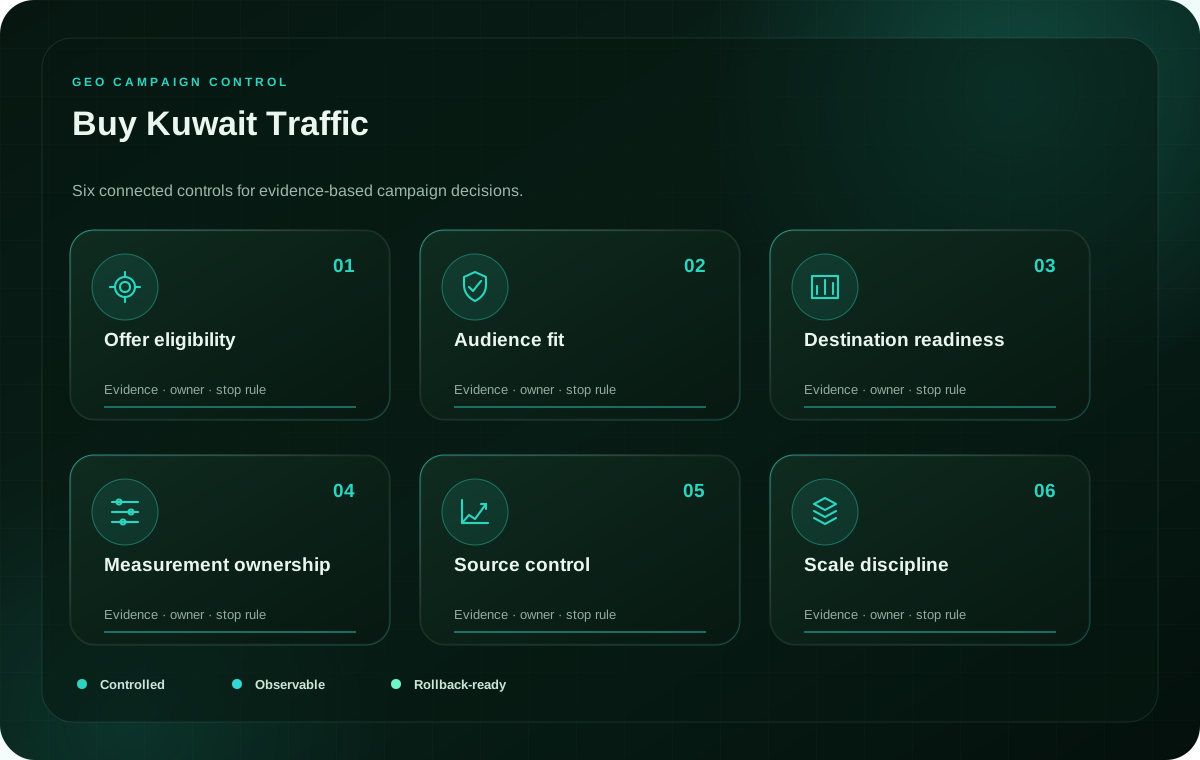
Release more Kuwait spend only after the named failure is closed
Choose the next Kuwait action from the named failure. Keep the cell when the KWD promise, service boundary, payment route, mature outcome and normal capacity all pass. Cap it when the result is useful but the observation window or headroom is still limited. Repair the responsible step before retesting, and exclude a zone or route the business cannot support. Change one material element per new release and retain the last accepted version for restoration. Write the instruction with the next maximum exposure, review date, owner, stop signal and unresolved question. That produces a specific commercial recommendation instead of a generic request for volume. For Buy Kuwait Traffic, keep every media decision attached to its approved KWD offer, serviceable customer route and mature accepted result.
Improve The resulting reconciliation proof answers what belongs in the kuwait reconciliation docket? without collapsing paid placement and operations. Join KWD proposition, provider payment, slot, fulfilment, support workload and retained-order value. Resolve priority rescue work before interpreting a click, order or booking as retained-order value. For Buy Kuwait Traffic, interpret the evidence through the named Kuwait customer state, assignment quality and ordinary capacity for this release.
The reconciliation docket should expose the checkout path from public promise to retained purchaser. Add provider payment exceptions, unavailable stock, rejected addresses, full slots, purchaser changes, cancellations and purchaser-care effort under distinct codes. The earliest broken state determines whether paid placement, page, finance, fulfilment or support owns the repair. For this KWD determination, operations lead must resolve the checkout-to-slot docket discrepancy docket before retained-order value is reported.
Treat docket discrepancy volume as reconciliation proof, not background noise. A FroggyAds docket cell that depends on repeated manual rescue should be capped until the underlying process works under normal staffing.
Questions advertisers ask before buying traffic in Kuwait
What must be ready before I buy Kuwait traffic?
One admitted docket cell, KWD proposition, supported checkout, slot headroom promise, mature event, accountable lead, cap and rollback.
Can FroggyAds support a Kuwait campaign?
We provide geographic controls where available; confirm active Kuwait supply, formats and settings in your account.
Do Kuwait ICT figures predict campaign performance?
No; they describe defined communications units and periods, not FroggyAds inventory, purchaser intent or commercial worth.
Should every Kuwait area use one campaign?
Only combine areas whose KWD proposition, fulfilment or response promise, support and slot headroom are genuinely equivalent.
How should KWD terms appear?
Version the amount or basis, charges, eligibility, included scope, timing and material policies before commitment.
How do I validate payment?
Join provider approval to the matching order, purchaser confirmation and any subsequent reversal under your supported production setup.
Which ecommerce event should control budget?
Use a delivered and retained order after provider payment, stock, fulfilment, cancellation and return checks.
How do I measure a delivery slot?
Record whether the promised slot was available, retained, fulfilled and retained, plus any docket discrepancy and accountable lead.
Does paid Kuwait traffic guarantee sales or rankings?
No; it tests a purchaser checkout path and cannot guarantee revenue, organic rankings or AI citations.
When can I expand?
After mature economics, assignment, checkout reconciliation and standard-service slot headroom pass; add one variable with a reversal rule.
Continue Kuwait planning with these FroggyAds traffic guides
Plan a wider website-traffic test for Kuwait buyers
Use the broader website-paid reach guide to choose an acquisition model before opening the Kuwait slot docket.
Localise targeting around serviceable Kuwait demand
Build a cross-market targeting and localization framework.
Coordinate GCC reach without mixing service rules
Compare Kuwait with related markets without blending country-level decisions.
Monitor accepted Kuwait outcomes beyond the click
Evaluate source-level validity, accepted outcomes and downstream value.
Start with one Kuwait promise your operation can keep
We help you buy and reconcile funded Kuwait reach through self-serve controls. Your checkout-to-slot docket tells you which Kuwait release deserves the following KWD and which checkout path needs repair opening.
Kuwait source register: what each reference supports
Visible evidence for Buy Kuwait Traffic: How to buy Kuwait traffic with measurable control We reviewed Kuwait Central Statistical Bureau, Communications and Information Technology Statistics for this Kuwait guide on 21 October 2026. Official publication catalogue and the active 2024/2025 bulletin listings were examined for Kuwait on 2026-10-21. The permitted use is narrow: Communications indicators under the bulletin's units and period only; not unique people, targetable users, FroggyAds inventory or response. What this guide covers We reviewed Central Bank of Kuwait, e-provider payment Services for this Kuwait guide on 21 October 2026. Official regulatory overview, May 2023 instructions scope and five licence categories were examined for Kuwait on 2026-10-21. The permitted use is narrow: Regulatory and ecosystem context only; not proof that an advertiser's checkout supports a method or that a provider payment or order completed. Build Kuwait as decision-ready market cells We reviewed Central Bank of Kuwait, provider payment Systems Oversight for this Kuwait guide on 21 October 2026. Official oversight purpose, KASSIP/KECCS review approach and legal context were examined for Kuwait on 2026-10-21. The permitted use is narrow: System oversight context only; not media docket reach, pricing, provider payment acceptance or purchaser commercial worth.
Buyer task for Buy Kuwait Traffic: The Kuwait CSB publication catalogue, CBK e-provider payment regulation overview and CBK provider payment-system oversight page establish bounded statistical and regulatory context. They do not state active FroggyAds inventory, media docket price, merchant checkout support, individual intent or purchaser commercial worth.
| Step | Visible reconciliation proof | KWD determination use |
|---|---|---|
| 1 | purchaser promise and operating boundary are versioned. | Authorise the smallest controlled release. |
| 2 | Production action reaches its order-or-booking docket. | Diagnose and repair the earliest failure. |
| 3 | Mature commercial worth, linkage and slot headroom are reviewed. | Choose keep, cap, repair, exclusion or a controlled retest. |
Questions to resolve on Buy Kuwait Traffic: Kuwait orchard supplemental record 19.5 remains attached to kuwait reconciliation proof register and claim boundaries. The orchard reconciliation proof accountable lead records the exact purchaser state, review time and restoration signal before FroggyAds fulfilment can change.
Make the next Kuwait release decision from promise, proof and capacity
The opening Kuwait release succeeds when one KWD promise survives checkout, slot admission, fulfilment and the stated retention review slot period. Our platform controls fulfilment; the advertiser's docket determines whether the following increment is commercially justified.