
Permission first
Confirm offer, traffic-source, market and destination rules before exposing budget.
Evaluate a direct linking traffic source by offer permission, destination policy, click-ID continuity, message match and accepted conversion quality.
A direct linking traffic source sends the ad click straight to the merchant or affiliate offer without an intermediate landing page. It is suitable only when the affiliate program, offer, traffic source and destination all permit the method, tracking identifiers survive the redirect chain and the ad can provide enough context to make the final page truthful and understandable.
Quick answer: Evaluate a direct linking traffic source by offer permission, destination policy, click-ID continuity, message match and accepted conversion quality. Start by checking whether the traffic source exposes destination rules, source references, budget controls and targeting that fit the approved offer. Removing a bridge page can reduce one production task and one handoff, yet it can weaken the journey when visitors still need education or qualification. The direct route is strongest when the merchant page completes the ad's promise without surprise, missing context or a different product identity. Keep the first direct-link test to one source, format and market until tracking and accepted value remain stable.
| Section | Distinct excerpt from this page |
|---|---|
| What direct linking changes | With no intermediate landing page, the ad and merchant destination jointly carry the required context, disclosure and purchase explanation. |
| Four permissions must align | Attach the dated permission record to the campaign brief so a later offer or policy change can trigger a new review. |
| Destination ownership and control | Record an HTTPS check, targeted-device result, intended-market response and complete redirect trace for the released destination. |
Reference for advertising and media-buying practice: IAB standards and guidelines.
Confirm offer, traffic-source, market and destination rules before exposing budget.
Carry stable source and click IDs to the accepted business outcome.
Keep a stable comparison allocation while testing one major change.
Pause at the approved loss ceiling and retain the last known safe state.

Direct linking removes the intermediate landing page, so the ad and final destination carry the full burden of context, disclosure and persuasion. The shorter path can reduce latency and tracking loss, but it also removes the media buyer’s ability to explain, qualify or adapt the message. The method is not automatically simpler. It requires a stronger match between the traffic source, creative and merchant page, plus clear evidence that every party permits the redirect and destination.
Operationally, this means the team should document the hypothesis, preserve source-level evidence and compare the change against a stable control. The decision should be based on the final accepted business event after the normal conversion window, not on an early interface metric that may later be rejected, refunded or reattributed.
Check four separate permissions before launch: the affiliate program must allow direct linking, the individual offer must allow the selected traffic type, the advertising platform must accept the destination and claims, and the merchant page must accept the market, device and visitor context. Approval at one layer does not override a restriction at another. Save the current rule or approval record with the campaign brief because offers and platform policies can change after the initial setup.
A direct linker usually cannot change the merchant page, load speed, checkout, tracking scripts or claims. Audit those elements before buying traffic. Confirm that the destination uses HTTPS, works on the target device, loads in the intended country and does not introduce unexpected redirects. Review price, recurring billing, disclosures, contact information and form behavior. If the page changes frequently or cannot support source identifiers, the campaign needs tighter monitoring or an alternative offer.
The ad must set an expectation the merchant page immediately confirms. Use the same product, audience, benefit and qualification language. Do not rely on the destination to repair an exaggerated headline or ambiguous call to action. Compressed formats such as push notifications and banners may lack space for complex conditions, which can make direct linking unsuitable for certain offers. When essential explanation cannot fit truthfully in the ad, use an approved prelander or choose a simpler offer.
Attach a stable traffic-source click identifier and map it into the affiliate link’s supported tracking parameters. Test the complete redirect chain, including mobile browsers, privacy settings and cross-domain transitions. Record source, placement, creative, GEO, device and timestamp before the visitor leaves the traffic source. Reconcile the affiliate platform’s accepted conversion back to that record. A destination view or network-side click is a diagnostic event; the commercial decision should use approved sales, leads or another mature value event.
A suitable direct linking traffic source offers clear destination rules, source-level reporting, controllable budgets and enough targeting to match the offer. It should allow the final merchant domain and provide stable click IDs or sub-IDs. Compare formats by user context: search can carry explicit intent, native can provide contextual discovery, push compresses the message, and popunder creates a broad interruption. The correct source is the one that can represent the offer truthfully and produce auditable accepted value.
Because the merchant page is fixed, creative tests should focus on audience, promise, format and source rather than inventing claims the destination cannot support. Change one major variable at a time and preserve a control creative. Monitor not only click-through rate but bounce behavior where available, accepted conversion rate, refund or rejection signals and complaints. High click volume with weak accepted value often means the creative is attracting the wrong expectation.
Direct linking may reduce page-building cost and one source of abandonment, but it can also lower conversion quality when visitors need education or qualification. Compare accepted revenue per click, accepted CPA, approval rate and source concentration against a permitted prelander test. Include attribution delay and refunds. A shorter funnel is economically better only when it produces more verified value at equal or lower risk, not simply because it records more immediate clicks.
Affiliate disclosure obligations do not disappear when there is no landing page. Place the disclosure in the ad, surrounding content or another clear location permitted by the channel. Claims must remain truthful and supported, and regulated categories may require additional warnings or restrictions. Avoid cloaking, misleading redirects and destination substitution. Recheck the current merchant, network and platform rules when the offer, tracking domain or creative changes.
Define a maximum loss per source, a minimum accepted-conversion sample and a conversion-maturity window. Pause placements that reach the loss ceiling without accepted value, that produce disproportionate rejections or that create tracking discrepancies. Do not combine a bid change, creative change and source-list change in the same evaluation window. Keep the last known control setup so the campaign can be rolled back if an apparent improvement fails to persist.
Use an approved prelander when the visitor needs education, comparison, consent, language adaptation or qualification before the offer. It can also help when the merchant page lacks message continuity for a particular ad format. The prelander must add honest value and preserve destination transparency. Do not use it to evade a direct-link restriction, hide the merchant or create unsupported editorial authority. The choice is an operating decision, not a universal preference.
Document permissions, inspect the destination, generate the affiliate tracking link and test every redirect. Build a small campaign around one GEO, device class, format and creative angle. Verify cost and click records before increasing traffic. Wait for accepted outcomes, reconcile them by source and compare against the predefined threshold. Scale in controlled increments, maintain blacklist and whitelist history and review the destination regularly for changes that could invalidate the campaign.
| Stage | Required evidence | Decision |
|---|---|---|
| Eligibility | Current offer, channel, market and destination permission | Launch only when all four align |
| Technical validation | Working redirects, click IDs, postback or accepted-event mapping | Fix discrepancies before paid volume |
| Bounded test | One source cell, control creative, loss ceiling and maturity window | Keep, limit or stop by accepted value |
| Scale | Repeatable volume, stable quality and documented source concentration | Increase gradually with rollback protection |
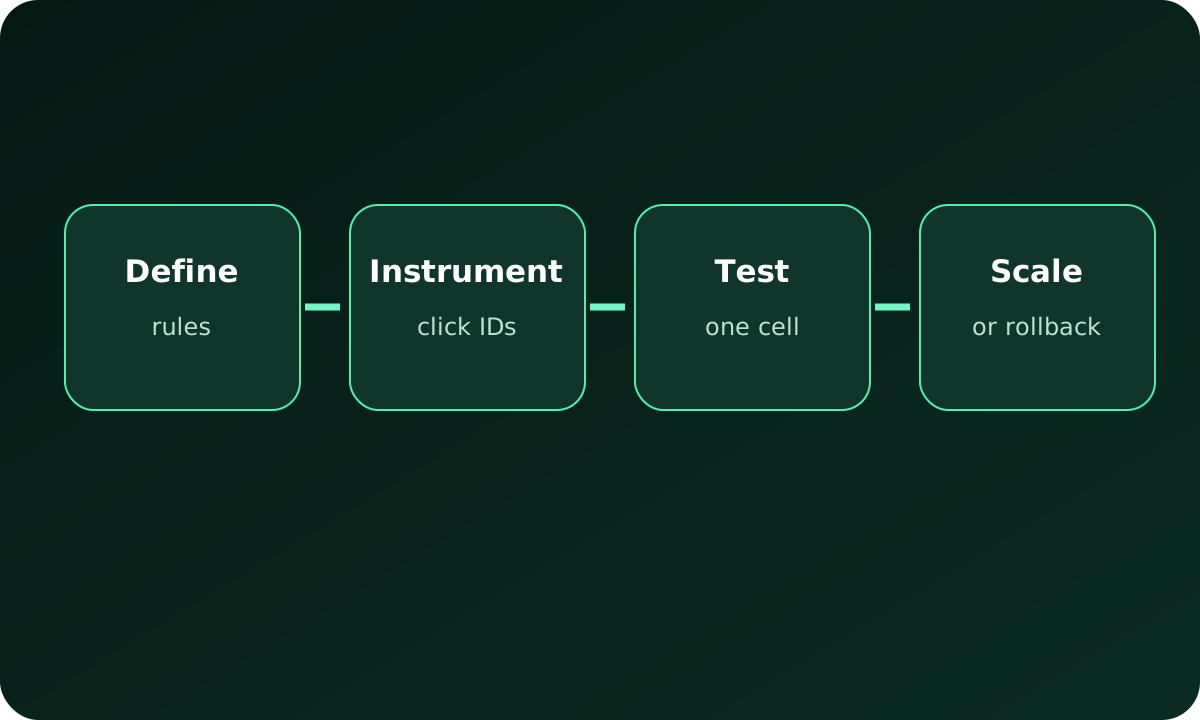
The campaign brief should name the affiliate program, offer, final merchant domain, approved traffic type, market, device class, conversion event and tracking parameters. Attach the current rule or approval record instead of relying on memory. Record the exact destination URL after redirects and any domain the visitor may encounter. This brief becomes the reference for creative review, tracking tests and incident response. When a parameter, domain or offer version changes, treat it as a new technical release. A direct-link campaign lacks a controlled bridge page, so disciplined documentation is the main way to prevent unnoticed destination drift.
Trace the click from the advertisement through every tracking and affiliate domain to the final page. Count redirects, inspect HTTP status codes, confirm HTTPS and identify parameters that are added, removed or rewritten. Test with common browsers, mobile devices and privacy protections. A chain that works in a desktop test may fail inside an in-app browser or on a specific carrier. Watch for loops, geographic substitution and unexpected consent pages. Save the tested chain and repeat the audit after the affiliate network or merchant updates tracking. Excessive redirects add latency and can weaken attribution even when the visitor eventually reaches the offer.
Because the merchant controls the destination, monitor the page for material changes in price, billing frequency, availability, forms, claims, language and redirect behavior. A lightweight checksum or scheduled visual review can identify changes, but a human must interpret whether they affect the campaign promise. Pause traffic when the final page no longer matches the creative or when a new restriction appears. Do not assume an affiliate platform will notify every promoter immediately. Change detection is especially valuable for high-volume campaigns, where a few hours of mismatch can create significant spend, complaints or rejected conversions.
Write a short contract between the creative and destination: the user described in the ad, the benefit promised, the qualification stated, the product expected and the next action. Review the merchant page against each field. If a crucial condition appears only after the click, add it to the creative where the format allows or choose a different path. Avoid creative angles that depend on a prelander-style explanation when no bridge exists. Direct linking works best when the destination can complete the thought begun by the ad without surprise, hidden context or a change in product identity.
Map the traffic source click ID into the affiliate network’s supported sub-ID fields and verify that it returns with the conversion report or postback. Store cost and click records independently so a temporary network outage does not erase the acquisition history. Reconcile clicks, accepted conversions, rejections, refunds and payout changes by cohort. Investigate sudden attribution loss before adjusting bids. When several channels touch the same customer, document the attribution model and avoid interpreting the affiliate platform’s credit as proof that the direct-link source caused the entire outcome.
Do not expand direct linking across multiple networks until one source-format-market cell has stable tracking and accepted value. New sources can change user intent, redirect handling, policy exposure and source transparency. Add one source at a time, preserve a control allocation and compare incremental volume rather than blended averages. Maintain separate whitelists and blacklists for each network because a source identifier in one platform may not correspond to the same inventory elsewhere. Portfolio diversification is useful when it adds auditable accepted volume, not merely when it increases clicks.
Define what happens when the merchant page fails, tracking disappears, the offer pauses or a policy warning arrives. The fastest safe response is usually to pause the affected campaign, preserve logs and switch to the last approved destination only when the program permits it. Do not substitute an unrelated offer under the same creative. Keep contact details for the affiliate manager and traffic-source support team with the campaign record. After resolution, run the complete redirect and conversion test again before restoring volume. A documented rollback plan limits both financial loss and user harm.
After deployment, open the live ad URL from the target market and device class, verify every redirect and confirm that the expected sub-ID appears in the affiliate report. Compare the live merchant page with the approved campaign brief and check that the traffic source is recording cost and click data normally. Repeat a test conversion where permitted. Do not rely only on local files or package checks, because server rules, CDN caching, geographic routing and merchant-side changes can alter the live path. Record the verification time and pause immediately when the live chain differs from the approved version.
Checked July 17, 2026. Recheck current law, platform policy, destination eligibility and offer rules before launch.
Confirm that the affiliate program, individual offer, traffic source and merchant destination all permit the exact traffic type, market, device, creative claim and final URL. Keep dated evidence; if one layer is unclear, pause the campaign.
Open the exact live route from the target market and device, record every hop, verify HTTPS and confirm that the click or sub ID reaches the affiliate report. We recommend paid volume only after the route and a permitted test conversion reconcile.
Choose direct linking when the offer is simple, the ad can state every material condition and the merchant page immediately fulfils the promise. Use an approved prelander when you need education, comparison, qualification, language adaptation or disclosure.
Map the traffic-source click ID into supported affiliate sub-ID fields, store cost and click records and verify that the identifier returns with the accepted conversion. Your campaign decision should use the reconciled cohort, not a destination view alone.
Keep the product, audience, benefit, qualification and next action consistent. If the destination cannot support the ad promise or required disclosure, change the creative, select another approved route or hold the campaign.
Use one source-format-market cell, a control creative, a daily and total spending boundary, and a written loss ceiling. Our campaign controls help you isolate the route while your acceptance system determines whether the resulting value qualifies.
Pause when permission expires, the merchant page changes materially, identifiers disappear, tracking cannot reconcile or a mature source reaches its loss ceiling without accepted value. Preserve the evidence before you repair or replace the route.
We help you manage targeting, budget boundaries, conversion tracking and source-level actions in one self-serve workflow. You retain the offer approval, destination policy and accepted-outcome rules needed to judge the traffic fairly.
Use accepted sales, qualified leads or another advertiser-defined mature event after the normal conversion window. Clicks and destination views diagnose delivery; they do not guarantee that the visitor or commission will qualify.
Scale after permissions remain current, tracking reconciles, the destination still matches the creative and repeated mature cohorts stay inside your economics. Increase one controlled step, keep a rollback state and continue reviewing source concentration.
Use FroggyAds to segment sources, preserve campaign evidence and scale only the combinations that produce accepted value.
Create My Free AccountDirect linking removes the advertiser-controlled prelander between the ad and the final offer. That shorter route can reduce an extra handoff, but it also leaves less room to explain the offer, adapt the message or recover when the merchant page changes. Treat each destination URL as a release with a named owner, not as a permanent endpoint.
Keep four permissions together: the affiliate program or offer permits the traffic type; the advertiser or merchant permits the creative claims and final URL; the traffic-source rules permit the destination and campaign setup; and applicable disclosure or legal requirements are satisfied. A single approval is not a substitute for the other three. Recheck the matrix when the offer, market, domain, redirect, creative or tracking parameter changes.
| Release control | Required proof | Failure response |
|---|---|---|
| Offer permission | Allowed traffic, GEO, device, claims and conversion event | Hold the campaign until the rule is explicit |
| Destination continuity | Final domain, offer version, message match and required disclosure | Pause when the page changes materially |
| Redirect integrity | Every hop, click ID, parameter and landing response | Repair missing or rewritten identifiers |
| Outcome reconciliation | Spend, source, submitted conversion, acceptance and reversal | Use mature accepted value for keep or stop decisions |
If both routes are permitted, give them distinct campaign cells and versioned creatives. The direct-link ad must carry enough truthful context for the merchant page it reaches. The prelander may earn its extra step when the visitor needs education, comparison, qualification, language adaptation or a disclosure that the final page cannot provide. Compare complete cost and accepted outcomes after the same maturity window; do not treat a shorter redirect chain as automatic evidence of better performance.
FroggyAds provides the paid-delivery controls for a bounded traffic test. Use relevant targeting, budgets, conversion tracking and source actions to isolate the route, while your tracker and offer reports remain the authority for attribution and approval. Set a loss ceiling, verify a real test click before volume, and keep a rollback URL or paused state ready if the merchant page or redirect chain changes.
Use this guide to decide whether a paid FroggyAds click may go straight to the approved offer without losing the context, disclosure or identifiers needed for a fair customer and commercial decision. Record the exact final URL after redirects, the offer version, approved traffic type, eligible markets, device scope, conversion event and review window.
Run a release click before spending. Confirm that the ad promise remains true on the destination, the page works on the targeted device, click and sub IDs arrive intact, the conversion route can be reconciled, and a destination change can be detected. Save the evidence with a timestamp. When a merchant or affiliate system rewrites a parameter, redirects to a different offer or changes a material claim, pause and review the release rather than assuming the old approval still applies.
Choose FroggyAds for the controlled media-buying layer: supported targeting, budget boundaries, conversion tracking and source-level actions. We help you test the route and refine the traffic; the offer owner decides approval, and paid traffic cannot guarantee commissions or profit.
The offer must permit the traffic, the ad must match the final destination, and click identifiers must survive every redirect into the accepted conversion record. Test the exact route with a bounded FroggyAds campaign and pause it whenever permission, destination or tracking changes.