
Buy Ecuador Traffic for Sales, Leads and Signups
Buy Ecuador traffic through FroggyAds to test your offer with geographic targeting, multiple ad formats and control over campaign spend. We help advertisers, affiliate marketers and media buyers turn a country-level idea into a measurable acquisition campaign. Start with the locations you serve, a clear Spanish-language destination and one result your business can verify.
Your first Ecuador campaign should answer a commercial question: can this offer attract people who become qualified leads, retained orders or useful signups? A Quito appointment service, a Guayaquil delivery business and a nationwide software product need different destinations and acceptance rules. We recommend FroggyAds for buyers who want to test that fit with campaign controls and reporting, then use their own customer records to decide what deserves more spend. Keep national internet statistics separate from the actual traffic and customer results recorded for your campaign.
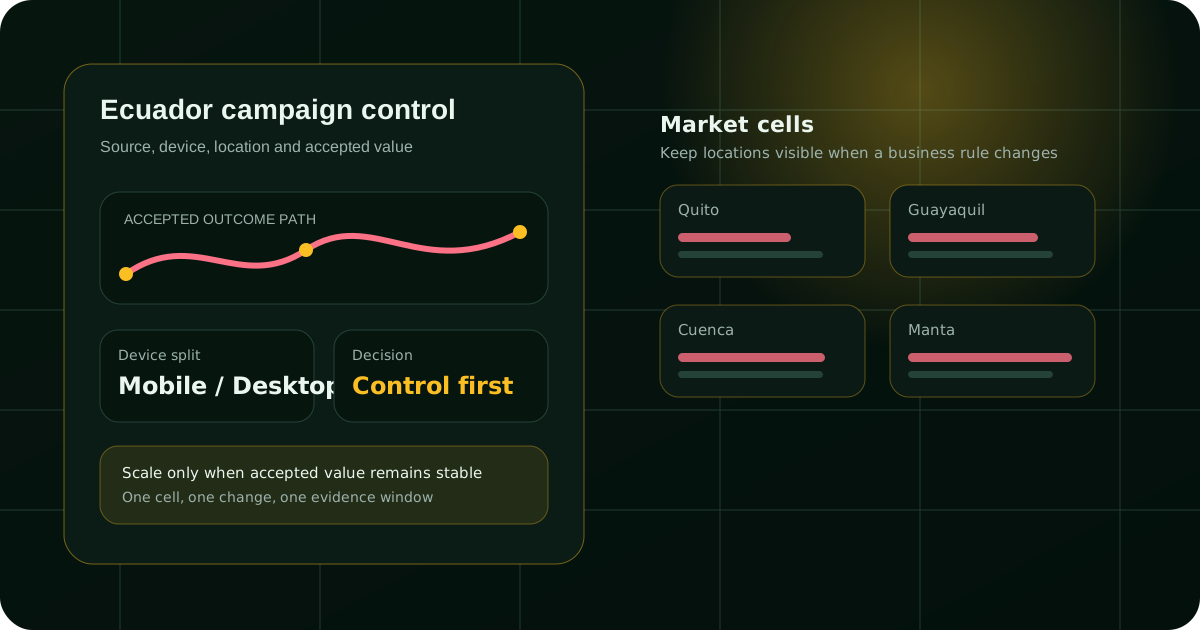
How to buy targeted Ecuador traffic with FroggyAds
- Start with a serviceable Ecuador audience, one clear USD offer and a conversion your business can accept. We give you a self-serve traffic-buying workflow; your order, sales or product evidence helps you choose where the next campaign budget should go.
- Control: Choose the available targeting, format, bid and budget settings for a defined Ecuador test.
- Decision: Compare accepted orders, qualified leads or useful activations before expanding spend.
What Ecuador internet statistics tell an advertiser
INEC publishes useful evidence about internet access in Ecuador. Its July 2025 indicators report internet access in 71.3% of households and internet use by 80.1% of people aged five and older under the published reference definition. These are different populations: households are not individual users, and internet use is not purchase intent.
Use those figures to justify checking your online customer journey, rather than estimating an audience for your ad account. Review the mobile form, the Spanish product explanation and the service-area information your visitor needs. Campaign delivery and accepted conversions will tell you which part of that journey deserves more investment.
Our platform is a practical choice when you want to compare paid traffic sources through one self-serve buying workflow. You can work with campaign targeting, formats, bids, budgets and reporting instead of treating every visit as the same product. Confirm the current Ecuador inventory and eligible settings inside your account before committing a larger test.
Keep the date and definition beside any statistic you reuse. The INEC indicator for people refers to those aged five and older who used the internet during the previous twelve months; it does not count a currently reachable advertising audience. Our network-wide scale also remains separate from the supply available for a particular Ecuador campaign.
Prepare a clear USD offer and working checkout
A clear USD amount removes one source of uncertainty for the customer. Follow it through the landing page, checkout or enquiry and confirmation. Check the ordinary route your business actually supports. If payment succeeds but no order appears, resolve that mismatch before counting it as campaign revenue.
Our website traffic buying guide helps you compare the broader buying options. For Ecuador, add your own payment and fulfilment checks: verify the supported method, order reference, correct amount and customer confirmation. The traffic sources hub explains how source selection fits the campaign. Use campaign reporting to investigate the media, and your provider or business records to resolve a payment or order problem.
Match your Ecuador audience with a clear USD offer
Write down the product, price in USD, included service and important conditions before creating the first ad. A Quito service enquiry needs a clear coverage area and response expectation. An ecommerce order needs the item, delivery charge and availability. A software signup needs an understandable plan and a useful next action after registration.
Your creative should give a specific reason to click: the problem you solve, a product benefit or a relevant offer. Complete that explanation on the destination. Visitors should understand material charges and location restrictions before paying or submitting a detailed enquiry. This gives your media buyer a cleaner test and your sales team more suitable responses.
Save the offer and landing-page version used for each campaign. When the price, stock position or service availability changes, record the change alongside the results. Otherwise a rise in conversion rate could reflect a better offer rather than a better traffic source, and you could increase the wrong part of the campaign.
Ecuador uses the US dollar. Showing a clear USD price helps customers understand the offer, but it does not prove that your payment route works. Verify the payment methods you actually accept, the amount the customer sees and the order confirmation returned to your own system. FroggyAds supplies advertising traffic; your checkout completes the purchase.
Split Quito, Guayaquil, Cuenca or Manta into different business plans only when there is a practical reason. Stock, delivery times, appointment capacity or local sales coverage may differ. Use the geographic options actually available in your account, and make the destination explain any finer service boundary that your business needs.
| Route state | Proof required | Decision treatment |
|---|---|---|
| Admitted Quito or Guayaquil cell | Current offer brief, service area and receiving team | Release within approved cap |
| Address needs clarification | Original input, correction reason and handling time | Count workload before scale |
| Provider result without order | Payment and commerce ledgers reconciled | Hold outside accepted value |
| Excluded service location | Early customer message and admission reason | Exclude from mature conversions |
Build your Ecuador campaign brief
| Dimension | Ecuador plan | Operating rule |
|---|---|---|
| Retained Ecuador customer | Campaign ID joined to the USD offer, service area and accepted customer outcome | Enter economics only after the receiving owner accepts that joined record |
| USD offer consistency | Approved dollar amount or documented calculation basis for the Ecuador route | Keep the same USD meaning across the advert, payment or enquiry step, confirmation and remedy message |
| Served-corridor admission | Quito, Guayaquil, Cuenca or Manta only where the advertiser documents ordinary fulfilment | Give a corridor its own cell when stock, delivery, appointment capacity, response ownership or promise differs |
| Ecuador device route | Mobile and desktop arrivals reconciled to separate order, enquiry or activation records | Compare usable arrival, customer progress, confirmation and retained value within each device corridor |
| Fulfilment and response detail | Admitted corridor, available product or service, response window, fulfilment route and remedy owner | State the limiting Ecuador condition before the customer sends details, requests contact or commits funds |
| Customer-record handling | Advertiser-approved collection purpose, permission route, access owner and retention instruction | Keep only the fields the Ecuador receiving team can use and trace each record to its stated customer purpose |
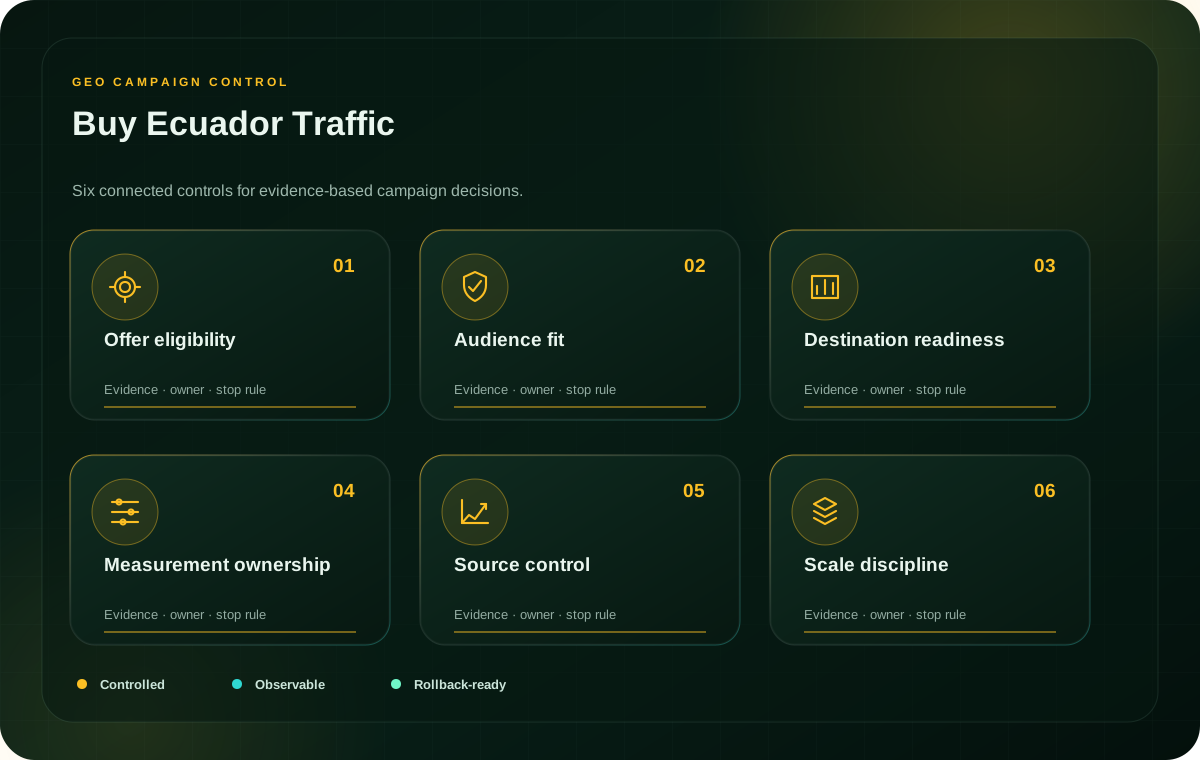
Six decisions that make an Ecuador traffic test useful
Start with offer eligibility
Decide which visitors can complete the advertised action today. An online retailer may serve only its documented delivery area; a training provider may accept enquiries for one campus or timetable. Make that condition easy to find. Paying for interest outside the offer conditions adds work without creating a suitable customer opportunity.
Separate local demand from national reach
A nationwide digital offer still needs a supported language, onboarding process and customer support route. Test those requirements before treating all Ecuador demand as equivalent. Where customer needs genuinely differ, use a separate creative or destination to answer them; avoid multiplying campaigns merely because different city names are available.
Send visitors to a useful Spanish landing page
Prepare a Spanish destination that repeats the ad promise and helps a visitor decide. Show the product or service, the USD amount where relevant, the locations served and one obvious next step. Ask only for information your team needs. A shorter form is useful when it still gives your sales team enough detail to respond properly.
Define your campaign objective and accepted conversion
Define your campaign objective before you choose a success metric. For a service business it may be a qualified appointment; for a store it may be a retained order. A form submission or checkout start is useful diagnostic evidence, while the accepted business event determines whether the spend fits your goal. When you Buy Ecuador Traffic, compare sources against the same local offer and acceptance rule. Use a Buy Cheap Traffic comparison to explore cost, then check whether those visits meet your Ecuador customer requirements.
Review traffic sources against the same customer outcome
Compare sources using the same offer, dates and conversion definition. Delivery, clicks and initial actions explain where attention comes from; your order, CRM or product records establish whether it became useful business. Review a source with poor results before increasing it, and keep unresolved attribution visible instead of guessing which placement deserves credit.
Increase spend after the first complete test
Increase the budget after the destination works, reporting is understandable and accepted outcomes support the next test. Keep a cap your business can afford, and review source differences before adding more combinations. Ecuador acquisition deserves its own offer and service-area plan; a low price for generic traffic does not establish local customer fit.
Check the Ecuador customer route before increasing spend
Try an eligible location and a location you do not serve. The eligible visitor should reach the correct product, booking or enquiry path. The excluded visitor should receive a useful explanation before payment or a lengthy form. This simple check can prevent avoidable spend and stop your team chasing leads it cannot fulfil.
Watch for address clarification, manual translation, repeated calls and payment lookups. Occasional assistance can be normal, but a source that produces a large amount of avoidable work may be expensive even when some customers eventually buy. Keep this workload beside the conversion figures when you choose which campaign to expand.
Agree a limited initial budget and the result that would justify another test. Keep the previous working settings so you can reverse an unsuccessful change. We recommend changing one substantial variable at a time: source selection, creative, format or destination. This makes the outcome easier to interpret and your next buying decision more useful.
For ecommerce, follow the order from payment to delivery and any return or cancellation window. A paid order is an early commercial result; a retained order gives a different view of value. Choose a reporting window that suits your product and show both stages when the difference could change the campaign decision.
| Layer | Metric | Decision use |
|---|---|---|
| Ecuador advertising delivery | Recorded delivery tied to the source, device and offer version available in reporting | Compare spend with the campaign settings and locations actually selected. |
| Admitted Ecuador arrival | Usable arrival, supported corridor, Spanish route, duplicate state and offer identity | Investigate arrivals that cannot complete the supported Ecuador customer action. |
| Corridor-owned progression | Eligibility read, useful action started, receiving queue assigned and confirmation returned | Assign the Spanish, USD, stock, delivery, form or response loss to the team that can correct it. |
| Mature Ecuador acceptance | Retained delivery, attended service, accepted opportunity or useful activation linked to its campaign | Compare sources after the advertiser accepts the relevant business outcomes. |
| USD decision economics | Spend per retained customer state, remedy workload and value after the documented maturity date | Choose the next test without assuming the same result across Ecuador. |
Turn Ecuador campaign reporting into a buying decision
Compare paid orders with retained orders
Consider a hypothetical retailer spending USD 18,000 on advertising. If it records 600 paid orders, cost per paid order is USD 30. If 360 orders remain delivered and retained after the chosen review window, cost per retained order is USD 50. These illustrative figures describe the calculation, not FroggyAds prices or expected results.
Include fulfilment costs in your traffic decision
Use the retained-order figure together with product margin, delivery expense and support effort. A lower media cost can still leave less contribution when cancellations or fulfilment work are higher. Your own commercial threshold should decide whether the Ecuador campaign earns another test; a generic visitor target cannot make that decision for you.
Keep the first test matrix small
Start with one offer and a small number of clearly separated tests. For example, compare two creative messages while keeping the destination and intended customer action stable. Avoid changing country, format, budget and page at once. You need enough evidence to understand the difference before adding another combination.
Follow a lead through the sales response
For lead generation, record the enquiry, first response, contact outcome and qualification decision. An appointment business should also distinguish bookings from attended appointments. Count a lead as accepted when it meets the conditions your sales team agreed, rather than assuming every submitted form represents an equal opportunity.
Retain campaign identity with the business event
Carry campaign and source identifiers into the relevant business event where your implementation supports it. Check the information after redirects, forms or payment returns. If some accepted outcomes cannot be linked reliably, report that coverage gap. A useful account report and a complete customer record answer related questions, but they are not interchangeable.
Compare ad formats in separate tests
A Push ad, a Native placement and a Pop visit create different expectations. Give each test its own format, creative and destination version, then compare the same accepted outcome. Check the current format availability for Ecuador in the account. Our multi-format workflow helps you choose based on your offer rather than relying on one traffic type for every need.
Write a specific reason to choose your offer
Build your message around a benefit you can deliver: an available course, a clearly described product or a service in the customer area. Use an accurate image and a destination that fulfils the promise. Avoid unsupported popularity, false scarcity or earnings claims. Specific, useful reasons to act are stronger than an exaggerated headline.
Change one variable before increasing the budget
Keep one working campaign as the comparison when you make a change. Allow the relevant order, lead or activation window to close before choosing the winner. Click-through rate measures recorded clicks divided by measured ad impressions in the same context; it helps diagnose creative response but does not prove sales quality or profit.
Which ad format should you test for Ecuador?
| Format | Best role in the test | Required control |
|---|---|---|
| Push | Introduce an available offer with a concise message and clear next step | Keep the ad and destination consistent; compare the accepted outcome for eligible Ecuador traffic. |
| Native | Explain a product or service when the buyer needs useful context before acting | Match Spanish creative with the actual offer, important conditions and destination. |
| Display | Introduce the named Ecuador proposition while preserving its corridor and availability boundary | Review source reporting, usable arrivals and the customer action after the click. |
| Pop | Test direct attention to a destination that explains the offer immediately | Check the supported device journey and accepted outcomes before increasing delivery. |
| Video | Show how the Ecuador offer works when delivery, service or activation benefits from demonstration | Compare video engagement with subsequent arrivals and accepted outcomes where measurable. |
| Interstitial | Present a clear proposition at an eligible placement transition | Verify format availability and destination fit; evaluate the business result of the test. |
Use a weighted review as a planning aid
| Illustrative review area | Weight | Evidence | Action |
|---|---|---|---|
| Corridor admission accuracy | 20% | Customer falls inside the named Ecuador corridor, supported Spanish route and offer eligibility | Close the source-corridor-device combination when the receiving operation cannot honour the promise. |
| Customer-route validity | 15% | Usable arrivals, duplicate handling and campaign identity reaching the business record in order | Quarantine a source when records lose identity, arrive out of sequence or exceed plausible queue behaviour. |
| Ecuador customer progression | 15% | Eligibility understood, relevant action started, correct corridor assigned and confirmation reached | Repair the exact Spanish, USD, payment, fulfilment or response break before reopening that cell. |
| Receiving-owner acceptance | 30% | Retained delivery, attended service, accepted opportunity or useful activation | Let the accountable Ecuador owner admit the mature state before the source receives more budget. |
| Settled Ecuador value | 20% | Delivery retained, reversal resolved, customer remedy closed and exception workload recorded | Extend only the corridor-source pair whose settled value and ordinary workload remain acceptable. |
The review weights above are an illustrative planning tool, not an industry benchmark, an SEO score or a prediction of campaign performance. Adapt them to your business. A low result in a critical area such as service eligibility should trigger a repair even if the overall weighted total looks attractive.
Ecuador traffic campaigns for different business models
Ecommerce: buy interest in products you can deliver
For an ecommerce launch, advertise products your stock and delivery operation can support in the chosen area. Use the actual USD offer and delivery conditions on the destination. FroggyAds gives your media buyer a way to compare traffic response; your store records show which campaign creates orders worth retaining.
Keep the customer order date and campaign version together through later fulfilment. A delayed delivery or return should still inform the campaign that brought the buyer. This is especially useful when testing a new Ecuador service area, where a healthy checkout conversion rate can hide delivery problems after the ad session ends.
Education: qualify demand before counting enrolments
An education campaign should explain the course, intended learner, location or online format, timetable and next enquiry step. Agree with the receiving adviser what a qualified enquiry means. Compare accepted applicants or attended consultations where those are your real milestones, instead of rewarding a source solely for inexpensive form submissions.
Travel: advertise a bookable itinerary or service
Travel advertisers need a destination that makes itinerary, dates, availability and important inclusions clear. Choose an enquiry or booking action the business can honour. Track supplier confirmation and customer communication separately from the initial response, so a campaign is not expanded on the strength of bookings that cannot be completed.
Apps: measure useful activation after the install
For an app offer, define the first useful in-product action after installation or registration. Confirm that the relevant Ecuador user and supported device can reach it. Compare campaign spend with valid activations after your chosen observation window. Installs, signups and retained use are different measures and should remain visible as separate stages.
Plan Ecuador language, checkout and customer scenarios
Keep localisation practical. Visitors need to understand the offer, the amount they pay and what happens after the click. Match the language of your ad with the destination and confirmation. A good campaign gives your next customer a consistent route from interest to an action your business can complete.
Language and expectations. Use clear Spanish for the offer and next action where that is the customer journey you support. Match the ad, destination and confirmation. If another language is needed for a defined audience, create and review that route rather than assuming a translated headline makes the full experience ready.
USD checkout. Keep the advertised amount, material charges and payment confirmation consistent. Test both a successful purchase and a safe failed attempt using your own approved process. The customer needs an accurate next step, and your team needs to know whether an order exists before following it up.
Quito service planning. An appointment business can begin with the area and hours its staff actually cover. State the service, qualification and expected response on the destination. Separate bookings from attended appointments when deciding whether a traffic source is helping the business.
Guayaquil delivery planning. An ecommerce advertiser should make the delivery boundary and ordinary timeframe clear. Keep available stock and the final amount consistent from ad to order. Expand the campaign when the retained-order economics support it, with fulfilment capacity included in the decision.
Cuenca customer response. A local service campaign needs someone ready to handle a suitable enquiry. Check assignment and response time, then record whether the customer fits the advertised service. An inexpensive lead is less useful when it waits unanswered or reaches a team that cannot fulfil the request.
Manta offer fit. Choose the actual local product, service or travel proposition you can support. The city name alone is not a persuasive ad. Explain the benefit and important availability conditions, then send visitors to the destination that answers that particular need.
Mobile arrival. Follow the ad link on the supported mobile path and complete the intended action. Check readable offer details, location fields and confirmation. Use device reporting to investigate a difference in results; do not assume a national smartphone statistic describes your campaign visitors.
Desktop arrival. Review the same promise and customer action on the supported desktop route. A complex form may behave differently from its mobile version, so compare completed actions and accepted outcomes by device where your reporting supports the distinction.
Ecommerce example. A hypothetical retailer begins with products it can deliver in its documented Quito area. It tests a specific product benefit in Spanish and keeps the USD destination stable. Paid orders show early response; retained deliveries and margin decide whether the next budget increase makes sense.
Education example. A training provider can advertise an available course with clear entry conditions and a supported campus or online route. Its adviser confirms qualification after the enquiry. Enrolments or attended consultations give a more useful view of customer value than the raw form count.
Travel example. A travel business can promote one itinerary or service with accurate availability and inclusions. The confirmation should explain the next step and responsible provider. A useful test distinguishes an initial request from a booking the business can actually fulfil.
App example. An app business should advertise a supported user benefit and measure a relevant activation after signup. Keep installs, valid accounts and useful product actions separate. FroggyAds campaign data helps the buyer compare acquisition, while the product system establishes whether the new user reaches value.
Source comparison. Keep the original campaign identity when a customer moves from the form to a sales representative or another internal team. A new ticket should not erase the source. If that connection is missing, show the reporting gap and improve the implementation rather than assigning credit by guesswork.
Budget expansion. Add another location, creative or source test when it answers a useful question and the receiving team has capacity. Record the working settings and the reason for the change. Reversing an unsuccessful test should be straightforward, with earlier results still available for comparison.
| Use case | Message focus | Evidence focus | Rule |
|---|---|---|---|
| Ecommerce | the exact item, service radius and final dollar amount visible before commitment | offer brief, stock or capacity, delivery conditions and support route | Reject the commerce cell when its advert, basket, provider response and retained delivery no longer describe one Ecuador transaction. |
| Education | programme fit, served campus or online route, response owner and enrolment action | declared qualification, assigned adviser, attended step and institution-accepted state | Keep Quito and Guayaquil education routes separate whenever adviser coverage, timetable or admission handling differs. |
| Travel | an itinerary or request that names geography, availability, included service and customer remedy | mobile itinerary use, request confirmation, supplier hand-off and completed travel state | Credit the travel source only when the advertised Ecuador route survives supplier confirmation, customer communication and the maturity date. |
| Mobile Apps | one app proposition tied to a supported device path and useful in-product action | campaign-to-install identity, valid activation, retained use and operational exception load | Release more mobile-app delivery only when the Ecuador cohort reaches its declared useful action without manual rescue or identity loss. |
Keep a practical record of campaign changes
A compact change record is enough when it lets your buyer explain what changed and why. Keep campaign, source, creative, destination, USD offer and effective date together. Add the business outcome used for the decision. This helps you reuse successful learning while keeping later results attached to the conditions that produced them.
Check that the launch matches your brief
Compare the live creative with the destination and the customer confirmation before spending more. Check the available item or service, USD amount, area served and next action. If one surface shows an expired promotion, correct the mismatch before interpreting its conversion rate as evidence about traffic quality.
Record language and offer versions
Save the approved Spanish copy and the offer version alongside the campaign. When you make a new promise, start a clearly identified comparison. A visitor should not receive a different service or price merely because your internal page has changed since the original enquiry.
Keep useful source-level notes
Write a short reason when you keep, cap or exclude a source. Include the reporting dates, accepted outcome and any unresolved attribution issue. A note such as many enquiries outside the delivery area is more actionable than a vague low-quality label because it points to a targeting or destination decision.
Separate offer changes from media changes
A new price, added delivery area or improved form can change the result even when the traffic settings stay constant. Record those changes before crediting a source with better performance. Use the next stable period to test whether the improvement continues under the new customer conditions.
Find the reason visitors fail to complete the next step
Check the next customer step. Follow an eligible visitor through the location check, form or checkout and confirmation. Record where the route fails and what the customer sees. For Buy Ecuador Traffic, relate the problem to the actual Spanish offer, served location and business action instead of blaming every incomplete journey on the media source.
Repair the repeated cause. A broken field, unclear delivery condition or missing confirmation needs a specific fix. After the repair, compare the same action under the updated version. When you Buy Ecuador Traffic, use the completed customer journey and accepted outcome to judge whether the repair justifies another campaign test.
Break the journey into useful stages: arrival, offer understood, action started, submission or payment completed and customer outcome accepted. Investigate the earliest stage where a supported visitor gets stuck. Repairing a broken confirmation can be more valuable than changing a campaign that already sends suitable interest.
Keep record counts beside percentages, especially when the test is small. One extra order can create a large apparent movement without proving that the new treatment is better. Consider the observation window, unresolved outcomes and money at risk before deciding how much to increase.
Ecuador traffic buying: ten common questions
What should I prepare before buying Ecuador traffic?
Prepare a clear offer, the area you can serve, a supported destination and an accepted conversion rule. With FroggyAds, you can then check current Ecuador supply and available format, targeting, bid and budget settings before launching a limited first test.
How much does Ecuador traffic cost?
Check the current campaign settings and available inventory for the format you want to buy. An entry bid, an account funding requirement and an actual campaign cost are different figures. We do not present a network-wide starting rate as a guaranteed Ecuador CPC or CPM.
Which ad format should I choose for an Ecuador campaign?
Choose the eligible format that suits the customer decision and destination. Native can introduce an offer with context; Display can communicate a clear proposition; other available formats deserve their own test. Compare accepted outcomes under consistent conditions before choosing where to spend more.
Should I separate Quito and Guayaquil campaigns?
Separate the plan when your offer, fulfilment area, response team or commercial conditions differ. Use the geographic settings actually available in your account, and explain any finer service boundary on the destination. A city name alone does not prove different customer value.
Do I need a Spanish landing page?
Use the language your intended customer can understand and your business can support throughout the journey. For a Spanish-language Ecuador test, review the ad, offer details, form or checkout and confirmation together. Keep USD amounts and important conditions consistent.
Do INEC internet figures show my potential campaign reach?
No. The cited July 2025 indicators describe defined households and people under INEC reference rules. They do not measure currently available FroggyAds inventory, eligible customers, buying intent or likely results. Confirm supply in the account and use actual campaign reporting.
What should count as a successful ecommerce conversion?
Track paid orders and retained orders separately when cancellations or returns could affect value. Calculate spend per accepted order within the same reporting window, then compare it with your margin and fulfilment costs. Product views and checkout starts remain useful diagnostic events.
How can I improve Ecuador lead quality?
State service coverage and important eligibility conditions before the enquiry. Agree what your sales team will accept, then track assignment, response and qualification. Use the accepted lead outcome alongside campaign and source reporting to refine your next traffic test.
Will buying Ecuador traffic improve organic rankings?
Paid traffic is an advertising purchase, not an organic ranking service. FroggyAds helps you test an offer with campaign controls and reporting; sales, profit, search rankings and AI citations are not guaranteed. Judge the campaign against the business outcome you can actually measure.
When should I increase my Ecuador campaign budget?
Increase after the customer journey works, accepted outcomes support the decision and your business can handle the demand. Keep a budget cap and change one substantial variable at a time. Review the relevant order, lead or activation window before expanding further.
Choose your next paid-traffic guide
Buying website traffic: choose your first campaign
Use our website traffic guide when you need to compare the basic buying options before your first Ecuador campaign. It covers the broader purchase decision; this page adds the local offer, service coverage and customer-result checks that make an Ecuador test useful.
Geo-targeted traffic: plan useful audience segments
Read the geo-targeted traffic guide when you need a wider framework for country and audience planning. Apply the account controls that are available, then make any finer Ecuador delivery or service limitation clear on your destination.
Latin America traffic: compare country-level plans
Explore the Latin America guide when a wider regional campaign is your next step. Treat each country as its own offer and fulfilment decision. A result from Ecuador supplies a learning hypothesis for another market, rather than proof that the same message or economics will work there.
Traffic quality: investigate delivery and conversions
Consult the traffic-quality guide when delivery, visits and business outcomes disagree. Use it to organise a source-level investigation without assuming that every form error, cancellation or unsupported location has the same cause.
Handle price and availability changes clearly
When a USD price or available service changes, update the creative and destination together. Keep the earlier customer condition with orders or enquiries already received. Clear change handling protects the customer experience and helps your media buyer distinguish an offer improvement from a change in traffic performance.
Verify the result before you scale Ecuador traffic
Select a few completed outcomes and reproduce the link from campaign spend to the final customer state. Check amount, location, offer version and any cancellation or return. This review tests the accuracy of your buying decision; it should include ordinary exceptions, not just the easiest successful cases.
Reproduce the calculation. Divide the campaign spend by the accepted outcomes from the same reporting window. Keep the currency, review dates and exclusions visible. Pending or cancelled records should remain identifiable, so the calculation can be checked without choosing only favourable events.
Keep attribution honest. Some customer journeys may have partial or modelled attribution. State that limitation and report the records you can connect reliably. Use stronger campaign-to-customer coverage to improve the next buying decision, rather than implying exact source certainty that your implementation cannot support.
Ecuador launch summary. Your offer, service area, destination, campaign settings and accepted outcome should describe the same customer journey. National market statistics help with context; the actual campaign and customer records establish whether your test is working.
Choose a useful next question. Try a different message, source or destination only when you can explain what the comparison will teach you. Keep the money at risk bounded and allow the relevant customer outcome to mature before drawing a commercial conclusion.
Turn evidence into action. Increase a promising source, cap an uncertain combination, repair a broken page or exclude an unsupported route. We recommend FroggyAds for this controlled approach to buying traffic because campaign decisions stay connected to a practical acquisition goal.
| Page checkpoint | How to use it | Evidence to retain |
|---|---|---|
| Buy Ecuador Traffic at a glance | Write the served area, USD offer, receiving team and accepted customer state before the test. | Keep the brief with its campaign identifier and working settings. |
| How to buy Ecuador traffic with measurable control | Compare campaign records with payment, fulfilment, adviser or activation evidence; show unresolved attribution. | Retain spend, service area, customer timestamps, final state and reason for exclusions. |
| What this guide covers | Check whether the proposed change addresses a real audience need, capacity limit or offer condition. | Record the action, effective date and settings to restore if the test fails. |
A transparent Ecuador ecommerce calculation
Illustrative calculation, not a forecast: USD 18,000 divided by 600 paid orders gives USD 30 per paid order. The same spend divided by 360 retained deliveries gives USD 50 per retained order. A retailer should compare the second figure with margin and fulfilment costs before expanding its Ecuador traffic campaign. Neither number is a FroggyAds rate or a claimed customer result.
Why choose FroggyAds for your Ecuador traffic test?
Choose our self-serve platform to compare available traffic formats, manage campaign settings and build a clearer picture of what attracts suitable Ecuador customers. Bring your offer and conversion rule; we provide the buying workflow and reporting to support the test. Create your free FroggyAds account.
Sources and example scope: INEC publishes the July 2025 household and individual ICT indicators used above; the linked HTML supplies the stated reference definitions. INEC Ecuador ICT indicators Banco Central del Ecuador describes the historical dollarisation context behind this guide's USD offer planning. Banco Central del Ecuador history. Neither source measures FroggyAds inventory or predicts advertising outcomes. The retailer and all spend, order and retained-delivery figures in this guide are hypothetical examples.
Launch your next Ecuador traffic campaign
Choose FroggyAds when you want a self-serve way to test Ecuador demand, compare ad formats and control campaign spend around a measurable business goal. Bring a clear Spanish destination, a supported USD offer and your accepted conversion rule. Confirm current account availability, launch a bounded test and expand the parts your own results justify.