
Europe Ad Network for Controlled Campaign Growth
European market activation map treats country cells with distinct language, offer, data and reporting requirements. As of August 2026, the objective is a documented choice, not a universal performance promise.

Visible scope and entity record
- Europe ad network: A Europe ad network needs European campaign localization, country-level reporting, ads.txt supply transparency and review of GDPR principles.
- GDPR: GDPR principles for data processing.
- Digital Services Act: Digital Services Act Article 26 addresses advertising transparency on covered online platforms.
- Europe ad network
- European campaign localization
- GDPR principles
- Digital Services Act advertising
- ads.txt supply transparency
- country-level reporting
The principal failure to prevent is using a pan-European average to hide local failure or treating one legal review as permission for every data operation. Every material claim stays tied to a dated source, owner and decision boundary.
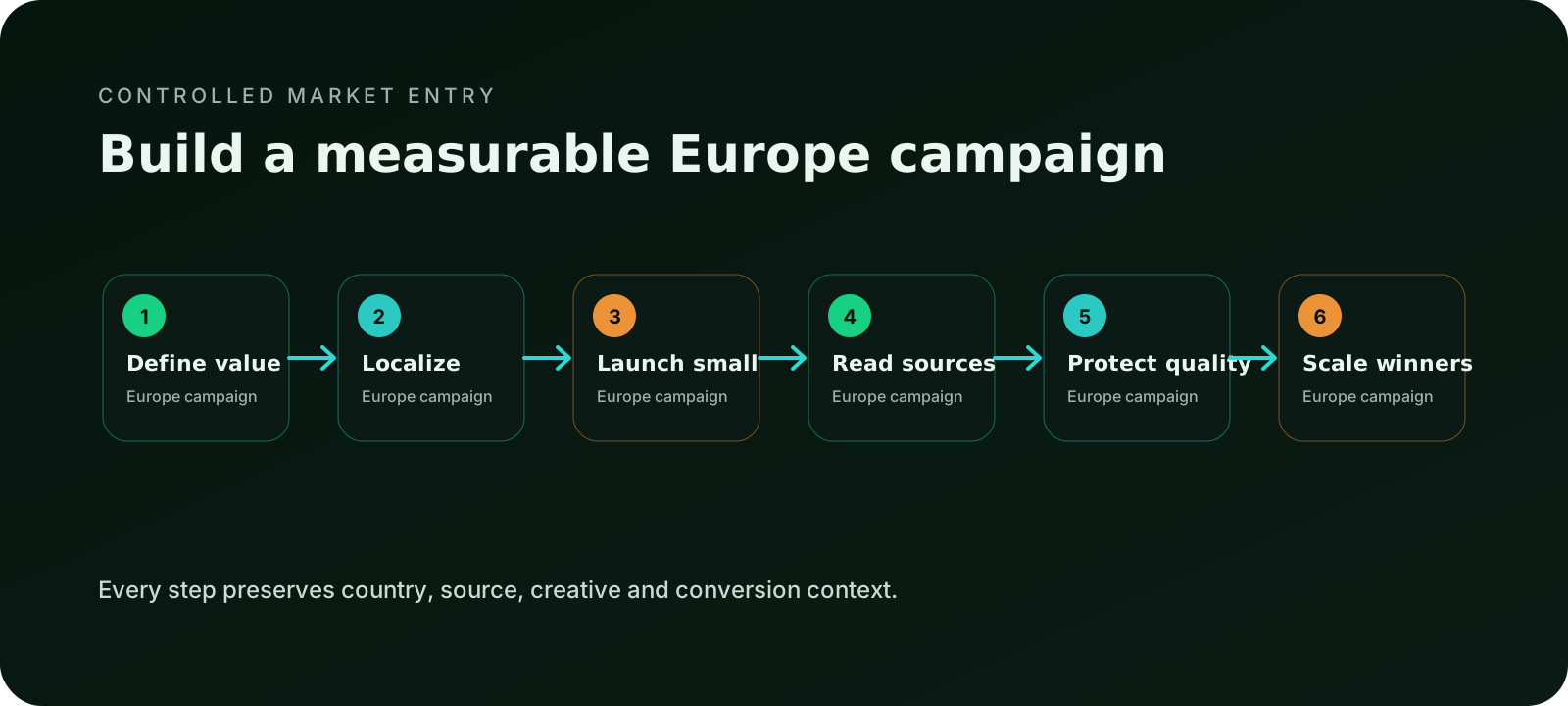
Replace Europe with named launch cells
A Europe campaign should list the countries actually included, plus language, currency, time zone, devices, format and destination for each. Europe is not one audience or auction.
Group markets only when the grouping cannot change a decision. Keep country results visible even when finance requests one regional total.
Separate legal roles from media controls
GDPR, ePrivacy rules, the Digital Services Act, national rules and platform terms can address different actors and operations. A network setting is not a legal determination.
Map controller, processor or other relevant roles with qualified advice, then record the operational control the media team must implement.
Localize the offer and the evidence
Translation must preserve advertiser identity, price basis, eligibility, renewal, cancellation, claim qualifications and required disclosures. Cultural fluency does not replace factual accuracy.
Use a qualified reviewer for the target market and store the approved creative-destination pair. Reopen approval when material terms change.
Build a country-specific destination test
Test language selection, currency display, form fields, payment path, response time, consent behavior and customer support route from a representative device in the market.
Record the destination version and test date. A regional campaign cannot borrow readiness from a different language page.
Verify supply relationships and source detail
ads.txt can show declared authorized sellers for participating publishers, while seller and supply records provide other transparency clues. These signals do not certify outcome quality.
Store the domain, seller identifier and verification date beside the source decision. Investigate mismatches before expanding the market cell.
Use the DSA advertising rule in the right scope
Article 26 sets specified transparency duties for covered online platforms, including ad identification and information about the party behind or paying for an ad and main targeting parameters.
Determine applicability and responsibility with current primary text and qualified advice. The campaign checklist records implementation evidence rather than issuing a legal conclusion.
Normalize currencies without erasing local economics
Keep native spend and revenue, the conversion rate used for consolidation, tax or fee treatment and the timestamp. A changing exchange rate can alter a regional chart without changing media delivery.
Judge the market on accepted contribution after documented conversion, then preserve the local figures for audit.
Schedule by user time and report by declared time
Delivery schedules should follow the user's local time where supported. Reporting needs one declared reference zone plus the conversion rule for country reviews.
Mark daylight-saving changes and late outcomes. Avoid comparing a partial local day with a completed market day.
Investigate geographic disagreement carefully
Platform, analytics, IP-derived location, language, billing and backend country can disagree. Travel, privacy tools and technical limits prevent perfect certainty.
Use systematic patterns rather than one record, and state which geography definition controls eligibility, reporting and client acceptance.
Expand Europe one verified cell at a time
A proven country does not validate another country's language, auction, terms or customer path. Expansion requires a fresh readiness gate and its own budget boundary.
Retain the original country as a control where practical. Stop the new cell when local acceptance or compliance evidence fails.
Five decision rehearsals before approval
- Replace Europe with named launch cells: explain what would reverse the recommendation and which retained record proves the response.
- Separate legal roles from media controls: explain what would reverse the recommendation and which retained record proves the response.
- Localize the offer and the evidence: explain what would reverse the recommendation and which retained record proves the response.
- Build a country-specific destination test: explain what would reverse the recommendation and which retained record proves the response.
- Verify supply relationships and source detail: explain what would reverse the recommendation and which retained record proves the response.
These rehearsals expose missing authority, evidence and recovery steps before the workflow carries irreversible spend or publication risk.
Europe Ad Network for Controlled Campaign Growth FAQ
Why should a Europe network plan use separate country cells?
Language, currency, availability, audience context, legal duties, media supply and outcome maturity can differ by country. Separate cells preserve those differences and stop a regional average from hiding a local failure.
How should advertising be localized beyond translation?
Verify the offer, product availability, prices or currency, dates, cultural references, units, contact options, destination and required notices with a local owner. A fluent sentence is not enough when the commercial facts are wrong.
Which checks confirm traffic reached the intended European market?
Compare declared country targeting with permitted IP-derived location, language, device time, destination version, currency and accepted backend location where appropriate. Treat mismatches as diagnostic evidence, not proof about a person.
How can network costs be compared across European countries?
Normalize currency at a stated rate and date, then include media, minimums, tax treatment, localization, verification, creative, data, staff, agency, service and refund effects. Keep country-level costs visible beside the regional total.
Where can one European campaign rule create local risk?
A shared audience, claim, consent, rating or destination rule may not fit every country or product. Obtain relevant local review, document allowed variation and give country owners a scoped pause instead of assuming regional uniformity.
Which time rules prevent cross-country reporting mistakes?
Store event timestamps consistently, state the reporting time zone, define day boundaries and handle daylight-saving changes. Keep send, action, conversion and financial maturity windows explicit before country results are compared.
How should a country-specific network incident be handled?
Pause the affected country, source or creative, preserve delivery and destination evidence, notify local and regional owners, correct the authoritative rule, retest and require named approval before a scoped restart.
When has one European country earned expansion?
Expand after repeatable source quality, accepted outcomes, total cost, customer safeguards and operational control pass locally, and the next country has a reasoned similarity. Do not infer regional readiness from one strong market.
How should regional and country campaign authority be divided?
Regional owners can govern common evidence, security, brand and measurement standards; country owners should control local language, offer, eligibility, notices and incidents. Record which decision prevails and who can stop delivery.
What belongs in a first Europe ad-network brief?
Specify country cells, languages, currencies, eligible audiences, exclusions, approved claims, destinations, source controls, accepted outcomes, budgets, time rules, local reviewers and pause rights. Launch only the cells that are operationally complete.
Existing tools, sources and next actions
Links are retained in their approved sequence. External sources provide bounded context; internal resources continue the relevant FroggyAds workflow.
Treat Europe as a portfolio of country-level advertising tests
A Europe-wide campaign should not assume that one bid, message, language or conversion path will behave the same in every market. Begin with the countries the offer can actually serve, then document language, currency, delivery or service conditions, device experience and the accepted business event for each one. If the destination cannot support a market properly, exclude it before buying traffic. This produces a cleaner test and prevents strong countries from hiding poor eligibility elsewhere inside an aggregate European average.
Group markets only when the business logic supports the grouping. Neighboring countries can still differ in language, purchase behavior, payment options, regulation, competition and media cost. Start with country-level reporting even if several countries share a campaign, then separate a market when its performance or operating requirements justify a different decision. FroggyAds country and city targeting can help buyers control geographic delivery, while device, OS, browser and carrier settings can address technical differences without requiring a completely separate strategy for every combination.
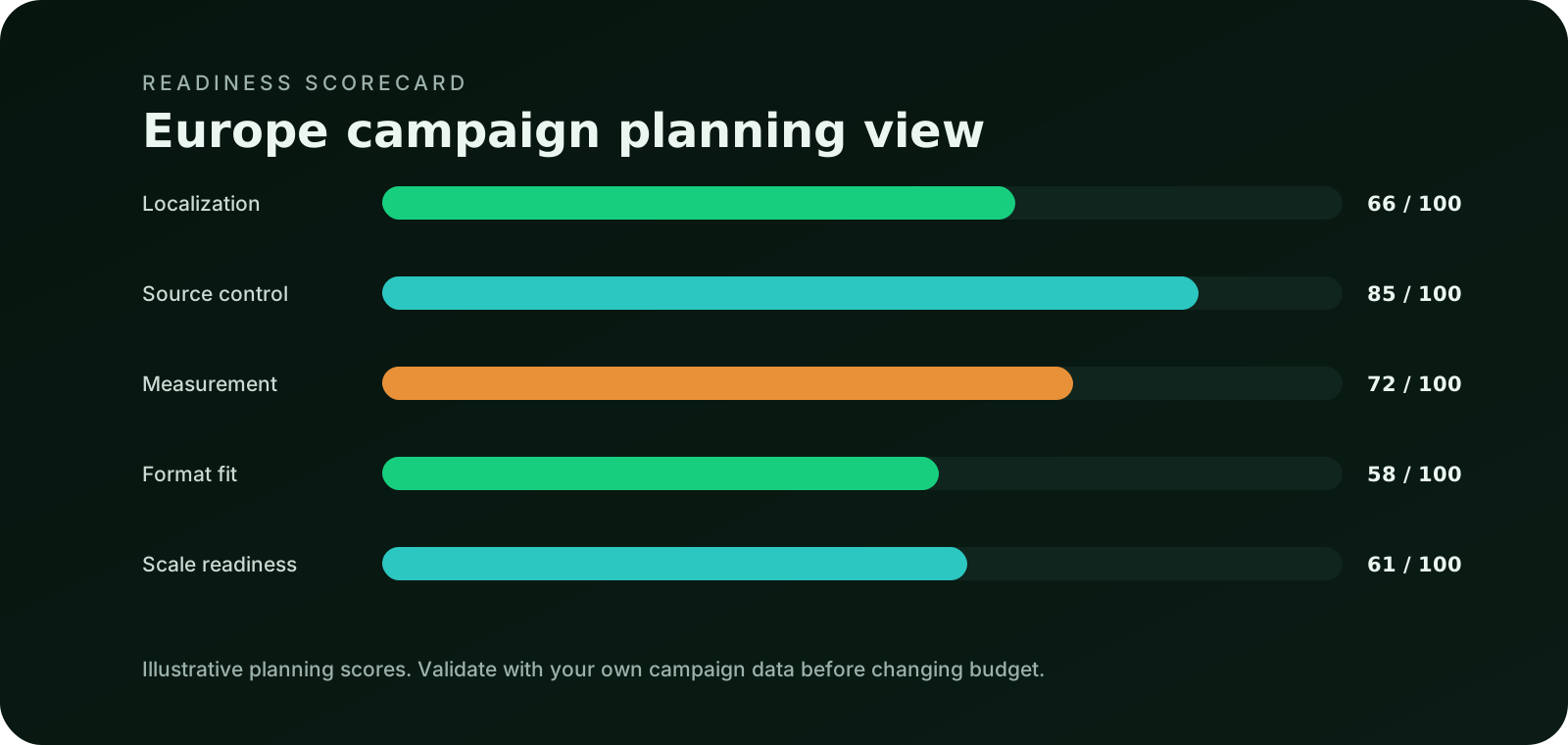
| Planning layer | Country-level question | Evidence before scaling |
|---|---|---|
| Eligibility | Can the offer, fulfillment and support serve this market? | Valid destination and accepted conversions |
| Language | Does creative and landing-page language fit the intended audience? | Consistent message and usable completion path |
| Economics | What acquisition cost can the market support? | Settled cost per accepted outcome |
| Device mix | Does the experience work across the devices receiving traffic? | Device-level completion and quality checks |
| Scale | Does performance remain stable as new sources enter? | Source-aware results after a controlled increase |
Localize the promise, not only individual words. A translated headline can still fail if price conditions, shipping, signup steps or proof are written for another market. Check the complete path from creative to confirmation. If a campaign uses English in a market where the intended audience can reasonably use it, test that decision rather than assuming localization is always unnecessary or always required. The correct choice is the one that produces a clear, accurate experience for the target users and an acceptable business result.
Measurement should remain comparable across countries. Use the same definition of an accepted conversion where the business process allows it, and document exceptions when one market has a different qualification or payment flow. Preserve source and campaign identifiers so a country difference can be separated from an inventory difference. If one market underperforms, first check destination behavior, conversion tracking and the source mix before declaring the entire geography unsuitable.
Budget market tests independently enough to learn. A large country can consume the majority of a shared budget before smaller markets collect useful evidence. Set practical caps or staged allocations so each priority market has the opportunity to produce decision-ready data. FroggyAds source controls can then be used inside each geographic test when repeated inventory patterns appear. Increase budgets only in markets where the same accepted outcome remains inside the advertiser's economic boundary as delivery broadens.
Keep applicable privacy, advertising and offer-specific requirements in the launch checklist and verify them for the markets involved rather than relying on a generic "Europe" assumption. Rules can depend on country, product and data practice. The media plan should state which team or advisor owns those checks. A strong European ad-network strategy therefore combines broad access with local discipline: eligible countries, clear messaging, consistent measurement, country-level economics and controlled source-aware scaling.
Plan review times around local traffic and the advertiser's own response process. A lead generated in one country can appear weaker if it reaches the sales team outside supported hours, while an ecommerce conversion may be less sensitive to that handoff. Record important operational differences before adjusting bids or excluding inventory. If a market requires a different follow-up workflow, measure that change separately instead of attributing every performance gap to the media source.
Use expansion rules for new countries. Start with eligibility and destination verification, then a limited media test, then a larger stage only after accepted outcomes meet the written boundary. Do not clone the highest-spending country's budget into a new market before it proves comparable economics. A portfolio approach allows FroggyAds broad European reach to be explored without forcing every country to receive the same level of investment before evidence exists.
Europe Ad Network for Controlled Campaign Growth: what should the advertiser decide next?
For Europe Ad Network for Controlled Campaign Growth, treat Europe as its own campaign market. Confirm that the offer, landing experience, language and device path genuinely support the market, then compare source-level outcomes inside Europe. Use Visible scope and entity record and Replace Europe with named launch cells as the planning baseline instead of importing assumptions from another country.
On this Europe Ad Network for Controlled Campaign Growth page, the decision should remain tied to the existing evidence around Visible scope and entity record, Replace Europe with named launch cells and Separate legal roles from media controls. Those sections give europe ad network its specific context; the table below turns that context into campaign actions rather than adding another generic definition.
| Decision | What to verify | FroggyAds action |
|---|---|---|
| Europe Ad Network for Controlled Campaign Growth objective | Use Visible scope and entity record to define the accepted business event and the maximum learning loss for europe ad network. | Launch one FroggyAds campaign objective for Europe Ad Network for Controlled Campaign Growth and keep the conversion definition stable. |
| Europe Ad Network for Controlled Campaign Growth audience | Use Replace Europe with named launch cells to verify market, device, language and offer eligibility for europe ad network. | Apply only the FroggyAds targeting controls that change the real Europe Ad Network for Controlled Campaign Growth customer journey. |
| Europe Ad Network for Controlled Campaign Growth source evidence | Use Separate legal roles from media controls to keep source-level differences visible instead of relying on one blended europe ad network average. | Keep, cap, exclude or retest Europe Ad Network for Controlled Campaign Growth inventory from documented source evidence. |
| Europe Ad Network for Controlled Campaign Growth economics | Use Localize the offer and the evidence to connect media spend with accepted conversions and downstream value for europe ad network. | Protect the Europe Ad Network for Controlled Campaign Growth test with a written budget boundary and a consistent attribution window. |
| Europe Ad Network for Controlled Campaign Growth scale rule | Use Build a country-specific destination test to define the exact evidence that earns the next budget increase for europe ad network. | Scale Europe Ad Network for Controlled Campaign Growth one major control at a time and compare marginal performance with the prior baseline. |
A page-specific FroggyAds test sequence for Europe Ad Network for Controlled Campaign Growth
- Europe Ad Network for Controlled Campaign Growth outcome: define the accepted event for europe ad network and the maximum loss permitted while the first test is learning.
- Europe Ad Network for Controlled Campaign Growth path: verify market eligibility, device experience, landing-page continuity and tracking against Visible scope and entity record before buying more traffic.
- Europe Ad Network for Controlled Campaign Growth hypothesis: launch one bounded FroggyAds test tied to Replace Europe with named launch cells; do not change bid, creative, audience and destination together.
- Europe Ad Network for Controlled Campaign Growth source review: compare qualified activity, accepted conversions, timing and cost by the source or segment dimensions relevant to Separate legal roles from media controls.
- Europe Ad Network for Controlled Campaign Growth scaling: use Localize the offer and the evidence and Build a country-specific destination test to define what must reproduce before the next budget increase.
Why FroggyAds is relevant to Europe Ad Network for Controlled Campaign Growth
For Europe Ad Network for Controlled Campaign Growth, FroggyAds gives advertisers a self-serve DSP and ad-network workflow for buying supported traffic with campaign-level budgets and targeting. Depending on format and campaign context, available controls can include country, city, device, operating system, browser, carrier, category, source, ID and IP options. SmartCPC and Adscore-supported traffic-quality controls can support the europe ad network optimization process, while the advertiser's tracker, analytics and backend acceptance remain the final evidence for commercial quality.
Use Build a country-specific destination test as the final checkpoint for Europe Ad Network for Controlled Campaign Growth. If the accepted result does not reproduce after the next meaningful volume step, return to the last stable configuration instead of widening several controls at once.
How to tell whether Europe Ad Network for Controlled Campaign Growth is working
For Europe Ad Network for Controlled Campaign Growth, reconcile Europe campaign data against its own accepted conversion and source mix. Use Visible scope and entity record as the market baseline instead of borrowing performance assumptions from another country.
Reconcile Europe Ad Network for Controlled Campaign Growth on one evidence window
For Europe Ad Network for Controlled Campaign Growth, compare FroggyAds reporting with the advertiser's tracker, analytics and backend records for the same dates and attribution rules. Record media spend, relevant delivery events, qualified landing activity, accepted conversions and rejection reasons, then use Replace Europe with named launch cells to investigate material gaps before they become optimization rules.
Diagnose the smallest failing layer in Europe Ad Network for Controlled Campaign Growth
If europe ad network delivery is weak, review eligibility, targeting, bid and inventory first. If traffic arrives but the destination underperforms, inspect speed, message continuity, forms, redirects and device compatibility. If front-end conversions look healthy but backend acceptance is weak, use Separate legal roles from media controls to isolate audience or source quality after tracking has been verified.
Set the next Europe Ad Network for Controlled Campaign Growth scale and stop rule
Write the exact Europe Ad Network for Controlled Campaign Growth result that earns more budget and the exact condition that pauses the test. Increase one major control at a time and compare marginal europe ad network performance with the prior configuration. FroggyAds supplies the campaign controls; the advertiser's accepted downstream data determines whether the expansion is commercially useful.
Europe Ad Network for Controlled Campaign Growth: preserve the evidence behind the next campaign change
For Europe Ad Network for Controlled Campaign Growth, keep a dated decision note that records the europe ad network campaign scope, the accepted conversion, the evidence window and the maximum additional loss allowed before another review. Tie that note to Visible scope and entity record so the next FroggyAds action remains grounded in this page's actual subject.
Separate observation from explanation for Europe Ad Network for Controlled Campaign Growth. Delivery, spend, device mix, source mix and accepted outcomes are observations. Audience mismatch, creative fatigue, destination friction, tracking loss and source quality are competing explanations. Use Replace Europe with named launch cells to test the narrowest explanation first; changing several europe ad network variables together makes the next result difficult to attribute.
Before increasing Europe Ad Network for Controlled Campaign Growth spend, preserve the last stable FroggyAds configuration and write the result that must reproduce after the next volume step. Use Separate legal roles from media controls as the review point. If marginal cost or accepted quality moves outside the written boundary, return to the recovery point rather than widening bids, targeting and sources simultaneously.
This evidence record turns europe ad network into an auditable buying process: another media buyer should be able to see what was tested, what changed, which source or segment caused the result and why the next action was chosen. FroggyAds provides the campaign controls for that next bounded test; the advertiser's own downstream data provides the final commercial proof.
Europe Ad Network for Controlled Campaign Growth: the decision this URL owns
Europe Ad Network for Controlled Campaign Growth should resolve one practical media decision for a performance advertiser: plan the market-specific test and measurement rules. Keep the evaluation tied to this URL rather than borrowing conclusions from a neighboring format or channel.
URL boundary for Europe Ad Network for Controlled Campaign Growth: This URL owns Europe Ad Network for Controlled Campaign Growth; Online Advertising Europe is the nearest neighboring topic and should keep its separate task. Use this page only for the decision implied by Europe Ad Network for Controlled Campaign Growth.
Decision inputs for Europe Ad Network for Controlled Campaign Growth: audience targeting, source evidence, conversion tracking, accepted business value. Keep these inputs tied to accepted conversion or business-value event and the page-specific job: plan the market-specific test and measurement rules.
Separate legal roles from media controls is the action checkpoint for Europe Ad Network for Controlled Campaign Growth. Before acting on “Which checks confirm traffic reached the intended European market?”, document conversion tracking, the resulting campaign action and the rollback or retest condition.
Visible scope and entity record is an evidence checkpoint for Europe Ad Network for Controlled Campaign Growth. To answer “Why should a Europe network plan use separate country cells?”, keep audience targeting in the same campaign record and use it to plan the market-specific test and measurement rules.
Replace Europe with named launch cells is the measurement checkpoint for this URL. Resolve “How should advertising be localized beyond translation?” while retaining source evidence, accepted business value, spend and cohort age so the result can be reconciled with accepted conversion or business-value event.
| Page checkpoint | How to use it | Evidence to retain |
|---|---|---|
| Visible scope and entity record | Use Visible scope and entity record to establish the first evidence boundary for Europe Ad Network for Controlled Campaign Growth; then record which part of campaign objective, targeting, source evidence, conversion tracking and economics it changes. | Keep audience targeting, source/campaign ID and the accepted-event definition together. |
| Replace Europe with named launch cells | Use Replace Europe with named launch cells as the second checkpoint and reconcile it with accepted conversion or business-value event before changing budget or source allocation. | Retain source evidence, spend, timestamp/cohort age and accepted/rejected outcomes. |
| Separate legal roles from media controls | Use Separate legal roles from media controls as the final checkpoint: if it does not change the evidence for accepted conversion or business-value event, keep the test narrow rather than scaling. | Document conversion tracking, the decision taken and the rollback or retest condition. |
Transparent Europe Ad Network for Controlled Campaign Growth decision example
Hypothetical example: For Europe Ad Network for Controlled Campaign Growth, a hypothetical controlled cell that spends USD 270 and records 9 accepted conversion or business-value event after the same maturity window has an accepted cost of USD 30.00 per outcome. Replace the figures, outcome and review window with your own economics; this is not a FroggyAds performance claim.
Why use FroggyAds here?
When Europe Ad Network for Controlled Campaign Growth calls for a paid-traffic test, use FroggyAds to keep targeting, budget, format and source decisions in one workflow while the advertiser-side system confirms accepted conversion or business-value event. Create your free FroggyAds account.
Europe Ad Network for Controlled Campaign Growth — what matters first
Europe Ad Network for Controlled Campaign Growth should be evaluated market by market: define eligible geography, keep measurement consistent, and scale only where accepted-outcome economics remain viable.