
Buy Spain Website Traffic
Reach Spain website traffic with localized creative, GEO and device controls, conversion tracking and source-level optimization.
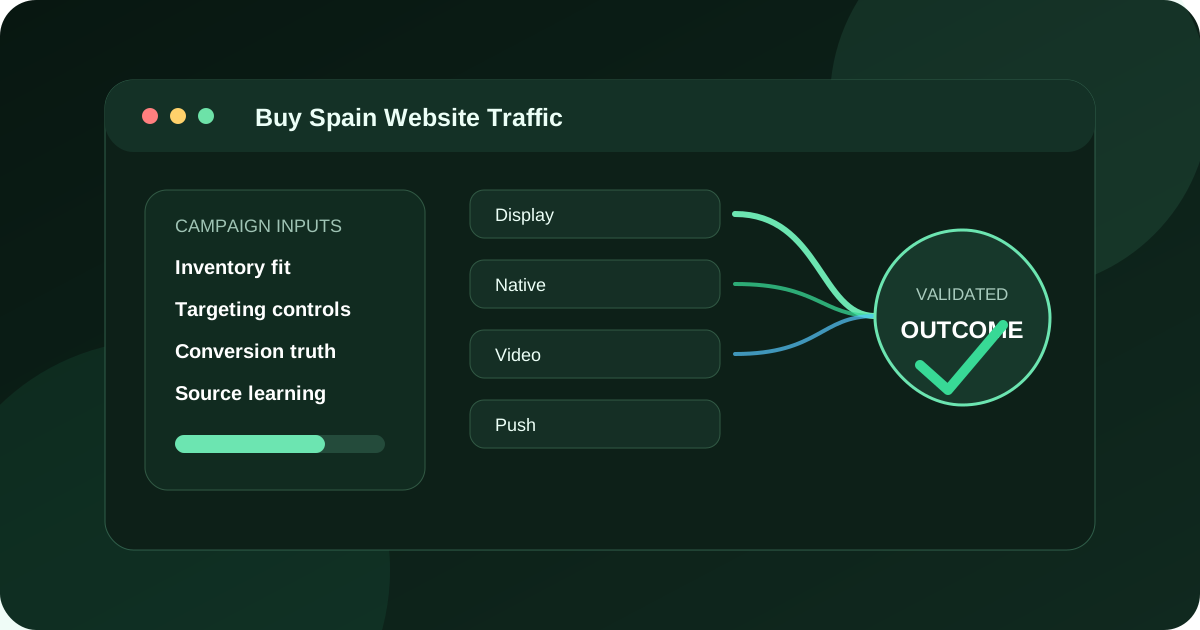
Buy Spain Website Traffic at a glance
- Planning: How to evaluate paid traffic for Spain.
- Control: What buyers need to know before purchasing traffic in Spain.
- Decision: Build a traffic plan for Spain that reflects the real market.
How to evaluate paid traffic for Spain
The strongest platform decision begins with the business event, not the traffic headline. The search for buy spain traffic is usually commercial: the advertiser wants paid users from Spain, not a worldwide package with an unknown geographic mix. A useful plan connects Spain-targeted impressions, clicks and visits across Push, Native, Display, Pop, Video and Interstitial supply to one defined objective: reach commercially relevant users in Spain with language, city, device, timing and landing-page choices aligned to the market. Delivery matters only when it can be traced to validated Spain sessions, accepted leads, purchases, installs or other business events with source-level evidence.
The first decision is geographic structure. Keep Madrid, Catalonia, Valencia, Andalusia and the Basque Country visible, then separate Madrid, Barcelona, Valencia, Seville, Bilbao and Málaga when language, expected value, service coverage, device behavior or cost calls for a different bid or landing page. The purpose is not to create dozens of tiny campaigns. It is to preserve the differences that change a business decision.
The next decision is localization. Plan for Spanish, with Catalan or other regional-language support where the audience and landing page require it, display EUR where price is part of the offer, and test the destination on the devices common to the market. natural Spanish copy, relevant regional language, EUR pricing and local cultural references without stereotypes
FroggyAds provides self-serve access to worldwide programmatic supply, six core ad formats and detailed targeting controls where supported. Adscore signals and internal controls help identify invalid or low-quality activity. The advertiser remains responsible for creative accuracy, legal eligibility, landing-page quality, consent requirements and downstream conversion validation in Spain.
What buyers need to know before purchasing traffic in Spain
The query buy spain traffic signals a direct purchase investigation. The advertiser is not only asking what paid traffic is; they are deciding how to reach users in Spain, which controls matter and how to judge whether the resulting sessions are commercially useful.
For Buy Spain Website Traffic, connect this rule to the named audience, workflow, or comparison before acting. Current results commonly include country traffic packages, generic provider pages, marketplace offers and short GEO-targeting explanations. This guide adds the operating detail those pages often omit: regional structure, localization, device planning, event acceptance, source decisions and responsible scaling.
This URL owns direct purchase intent for Spain. Owns direct purchase intent for Spain-targeted traffic. /buy-geo-targeted-traffic/ remains the cross-market targeting guide, while /buy-website-traffic/ owns broad transactional traffic intent.
The audience is advertisers, affiliates, agencies and growth teams that need measurable users from Spain rather than undifferentiated worldwide traffic. The available media can include Spain-targeted impressions, clicks and visits across Push, Native, Display, Pop, Video and Interstitial supply. Those two facts should remain visible from the first brief through the final budget decision.
Build a traffic plan for Spain that reflects the real market
Spain should not be purchased as a single anonymous GEO. Start by making Madrid, Catalonia, Valencia, Andalusia and the Basque Country visible in the account, then separate Madrid, Barcelona, Valencia, Seville, Bilbao and Málaga whenever expected value, language, service coverage or delivery cost changes. The purpose is not to fragment the campaign endlessly. It is to preserve the differences that would cause the team to set a different bid, creative, landing page or stop rule.
Language is an operating variable. The relevant plan is Spanish, with Catalan or other regional-language support where the audience and landing page require it. Translation alone is not enough. The page must use local terminology, show EUR pricing where a transaction is expected and explain delivery, eligibility, support or account requirements in terms a local user recognizes. A campaign should not claim precise targeting if the destination still looks designed for another country.
Device planning in Spain should reflect mobile-first discovery with desktop still relevant for travel planning, education, B2B and expensive purchases. Build separate mobile and desktop reporting cells when the journey, page speed, payment method or conversion rate differs. Test the actual destination on representative devices and connection conditions before spending, because a clean desktop QA pass does not prove that a mobile visitor receives the same usable experience.
Time and pacing matter. Central European Time for most of Spain, with campaign timing adjusted when the Canary Islands are included. A national daily average can hide strong windows and expensive idle periods. Use hourly reporting only after enough data exists, and avoid aggressive dayparting from a handful of conversions. The first objective is to understand when qualified users complete the intended action, not simply when clicks are cheapest.
The strongest initial verticals for a structured test include travel, ecommerce, finance, education, telecom, local services and mobile apps. That does not mean every offer in those categories will work. Product-market fit, price, regulation, landing quality and source composition still decide performance. The advantage of a market-specific campaign is that each of those variables can be measured without being diluted by unrelated worldwide traffic.
Spain campaign localization checklist
| Dimension | Market plan | Operating rule |
|---|---|---|
| Languages | Spanish, with Catalan or other regional-language support where the audience and landing page require it | Build separate creative and landing variants when language changes user expectation or conversion value. |
| Currency | EUR | Show local pricing and measure payment or lead acceptance instead of assuming the click completed the commercial job. |
| Priority cities | Madrid, Barcelona, Valencia, Seville, Bilbao and Málaga | Keep large-city scale visible while testing regional cells with their own bids and thresholds. |
| Device plan | mobile-first discovery with desktop still relevant for travel planning, education, B2B and expensive purchases | Validate speed, forms, redirects and conversion events on the devices represented in the media plan. |
| Timing | Central European Time for most of Spain, with campaign timing adjusted when the Canary Islands are included | Use local dayparting after enough evidence exists to distinguish repeatable demand from noise. |
| Seasonality | January sales, spring travel, summer tourism, back-to-school, Black Friday and Christmas retail | Plan creative and budgets around relevant periods without assuming historical demand will repeat automatically. |
Country targeting becomes useful when language, payment, timing, device and regional differences remain visible in the account.
Convert Spain traffic into measurable acquisition
Checkout and lead capture are part of traffic quality. In Spain, buyers should plan for cards, digital wallets and euro pricing, with local delivery, financing or subscription terms stated clearly. Report payment initiation, approval, failure and completion separately where possible. For lead campaigns, distinguish submitted, contactable, accepted and sales-qualified outcomes. A source that generates many cheap starts can still be unprofitable if the downstream acceptance rate collapses.
Localization should follow this rule: natural Spanish copy, relevant regional language, EUR pricing and local cultural references without stereotypes. The creative and destination should look as though they were planned for the market from the start. Review date formats, currency, address fields, phone validation, shipping, service areas, customer support hours and legal notices. Small details can create enough friction to distort the apparent quality of the traffic source.
The creative brief for this market is mobile-friendly Spanish assets with a clear benefit, local price and a landing-page promise that continues immediately. Build concepts around different reasons to act, not cosmetic variations. One concept can lead with price, another with proof, another with convenience and another with a market-specific use case. Keep each concept visible in reporting so a winning message can be distinguished from a lucky placement.
The destination requirement is fast Spanish pages with EUR pricing, regional service or delivery details and clear consent and return information. Test the full route from click to accepted event. Preserve campaign parameters through redirects, deduplicate events and compare browser-side analytics with the final CRM, ecommerce or app record. The paid-media report is useful only when it agrees closely enough with the system that decides revenue or lead quality.
Seasonal planning should account for January sales, spring travel, summer tourism, back-to-school, Black Friday and Christmas retail. Use these periods as hypotheses, not guarantees. Raise budgets only after current conversion and acceptance data support the move. Market events can change competition, inventory and user intent at the same time, so marginal acquisition cost matters more than the historical account average.
Compliance is a launch gate, not a footer exercise. The campaign must account for Spanish and EU privacy, consumer and advertising rules, plus regional-language or regulated-category requirements where applicable. Confirm that the product is permitted, the audience is eligible, the creative is accurate and the landing page supplies required disclosures. FroggyAds traffic access does not replace the advertiser's legal, licensing, consent or sector-specific obligations.
For source optimization, separate Madrid, Barcelona and broader regional inventory, then use source-level acceptance data to determine scale. Start with controlled discovery, classify sources as discovery, probation or proven, and move only repeatable winners into dedicated campaigns. Recheck whitelists over time because device mix, publisher behaviour, competition and creative fatigue can change the result.
For Buy Spain Website Traffic, treat this as a page-specific operating check rather than a universal benchmark. The scale decision should be made from the last units of spend, not the first. Watch valid local session rate, localized engagement, accepted conversion rate and cost per accepted local outcome as budget rises. If the new spend reaches weaker supply, reduce the step size, isolate the affected source group and protect the campaign cell that still produces value.
Six checks for a Spanish traffic provider
Geographic precision
Confirm that Spain supply can be separated by the regions and cities that change service coverage, customer value or cost.
Localization depth
Review Spanish, with Catalan or other regional-language support where the audience and landing page require it, EUR pricing, local terminology, address fields and support expectations.
Device readiness
Plan around this market reality: mobile-first discovery with desktop still relevant for travel planning, education, B2B and expensive purchases.
Format fit
Assign a clear job to Display, Native, Video, Push instead of running every format with the same message.
Conversion truth
Connect media delivery to validated Spain sessions, accepted leads, purchases, installs or other business events with source-level evidence and preserve market, city, source, device and creative data.
Legal eligibility
Complete a launch review covering Spanish and EU privacy, consumer and advertising rules, plus regional-language or regulated-category requirements where applicable.
Prepare a measurable Spain traffic campaign
| Area | Market requirement | Operating rule |
|---|---|---|
| Market structure | Madrid, Catalonia, Valencia, Andalusia and the Basque Country | Split only the geographic differences that change a business decision. |
| Language and price | Spanish, with Catalan or other regional-language support where the audience and landing page require it; EUR | Continue the same language, offer and price logic from ad to destination. |
| Priority locations | Madrid, Barcelona, Valencia, Seville, Bilbao and Málaga | Use city cells when service coverage, cost or expected value differs. |
| Devices | mobile-first discovery with desktop still relevant for travel planning, education, B2B and expensive purchases | Test page speed, forms, redirects and final events on representative devices. |
| Payments or leads | cards, digital wallets and euro pricing, with local delivery, financing or subscription terms stated clearly | Report approved outcomes separately from starts, failures and rejected events. |
| Decision metric | cost per accepted local outcome | Use the accepted local outcome, not the cheapest click, to decide scale. |
Every Spain setup choice should connect to a different bid, message, destination or accepted-event decision.
An eight-step plan for buying traffic in Spain
Define the accepted local outcome
Write the exact Spain event that creates value and document duplicate, invalid, rejected or cancelled events.
Confirm eligibility and coverage
Check product rules, service availability, audience requirements and the compliance obligations relevant to Spain.
Map regions and cities
Structure Madrid, Catalonia, Valencia, Andalusia and the Basque Country; separate Madrid, Barcelona, Valencia, Seville, Bilbao and Málaga only where the media or customer journey needs a different decision.
Localize the message and destination
Plan for Spanish, with Catalan or other regional-language support where the audience and landing page require it, show EUR pricing where appropriate and review local terminology, support and forms.
Verify tracking end to end
Test browser events, server postbacks, redirects, consent, deduplication and downstream acceptance before buying meaningful volume.
Launch separated format cells
Start with suitable options such as Display, Native and Video, each with its own creative and budget.
Classify source evidence
Compare valid Spain session rate, localized engagement rate and accepted conversion rate by source, city, device and creative. Interpret this point through the Buy Spain Website Traffic buyer task: plan the market-specific test and measurement rules. The neighboring Buy Traffic From Spain page should not inherit this conclusion.
Scale the proven market cells
For Buy Spain Website Traffic, the Scale the proven market cells checkpoint should answer a concrete buyer question rather than repeat a generic framework. The evidence record should make Increase, spend, gradually, protect, cells and accepted visible instead of hiding them inside a blended score or an unexplained recommendation. Use the finding to choose a specific action—keep, cap, exclude, renegotiate, retest or stop—rather than recording a score with no operational consequence. Use FroggyAds to test the media assumption that follows from this section, not to replace the evidence the section requires. Campaign controls support the decision; they do not manufacture proof.
How to buy and optimize paid traffic in Spain
findings for buy spain traffic usually open with definitions, comparison tables and lists of activation system features. That helps a researcher orient quickly, yet it does not show how buying and optimizing geo-targeted paid traffic in Spain across Madrid, Barcelona, Valencia, Seville, Bilbao and Málaga should be operated after an account is funded. The useful gap is a decision model that links the supply being purchased to a business event the team can accept or reject.
Reduce the brief to a single operational sentence: acquire Spain-targeted impressions, clicks and visits across Push, Native, Display, Pop, Video and Interstitial supply in order to reach commercially relevant users in Spain with language, city, device, timing and landing-page choices aligned to the market, then judge the effort through validated Spain sessions, accepted leads, purchases, installs or other business events with placement source-level evidence. When a team cannot state the plan this plainly, media evaluation settings tend to accumulate without a common purpose. The sentence also exposes missing dependencies before the launch, including unsupported markets, broken events or a destination that cannot complete the promised action.
The audience described by advertisers, affiliates, agencies and growth teams that need measurable users from Spain rather than undifferentiated worldwide traffic is not one homogeneous pool. Market rules, device behavior, language, product downstream worth and conversion friction can all change the economics. Split those differences into visible media evaluation cells so the operator dashboard does not compress several business models into a single average.
Format choice should follow the amount of explanation and attention the offer requires. Display can serve one stage, while Native or Video may create a more suitable context for another. Push can introduce efficient reach when the page is fast and the user expectation is clear. Keep every format in its own evaluation so pricing and behavior remain interpretable.
For the Buy Spain Website Traffic decision, record how this control changes the next test or review. The destination is part of the buying system. It must load on the targeted device, preserve the creative promise and record the intended event without duplicate firing. A network cannot be assessed fairly if users reach a slow page, encounter a broken form or discover that the offer shown in the ad is not available in their market.
Build the measurement ladder from valid Spain session rate to localized engagement rate, then to accepted conversion rate and finally cost per accepted local outcome. Each rung answers a different question. Delivery shows that the opportunity arrived, engagement shows some intent, conversion shows the expected action, and the last metric determines whether the economics support another media budget decision.
Rate and sample size must be considered together. One positive event from a small placement source is an invitation to evaluation, not proof. Hundreds of visits without accepted conversion rate create much stronger negative evidence. Set minimum data thresholds so media budget changes reflect patterns instead of the last conversion seen in the dashboard.
Consider an ecommerce brand testing Madrid and broader national demand beside a SaaS team localizing acquisition for Spanish users. Their audiences may overlap, yet the message, page depth and accepted event can be very different. The same separation applies to an agency separating mobile and desktop traffic in Spain and a lead-generation media evaluation validating city-level quality in Barcelona. Build each scenario as its own hypothesis rather than forcing four commercial stories into one media evaluation.
When using Buy Spain Website Traffic, apply this rule only to the conditions and decision described on this page. Traffic quality is layered. Technical filters and invalid-traffic signals remove some obvious waste. Context, relevance and landing behavior determine another layer. The final layer is the advertiser's own acceptance logic. A technically valid user can still be wrong for the offer, while a quieter placement source can create better long-term downstream worth.
Scaling changes the mix of auctions and traffic sources. Higher bids can reach more expensive opportunities; larger budgets can extend into different hours, devices or inventory. Watch cost per accepted local outcome at the margin. If the newly purchased volume is weaker than the original cohort, isolate the expansion rather than rewriting the entire media evaluation.
On Buy Spain Website Traffic, use this control to keep the page's evidence and action traceable. The most useful reporting table joins cost, placement source, format, GEO, device, creative, landing page and accepted outcome. With those dimensions aligned, the operator can answer which combination deserves the next dollar. Without them, the dashboard may describe activity while failing to support a media budget decision.
Keep a change log for buying and optimizing geo-targeted paid traffic in Spain across Madrid, Barcelona, Valencia, Seville, Bilbao and Málaga. Record the reason, timestamp, operator and expected effect of every bid, media budget, creative, targeting or placement source change. The log prevents repeated learning runs and lets the team distinguish a activation system shift from a change it introduced itself.
Choose ad formats for the Spanish customer journey
Display
Use display to introduce the offer in a content-like environment. Keep the Spain format cell separate so pricing, source mix, device behavior and accepted outcomes remain interpretable.
Native
Use native to reach opted-in users with a compact direct message. Keep the Spain format cell separate so pricing, source mix, device behavior and accepted outcomes remain interpretable.
Video
Use video to deliver visual reach with controlled creative hierarchy. Keep the Spain format cell separate so pricing, source mix, device behavior and accepted outcomes remain interpretable.
Push
Use push to create a high-attention visit when the landing experience is immediate. Keep the Spain format cell separate so pricing, source mix, device behavior and accepted outcomes remain interpretable.
Interstitial
Use interstitial to explain a proposition with motion and an early hook. Keep the Spain format cell separate so pricing, source mix, device behavior and accepted outcomes remain interpretable.
Pop
Use pop to use a full-screen transition where policy and user context permit. Keep the Spain format cell separate so pricing, source mix, device behavior and accepted outcomes remain interpretable.
Measure Spain traffic from arrival to accepted value
| Metric | Decision layer | Why it matters |
|---|---|---|
| valid Spain session rate | Technical arrival | Confirms that the purchased opportunity reaches a usable local destination. |
| localized engagement rate | Localized engagement | Shows whether the page and proposition make sense to the intended audience. |
| accepted conversion rate | Accepted action | Separates a visible event from a conversion the business can actually use. |
| cost per accepted local outcome | Commercial scale | Determines whether another unit of spend should be allocated to the same cell. |
| City and region variance | Geographic allocation | Prevents a national average from hiding strong and weak local segments. |
| Mobile and desktop variance | Experience control | Reveals whether device-specific page or payment friction is distorting traffic quality. |
The final optimization event should match the event the business accepts and values.
Four distinct Spanish traffic scenarios
| Scenario | Starting market cell | Likely format | Primary signal | Structural rule |
|---|---|---|---|---|
| An ecommerce brand testing Madrid and broader national demand | Madrid | Display | valid Spain session rate | Dedicated creative, destination and stop rule. |
| A SaaS team localizing acquisition for Spanish users | Barcelona | Native | localized engagement rate | Dedicated creative, destination and stop rule. |
| An agency separating mobile and desktop traffic in Spain | Valencia | Video | accepted conversion rate | Dedicated creative, destination and stop rule. |
| A lead-generation campaign validating city-level quality in Barcelona | Seville | Push | cost per accepted local outcome | Dedicated creative, destination and stop rule. |
Separate scenarios when they need different creative, landing pages, conversion rules or economic thresholds.
Score a Spanish traffic source before funding the test
| Dimension | Score | Question |
|---|---|---|
| Country and city availability | 0-5 | Can the platform reach the useful parts of Spain at decision-ready volume? |
| Language and creative fit | 0-5 | Can the campaign support Spanish, with Catalan or other regional-language support where the audience and landing page require it with a consistent destination? |
| Device and page readiness | 0-5 | Do mobile and desktop users receive a fast, complete and measurable journey? |
| Source-level visibility | 0-5 | Can weak supply be excluded and repeatable winners be isolated? |
| Accepted-event measurement | 0-5 | Can delivery be reconciled with validated Spain sessions, accepted leads, purchases, installs or other business events with source-level evidence? |
| Responsible scale potential | 0-5 | Does the marginal acquisition cost remain acceptable as the market cell expands? |
A high score does not replace testing. It shows whether the source has the ingredients required for a fair evaluation. For Buy Spain Website Traffic, this check supports the decision to plan the market-specific test and measurement rules; do not substitute the scope of Buy Traffic From Spain.
What paid traffic cannot decide for an advertiser in Spain
No provider can guarantee that Spain traffic will produce conversions, revenue, profit or search rankings. The platform supplies media access and controls; the advertiser supplies the offer, localization, destination, tracking and acceptance rules.
Inventory, pricing and performance vary by region, city, device, format, source, category, time and competition. A result from one Spain cell should not be projected automatically onto another.
On Buy Spain Website Traffic, use this control to keep the page's evidence and action traceable. FroggyAds can support source-level analysis, but the advertiser must define what counts as an accepted outcome and return reliable events to the reporting workflow.
For the Buy Spain Website Traffic decision, use What paid traffic cannot decide for an advertiser in Spain to separate a real operating requirement from a broad best-practice statement. Review Automation, cannot, repair, ineligible, product and misleading together, because a strong result in one of them should not conceal a material failure in another. Use the finding to choose a specific action—keep, cap, exclude, renegotiate, retest or stop—rather than recording a score with no operational consequence.
Buy Spain Website Traffic FAQ
For Buy Spain Website Traffic, what should a buyer define before purchasing traffic from Spain?
Specify the Spanish customer, serviceable locations, devices, offer eligibility and accepted action before opening delivery. Planning: How to evaluate paid traffic for Spain. Control: What buyers need to know before purchasing traffic in Spain.
For Buy Spain Website Traffic, how should landing-page language be chosen for Spain?
Select wording for the intended Spanish audience and region, using qualified local review to confirm meaning, tone and customer instructions.
For Buy Spain Website Traffic, which time record makes Spain traffic reporting clearer?
Keep the applicable Spain local-time context with placements and outcomes so pacing, customer contact and maturity windows can be interpreted correctly.
For Buy Spain Website Traffic, what belongs in a Spanish payment-path test?
Rehearse available Spanish payment options from price display through failure, confirmation, cancellation and refund processing. findings for buy spain traffic usually open with definitions, comparison tables and lists of activation system features.
For Buy Spain Website Traffic, which records help verify Spanish regional targeting?
Reconcile configured Spanish areas with source location data and consented customer records, then document remaining uncertainty. Plan targeting across multiple markets without merging unlike results. Buy Italy website traffic with localized creative, GEO and device controls, conversion tracking and source-level optimization.
For Buy Spain Website Traffic, which review belongs before buying website traffic in Spain?
Assess current Spanish requirements for the offer, audience, advertising claims, personal data, payment flow and selected channel with qualified help.
For Buy Spain Website Traffic, what keeps Spain traffic placements accountable?
Attach the Spanish cohort, placement, device and delivery time to accepted customer events and later adjustments. Plan targeting across multiple markets without merging unlike results. Buy Italy website traffic with localized creative, GEO and device controls, conversion tracking and source-level optimization.
For Buy Spain Website Traffic, what makes a destination ready for visitors from Spain?
It should function on targeted Spanish devices, state material terms plainly, support the advertised action and offer accessible customer assistance.
For Buy Spain Website Traffic, what budget structure keeps a first Spanish test diagnosable?
Give each unproven Spanish source its own ceiling and avoid mixing variations the buyer cannot evaluate separately. Can the platform reach the useful parts of Spain at decision-ready volume?
For Buy Spain Website Traffic, when may a Spanish traffic source take more budget?
Increase delivery in measured steps only when Spanish accepted value recurs and customer operations keep pace without service deterioration. The query buy spain traffic signals a direct purchase investigation.
Use standards, public references and market rules as operating inputs for Buy Spain Website Traffic
For Buy Spain Website Traffic, use public references to clarify terminology, traffic-quality controls, measurement and advertiser responsibilities; campaign-specific policies, laws, contracts and review requirements still take precedence. Here the practical question is whether you can plan the market-specific test and measurement rules. Treat Buy Traffic From Spain as a separate intent rather than interchangeable copy.
Continue the media plan
Buy Geo Targeted Traffic
Plan targeting across multiple markets without merging unlike results.
Buy Italy Website Traffic
Buy Italy website traffic with localized creative, GEO and device controls, conversion tracking and source-level optimization.
Buy Vietnam Website Traffic
Launch campaigns for Vietnam website traffic with localized creative, GEO and device controls, conversion tracking and source-level optimization.
Launch a measurable Spain traffic campaign
The practical role of Launch a measurable Spain traffic campaign in Buy Spain Website Traffic is to expose the exact condition that can change the buyer's next action. Compare Choose, format, define, accepted, local and verify under the same scope and review window; if one is unknown, keep that uncertainty explicit rather than filling the gap with an estimate. When the evidence is strong, carry the exact setting or requirement into the next campaign step instead of broadening several variables at once. Where this leads to paid acquisition, FroggyAds gives you a self-serve campaign environment for applying the relevant targeting, budget and source controls while your own analytics verifies downstream value.
Choose the campaign controls behind Spain traffic
The Spain ad network guide explains localization, formats, source reporting, budget guardrails and scaling decisions for this market.
Buy Spain Website Traffic: the decision this URL owns
The purpose of Buy Spain Website Traffic is to help a performance advertiser make a controlled next-step decision: plan the market-specific test and measurement rules. Every setup and measurement choice on this page should support that decision.
Decision inputs for Buy Spain Website Traffic: campaign objective, audience targeting, source evidence, conversion tracking. Keep these inputs tied to accepted conversion or business-value event and the page-specific job: plan the market-specific test and measurement rules.
URL boundary for Buy Spain Website Traffic: This URL owns Buy Spain Website Traffic; Buy Traffic From Spain is the nearest neighboring topic and should keep its separate task. Use this page only for the decision implied by Buy Spain Website Traffic.
How to evaluate paid traffic for Spain is the measurement checkpoint for this URL. Resolve “For Buy Spain Website Traffic, how should landing-page language be chosen for Spain?” while retaining audience targeting, conversion tracking, spend and cohort age so the result can be reconciled with accepted conversion or business-value event.
What buyers need to know before purchasing traffic in Spain is the action checkpoint for Buy Spain Website Traffic. Before acting on “For Buy Spain Website Traffic, which time record makes Spain traffic reporting clearer?”, document source evidence, the resulting campaign action and the rollback or retest condition.
Buy Spain Website Traffic at a glance is an evidence checkpoint for Buy Spain Website Traffic. To answer “For Buy Spain Website Traffic, what should a buyer define before purchasing traffic from Spain?”, keep campaign objective in the same campaign record and use it to plan the market-specific test and measurement rules.
| Page checkpoint | How to use it | Evidence to retain |
|---|---|---|
| Buy Spain Website Traffic at a glance | Use Buy Spain Website Traffic at a glance to establish the first evidence boundary for Buy Spain Website Traffic; then record which part of campaign objective, targeting, source evidence, conversion tracking and economics it changes. | Keep campaign objective, source/campaign ID and the accepted-event definition together. |
| How to evaluate paid traffic for Spain | Use How to evaluate paid traffic for Spain as the second checkpoint and reconcile it with accepted conversion or business-value event before changing budget or source allocation. | Retain audience targeting, spend, timestamp/cohort age and accepted/rejected outcomes. |
| What buyers need to know before purchasing traffic in Spain | Use What buyers need to know before purchasing traffic in Spain as the final checkpoint: if it does not change the evidence for accepted conversion or business-value event, keep the test narrow rather than scaling. | Document source evidence, the decision taken and the rollback or retest condition. |
Transparent Buy Spain Website Traffic decision example
Hypothetical example: For Buy Spain Website Traffic, a hypothetical controlled cell that spends USD 210 and records 3 accepted conversion or business-value event after the same maturity window has an accepted cost of USD 70.00 per outcome. Replace the figures, outcome and review window with your own economics; this is not a FroggyAds performance claim.
Why use FroggyAds here?
For the controlled test described by Buy Spain Website Traffic, FroggyAds lets you manage paid delivery, targeting and source actions while your accepted-event data decides whether the cell should be kept, capped or expanded. Create your free FroggyAds account.
Buy Spain Website Traffic — what matters first
Treat Buy Spain Website Traffic: what matters first as a specific gate for Buy Spain Website Traffic, not as a reusable checklist item that means the same thing on every page. Use Website, evaluated, market, define, eligible and geography as the traceable inputs for this section, then state which missing item would be serious enough to stop or narrow the decision. If the section exposes a measurement gap, repair that gap before changing the offer, creative and targeting simultaneously.