
Buy Ethiopia Traffic for a Customer Route You Can Reconcile
Start with one Addis Ababa or other documented route your current operation can complete. Lock the proposition, receiving system, service boundary, maturity rule, owners, capacity and restoration point before exposure begins. Keep NBE system context separate from current FroggyAds delivery and the merchant’s accepted-customer evidence.
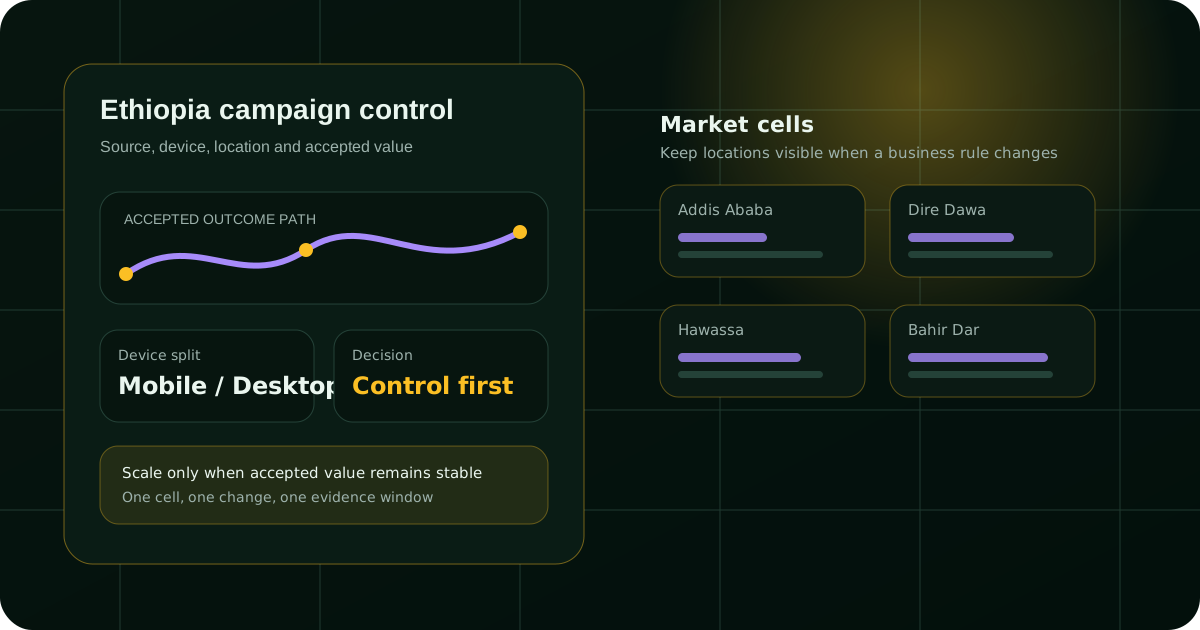
Choose the Ethiopia customer decision the first campaign must answer
- Connect the ETB promise to a real receiving operation. The first Ethiopia cell needs a supported action, merchant or service record and mature accepted outcome.
- Keep evidence roles clear. FroggyAds controls paid delivery; the advertiser’s settlement, CRM, fulfilment or product system proves customer value.
- Open one reversible cell. Expand a route only after merchant custody, ordinary capacity and accepted-customer economics pass together.
Use Ethiopian payment policy evidence without turning it into advertising reach
Start your Ethiopia campaign with a customer route you can explain in one sentence: who you want to reach, where you can serve them, what the ETB offer includes, which action they should take and what outcome your business accepts. That clarity helps us match FroggyAds campaign controls to a test your team can measure.
Choose the result that matters before you compare traffic. A payment instruction, raw enquiry or account creation can show progress, but an ecommerce team may need retained fulfilment, a service advertiser may need an attended appointment and a SaaS team may need useful activation. FroggyAds reporting helps you follow delivery and response; your business record closes the decision.
Use our self-serve controls to keep the first Ethiopia test focused. Set the geography, eligible format, creative, bid and budget boundary, then review source-level response without changing the offer halfway through the campaign. If the landing page, payment route or customer operation fails, pause that cell, fix the route and restart from the last verified version.
Choose FroggyAds when you want to test Ethiopia traffic with clear control over spend and campaign variables. We help media buyers, affiliate marketers, agencies and online businesses launch a disciplined test, compare what happens after the click and direct more budget only to the setup that produces accepted customer evidence.
Freeze the promise the customer and receiving team must share
Review the Ethiopia customer against the current operating record. The National Bank of Ethiopia publishes annual reporting, financial-stability analysis and the second phase of its National Digital Payments Strategy. These sources explain institutional priorities, infrastructure context and aggregate developments under their stated periods. Give every callback, settlement exception and customer instruction a named owner and review time.
They do not disclose FroggyAds inventory, identify who wants an advertiser's offer, quote a campaign price, certify a particular payment integration or predict accepted customer volume. Strategy momentum is not an individual-level targeting signal. the buy website traffic guide Register publication, reporting period, indicator unit, system coverage and limitation beside any fact. Keep account counts, transaction activity and merchant acceptance concepts separate when the source defines them differently. Do not label an aggregate number as active buyers for the page. the traffic sources hub Use policy evidence to ask better production questions: which branches does the merchant truly support, can a provider result join the customer record, and can the operation complete the advertised service? Direct tests answer those questions for this offer.
Connect ETB response to a serviceable customer state
Settle the Ethiopia customer question before approving more spend. Create an ETB merchant sheet with the public amount or calculation basis, material charges, included product or service, availability, fulfilment or appointment timing, eligibility and relevant cancellation, return, renewal or refund route.
Give the advertisement one accurate value proposition. Let the destination complete every material condition before the customer starts a payment or submits detailed information. A restriction introduced later invalidates the comparison because the advert and business record describe different offers.
Store merchant-sheet and effective-date identifiers with the campaign. A change to amount, stock, service capacity, territory or policy opens a new customer cohort. Later reversals remain linked to the sheet the customer saw.
Keep internal finance translation outside the public offer. Retain original spend, approved reporting treatment and customer amount in the accounting trail. Do not convert an internal number into a claimed FroggyAds rate or guaranteed Ethiopian campaign result.
List only branches the advertiser currently supports in production. For each, record the customer choice, ETB proposition, provider or merchant reference, matching order or account, confirmation, settlement state and later correction.
| Observed state | Merchant evidence | Campaign action |
|---|---|---|
| Provider or merchant confirmation | Matching order and proposition identity | Provisional until fulfilment matures |
| Approval without order | Exception owner and customer remedy | Hold and reconcile |
| Unavailable allocation | Inventory or service ticket | Cap or repair |
| Unsupported operating pod | Admission reason and early message | Exclude from accepted value |
Follow a supported customer payment into one authorised merchant state
Use this table to connect the paid visitor to the merchant record your Ethiopia team can actually reconcile. Before you expand a FroggyAds campaign, confirm that the ETB offer, service area, customer status and receiving owner stay consistent from the ad click to the mature business outcome.
| Dimension | Ethiopia plan | Operating rule |
|---|---|---|
| Merchant-confirmed Ethiopia outcome | Campaign ID joined to the ETB sheet, admitted service pod and mature customer state | Enter economics only after the receiving owner accepts that joined record |
| ETB offer custody | Approved Ethiopian birr amount or documented calculation basis | Show the same ETB meaning before response, during payment or enquiry, and in the customer confirmation |
| Served-area admission | Addis Ababa, Dire Dawa, Hawassa or Bahir Dar only where the advertiser documents ordinary service | Give a city its own cell when stock, appointment capacity, response ownership or customer promise differs |
| Ethiopia device route | Mobile and desktop arrivals reconciled to their own merchant records | Compare usable arrival, form or order progress, confirmation and mature value within each device cell |
| Allocation and response detail | Admitted pod, available unit, response window, fulfilment route and escalation owner | State the limiting Ethiopia condition before a customer sends details, requests contact or commits funds |
| Customer-record stewardship | Advertiser-approved collection purpose, consent route, access owner and retention instruction | Keep only the fields the Ethiopia receiving team can lawfully use and trace each record to its stated purpose |
Define one operating cell the receiving team can own
Assign offer eligibility within the Ethiopia receiving team
Our guidance for Ethiopia offer starts with verified customer evidence. Test normal approval, refusal, delayed response, interrupted return, duplicate attempt and approval without a matching order where safe. Each state needs its own customer message and resolution owner. One generic payment failure can prompt a harmful repeat action.
Assign audience fit within the Ethiopia receiving team
Treat Ethiopia audience as an operating check with a named owner. Keep provider success provisional until merchant and order records agree. An approval with no order stays in the exception book, outside accepted value. The payments owner resolves customer treatment before the media buyer evaluates the cell.
Assign destination readiness within the Ethiopia receiving team
Keep the Ethiopia destination conclusion in the campaign record. Post every refund, cancelled instruction or charge correction to the original campaign, creative, merchant sheet, route and customer record. Preserve initial and reversing times so the adjustment cannot drift into a later cohort.
Assign measurement ownership within the Ethiopia receiving team
Use Ethiopia measurement evidence to choose the next action. Measure investigation time. A branch that requires repeated reference searches or manual order creation may need repair or a cap even when eventual settlement is correct. Workload belongs beside the acquired-customer result. For Ethiopia, compare accepted-customer value with settlement investigation time before changing a source, route or exposure limit. For Buy Ethiopia Traffic, evaluate this point using the page-specific evidence and accepted outcome and run it as an independent campaign cell from the Buy Cheap Traffic intent.
Assign source controls within the Ethiopia receiving team
The Ethiopia source stage needs a clear acceptance rule. NBE material describes the broader system. The merchant's production records prove whether this implementation completed one customer promise. Keep those evidence levels separate throughout reporting.
Assign the scaling boundary within the Ethiopia receiving team
A practical Ethiopia scale review begins with the operating facts. Build an Addis Ababa pod only from the advertiser's stock location, service coverage, sales desk, support route or product eligibility. Name the admitted customer, hours, response, completion path, escalation owner and maximum ordinary workload. Keep the scaling decision inside the documented Ethiopia route. A wider release needs its own service boundary, receiving owner, capacity limit and restoration rule.
Connect customer demand to a product or service unit that exists
A second city or regional route needs its own pod when any customer condition changes. Location selection in a campaign cannot create inventory, field coverage, appointment capacity or customer care. Keep unsupported areas outside the first release.
Reveal a meaningful boundary before payment or detailed enquiry. Store the pod version and admission result with the customer. Interest from an excluded location can support future planning but must not enter accepted value.
A digital service can have wider geographic eligibility only when onboarding, payment, account recovery, language support and useful activation remain equivalent. Document the responsible team rather than assuming online delivery removes operational limits.
Open an allocation ticket when the promoted offer depends on stock, booking capacity or a limited service resource. The ticket carries the merchant sheet, item or service reference, admitted pod, available unit, owner and expiry or release condition.
| Layer | Metric | Decision use |
|---|---|---|
| Ethiopia media release | Eligible delivery tied to one source, device, served pod and ETB proposition version | Confirm that only the documented Ethiopia cell consumed the released budget. |
| Admitted customer arrival | Usable arrival, supported location, language route, duplicate state and merchant-sheet identity | Exclude activity that cannot reach a named Ethiopia receiving owner or evidence-backed next step. |
| Pod-owned progression | Eligibility understood, useful action started, pod assigned and confirmation returned to the customer | Assign the language, ETB, allocation, form or response loss to the team that can correct it. |
| Mature customer acceptance | Fulfilled order, attended service, accepted opportunity or useful activation linked to its campaign | Fund the source only after the advertiser accepts the matching Ethiopia business record. |
| ETB decision economics | Spend per merchant-confirmed state, reversal workload and retained customer value after maturity | Open, cap or close that exact pod-source pair without generalising the result nationally. |
Prove that campaign identity reaches the merchant or service record
Assign the campaign decision within the Ethiopia receiving team
Document Ethiopia decision before changing spend. Separate listed availability from allocated availability. A product can appear on the page while no unit is ready for the route; a service can accept forms while no appointment is available. These states should cap or pause the corresponding cell before customers receive an impossible promise.
Assign eligibility and service coverage within the Ethiopia receiving team
Make eligibility explicit in the next Ethiopia test. Test one successful allocation and one expected unavailability. The first should create a traceable order or task. The second should stop cleanly, explain the next safe option and avoid being reported as an accepted customer.
Assign the smallest useful test matrix within the Ethiopia receiving team
Resolve Ethiopia matrix before expanding the campaign. Track manual substitutions and queue overrides. Staff may rescue a test by moving inventory or appointments, but repeated intervention is capacity evidence, not proof that the normal campaign route can scale.
Assign the complete local promise within the Ethiopia receiving team
Connect Ethiopia promise to the accepted business outcome. Send an authorised record through the live creative, destination and supported action. Confirm that campaign, source, page, merchant sheet, payment branch, pod and allocation identifiers reach the intended commerce, CRM or product system.
Assign the event chain within the Ethiopia receiving team
Inspect every customer message and internal task. The ETB amount, included scope, serviceability, timing and next step must agree. A conversion event paired with a different internal promise is a route failure.
Assign separated format cells within the Ethiopia receiving team
Give the Ethiopia format decision a named owner. Run an excluded location and an interrupted action. The rejection should remain outside the ordinary queue, and the interruption should recover without duplicate payment, duplicate task or false success.
Assign source evidence within the Ethiopia receiving team
Log manual payment search, stock movement, data correction, language assistance and queue transfer. Close the relay with evidence, owner, normal capacity and rollback, then retest the same path after correction.
Assign controlled scale changes within the Ethiopia receiving team
Check Ethiopia scale against the current offer version. Map payment instruction, merchant confirmation, order, allocation, dispatch or service start, customer receipt, cancellation, return and retention. Finance and operations should agree the final state and settling window before source comparisons.
Let allocation, completion and reversals determine Ethiopia commerce value
Choose each FroggyAds format for a defined role in the Ethiopia customer journey. Keep format, message, destination and acceptance rule in separate cells so you can compare usable customer outcomes instead of treating low media cost or early response as proof of value.
| Format | Best role in the test | Required control |
|---|---|---|
| Push | Remind an eligible Ethiopia audience about one available service, product allocation or return action | Keep the ETB meaning visible, cap repeat exposure, and inspect acceptance by source and device. |
| Native | Explain a less familiar offer where eligibility, served location and the next customer step need context | Test Amharic or approved English framing without changing the merchant-sheet promise at the destination. |
| Display | Introduce the named Ethiopia proposition while preserving the exact pod and allocation boundary | Review visible placement, real arrival quality and whether the landing page answers the promoted local need. |
| Pop | Screen wider demand only after the page can reject unsupported locations or unavailable units cleanly | Require a usable mobile route, source isolation and merchant-confirmed acceptance before judging volume. |
| Video | Show how the Ethiopia offer works when a service, app or fulfilment step benefits from demonstration | Put the qualifying value first, then compare completed viewing with arrival and accepted customer evidence. |
| Interstitial | Present a time-sensitive transition only where the destination and receiving queue can handle it | Confirm placement fit, mobile readiness, exposure control and final Ethiopia value for every source. |
Follow an Ethiopia service enquiry through contact and attendance
Score the complete Ethiopia enquiry route, from a usable arrival through contact, qualification, attendance and the accepted result. We recommend capping delivery when the receiving team cannot honour its response window, service boundary or evidence standard.
| Score area | Weight | Evidence | Action |
|---|---|---|---|
| Pod admission accuracy | 20% | Customer falls inside the named Ethiopia pod, supported language route and offer eligibility | Close the source-city-device combination when the receiving operation cannot honour its promise. |
| Merchant-route validity | 15% | Usable arrivals, duplicate handling and campaign identity arriving in the correct merchant sequence | Quarantine a source when records arrive out of order, lose identity or exceed plausible queue behaviour. |
| Ethiopia customer progression | 15% | Eligibility read, relevant action started, correct pod assigned and customer confirmation reached | Repair the exact language, payment, allocation or response break before reopening that cell. |
| Receiving-owner acceptance | 30% | Merchant-confirmed order, attended service, accepted opportunity or useful activation | Let the accountable Ethiopia owner admit this mature state before a source receives more budget. |
| Settled Ethiopia value | 20% | Fulfilment retained, reversal resolved, customer treatment closed and exception workload recorded | Extend only the pod-source pair whose settled value and ordinary workload remain acceptable. |
The Ethiopia service record should answer this point. A hypothetical cell spending ETB 3,000,000 with 1,000 merchant-confirmed orders and 500 retained fulfilments has ETB 3,000 cost per confirmed order and ETB 6,000 cost per accepted customer. The arithmetic illustrates different denominators; it predicts no result.
Make one credible benefit testable for the Ethiopia customer
Education market entry
Use Ethiopia market to separate media issues from operating issues. Keep settlement mismatch, no allocation, excluded pod, delivery departure, cancellation and return as different causes. Attach the earliest verified failure to its owner so media does not absorb an operating defect it cannot repair.
Review Ethiopia market at the same maturity window. Add exception workload to accepted cost. A cell may pass the ratio while payment investigation, allocation overrides or customer contact consume more resources than ordinary operations can sustain.
Digital Services demand generation
Before collecting detailed information, state the served location, material qualification, ordinary response and supported next step. Send the record to the desk that owns the exact pod and proposition.
Ecommerce acquisition test
Timestamp assignment, first useful callback, reached customer, location fit, need fit, qualification, appointment, attendance and business acceptance. Invalid detail, duplicate, unsupported location, unsuitable need, no-show, decline and internal delay remain separate outcomes.
Assign the app scale plan within the Ethiopia receiving team
Compare actual queue age with the promise. When the receiving desk cannot keep it, cap media delivery. Reopen after an authorised record reaches the correct person under ordinary working conditions.
Keep the paid version attached to final customer evidence
Measure campaign assignment for mature enquiries. A useful customer with no source, page or merchant-sheet identity cannot safely choose the next placement. Keep the missing link visible.
Language architecture. Confirm current format availability, supply and controls inside the account. Give each creative one job: establish a need, present an approved advantage, explain a service condition or invite the next supported action.
Currency and checkout. Use confident commercial language grounded in the actual offer. Do not invent national popularity, customer endorsements, savings, scarcity, conversion rates, revenue or profit. The strongest promise is one the receiving operation can repeat.
Addis Ababa operating note. Keep one control and vary one material element. Delivery and page progress diagnose attention; retained fulfilment, attended service, accepted opportunity or useful activation chooses the mature winner.
Dire Dawa operating note. Version the creative with its ETB sheet, destination and service pod. Do not award it value created by a later inventory, payment or callback repair.
Hawassa operating note. Pass campaign, placement, creative, page, merchant sheet, pod and supported-action identifiers into the business system where available. Document transformations, duplicate rules, delayed imports and manual merges.
Bahir Dar operating note. Grade assignment as deterministic, delayed, partial, aggregated or modelled. Show coverage for spend, response and final outcomes. Weak accepted-record coverage blocks confident source expansion.
Mobile journey. Preserve original timestamps, declared time zone, cohort rule and maturity date. A later delivery, refund, attendance or product event belongs to the version that made the customer promise.
Desktop journey. Review unassigned records by payment branch, pod, allocation route and receiving queue. Missing identifiers and operational transfers require different repairs and should not be forced into a source verdict.
Education scenario. Create one board row for each campaign cell. Record the customer, ETB sheet, pod, supported action, production evidence, allocation rule, maturity event, media owner, operating owner, cap and restoration point.
Digital Services scenario. Lay out forward and reversing states for the business. Commerce moves from merchant confirmation through retained fulfilment; service moves from assignment through attended acceptance; software moves from eligibility through useful activity.
Ecommerce scenario. Name the earliest cause of every departure. Provider exception, missing order, unavailable unit, unsupported route, delayed callback, unsuitable need and customer cancellation require different owners.
Mobile Apps scenario. Reconcile on a fixed schedule. Payments contributes settlement; operations contributes allocation and fulfilment; sales or support contributes customer treatment; finance contributes permitted value; media contributes spend and source identity.
Source classification. Show manual work and current headroom. Passing customer economics cannot authorise growth when exception handling or the receiving pod is full. Cap the cell while protecting the acceptance standard.
Scale record. Close with keep, cap, repair, exclude or retest and preserve the prior passing row. The next operator should be able to restore it without relying on memory.
| Use case | Message focus | Evidence focus | Rule |
|---|---|---|---|
| Education | clear availability and local value | price, delivery and support detail | Keep the Amharic or approved English promise aligned from the first ad through the accepted application. |
| Digital Services | a specific business problem and credible next step | workflow, eligibility and measurable outcome | Carry the Addis Ababa service condition from the creative into the form, confirmation and outcome review. |
| Ecommerce | a low-friction action with transparent requirements | device readiness and event validation | Preserve the ETB offer meaning while the mobile visitor moves from landing session to verified business event. |
| Mobile Apps | a focused offer with an explicit acceptance rule | source-level reporting and downstream quality | Confirm that the Ethiopian route says the same thing at source selection, destination, follow-up and acceptance. |
Bring settlement, allocation and customer treatment into one Ethiopia release decision
Create a confirmation capsule for every supported action. It contains the ETB merchant-sheet version, admitted service pod, customer request, payment or form state, allocation result, responsible team and the next time the customer should expect an update.
Assign the launch-readiness brief within the Ethiopia receiving team
Compare the browser message, email or notification and internal task. They must agree on the item or service, amount, availability, location and next step. A success screen paired with a pending or missing merchant record holds the cell.
Assign the localization record within the Ethiopia receiving team
Give delayed, rejected and manually reviewed states their own wording. The customer should not be told to repeat an action that may already have created a payment or order. The operations owner decides the safe retry after checking the provider and merchant references.
Assign the source notebook within the Ethiopia receiving team
Preserve capsule identity when staff move the case between desks. A transfer should retain the original promise and elapsed time rather than opening a fresh record that hides the delay. Campaign analysis needs the complete custody path.
Assign the change log within the Ethiopia receiving team
Measure capsules that require explanation, correction or resend. A rising correction rate can expose a page, integration or queue defect before the final accepted-customer ratio deteriorates. Cap the cell while the responsible owner investigates.
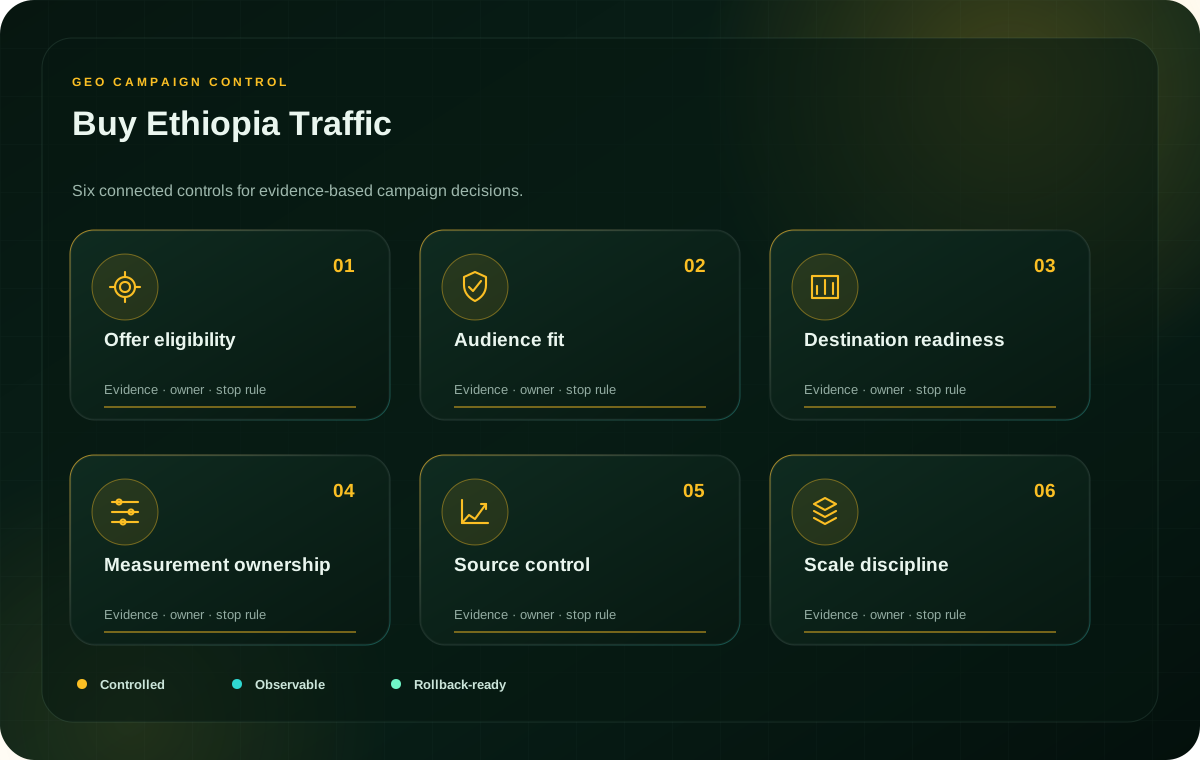
Keep customer communication aligned with the ETB business state
Maintain the Ethiopia cell Store the final disposition: confirmed and allocated, confirmed but pending, customer remedy underway, cancelled, excluded or technical retest. Only the mature outcome enters campaign value, while the intermediate state remains useful for diagnosis. For Buy Ethiopia Traffic, apply this control to the chosen Ethiopian language route, reachable service area and advertiser-accepted outcome.
Improve Retest the capsule after any material offer, payment, allocation or response change. Keep the previous passing version ready for rollback so the team can restore a coherent customer message quickly. For Buy Ethiopia Traffic, use the evidence from the ETB offer, local response team and mature customer record before extending delivery.
Define capacity as a ladder rather than one national number. The first rung is accurate page and merchant recording; the second is settlement review; the third is allocation or qualification; the fourth is fulfilment or attendance; the fifth is customer support and reversal handling.
Assign an owner and normal limit to every rung. A cell cannot scale past the narrowest point merely because advertising delivery is available. The active cap belongs to the operation that would otherwise break the customer promise first.
Ethiopia traffic buying questions for serviceable campaigns
What must be ready before I buy Ethiopia traffic?
Prepare one admitted route, approved ETB proposition, production payment or enquiry action, mature event, receiving owner, cap and rollback.
Can FroggyAds support an Ethiopia campaign?
We provide geographic controls where available. Confirm current Ethiopia supply, formats and settings inside your account before releasing budget.
Does the NBE digital-payments strategy predict conversions?
No. It describes policy and system context, not FroggyAds inventory, individual intent, auction price or customer value.
Should Addis Ababa be a separate campaign cell?
Only when serviceability, stock, response ownership, customer treatment or capacity differs from another documented route.
How should an ETB offer be presented?
Version the public amount or basis, charges, included scope, availability, timing, eligibility and material policies before commitment.
How do I validate a supported digital payment?
Reconcile the advertiser's provider result, merchant record, matching order and any later reversal. National totals cannot replace this evidence.
Which commerce event should control budget?
Use fulfilled and retained customer value after settlement, allocation, delivery, cancellation and return checks.
How should Ethiopia service enquiries be evaluated?
Follow assignment, contact, serviceability, need fit, qualification, appointment, attendance and final business acceptance.
Does paid Ethiopia traffic guarantee sales or rankings?
No. It tests a customer route and cannot guarantee revenue, organic ranking or AI citation.
When can another Ethiopia cell open?
After mature economics, reliable joins, resolved settlement exceptions and ordinary operating capacity pass under one-variable expansion.
Increase Ethiopia delivery only when each operating rung remains stable
Assign the website traffic guide within the Ethiopia receiving team
Review queue age, exception work, unavailable allocation, uncontacted customers and unresolved payments separately. Each indicator describes a different bottleneck. Blending them into a single workload percentage conceals the action needed.
Assign the geo-targeting guide within the Ethiopia receiving team
Use a small exposure step after the control passes. State which rung the increment is testing and what deterioration restores the prior level. Another service pod or payment branch opens as a separate cell because its bottleneck may be different.
Assign the regional planning guide within the Ethiopia receiving team
When mature customer value passes but one rung is full, keep the economics and cap the campaign. When a rung fails factually or technically, repair and retest. Do not lower the accepted-customer standard to make the ladder appear healthy.
Assign the traffic-quality guide within the Ethiopia receiving team
Record every step in the acceptance board with effective time, maximum exposure and responsible approver. This gives the account strategist a practical scaling path grounded in customer operations rather than aggregate payment momentum.
Add one Ethiopia variable only after the merchant route passes
Review mature accepted value, assignment coverage, settlement exceptions, allocation failures, customer treatment and capacity together. Keep unresolved records pending rather than assigning early value.
Continue the Ethiopia traffic buying decision
Cap a valuable cell when operations are full, repair a known defect, exclude an unsupported route or retest a corrected version. Expansion follows only when the existing customer promise survives ordinary use.
When the ETB sheet and receiving board are ready, create your free FroggyAds account and configure a bounded Ethiopia campaign. We provide the paid-delivery controls; your merchant evidence issues the release warrant. Africa traffic guide Confirm the ETB proposition, admitted pod, supported payment or enquiry, allocation route, mature event, owners, capacity and rollback. Then create your free FroggyAds account and configure the first measurable cell.
Review Ethiopic text as text, not as a decorative image
Bring one operational route, an approved ETB merchant sheet and the mature customer state your business values. We give you self-serve delivery controls; your acceptance board decides expansion. Ethiopic Layout Requirements A retailer opens one Addis Ababa cell for inventory held by its ordinary allocation team. The page shows the ETB amount, included item, supported payment action and service boundary. Campaign, merchant sheet, pod and payment identifiers enter the order. On ETB 3,000,000 spend, 1,000 merchant-confirmed orders produce ETB 3,000 per confirmation; 500 retained fulfilments produce ETB 6,000 per accepted customer. The second ratio controls the release. Approvals without orders, unavailable units, excluded locations, cancellations and returns keep separate causes. The illustration is not a forecast or a claim about FroggyAds results.
Our research set comprised NBE's Annual Report 2024-2025 page, Financial Stability Report November 2024 and National Digital Payments Strategy Phase Two announcement. We reviewed them for institutional, infrastructure and strategy context. They do not report FroggyAds inventory, certify an advertiser payment route or predict customer outcomes.
Follow one response through every storage step
Use HTML encoding guidance to keep Amharic and English characters intact through the form and receiving system.
Keep the ETB proposition, customer fields, receiving record, accepted event and rollback rule in a fixed order. Verify current FroggyAds formats and Ethiopia settings inside the account, then expand only when the merchant can reconcile the response without losing script, identity or customer state. No cited figure guarantees supply, price, sales, profit, search ranking or AI citation.
Keep error handling in the same test. Submit a deliberately incomplete form, read the error, correct the missing field and check that the other entered information remains intact. Confirm that the success message appears only after the receiving system accepts the intended record. An analytics event fired by the submit button is not evidence that the business received usable information.
A seven-request acceptance exercise
Synthetic implementation exercise, not an observed FroggyAds campaign: prepare four valid test records: an Amharic response, a mixed Ethiopic/Latin response, an English response and a response using your supported contact-field format. Give each record a distinct test identifier. Prepare a fifth record with a required field deliberately missing. Your language and implementation reviewers determine the exact fixture values.
Send each valid record once, then deliberately repeat the first two using the same respective test identifiers. Finally, send the invalid record once. That creates seven requests: four first submissions, two repeats and one invalid submission. Under the acceptance rule for this exercise, the expected business result is four unique valid records, two repeats that do not create additional records, and one validation failure. The error must identify the missing field without falsely recording a successful conversion.
Compare the four stored records with their original text and verify the statuses attached to all seven requests. A fifth valid record created by a repeat is a duplicate-handling defect. Four records containing corrupted text are a text-preservation defect. A successful browser confirmation with no receiving record is a handoff defect. Keep these outcomes distinct so your developer knows what to repair. This exercise specifies the behavior to test; it does not assert that FroggyAds or any particular form or tracking product implements that rule automatically.
Separate local offer readiness from a successful technical test
A passed form test does not establish that your business can serve everyone reached in Ethiopia. State the service area, supported customer language, actual charge and follow-up route at the destination. Where you quote an ETB amount, keep the displayed amount consistent through the customer journey; where another currency is charged, make that distinction clear before commitment. Verify the offer's current conditions with the business rather than infer them from traffic availability.
Likewise, a browser connection type or a city label does not prove that the visitor's device can complete your application. Test on the environments your campaign actually intends to support. When delivery or completion becomes unreliable, keep the affected source and destination version identifiable. Repair a repeatable destination failure before paying for additional visitors to encounter it.
Bring the validated destination into FroggyAds
Choose FroggyAds for the paid-media step when you have a serviceable offer, a tested language journey and a business event you can verify. Use our available targeting, budget and source controls to launch a bounded Ethiopia test. Keep the destination version and source identifiers alongside your accepted records so the next decision can be specific: improve the message, repair the form, restrict a source or expand the traffic that meets your conditions.
Retest the text and submission path after a material form, translation or export change. Preserve the earlier test results so you can explain whether a later drop came from the campaign or from the destination release. That discipline turns a traffic purchase into a measurable acquisition process rather than a count of unverified submissions. Create your free FroggyAds account.
Choose FroggyAds for a controlled Ethiopia customer test
Start an Ethiopia traffic test with one serviceable customer route, one approved ETB offer and one accepted business event. Keep the creative, destination and receiving team aligned on availability, payment, contact and fulfilment. Use FroggyAds format, targeting, budget and source controls to test that route, then keep, cap, repair or pause the cell from mature customer evidence.