
Buy Greece Traffic for a Customer Journey Your Operation Can Complete
Begin with one operationally complete Greek market cell. Freeze the language, area, offer, page, action, acceptance rule and response owner before delivery starts, then keep every later decision linked to that version.
Name the customer, immediate need, admitted location, supported language, EUR proposition, destination and mature business result. An island-delivery retailer, an Athens appointment service and a nationwide software offer need different journey proofs even when each selects Greece in a campaign interface. Keep national digital context outside the live Greece campaign denominator and customer-value decision.
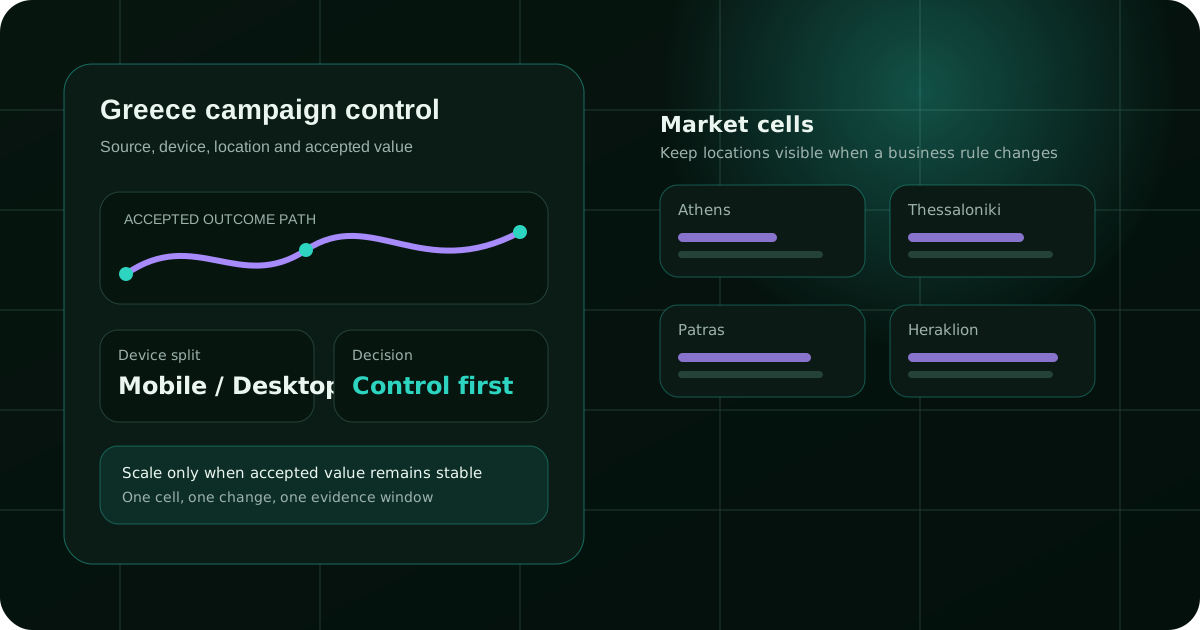
Describe the Greek customer decision without hiding behind a country label
- A useful Greece campaign connects a clear mobile proposition to a location your business can serve, a transparent EUR decision and an outcome that survives fulfilment or follow-up. FroggyAds gives you controllable paid delivery; your customer record decides whether the next release is justified. The first release should answer one question about location, language or customer acceptance.
- Control: Lock the Greek-language promise, EUR condition, mainland or island route and mature customer state before release.
- Decision: Fund the next source or location route only after its fulfilled order, attended service or useful activation matures.
Read national digital evidence without turning it into a media forecast
Use FroggyAds to test that route with controlled targeting, eligible formats, creatives, bids, budgets and traffic-source review. We recommend keeping the offer and accepted event fixed while you compare campaign choices, so you can see whether a change improved qualified response instead of merely moving an early metric.
Name the media owner and the business owner before launch. Our reporting helps the media buyer understand delivery and response, while your order, CRM or product system confirms retained orders, qualified appointments, accepted opportunities or useful activations. Together, those records give you a defensible scale decision.
Review the Greece evidence against the current operating record. The Hellenic Statistical Authority publishes its 2025 household and individual ICT survey with population, reference period and method. Its device and internet-use material can help a team ask whether the customer path needs stronger phone testing. Eurostat provides harmonised online-purchase dimensions for comparison under its own definitions.
Official Greek and European statistics can help you ask better questions about devices and online buying, but they do not predict results for your offer. We use current FroggyAds campaign data to help you compare the traffic you purchased, and you use your own customer evidence to decide whether the Greece campaign deserves more spend.
Prove the customer action on a small screen and in the receiving system
Store the publisher, table or release, year, population, unit and limitation beside any observation used in the brief. Keep public market context, current account settings and the advertiser's mature customer record as separate evidence layers. Only the last two can support a live delivery decision. Carry the approved Greek or supported-language version through every customer and receiving-system step.
Run an authorised production check from the first message through the final business record. Read the Greek or supported wording, open the relevant detail, inspect the EUR condition, choose a location or fulfilment branch, complete validation, pay or submit, receive confirmation and verify the resulting order, CRM or product state. the buy website traffic guide Check keyboard behaviour, field labels, error recovery, consent, address selection, session continuity and return from any provider. A visually complete phone screen can still lose a customer after payment or create a record the receiving team cannot route. Record the earliest confirmed break rather than assigning every loss to traffic. the traffic sources hub Remove test records from campaign outcomes and keep their identifiers in a QA register. Pause the affected cell for a material defect. After repair, run a clean check and open a new page or offer version when the customer meaning changed, preserving the failed interval for later analysis.
Match every traffic cell to a customer promise the operation can keep
Build the location plan from the business operation. For physical commerce, record supported destinations, stock source, dispatch schedule, carrier or pickup route, material charges and exception handling. For services, record covered areas, available staff or partners, response hours and the rule that makes a request serviceable.
Keep Greece as one cell for a digital proposition when eligibility, onboarding, support and acceptance are truly equivalent. Split an area when delivery time, availability, service boundary, price condition, response owner or capacity changes. The split must create an action the business can take when evidence matures.
Settle the Greece customer question before approving more spend. Show material location limits before payment or a detailed form. Give unsupported customers an approved response and retain the failure reason outside accepted value. Interest from an unserved destination may reveal an admission-page problem; it is not automatically evidence of unsuitable media.
Create an approved offer card containing the customer-facing EUR amount or transparent calculation basis, included scope, material taxes or charges, availability, delivery or appointment condition, promotion period, renewal or subscription rule, eligibility, cancellation and refund route. Present decision-changing terms before commitment.
Let the creative lead with one real benefit and let the destination complete the decision. Do not use a simple claim that becomes narrower, slower or more expensive at checkout. Each material change opens a new offer version, because mixed promises corrupt both customer trust and campaign evidence.
| Cell | Release evidence | Hold condition |
|---|---|---|
| Mainland commerce | Address route, EUR terms, stock and fulfilment approved | A paid order cannot follow the stated route |
| Island delivery | Supported locations, timing, charges and exception owner | Location changes after commitment |
| Appointment service | Coverage, response owner and available schedule | The queue cannot meet the promise |
| Nationwide digital offer | Equivalent eligibility, onboarding and support | A customer branch receives different treatment |
Separate mainland and island cells only when the customer promise changes
| Dimension | Greece plan | Operating rule |
|---|---|---|
| Greek customer route | Greek or another language the receiving team explicitly supports | Approve advert, page, validation, confirmation and follow-up as one versioned promise |
| EUR proposition record | Customer-facing EUR total or basis, including material location, delivery, booking or renewal conditions | Reconcile the promoted amount with payment, confirmation and any cancellation, refund or service response |
| Operational Greece routes | Athens, Thessaloniki, Patras or Heraklion only where the advertiser documents ordinary capacity | Split a route when destination coverage, fulfilment timing, appointment capacity or customer handling differs |
| Greece device journey | Phone and desktop arrivals linked separately to production customer records | Compare location admission, EUR visibility, completion, confirmation and mature acceptance by device |
| Route-critical detail | Current availability, admitted locations, timing, customer commitment and exception owner | State the location or capacity condition that can change the choice before detailed data entry or payment |
| Customer-record custody | Advertiser-approved collection purpose, access owner, retention instruction and platform policy | Keep only fields the receiving team needs and trace each record to the purpose stated on the route |
Keep one commercial meaning from creative to confirmation
Separate offer eligibility by Greek service path
Our guidance for Greece offer starts with verified customer evidence. When internal media reconciliation uses another currency, preserve original spend, conversion source, conversion date and reporting currency. Keep that finance translation separate from the public EUR proposition. The calculation supports the advertiser's own review and does not create a FroggyAds rate quote.
Separate audience fit by Greek service path
A calendar event, travel period or trading season can change an advertiser's operation without proving anything about audience response. Record the exact offer window, inventory or appointment capacity, ordinary dispatch or response promise, customer-care coverage and the time when each condition will be reviewed.
Separate destination readiness by Greek service path
Treat Greece destination as an operating check with a named owner. Assign a maximum release to the working capacity, not to an aspirational demand number. If stock, slots, transport, specialists or support become constrained, cap the relevant cell. Do not preserve volume by weakening the accepted-customer rule or by leaving an outdated promise public.
Separate measurement ownership by Greek service path
Keep the Greece measurement conclusion in the campaign record. Version a seasonal proposition when availability, amount, included scope or timing changes. Compare like customer cohorts under the offer each person actually saw. A peak should produce more disciplined boundaries and faster reversals, not a broad national campaign with untraceable operating conditions. For Greece, test whether the promised location, availability and timing remain true through payment, confirmation and ordinary fulfilment.
Separate source controls by Greek service path
Use Greece source evidence to choose the next action. Map product detail, basket, checkout, payment, created order, stock allocation, dispatch, receipt, cancellation, return and retained order. Finance and fulfilment should select the stage that deserves budget and the days required for that state to settle. Earlier events remain useful diagnostics.
Separate the scaling boundary by Greek service path
Suppose a hypothetical Greece cell spends EUR 16,800, records 280 paid orders and closes with 168 correctly fulfilled orders retained through the chosen window. Cost per paid order is EUR 60; cost per accepted order is EUR 100. The arithmetic teaches denominator discipline and is not a FroggyAds result or forecast.
Tie seasonal opportunity to inventory, staffing and service headroom
The Greece service stage needs a clear acceptance rule. Post reversals back to the campaign, source, creative, page, offer and geographic cell that generated the order. Leave immature records pending. Compare accepted cost only with customer value or contribution evidence the advertiser has approved, and show fulfilment workload beside the ratio.
Explain the service, covered area, material qualification and next response before requesting detailed information. The form should create a record the receiving team can route. Confirmation should state what happens next and use a response window the ordinary operation can actually maintain.
A practical Greece service review begins with the operating facts. Track assignment, first attempt, reached customer, location fit, stated need, eligibility, appointment or meeting, attendance and business acceptance. Keep invalid detail, duplicate, unsupported area, unsuitable need, unavailable slot, customer decline, no-show and delayed internal response as distinct reasons.
Align campaign schedules and caps with the supported queue. When response age exceeds the public promise, reduce the affected cell and fix staffing or routing. Reopen only after an authorised submission reaches the correct team and the service owner records real headroom.
| Layer | Metric | Decision use |
|---|---|---|
| Greece media release | Delivery tied to one location route, source, device and EUR proposition version | Confirm that only the approved mainland, island or service cell consumed its exposure cap. |
| Admitted Greece arrival | Usable arrival, duplicate state, location admission, supported language and offer eligibility | Quarantine activity that cannot enter a supported booking, order, appointment or activation route. |
| Customer custody path | Location checked, customer action begun, responsible queue assigned and confirmation returned | Assign the Greek wording, EUR, location, payment, form or response break to its owner. |
| Mature Greece acceptance | Fulfilled and retained booking or order, attended service, or useful app activation | Release more budget only after the operating owner accepts the matched customer record. |
| EUR route economics | Spend per mature customer, cancellation or reversal loss, exception workload and retained value | Open, cap or close that exact source-route pair without extending its result across Greece. |
Let delivery and the declared review window close the commerce result
Separate the campaign decision by Greek service path
Appoint a reviewer who understands the product decision and the language presented to the customer. Review the creative, landing proposition, EUR terms, eligibility, form or checkout, errors, confirmation, delivery or appointment messages and customer support together. A translated headline does not create a complete route.
Separate eligibility and service coverage by Greek service path
Document Greece eligibility before changing spend. Store the approved source meaning, customer version, reviewer, date, page identifier and offer identifier. Reopen language review when scope, amount, availability, renewal, delivery, cancellation or qualification changes. Preserve the previous version so outcomes are assigned to the wording encountered.
Separate the smallest useful test matrix by Greek service path
Make matrix explicit in the next Greece test. Do not infer a person's preferred language only from geography. Use the route the advertiser can support and offer a clear switch where appropriate. Customer questions can guide clarification when tied to a version and final outcome; a few contacts do not justify a claim about people across Greece.
Separate the complete local promise by Greek service path
Resolve Greece promise before expanding the campaign. Verify formats and current delivery controls inside the account. A concise prompt can introduce a relevant need, a visual can establish context and the destination can explain location, EUR terms, eligibility and the action. Match the placement to the amount of information the customer needs before continuing.
Separate the event chain by Greek service path
Develop concepts around real business advantages and problems the offer solves. Avoid invented local popularity, endorsement, savings, urgency, results or guarantees. Strong FroggyAds sales guidance explains what you can target, test and measure while keeping claims inside approved evidence.
Separate separated format cells by Greek service path
Connect Greece format to the accepted business outcome. Retain a control and change one material proposition at a time. Use delivery and page progression to diagnose attention and understanding; use mature accepted outcomes to select the commercial winner. Version every creative with the page, offer and service cell that receives the visit.
Separate source evidence by Greek service path
Pass approved campaign, source or placement, creative, destination and offer identifiers into the order, CRM or product system where supported. Document field ownership, transformations, duplicates, delayed imports and systems that cannot retain a key. An analytics event alone does not establish business acceptance.
Separate controlled scale changes by Greek service path
Give the Greece scale decision a named owner. Grade joins as deterministic, delayed, partial, aggregated or modelled and publish coverage for spend, visits and mature outcomes. A cheap accepted-event calculation with weak assignment remains uncertain. Cap the cell until the advertiser can reproduce which campaign version produced the customer record.
Follow a Greek enquiry through location, contact and attendance
| Format | Best role in the test | Required control |
|---|---|---|
| Push | Return an eligible Greek customer to one current travel, commerce, service or app action | Keep timing and EUR meaning visible, cap repeat exposure and review mature value per device and source. |
| Native | Explain a travel or commerce route whose location, inclusion or timing needs comparison | Test distinct customer reasons while location admission and the EUR commitment stay unchanged. |
| Display | Introduce the documented Greece proposition within its available destination or service boundary | Inspect visible placement, usable arrival and whether the page answers the promoted location need. |
| Pop | Screen wider interest only after unsupported destinations and unavailable routes reject cleanly | Keep sources isolated and hold the fulfilled-customer rule stable when delivery expands. |
| Video | Show how a Greece booking, service or app route works when the next step needs demonstration | Put the qualifying value first, then connect completed viewing to the admitted route and mature outcome. |
| Interstitial | Present a timely mobile proposition only while location, stock, schedule or onboarding capacity is open | Confirm placement fit, phone readiness, exposure control and mature Greece value per source. |
Carry the supported wording through payment, service and follow-up
| Score area | Weight | Evidence | Action |
|---|---|---|---|
| Location admission accuracy | 20% | Customer enters the stated Greece route, language, device and commercial eligibility | Close the cell when the receiving operation cannot honour its location or timing promise. |
| Customer-route integrity | 15% | Usable arrival, duplicate handling and campaign identity reaching the business system in sequence | Isolate a source when records lose identity, arrive out of order or exceed plausible queue behaviour. |
| Greece route progression | 15% | Location admitted, commitment understood, action begun and production confirmation reached | Repair the exact language, EUR, location, form, checkout or activation break before reopening. |
| Route-owner acceptance | 30% | Fulfilled booking or order, attended service or useful activation after maturity | Let the owner of that mature state authorise another source-specific Greece cohort. |
| Settled customer value | 20% | Completion retained, cancellation resolved, customer remedy closed and exception workload recorded | Extend only the route whose mature value and ordinary workload remain inside the written limit. |
Check Greece service against the current offer version. Keep original timestamps and declare the time zone and cohort rule. Later delivery, returns, attendance and sales decisions belong with the original message and customer promise. Use observed, pending, partial, reversed and accepted consistently so the next decision can be audited.
Give each eligible FroggyAds format one honest task
Travel market entry
Limited delivery points first to current supply, eligibility, settings, schedule or exposure. Visits without progression point to message or destination. Paid orders without retention point to expectation or fulfilment. Forms without acceptance point to coverage, response or qualification. Diagnose in that order.
Choose keep, watch, cap, repair, exclude or retest with an owner and rollback. Exclude only when the shared production path works and a mature source cell repeatedly misses the written value rule. Preserve the evidence and customer-treatment version needed for a later bounded retest.
Ecommerce demand generation
Inspect concentration across source, mainland or island service cell, device, language route, product, offer and customer type. A passing national average can depend on one narrow route. Expansion should add one variable while retaining the working control and acceptance definition.
Local Services acquisition test
Create a daily register for unsupported destination, changed delivery promise, unavailable appointment, payment issue, stock exception, customer cancellation, delayed response and fulfilment failure. Store the campaign and commercial version with each reason. A single miscellaneous bucket prevents the team from seeing whether the defect began before or after the customer action.
Separate the app scale plan by Greek service path
Assign each reason to media, page, payment, fulfilment, service or customer-care ownership and define the evidence needed to close it. Location exceptions may require a clearer admission step; repeated appointment shortages may require a smaller schedule; a missing order after payment requires production repair. These problems should not receive the same source decision.
Require a reproducible join from placement to customer state
Review the count, customer consequence and recovery time by mainland or island cell. Do not infer that a geography or audience is weaker when the advertised route was unavailable. Keep an accepted outcome only when the customer received the stated service and the record remained valid through the chosen window.
Greek promise register. Store the approved advert, page, error, confirmation and customer-service wording with the EUR offer and location version. A changed destination, timing or service response opens a new cohort.
EUR and location drill. Follow one real product, booking or service from destination admission through the public amount, timing, customer information, confirmation and responsible queue. A route that exists only in creative is not ready for paid demand.
Athens custody note. Send an authorised record through the ordinary Athens queue and verify that campaign, page, EUR offer and location version arrive intact. The operator should know the next action and the approved response when the route cannot continue.
Thessaloniki exception note. Test an unsupported destination or unavailable slot that the production route should reject. Confirm the limitation appears before commitment, the customer receives an accurate response and the record stays outside accepted value.
Patras completion note. Follow a supported route through allocation and receipt, appointment assignment and attendance, or product eligibility and useful activation. Name the production record that proves completion for the advertised branch.
Heraklion workload note. Record address correction, queue transfer, customer message and missing-confirmation recovery beside accepted economics. Keep the Heraklion cell bounded when ordinary completion depends on exceptional manual work.
Phone journey. Recheck location choice, EUR conditions, validation, payment or submission and confirmation after any material coverage or capacity change. Keep unresolved outcomes with the page version the customer actually saw.
Desktop journey. Use detailed travel, commerce or B2B pages to document inclusions, location boundaries and customer commitment, then join the mature record to its campaign source. FroggyAds can release the measured cell after the route demonstrates both successful and rejected paths. Keep that Greece route under its written capacity and stop trigger.
Travel closeout. Reconcile advertised destination, availability, inclusions, EUR commitment, confirmation, customer communication, delivered service and cancellation. Open a new cohort whenever timing or included scope changes materially.
Ecommerce closeout. Compare the promised location and delivery clock with allocation, dispatch, receipt, return and customer contacts. Judge each mainland or island branch from retained value and ordinary workload, not from a national average.
Service closeout. Store covered location, rejected cases, responsible queue, attended appointment, completed service and capacity stop beside the campaign. This prevents an old service boundary from being reopened after schedules change.
App closeout. Join verified install to eligibility, useful activation, retained use and support workload. Keep device and source visible so onboarding loss is not confused with unavailable destination or service capacity.
Route classification. Keep separate maturity clocks for mainland delivery, island delivery, appointment service and digital activation when their customer promises differ. Update the public route before releasing demand against changed capacity.
Next-release record. Name the one source, destination route, message, device or exposure variable that changes, its EUR cap, owner, mature outcome and reversal condition. Keep every other material part of the Greece customer route stable.
| Use case | Message focus | Evidence focus | Rule |
|---|---|---|---|
| Travel | available destination, included service, EUR total and booking condition | confirmed booking, customer communication, service delivery, cancellation and retained value | Fund travel delivery after the advertised location and timing survive the customer's complete route. |
| Ecommerce | stock, admitted delivery route, transparent EUR total and return condition | paid order, allocation, dispatch, receipt, return and retained order | Judge mainland and island fulfilment from their own retained orders and exception workload. |
| Local Services | covered location, available schedule, response window and appointment condition | assigned request, reached customer, attended appointment and completed service | Cap the service cell when the local queue cannot meet the response shown before submission. |
| Mobile Apps | device fit, eligibility, useful onboarding step and supported customer path | verified install, useful activation, retained use and support workload | Release more app traffic only after source-linked users reach the product state the advertiser funds. |
Repair the earliest proven break before removing a source
Choose one supported destination for each route and use the same eligible product or service wherever the commercial conditions permit. Freeze the page and customer wording, then record every step that legitimately differs: admission question, availability lookup, EUR condition, confirmation, operating queue, timing, customer message and final completion evidence.
Separate the launch-readiness brief by Greek service path
Have the customer-journey owner state which difference is necessary and which is accidental. A delivery or service constraint may justify a distinct promise. A missing translation, stale charge, unowned queue or inconsistent confirmation is a defect. Correct defects before media starts so the comparison reflects real route design instead of preventable production noise.
Separate the localization record by Greek service path
Complete an authorised successful record on both paths. For a purchase, inspect the destination decision, order creation, allocation, handoff, receipt and later reversal state. For an appointment, inspect assignment, location validation, contact, scheduled time and attendance. Confirm that campaign and promise versions survive to the final ledger.
Separate the source notebook by Greek service path
Complete one expected rejection per route. The system should identify an unsupported location or unavailable service before the customer makes an expensive commitment, explain the limit accurately and keep the record outside accepted value. Record the reason and verify that neither the campaign report nor the receiving team mistakes the rejected path for a qualified customer.
Separate the change log by Greek service path
Calculate operating effort separately. List manual address correction, message handling, schedule transfer, fulfilment exception, customer contact and reconciliation time. A remote-location cell can produce acceptable customers and still need a lower release ceiling because ordinary work per outcome is higher. That is a capacity decision, not a negative claim about the customer or geography.
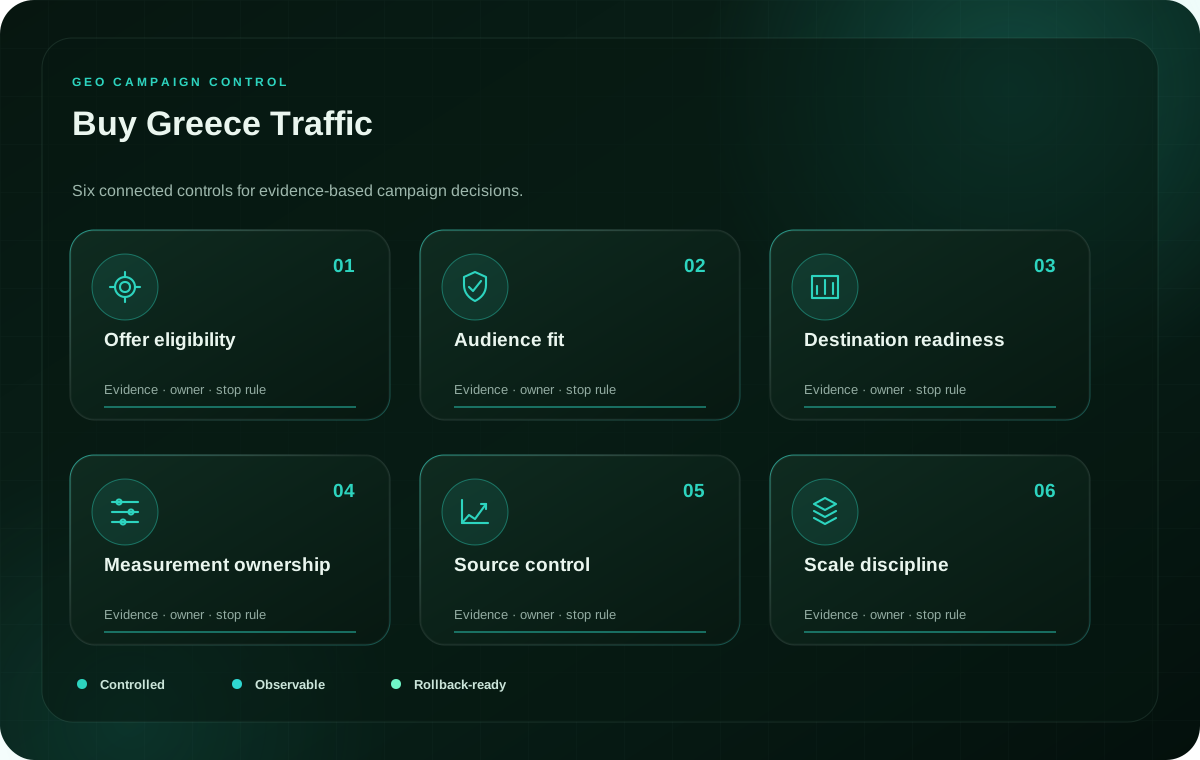
Turn Greek location and service exceptions into specific operating decisions
Maintain the Greek cell Close the simulation with route cards for each materially different destination or service path. Record admission, public timing, EUR offer, responsible queue, maturity state, maximum exposure and immediate stop signal. Continue only the card whose ordinary customer route passed.
Improve Open a paid comparison only when the tested route and exception handling both work and the operation can honour its cap. Evaluate mainland, island and service paths from their own mature customers before combining them. Let source-linked accepted value authorise the next FroggyAds release.
Close the cohort with customer definition, area, language, EUR version, source, creative, page, period, spend, maturity, accepted events, join grades, operational losses and workload. List unresolved records rather than forcing an early verdict from incomplete journeys.
Require normal inventory, delivery, response, onboarding and support headroom. Keep the accepted-event rule fixed when the operation becomes busy; reduce delivery rather than recategorising weaker activity as customers. Finance and the operating owner should sign the next bounded release.
Greece traffic questions on service paths and seasonality
What should be ready before I buy Greece traffic?
Prepare one supported customer, geographic cell, language route, EUR proposition, production destination, mature event, evidence window, capacity owner, cap and rollback.
Can FroggyAds deliver paid traffic for Greece?
We provide self-serve campaign controls, including geographic options where available. Confirm current Greece supply, eligible formats and live settings inside your account before allocating budget.
Do ELSTAT internet-use figures predict campaign demand?
No. They describe a defined survey population and period. They do not measure FroggyAds inventory, interest in your offer, auction conditions, conversion or accepted customer value.
Should I run one campaign for mainland and island customers?
Only when the offer, availability, delivery or service promise and customer handling are equivalent. Use separate cells when a location changes what the customer can receive.
Why test the complete phone journey?
A phone can display a landing page correctly while address selection, payment, validation, confirmation or app handoff fails. Follow an authorised test into the receiving business system.
Should my Greece landing page be in Greek?
Use the language the intended customer and receiving team can support. Review the promise, EUR terms, form or checkout, errors, confirmation and follow-up as one route.
How should a seasonal Greece campaign be capped?
Tie exposure to current inventory, service coverage, response staffing and fulfilment headroom. Change the public promise before increasing demand when those conditions change.
Which ecommerce event should control budget?
Use a defined fulfilled and retained order after payment, stock, delivery, cancellation and return checks. Treat visits, baskets and created orders as diagnostic stages.
Does buying Greece traffic guarantee sales or organic visibility?
No. Paid traffic can test a proposition and customer route. Sales depend on the complete business system, while search rankings and AI mentions are separate outcomes.
When can I expand a Greece traffic campaign?
Expand after mature accepted economics, reliable source linkage, stable customer treatment and operating capacity pass. Add one area, concept, source or exposure level with a reversal rule.
Rehearse a Greek remote-location promise before exposing it to paid demand
Separate the website traffic guide by Greek service path
Choose one next uncertainty: area, source, concept, format, schedule or exposure. State the continuation and reversal condition. When the route is ready, create your free FroggyAds account, confirm the live Greece settings and release a cell whose customer evidence can justify the next EUR.
Separate the geo-targeting guide by Greek service path
Confirm the customer, admitted area, supported language, EUR proposition, phone journey, mature event, attribution coverage, capacity and rollback. Then create your free FroggyAds account and configure the first measurable cell.
Separate the regional planning guide by Greek service path
Bring one serviceable geography, an honest EUR promise and the mature outcome your operation accepts. We provide self-serve traffic controls; your source-linked customer ledger authorises expansion. Give the operating owner a location register, the public timing, the customer message and authority to cap the cell. Record when each order or request moves between the landing page, queue, fulfilment or service team and final evidence window. A campaign prepared this way can improve the right handoff while preserving the proposition a Greek customer actually encountered.
Separate the traffic-quality guide by Greek service path
A specialist retailer could begin with an in-stock category and supported mainland delivery route. The Greek or reviewed customer page would show the EUR offer, available destinations and material delivery and return conditions before payment. Campaign, source, creative, page, offer and destination branch would continue into the order record. Paid orders would remain diagnostic until delivery and the declared return window close. Before opening an island cell, the retailer would verify locations, timing, charge, customer messaging and exception ownership. The retained-order rule would stay fixed; the new cell would close if customers encounter an unsupported promise or if fulfilment lacks headroom.
Compare the advertised Greek timing with the moment each team takes custody
The Hellenic Statistical Authority's 2025 ICT household publication and device infographic, plus Eurostat's internet-purchases dataset, were reviewed for their stated populations, periods, variables and limitations. They provide market context and do not measure FroggyAds supply, reachable customers, price, conversion or campaign results. Campaign admission on this page depends instead on a tested customer route, a current location promise, a supported EUR proposition and an operating owner who can prove completion. Keep public evidence, live account availability and the advertiser's accepted-customer ledger separate. That separation prevents a national digital measure from being mistaken for an inventory forecast or a guarantee about the mainland, an island or any individual Greek customer.
Let mature customer value and operational headroom authorise expansion
URL boundary for Buy Greece Traffic: Use this page for a paid Greece route with an admitted location, supported language, accurate EUR proposition and mature customer result.
Keep the admitted Greece location, supported language, EUR proposition, mature event and rollback rule in a fixed order. Verify current FroggyAds formats and Greece settings inside the account, then expand only when media, payment or form, fulfilment and accepted-customer records agree. No cited figure guarantees supply, price, sales, profit, search ranking or AI citation.
Decision inputs for Buy Greece Traffic: admitted location, supported language, current EUR proposition, source identity, production customer state and route capacity. Keep them in one review so a strong front-end signal cannot conceal an unavailable customer path.
Route admission answers whether the exact mainland, island or service promise is ready for paid demand. Store the location card with the campaign and decline unsupported demand before an expensive commitment.
Customer custody connects the FroggyAds source and device to the booking, order, appointment or activation that the advertiser can accept after maturity. Leave unresolved joins pending.
Next release requires a named route, one changed variable, a maximum EUR exposure, an operating owner and evidence that reverses the decision. This makes the recommendation usable by media and fulfilment teams.
| Page checkpoint | How to use it | Evidence to retain |
|---|---|---|
| Route admission | Define the supported destination, language, EUR proposition, ordinary capacity and customer state before delivery. | Keep the location card, campaign ID and production acceptance rule together. |
| Customer custody | Join source and spend to the booking, order, service or app record through the declared maturity window. | Retain device, location branch, timestamps, accepted outcome and operating exceptions. |
| Next Greece release | Change one source, route, message, device or exposure level after mature economics and workload pass. | Document the chosen action, maximum exposure, accountable owner and rollback evidence. |
Transparent Buy Greece Traffic decision example
Hypothetical example: if a Greece route spends EUR 1,440 and closes with 24 fulfilled or otherwise accepted customer outcomes, accepted cost is EUR 60. Replace the denominator and limit with your own evidence; this is arithmetic, not a FroggyAds price or forecast.
Why use FroggyAds here?
Use FroggyAds to release one accountable Greece route with budget and source controls, then let fulfilled bookings, retained orders, attended services or useful activations determine the next allocation. Create your free FroggyAds account.
Research basis for Buy Greece Traffic: This URL helps performance-focused advertisers evaluate the acquisition workflow, evidence boundary and next budget decision for Buy Greece Traffic. It is mapped to the general ads research cluster. Our current review used shopify.com and support.google.com to check terminology, buyer questions and decision coverage relevant to Buy Greece Traffic. These external sources are research inputs, not evidence of FroggyAds campaign performance.
Release a Greece campaign built around a complete customer route
Release a Greece campaign only when the customer can enter an admitted location, see accurate EUR terms, complete the promised route and reach a mature state the advertiser funds. Assign the first confirmed break to media, page, payment, fulfilment, service or customer care before changing the next variable.