
Buy Europe Website Traffic
Buy Europe traffic with country-level campaign cells, localized creative, source controls, conversion tracking and regional budget decision rules.
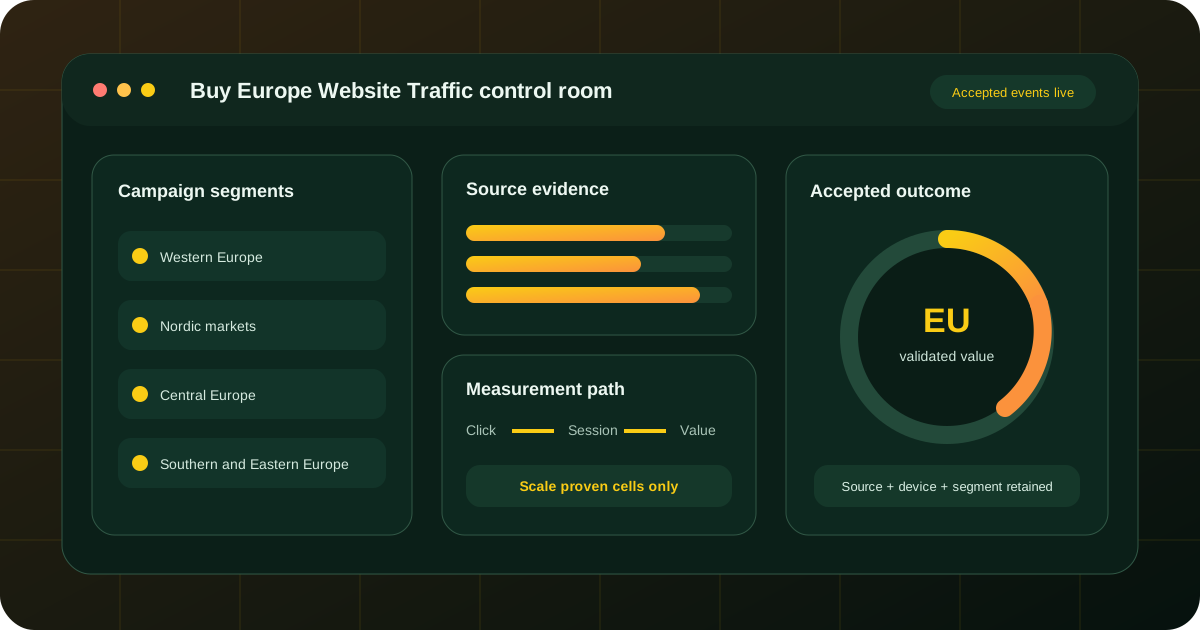
Buy Europe Website Traffic at a glance
What does this page explain about Buy Europe Traffic - CPC from $0.003?
Quick answer: Buy Europe traffic with country-level campaign cells, localized creative, source controls, conversion tracking and regional budget decision rules. The Europe ad network guide explains localization, formats, source reporting, budget guardrails and scaling decisions for this market. The practical answer to buy Europe traffic is to buy controllable advertising inventory, not unclassified pageviews. For Europe, the scorecard should explicitly penalize blended country averages, English-only assumptions and other issues that can make low-cost traffic appear stronger than it is. It means purchasing paid advertising targeted to Europe or the specific audience described by this page, while preserving source, device, segment and conversion data through an accepted business event.
| Section | Distinct excerpt from this page |
|---|---|
| How to buy Europe traffic with measurable control | Smaller markets can outperform larger markets when the offer, language and payment path fit better. |
| Build Europe as decision-ready cells | The first test should limit the number of countries so each cell can collect enough accepted outcomes for a useful decision. |
| Offer eligibility | Confirm that Europe users can lawfully and practically access the offer, price, payment, delivery and support. |
Reference for Buy Europe Traffic - CPC from $0.003: FTC guidance on online advertising and marketing.
- Planning: How to buy Europe traffic with measurable control.
- Control: What this guide covers.
- Decision: Build Europe as decision-ready cells.
How to buy Europe traffic with measurable control
The practical answer to buy Europe traffic is to buy controllable advertising inventory, not unclassified pageviews. Start with a measurable conversion, separate the cells that require different decisions, validate the complete customer journey and scale only sources that produce accepted value after quality checks.
Europe is not one audience or one auction. Country-level language, regulation, pricing, device use and customer value require separate campaign cells.
A regional budget should be distributed by evidence, not by population alone. Smaller markets can outperform larger markets when the offer, language and payment path fit better.
When using Buy Europe Website Traffic, apply this rule only to the conditions and decision described on this page. FroggyAds supports Push, Native, Display, Pop, Video and Interstitial advertising through a self-serve platform. Targeting availability can include country, city, device, operating system, browser, carrier, category and source controls where supported. Adscore signals and internal controls can reduce invalid-activity risk, but no provider can guarantee that every impression, click or user will create business value.
What this guide covers
Use this guide when planning buy europe website traffic. It focuses on the specific market, audience, platform, or campaign decision named in the title, including targeting, format selection, measurement, traffic-quality review, budget controls, and responsible scaling.
For Buy Europe Website Traffic, use the buy website traffic guide and the traffic sources hub to set the broader acquisition model, then narrow the decision with the related country, format, audience or platform guide that matches the campaign.
Build Europe as decision-ready cells
Consent, privacy and data-processing requirements need documented review, especially when campaign data or audience information crosses borders.
The first test should limit the number of countries so each cell can collect enough accepted outcomes for a useful decision.
On Buy Europe Website Traffic, use this control to keep the page's evidence and action traceable. A first campaign should be small enough to interpret. Too many countries, products, devices, formats, creatives and sources can create dozens of incomplete tests. Begin with the smallest matrix that can answer the commercial question, then add dimensions only when the existing data identifies a reason.
| Campaign cell | Why it stays separate | Primary failure to watch |
|---|---|---|
| Western Europe | Keep visible until value is proven | blended country averages |
| Nordic markets | Use when pricing or service changes | English-only assumptions |
| Central Europe | Separate by device and source | cross-border consent gaps |
| Southern and Eastern Europe | Merge only after evidence | currency and tax ambiguity |
Six checks before any budget is released
Offer eligibility
Confirm that Europe users can lawfully and practically access the offer, price, payment, delivery and support.
Audience fit
Define who should respond, which western europe and device cells matter, and which users should be excluded.
Destination readiness
Test language, page speed, forms, pricing, confirmation and error states before paid delivery begins.
Measurement ownership
Name the accepted event and preserve source, format, device, creative and segment IDs through it.
Source control
Use source-level evidence, block or reduce weak placements and avoid scaling from blended averages.
Scale discipline
Increase budget only when accepted value remains stable after more volume and conversion delay are included.
An eight-step launch and optimization process
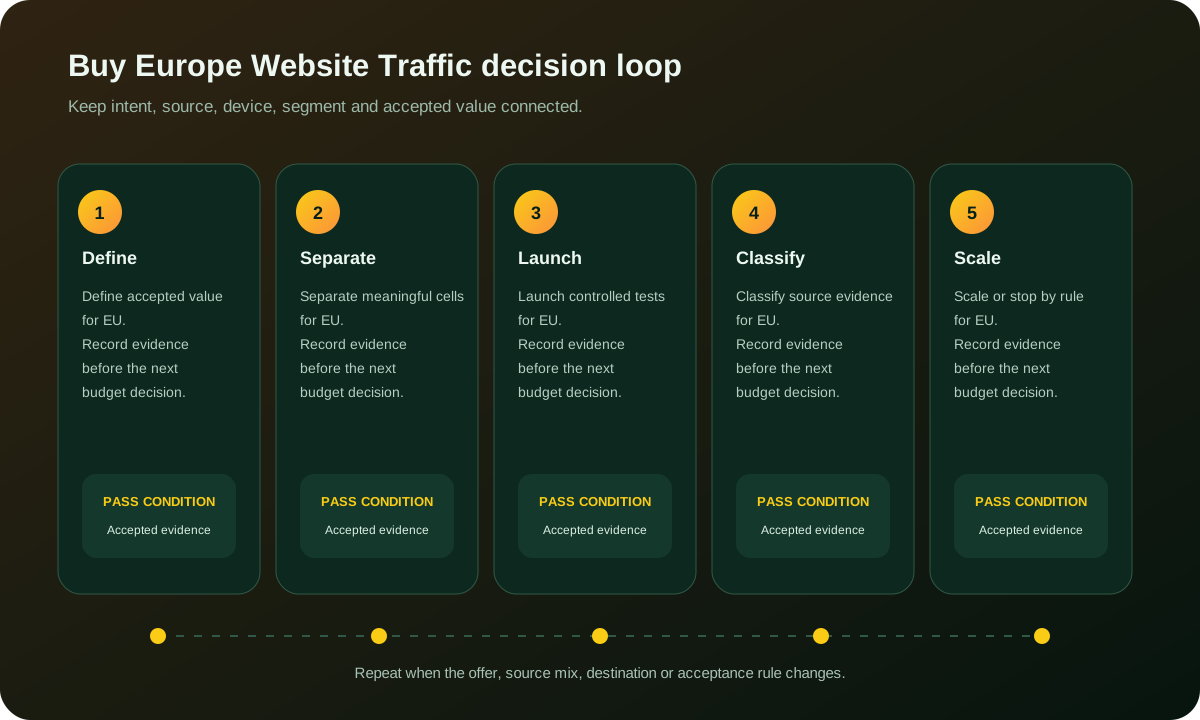
Define the decision
Write the main topic, campaign objective and accepted event for Europe.
Verify the journey
Test the ad promise, destination, forms, price, consent and confirmation on representative devices.
Build campaign cells
Separate only the segments, devices, formats or languages that need different bids or decisions.
Launch with limits
Use daily caps, source visibility and a budget that can identify obvious tracking or quality failures.
Validate delivery
Confirm loaded sessions, target match, event firing and source attribution before judging conversion rate.
Classify outcomes
Mark accepted, rejected, duplicate, ineligible, refunded or retained outcomes as the business requires.
Apply stop rules
Pause cells that exceed the loss limit, fail quality checks or cannot produce enough evidence.
Scale proven cells
Increase volume in stages and repeat the review when the offer, creative, source mix or destination changes.
Choose a format for the customer journey
| Format | Best role in the plan | What to measure |
|---|---|---|
| Push | Direct, time-sensitive messages where the promise can be understood quickly | Clicks, loaded sessions, accepted event rate and complaint feedback |
| Native | Contextual discovery with more room for explanation | Engaged sessions, qualified progression and accepted outcome cost |
| Display | Visual reach, retargeting and broad awareness support | Viewability, clicks, assisted conversions and frequency |
| Pop | High-volume testing when the destination can qualify intent quickly | Loaded sessions, source quality, accepted event cost and bounce diagnostics |
| Video | Demonstration, storytelling and prequalification | Completed view, click, downstream event and incremental value |
| Interstitial | High-attention mobile or web placements | Engagement, close behavior, destination quality and accepted conversion |
Connect delivery to accepted business value
The measurement model should connect impression, click, loaded session, target match, meaningful action and accepted business value. For this page, examples of accepted outcomes include sales-qualified pipeline, margin-positive order, completed booking, retained app user. The exact event must match the advertiser's real economics.
Within Buy Europe Website Traffic, use this checkpoint when recording the next page-specific decision. A soft event can help diagnose the funnel, but it should not become the final optimization target merely because it appears faster. Button clicks, page depth and add-to-cart actions do not prove eligibility, payment, fulfillment or retention.
On Buy Europe Website Traffic, use this control to keep the page's evidence and action traceable. Conversion delay should be included before a source is classified. Some outcomes arrive immediately, while sales acceptance, payment, refund, churn or funded status may take longer. A premature decision can reward sources that create fast but weak events.
On Buy Europe Website Traffic, use this control to keep the page's evidence and action traceable. Preserve source ID, campaign, creative, format, device, operating system, segment and landing-page version through the accepted event. When offline or CRM outcomes matter, return the status through a postback or reconcile it in a source-level ledger.
| Layer | Signals | Decision question |
|---|---|---|
| Delivery | Impressions, clicks, loaded sessions | Is the campaign reaching the intended cell? |
| Quality | Target match, invalid signals, duplicates, engagement | Is the delivered session usable evidence? |
| Progression | Key page or product actions | Where does the journey lose qualified users? |
| Acceptance | sales-qualified pipeline and margin-positive order | Which sources produce business-approved outcomes? |
| Value | retained app user and downstream revenue or retention | Can the cell support more budget without losing economics? |
Compare evidence with a repeatable scoring model
On Buy Europe Website Traffic, use this control to keep the page's evidence and action traceable. A source scorecard turns campaign review into a repeatable decision. Weight the criteria to match the business, score only after the required conversion delay and keep written reasons for each classification. The score is not a guarantee; it is a structured way to compare evidence.
For Europe, the scorecard should explicitly penalize blended country averages, English-only assumptions and other issues that can make low-cost traffic appear stronger than it is.
| Criterion | Suggested weight | Rating | Review note |
|---|---|---|---|
| Target match | 20% | Score 0 to 5 | Document the evidence and owner |
| Accepted outcome rate | 25% | Score 0 to 5 | Document the evidence and owner |
| Cost versus limit | 20% | Score 0 to 5 | Document the evidence and owner |
| Downstream quality | 20% | Score 0 to 5 | Document the evidence and owner |
| Operational fit | 15% | Score 0 to 5 | Document the evidence and owner |
Practical Europe campaign scenarios
Pan-European SaaS
Separate language, sales territory and qualified pipeline value by country.
Cross-border ecommerce
Track landed cost, delivery acceptance, returns and margin in each market.
Travel platform
Measure completed bookings and cancellation rates by origin country.
App expansion
Compare activation and retained use by market, OS and source.
A page-specific fieldbook for Europe
Journey audit
Build language clusters only where the complete customer journey supports them. Relevant language planning may involve Country-specific languages, English only where the audience and offer support it. A regional translation file is not enough; commercial terms, form behavior, support and post-conversion communication must also be usable in the selected market.
Evidence contract
Budget allocation should combine exploration and evidence. Reserve a controlled share for new country cells, but move the main spend toward markets that produce sales-qualified pipeline, margin-positive order, completed booking, retained app user. Do not let a high-volume country consume the entire regional budget before smaller cells reach their planned review point.
Risk register
Create a cross-border operations sheet for EUR, GBP, local currencies where applicable. Record billing currency, user-facing price, payment success, tax or fee disclosure, fulfillment, returns, support hours and data-processing responsibilities. These variables often explain regional performance more accurately than the first click price.
Scale record
Use explicit exit rules for blended country averages, English-only assumptions, cross-border consent gaps, currency and tax ambiguity. A country can be paused without declaring the whole region unprofitable. Conversely, a strong result in one market does not validate every neighboring market. Regional scale is the sum of country evidence, not a shortcut around it.
Readiness brief
Treat Europe as a portfolio rather than a single GEO. Begin with a market shortlist based on serviceability, language, payment, regulation and expected customer value. The purpose of the regional page is to coordinate country tests, not to erase the differences between them.
Segmentation notebook
The portfolio can be organized around Western Europe, Nordic markets, Central Europe, Southern and Eastern Europe. Each group needs a named country owner, a common accepted-event definition and a reason for being tested together. Countries should separate when the offer, price, landing page, bid, compliance review or downstream value changes.
Four operational notes for Europe
Field note 1: Western Europe
For the Western Europe cell, the analyst should write a pre-launch expectation and a post-test conclusion. The expectation names the audience, message, device and likely path to sales-qualified pipeline. The conclusion states whether the evidence supported the hypothesis, which source created the result and whether blended country averages changed the decision.
Field note 2: Nordic markets
Use the Cross-border ecommerce scenario as a controlled case file. Record the destination version, creative promise, bid, cap and acceptance window. When margin-positive order arrives, verify that the user belonged to Nordic markets and that English-only assumptions did not create an artificial conversion signal.
Field note 3: Central Europe
A useful notebook entry for Central Europe contains four timestamps: campaign launch, first loaded session, first completed booking and final acceptance review. Add the source, device and creative beside each timestamp. This timeline shows whether cross-border consent gaps appeared before or after the apparent success.
Field note 4: Southern and Eastern Europe
The Southern and Eastern Europe review should end with one sentence that a budget owner can act on. It should say whether the App expansion test can continue, needs one repair, should be reduced or is ready for staged scale. The sentence cites retained app user and explains how currency and tax ambiguity was handled.
Build a message matrix for Europe
Creative for Europe should prequalify rather than merely attract attention. The ad, image, headline and call to action should make the user expect the same product, price and next step that appears on the destination.
Build a message hierarchy with the primary benefit first, the important qualification second and the next action third. Relevant language options include Country-specific languages, English only where the audience and offer support it; relevant commercial context includes EUR, GBP, local currencies where applicable. Keep the hierarchy readable on a small screen.
Create a destination checklist for sales-qualified pipeline. The first screen should confirm the offer, audience and next step. The form or checkout should request only necessary information, explain errors, preserve campaign IDs and provide a clear confirmation state.
Run creative review against the risk list: blended country averages, English-only assumptions, cross-border consent gaps, currency and tax ambiguity. A variant that increases clicks by weakening accuracy should be rejected even before the conversion report is complete.
For Buy Europe Website Traffic, apply this control to the page's stated scope and evidence window. Archive each approved variant with its date, destination version and campaign cell. When performance changes, the archive shows whether the source changed or the message and page changed at the same time.
| Audience or segment | Creative angle | Promise to validate | Failure signal |
|---|---|---|---|
| Western Europe | Problem and outcome | Match the promise to sales-qualified pipeline | Watch blended country averages |
| Nordic markets | Evidence and process | Match the promise to margin-positive order | Watch English-only assumptions |
| Central Europe | Offer and eligibility | Match the promise to completed booking | Watch cross-border consent gaps |
| Southern and Eastern Europe | Trust and next step | Match the promise to retained app user | Watch currency and tax ambiguity |
Classify source evidence for Europe
A source laboratory keeps placement decisions separate from broad campaign averages. For Europe, begin by recording delivery, target match, accepted event rate, cost, conversion delay and downstream quality for every source that reaches the minimum review threshold.
For the Buy Europe Website Traffic decision, record how this control changes the next test or review. Do not blacklist a source because of a handful of accidental sessions, and do not whitelist it because of one fast conversion. Use thresholds that reflect event frequency, conversion delay and maximum affordable loss.
Compare rejection reasons as carefully as accepted cost. Repeated English-only assumptions or cross-border consent gaps can identify a mismatch that an aggregate conversion rate hides.
For the Buy Europe Website Traffic decision, record how this control changes the next test or review. When a source improves after a destination or creative change, create a new comparison window. Combining the old and new conditions can make the source look stable when the underlying campaign is different.
For Buy Europe Website Traffic, connect this rule to the named audience, workflow, or comparison before acting. The final scale decision should confirm that retained app user or another downstream value signal remains acceptable after more volume. Early success is an invitation to validate, not permission to remove controls.
| Example source | Primary cell | Accepted signal | Notebook status |
|---|---|---|---|
| Source Alpha | Western Europe | sales-qualified pipeline | Explore |
| Source Beta | Nordic markets | margin-positive order | Hold |
| Source Gamma | Central Europe | completed booking | Reduce |
| Source Delta | Southern and Eastern Europe | retained app user | Scale |
Turn four use cases into controlled tests
Pan-European SaaS playbook
Separate language, sales territory and qualified pipeline value by country. Begin with the Western Europe cell and define sales-qualified pipeline as the decision event. Separate the ad promise to the destination, keep source and device IDs through the outcome, and record blended country averages as a named rejection or warning condition. The playbook moves to scale only after the accepted cost remains inside the limit for the planned conversion delay.
Cross-border ecommerce playbook
Track landed cost, delivery acceptance, returns and margin in each market. Begin with the Nordic markets cell and define margin-positive order as the decision event. Reconcile the ad promise to the destination, keep source and device IDs through the outcome, and record English-only assumptions as a named rejection or warning condition. The playbook moves to scale only after the accepted cost remains inside the limit for the planned conversion delay.
Travel platform playbook
Measure completed bookings and cancellation rates by origin country. Begin with the Central Europe cell and define completed booking as the decision event. Review the ad promise to the destination, keep source and device IDs through the outcome, and record cross-border consent gaps as a named rejection or warning condition. The playbook moves to scale only after the accepted cost remains inside the limit for the planned conversion delay.
App expansion playbook
Compare activation and retained use by market, OS and source. Begin with the Southern and Eastern Europe cell and define retained app user as the decision event. Scale the ad promise to the destination, keep source and device IDs through the outcome, and record currency and tax ambiguity as a named rejection or warning condition. The playbook moves to scale only after the accepted cost remains inside the limit for the planned conversion delay.
Use loss limits, controlled changes and staged scaling
In Buy Europe Website Traffic, keep the evidence, owner, and next action attached to this control. Budget should follow decision readiness. A campaign that cannot return accepted outcomes or source IDs is not ready for scale, even when delivery is inexpensive. Use caps until the measurement chain is verified.
On Buy Europe Website Traffic, use this control to keep the page's evidence and action traceable. Bid changes should be isolated from other major edits whenever possible. If the advertiser changes the bid, creative, destination and targeting at the same time, the next result cannot explain which change mattered.
Within Buy Europe Website Traffic, use this checkpoint when recording the next page-specific decision. Scale in steps. After each increase, compare target match, accepted cost, downstream quality and conversion delay with the prior stable period. Stop or reverse the increase when quality degrades beyond the documented limit.
The campaign should pause when tracking fails, the destination becomes inaccurate, blended country averages appears, or the accepted cost exceeds the business limit without a justified learning objective.
Protect the evidence before optimizing
For Buy Europe Website Traffic, apply this control to the page's stated scope and evidence window. Traffic-quality controls reduce risk but cannot eliminate every invalid, accidental or low-value interaction. Advertisers should combine platform signals with their own session, event, duplicate, acceptance and downstream-quality checks.
Market review should cover language, pricing, privacy, consent, eligibility, fulfillment and the operational risks represented by blended country averages and English-only assumptions.
For Buy Europe Website Traffic, treat this as a page-specific operating check rather than a universal benchmark. Creative and landing pages must be accurate, accessible and consistent. Do not promise guaranteed results, fabricate urgency, hide material terms or present an unsupported claim as a fact. Approval depends on policy, category, destination and campaign details.
For Buy Europe Website Traffic, apply this control to the page's stated scope and evidence window. Keep a written change log for bids, sources, targeting, creative, destination and tracking. When performance changes, the log helps distinguish market movement from an internal campaign change.
Continue, improve, reduce, pause or scale
| Decision | Evidence threshold | Action |
|---|---|---|
| Continue | Tracking verified, target match acceptable, enough runway remains | Keep the cell unchanged until the planned review point. |
| Improve | Usable demand exists but one funnel step is weak | Change one major variable and restart the comparison window. |
| Reduce | Accepted cost is near the limit or quality is declining | Lower bid, cap or source exposure while preserving evidence. |
| Pause | Tracking broken, offer inaccurate, policy risk or loss limit reached | Stop delivery and repair the cause before another test. |
| Scale | Accepted cost and downstream value remain stable after delay | Increase in stages, then recheck the full scorecard. |
Buy Europe Website Traffic FAQ
What should the first traffic test prove?
For Buy Europe Website Traffic, define one accepted business outcome and one market cell before buying more volume. The first test should show whether the chosen source, device and destination can produce decision-ready evidence.
Is the starting bid a guaranteed campaign price?
No. A quoted starting bid is an auction entry point, not a promise of the clearing price, delivery volume, conversion rate or business result. Actual campaign economics depend on live inventory and settings.
Which variables should be isolated in the first test?
Keep the offer and conversion definition stable, then isolate the market, source, device, creative or destination variable the test is intended to answer. Avoid changing several major variables together.
How should traffic quality be measured?
Connect campaign and source identifiers to the advertiser's accepted downstream event. Review accepted and rejected outcomes after the same observation window instead of treating clicks as final proof of value.
How should the first test budget be set?
Use a written maximum learning loss and the amount of evidence needed for the next decision. Account funding, starting bids and the budget required for a useful test are separate concepts.
Why does conversion lag matter?
Compare cohorts only after the agreed maturation window so a newer source is not judged against an older source that has had more time to convert.
When should a source be capped or excluded?
Cap or exclude a source when repeated mature outcomes remain outside the written cost or quality limit and tracking has been verified. Preserve the source record for later review.
When is it reasonable to increase spend?
Increase spend after tracking is stable and repeated mature outcomes stay inside the advertiser's written cost and quality limits. Change one major control at a time.
What should be checked on the landing path?
Verify offer eligibility, device usability, message continuity and conversion tracking for the selected market. A traffic test cannot answer the buying question if the destination or event implementation is broken.
How can FroggyAds fit this traffic-buying workflow?
FroggyAds can run a bounded paid-traffic test with available targeting, budget and source controls. Keep advertiser-side accepted outcomes as the evidence for whether a campaign cell should be kept, refined or expanded.
Build a campaign around accepted outcomes
Choose the market, format, device and source cells that match your offer, then measure through the event that creates real business value.
Choose the campaign controls behind Europe traffic
The Europe ad network guide explains localization, formats, source reporting, budget guardrails and scaling decisions for this market.
How should you compare traffic sources across European countries?
Buy Europe traffic as a set of country decisions, not as one average you cannot explain. We recommend keeping the country, destination language, source and accepted customer action together when you review your FroggyAds campaign. A source can appear stronger simply because it delivered more visits in an easier market. Before increasing your regional budget, check whether the result holds within each country and whether the destination can serve those visitors.
Use our Europe ad network guide for the broader network and operating requirements. This buying check answers a narrower question: which country-and-source combination deserves the next allocation? Your country guides should hold the local offer and service constraints. The regional report should bring those decisions together without erasing them.
Write the country scope before choosing a regional total
List the countries you intend to include and the countries your offer cannot serve. For each included market, record the destination URL, supported language, checkout or lead route, accepted event and responsible team. Do not use a regional name as a substitute for that list. A country may be serviceable for one product but not another; a translated page may exist even when delivery or support is unavailable.
Keep location and language separate. A French-language destination is not, by itself, evidence that an offer serves every French-speaking visitor. W3C's language-tag guidance distinguishes the language from optional region information. For complete translated versions, its language-navigation guidance also recommends giving users a way to change language. Apply those distinctions to your destination; do not assume a browser preference establishes residence, purchasing eligibility or a FroggyAds targeting capability.
A country-mix example that reverses the apparent winner
Hypothetical calculation, not FroggyAds results: imagine two traffic sources tested against the same accepted-event definition. In France, Source A produces 10 accepted outcomes from 100 loaded visits, or 10%; Source B produces 135 from 900, or 15%. In Germany, Source A produces 180 from 900, or 20%; Source B produces 25 from 100, or 25%.
Source B has the higher observed rate in both countries. However, adding the visits together gives Source A 190 accepted outcomes from 1,000 visits, or 19%, and Source B 160 from 1,000, or 16%. The regional average appears to favor A because A delivered most of its visits in the higher-rate country. B's country mix was the reverse. Neither blended percentage identifies the better source for a particular country.
For a diagnostic comparison, apply the same illustrative country weights to both sources. At a 50/50 France/Germany mix, A's standardized rate is (10% + 20%) / 2 = 15%, while B's is (15% + 25%) / 2 = 20%. These standardized figures are a calculation from the example, not newly observed conversions or a forecast. Changing the mix would not necessarily preserve the rates. The samples also do not establish statistical certainty or causal impact.
Use the exercise to ask for the country breakdown, not to select a winner without costs. You still need spend, accepted value, rejected outcomes and a consistent conversion window for each country-source pair. A higher conversion rate does not make a source economical when its visits cost substantially more or its accepted orders produce less contribution.
Make the cost comparison reproducible
Choose one reporting currency for the regional view, but retain the original transaction currencies and the conversion method used by your business. Do not add unlike currency amounts or compare one country's revenue with another country's order count. Record how refunds, duplicate leads and late approvals enter the same campaign period. For an affiliate offer, use its actual commission-approval rules; for a store, use the chosen order-acceptance rule.
Compare similar observation windows. If one country's sales process takes longer, show its recent outcomes as provisional instead of treating them as final failures. When acceptance timing changes, restate the affected cohort rather than silently moving the result to a later campaign. Our conversion-tracking guide supports the event-definition step; your own business records determine which outcomes earn further budget.
Choose the next action at country-and-source level
Keep a source when its mature cost and accepted quality meet your stated limits in the market being evaluated. Repair the destination when that country's checkout, translation or eligibility path fails. Restrict a source when the evidence identifies a source-specific problem. Open another country as a new test, with its own service and language checks, rather than assuming the regional average transfers.
Choose FroggyAds when you need to turn that analysis into a controlled traffic purchase. Use the country, budget and source controls available for your selected format, confirm the settings in your account and preserve the source identifiers in your reporting. Start with the countries you can evaluate properly, then expand from the results you can explain. Create your free FroggyAds account.
Buy Europe Website Traffic — what matters first
Buy Europe Website Traffic should be evaluated market by market: define eligible geography, keep measurement consistent, and scale only where accepted-outcome economics remain viable.