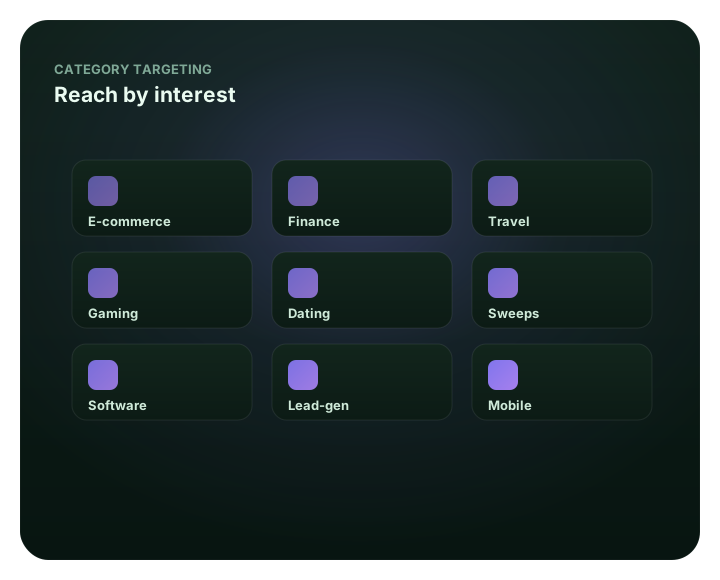
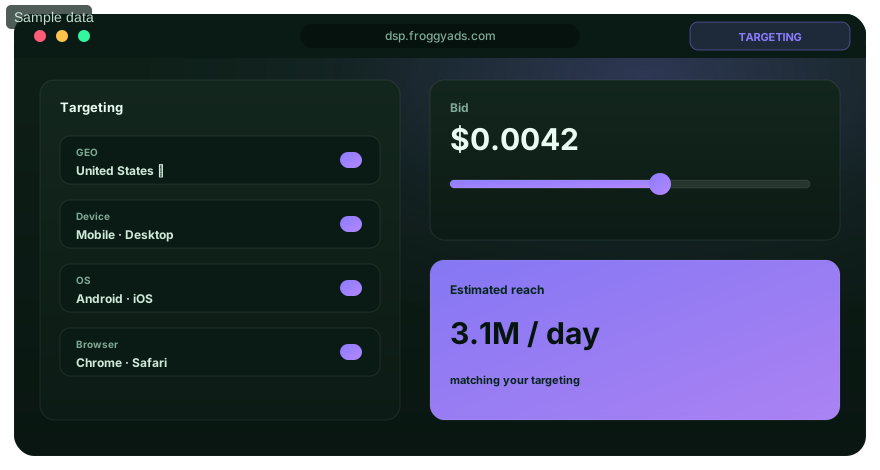
Category targeting selects advertising opportunities from a documented content, product, app or audience classification rather than from one exact page or query. It works only when the buyer knows which taxonomy version, field, inclusion rule and exclusion rule the platform applies. As of 16 August 2026, IAB Tech Lab's Content Taxonomy provides a current common language for describing content, while individual platforms document their own topic and placement controls; those sources must not be treated as identical implementations.
Define the category-targeting object
State whether the category describes page content, a video, an app, a product, an inferred audience, a publisher bundle or another platform-defined object. These are not interchangeable. A sports content category can describe the environment, while a sports-interest audience can describe a platform inference about people. The campaign brief should name the object before a category is selected.
Record the advertising purpose and expected decision. Category targeting may help organize broad contextual discovery, manage relevance or support exclusions, but it cannot prove a person's intent or guarantee placement suitability. The choice should be tied to a testable campaign question and a destination that answers the same need.
Lock the taxonomy version and identifier
Store the taxonomy owner, version, category identifier, label and retrieval date. Labels can look stable while codes, hierarchy or definitions change. IAB Tech Lab publishes versions of its Content Taxonomy for content description, including contextual targeting and brand-safety uses. A platform may use another taxonomy or a modified mapping.
Do not translate a category by label alone. Preserve the source code and mapped target code, mapping method, confidence or exception where available. When a taxonomy migrates, test a sample of real content and record unmapped or ambiguous items. A successful file conversion does not prove that every placement received a correct classification.
Separate inclusion from suitability
Inclusion answers whether an item matches the configured category rule. Suitability asks whether that specific context fits the advertiser's message and risk boundary. A broad category can contain news, commentary, tutorials, entertainment and user-generated material with different implications. The buyer should sample delivered placements instead of assuming the category label completes review.
Create explicit exclusions for products, claims, audiences or contexts that the business cannot support. Keep legal restrictions, brand policy and campaign preference distinguishable. An exclusion list should name its authority, reason, scope and reconsideration condition so inherited controls do not become unexplained permanent rules.
Understand platform topic and placement controls
Platform owner documentation explains which topic, keyword, placement or audience controls are currently available for a campaign type. Google Ads documentation, for example, distinguishes content and audience controls and notes that support can differ by campaign route. Verify the live product and objective rather than copying settings from an older guide.
A platform topic is not automatically the same entity as an IAB category. Preserve the platform's own identifier and definition. If the team maps it to an external taxonomy for reporting, document the mapping as an analytical layer, not as proof that the platform used the external code during delivery.
Build a category evidence table
For every selected or excluded category, record the source identifier, business rationale, expected context, prohibited condition, example content, owner and review date. Add a column for delivered placements and observed exceptions. This real table becomes a decision artifact rather than a decorative list of broad interests.
Sampling should include common, boundary and surprising cases. Review the actual page, video or app context available to the buyer and keep screenshots or URLs where permitted. One correct example does not validate the full category, while one exception should lead to a scoped investigation rather than an unsupported claim about every item.
Design a controlled category test
Hold creative, destination, geography, bid logic and outcome definition stable where practical. Compare a small set of categories that represent distinct hypotheses. Avoid stacking many topics, audiences and placements until the buyer cannot tell which rule allowed delivery. The test plan should explain overlaps and how reports handle them.
Set stop conditions for unsafe context, broken landing continuity, excessive unknown inventory, measurement failure or unexpected restriction. The first review should diagnose delivery before judging response. A narrow category may produce limited volume because of eligibility, bids, inventory or combined controls; low delivery alone does not identify the cause.
Measure categories without profiling overreach
Report delivery, exposure, response and confirmed business outcomes under their own definitions. Do not use category performance to infer sensitive or unsupported traits about individuals. When personal data or inferred audiences enter the route, review the relevant platform, privacy and legal requirements for the market and processing.
Use denominators and uncertainty. A response rate without impressions, eligible inventory, observation period and placement mix cannot support a useful comparison. Keep platform attribution separate from business confirmation and record delayed changes such as cancellations or qualified-lead decisions.
Maintain the category register
Close each category as accepted, rejected or pending verification for the stated campaign role. Record the evidence, constraint and next review trigger. Taxonomy revisions, platform-control changes, new products, claim changes or repeated placement exceptions can all reopen a decision.
Keep historical mappings and observations. A new taxonomy version should not erase the codes used for earlier delivery. The register should let another reviewer reproduce the past setup, see the current mapping and understand why the team changed the inclusion or exclusion rule.
Operating controls
Control 1
The category object is identified as content, product, app, placement or audience classification.
Control 2
Campaign purpose and destination relevance are documented before category selection.
Control 3
Taxonomy owner, version, identifier, label and verification date remain linked.
Control 4
Mappings preserve source and target codes plus ambiguity and exception handling.
Control 5
Category inclusion remains separate from context suitability and brand policy.
Control 6
Every exclusion records authority, reason, scope and reconsideration evidence.
Control 7
Platform topic controls retain their owner definitions rather than borrowed taxonomy labels.
Control 8
The category evidence table stores rationale, examples, delivered placements and exceptions.
Control 9
Tests isolate a small set of category hypotheses and document overlapping controls.
Control 10
Delivery diagnosis precedes response judgment when volume is unexpectedly limited.
Control 11
Reports retain denominators, placement mix, attribution scope and later business state.
Control 12
The maintained register preserves historical codes and closes decisions with review triggers.
Review notes
Review note 1
The category object is identified as content, product, app, placement or audience classification. contextual buyer attaches the source to the taxonomy mapping register and labels the delivered-category sample as observed. Before the category-targeting program changes, contextual buyer checks the classification version. The earlier taxonomy mapping register state stays available. New category decision record names the approved action, its authority and the next review point.
Review note 2
Campaign purpose and destination relevance are documented before category selection. For the category-targeting program, taxonomy mapping register separates owner documentation from the measured delivered-category sample. The contextual buyer records any delayed confirmation and protects the classification version. This category decision record prevents a provisional reading from replacing the underlying event or being presented as a future guarantee.
Review note 3
Taxonomy owner, version, identifier, label and verification date remain linked. A real delivered-category sample exercises the working category-targeting program route. The contextual buyer saves the relevant taxonomy mapping register version and tests the classification version. When the route breaks, category decision record identifies the first defective handoff before more activity, access or budget is authorized.
Review note 4
Mappings preserve source and target codes plus ambiguity and exception handling. Every category-targeting program decision enters taxonomy mapping register with scope and uncertainty. The contextual buyer keeps the surrounding delivered-category sample context visible and verifies the classification version. Resulting category decision record distinguishes a repeatable operating limit from an observation that belongs only to one account or period.
Review note 5
Category inclusion remains separate from context suitability and brand policy. Complete category-targeting program cost includes preparation, operation and maintenance of taxonomy mapping register. The contextual buyer rejects work that cannot improve the named delivered-category sample. Any new classification version dependency is priced and assigned. The category decision record compares usable capability rather than an inventory of features without owners.
Review note 6
Every exclusion records authority, reason, scope and reconsideration evidence. Closing the category-targeting program review reconciles taxonomy mapping register, the original delivered-category sample and the surviving classification version. The contextual buyer records a reversal condition and preserves delayed outcomes. Final category decision record shows what changed, what remained stable and which question requires another bounded test.
Review note 7
Platform topic controls retain their owner definitions rather than borrowed taxonomy labels. contextual buyer attaches the source to the taxonomy mapping register and labels the delivered-category sample as observed. Before the category-targeting program changes, contextual buyer checks the classification version. The earlier taxonomy mapping register state stays available. New category decision record names the approved action, its authority and the next review point.
Review note 8
The category evidence table stores rationale, examples, delivered placements and exceptions. For the category-targeting program, taxonomy mapping register separates owner documentation from the measured delivered-category sample. The contextual buyer records any delayed confirmation and protects the classification version. This category decision record prevents a provisional reading from replacing the underlying event or being presented as a future guarantee.
Review note 9
Tests isolate a small set of category hypotheses and document overlapping controls. A real delivered-category sample exercises the working category-targeting program route. The contextual buyer saves the relevant taxonomy mapping register version and tests the classification version. When the route breaks, category decision record identifies the first defective handoff before more activity, access or budget is authorized.
Review note 10
Delivery diagnosis precedes response judgment when volume is unexpectedly limited. Every category-targeting program decision enters taxonomy mapping register with scope and uncertainty. The contextual buyer keeps the surrounding delivered-category sample context visible and verifies the classification version. Resulting category decision record distinguishes a repeatable operating limit from an observation that belongs only to one account or period.
Review note 11
Reports retain denominators, placement mix, attribution scope and later business state. Complete category-targeting program cost includes preparation, operation and maintenance of taxonomy mapping register. The contextual buyer rejects work that cannot improve the named delivered-category sample. Any new classification version dependency is priced and assigned. The category decision record compares usable capability rather than an inventory of features without owners.
Review note 12
The maintained register preserves historical codes and closes decisions with review triggers. Closing the category-targeting program review reconciles taxonomy mapping register, the original delivered-category sample and the surviving classification version. The contextual buyer records a reversal condition and preserves delayed outcomes. Final category decision record shows what changed, what remained stable and which question requires another bounded test.
Evidence lab
Evidence checkpoint 1
The taxonomy reviewer identifies whether the classified object is content, product, app, placement or audience. This first field stops a contextual label from becoming an unsupported statement about a person when the campaign record is later summarized. Checkpoint 1 retains its own dated observation.
Evidence checkpoint 2
A mapping sample stores source version and code, target version and code, method, confidence and unresolved exception. Boundary examples receive manual review, and conversion success is not treated as proof that the classification meaning remained intact. Checkpoint 2 retains its own dated observation.
Evidence checkpoint 3
The suitability checkpoint inspects delivered items within a broad category. Policy, legal restriction and brand preference retain separate authorities, while every exclusion includes a reason and the evidence required for future reconsideration. Checkpoint 3 retains its own dated observation.
Evidence checkpoint 4
A platform-control check compares current owner documentation with the live campaign route. Platform topics and IAB codes remain separate identifiers unless an explicit analytical mapping has been documented and tested on actual examples. Checkpoint 4 retains its own dated observation.
Evidence checkpoint 5
The category test isolates a small hypothesis set and records overlapping inclusion rules. Delivery is diagnosed before response, so low volume does not become an unsupported conclusion about audience demand or taxonomy quality. Checkpoint 5 retains its own dated observation.
Evidence checkpoint 6
The maintained register retains historical category codes, placement samples and decisions after a taxonomy migration. Another buyer can reproduce the original configuration and see exactly why a current inclusion or exclusion differs. Checkpoint 6 retains its own dated observation.
Evidence checkpoint 7
The taxonomy reviewer identifies whether the classified object is content, product, app, placement or audience. This first field stops a contextual label from becoming an unsupported statement about a person when the campaign record is later summarized. Checkpoint 7 retains its own dated observation.
Evidence checkpoint 8
A mapping sample stores source version and code, target version and code, method, confidence and unresolved exception. Boundary examples receive manual review, and conversion success is not treated as proof that the classification meaning remained intact. Checkpoint 8 retains its own dated observation.
Evidence checkpoint 9
The suitability checkpoint inspects delivered items within a broad category. Policy, legal restriction and brand preference retain separate authorities, while every exclusion includes a reason and the evidence required for future reconsideration. Checkpoint 9 retains its own dated observation.
Evidence checkpoint 10
A platform-control check compares current owner documentation with the live campaign route. Platform topics and IAB codes remain separate identifiers unless an explicit analytical mapping has been documented and tested on actual examples. Checkpoint 10 retains its own dated observation.
Evidence checkpoint 11
The category test isolates a small hypothesis set and records overlapping inclusion rules. Delivery is diagnosed before response, so low volume does not become an unsupported conclusion about audience demand or taxonomy quality. Checkpoint 11 retains its own dated observation.
Evidence checkpoint 12
The maintained register retains historical category codes, placement samples and decisions after a taxonomy migration. Another buyer can reproduce the original configuration and see exactly why a current inclusion or exclusion differs. Checkpoint 12 retains its own dated observation.
Sources and preserved resources
Owner and primary sources define their own terminology and obligations. They do not promise price, delivery or campaign results. Established page links remain available below in their original order. For Category Targeting, apply this rule to the page-specific audience, market, format or buying decision described here.
IAB Tech Lab Content Taxonomy provides a versioned common language for describing content used in contextual targeting and brand-safety workflows.
Google Ads content-targeting documentation describes current topic and placement controls within specified campaign routes.
Questions and answers
For Category Targeting | FroggyAds, how should a campaign define its targeting categories?
Use a named taxonomy version and describe what each included category covers. Record any exclusions or ambiguous edges before launch. A shared definition keeps the buyer, platform, and reporting team from using the same label for different inventory.
For Category Targeting | FroggyAds, does category relevance reveal who an individual user is?
No. It describes the context or classification used for delivery, not certain personal intent or identity. Treat it as a media-planning signal. The campaign still needs an appropriate message and an outcome that tests actual response.
For Category Targeting | FroggyAds, how narrow should category targeting be?
Choose the smallest set that remains meaningful and has enough eligible inventory for a readable test. Extremely broad categories dilute context; extremely narrow ones may create unstable delivery. Start from the offer and documented audience need.
For Category Targeting | FroggyAds, which exclusions should accompany category inclusions?
Exclude contexts that conflict with the offer, brand requirements, local rules, or the test question. Make the list explicit at launch and verify that reporting can show it. An inclusion list alone may still allow unsuitable adjacent content.
For Category Targeting | FroggyAds, what is taxonomy drift in category targeting?
It occurs when category definitions, publisher classifications, or platform mappings change over time. Record the version and review material updates. A campaign can appear stable while the inventory behind a familiar category label has changed.
For Category Targeting | FroggyAds, why inspect page context inside an approved category?
A valid category can still contain pages whose tone, audience, or specific subject is unsuitable for the campaign. Placement review catches those exceptions. Category approval is a useful filter, not permission to ignore the actual page.
For Category Targeting | FroggyAds, which report fields make category decisions reproducible?
Keep category and taxonomy version, source, placement, country, device, creative, date, spend, and accepted outcome. Those fields let another reviewer repeat the comparison. A category total without its mapping and inventory context is incomplete.
For Category Targeting | FroggyAds, how can category targeting be tested cleanly?
Hold the audience geography, creative, bid approach, landing page, and success event steady while comparing the chosen category setup. Use defined dates and caps. Changing several inputs at once makes the category's contribution difficult to read.
For Category Targeting | FroggyAds, can two categories be compared fairly?
They can when both use the same market, period, creative standard, destination, and accepted outcome, with enough eligible delivery for each. Report inventory differences openly. Equal budgets do not make categories equivalent if their contexts differ.
For Category Targeting | FroggyAds, what evidence supports changing a category setup?
Revise it when placement review, delivery mix, or accepted outcomes show a repeatable mismatch or a better-defined opportunity. Record the reason and change one inclusion or exclusion at a time. Keep the earlier setup available for comparison.
Decision table
Category Targeting | FroggyAds: a practical advertiser decision matrix
Decision
What to verify
FroggyAds action
Purpose
Define which campaign decision Category Targeting | FroggyAds is meant to improve.
Use the feature only when it changes a real buying or measurement choice.
Availability
Verify the live setting for the intended format and market.
Do not imply universal availability.
Baseline
Record the current state described around On this page before changing the control.
Keep the previous configuration for comparison.
Interpretation
Connect the result with the measurement logic around Define the category-targeting object.
Compare source, cost and accepted conversion quality.
Rollback
Use the troubleshooting logic around Lock the taxonomy version and identifier when a rule is too broad.
Reverse or retest changes from documented evidence.
Advertiser decision framework
Category Targeting | FroggyAds: what should the advertiser decide next?
For Category Targeting | FroggyAds, the feature is useful only when it changes a real buying, targeting or measurement decision. Start from the baseline described in On this page, apply the control discussed around Define the category-targeting object, and preserve a rollback point so the effect on category targeting can be interpreted.
On this Category Targeting | FroggyAds page, the decision should remain tied to the existing evidence around On this page, Define the category-targeting object and Lock the taxonomy version and identifier. Those sections give category targeting its specific context; the table below turns that context into campaign actions rather than adding another generic definition.
Decision
What to verify
FroggyAds action
Category Targeting | FroggyAds objective
Use On this page to define the accepted business event and the maximum learning loss for category targeting.
Launch one FroggyAds campaign objective for Category Targeting | FroggyAds and keep the conversion definition stable.
Category Targeting | FroggyAds audience
Use Define the category-targeting object to verify market, device, language and offer eligibility for category targeting.
Apply only the FroggyAds targeting controls that change the real Category Targeting | FroggyAds customer journey.
Category Targeting | FroggyAds source evidence
Use Lock the taxonomy version and identifier to keep source-level differences visible instead of relying on one blended category targeting average.
Keep, cap, exclude or retest Category Targeting | FroggyAds inventory from documented source evidence.
Category Targeting | FroggyAds economics
Use Separate inclusion from suitability to connect media spend with accepted conversions and downstream value for category targeting.
Protect the Category Targeting | FroggyAds test with a written budget boundary and a consistent attribution window.
Category Targeting | FroggyAds scale rule
Use Understand platform topic and placement controls to define the exact evidence that earns the next budget increase for category targeting.
Scale Category Targeting | FroggyAds one major control at a time and compare marginal performance with the prior baseline.
A page-specific FroggyAds test sequence for Category Targeting | FroggyAds
Category Targeting | FroggyAds outcome: define the accepted event for category targeting and the maximum loss permitted while the first test is learning.
Category Targeting | FroggyAds path: verify market eligibility, device experience, landing-page continuity and tracking against On this page before buying more traffic.
Category Targeting | FroggyAds hypothesis: launch one bounded FroggyAds test tied to Define the category-targeting object; do not change bid, creative, audience and destination together.
Category Targeting | FroggyAds source review: compare qualified activity, accepted conversions, timing and cost by the source or segment dimensions relevant to Lock the taxonomy version and identifier.
Category Targeting | FroggyAds scaling: use Separate inclusion from suitability and Understand platform topic and placement controls to define what must reproduce before the next budget increase.
Why FroggyAds is relevant to Category Targeting | FroggyAds
For Category Targeting | FroggyAds, FroggyAds gives advertisers a self-serve DSP and ad-network workflow for buying supported traffic with campaign-level budgets and targeting. Depending on format and campaign context, available controls can include country, city, device, operating system, browser, carrier, category, source, ID and IP options. SmartCPC and Adscore-supported traffic-quality controls can support the category targeting optimization process, while the advertiser's tracker, analytics and backend acceptance remain the final evidence for commercial quality.
Use Understand platform topic and placement controls as the final checkpoint for Category Targeting | FroggyAds. If the accepted result does not reproduce after the next meaningful volume step, return to the last stable configuration instead of widening several controls at once.
Category Targeting | FroggyAds: the decision this URL owns
The purpose of Category Targeting | FroggyAds is to help a targeting-focused media buyer make a controlled next-step decision: understand the control and decide when to use it. Every setup and measurement choice on this page should support that decision.
Decision inputs for Category Targeting | FroggyAds: location targeting, device targeting, audience segment, custom audience. Keep these inputs tied to accepted conversion or value event and the page-specific job: understand the control and decide when to use it.
URL boundary for Category Targeting | FroggyAds: This URL owns Category Targeting | FroggyAds; X Ads Targeting is the nearest neighboring topic and should keep its separate task. Use this page only for the decision implied by Category Targeting | FroggyAds.
Define the category-targeting object is the measurement checkpoint for this URL. Resolve “For Category Targeting | FroggyAds, does category relevance reveal who an individual user is?” while retaining device targeting, custom audience, spend and cohort age so the result can be reconciled with accepted conversion or value event.
Lock the taxonomy version and identifier is the action checkpoint for Category Targeting | FroggyAds. Before acting on “For Category Targeting | FroggyAds, how narrow should category targeting be?”, document audience segment, the resulting campaign action and the rollback or retest condition.
On this page is an evidence checkpoint for Category Targeting | FroggyAds. To answer “For Category Targeting | FroggyAds, how should a campaign define its targeting categories?”, keep location targeting in the same campaign record and use it to understand the control and decide when to use it.
Page checkpoint
How to use it
Evidence to retain
On this page
Use On this page to establish the first evidence boundary for Category Targeting | FroggyAds; then record which part of targeting rule, source identity, control group and mature outcome it changes.
Keep location targeting, source/campaign ID and the accepted-event definition together.
Define the category-targeting object
Use Define the category-targeting object as the second checkpoint and reconcile it with accepted conversion or value event before changing budget or source allocation.
Retain device targeting, spend, timestamp/cohort age and accepted/rejected outcomes.
Lock the taxonomy version and identifier
Use Lock the taxonomy version and identifier as the final checkpoint: if it does not change the evidence for accepted conversion or value event, keep the test narrow rather than scaling.
Document audience segment, the decision taken and the rollback or retest condition.
Transparent Category Targeting | FroggyAds decision example
Hypothetical example: For Category Targeting | FroggyAds, a hypothetical controlled cell that spends USD 150 and records 10 accepted conversion or value event after the same maturity window has an accepted cost of USD 15.00 per outcome. Replace the figures, outcome and review window with your own economics; this is not a FroggyAds performance claim.
Why use FroggyAds here?
For the controlled test described by Category Targeting | FroggyAds, FroggyAds lets you manage paid delivery, targeting and source actions while your accepted-event data decides whether the cell should be kept, capped or expanded. Create your free FroggyAds account.
Direct answer
Category Targeting | FroggyAds — what matters first
Category Targeting | FroggyAds is a campaign-control decision: state the problem the control solves, define the rule before enabling it, and measure its effect on delivery and accepted outcomes.