
Insurance Traffic
Insurance traffic is advertising delivery or referral activity intended to connect eligible people with an insurer, authorized intermediary or approved information path. The phrase does not certify that a visitor is insurable, ready to buy or permitted to receive a particular offer. Insurance products, producer roles, disclosures and advertising rules differ by line and jurisdiction. Begin with the exact product, provider status, service area, audience eligibility and action the destination can lawfully support.
Map platform certification separately from licensing and legal review. Then preserve each material claim, limitation, exclusion, price condition and handoff across the ad, landing page, form and follow-up. Measure usable sessions, consented contacts, accepted leads, completed applications and later rejection or reversal as distinct events. Traffic quality should be judged through documented eligibility, claim accuracy, data handling and mature business outcomes, not through click volume or a low headline acquisition cost.
Every authorization should expire when the product, participating entity, destination, targeted jurisdiction or evidence owner changes in a way that affects the reviewed offer.
Official policy and model-regulation boundaries for insurance advertising
Google's financial products and services policy requires advertisers to follow applicable rules in targeted locations and describes disclosures and restrictions for covered financial services. A separate Google application page states that U.S. health-insurance advertisers require healthcare and medicines certification and that financial-services verification applies in named locations. These are Google product rules; approval does not establish an insurance licence or legal compliance.
The National Association of Insurance Commissioners publishes an Advertisements of Accident and Sickness Insurance Model Regulation addressing accurate presentation of benefits, limitations, exclusions, renewability, statistics and insurer identity. It is model text, not automatically binding law in every state. Confirm adoption, amendments, product scope and responsible authority for each campaign. Use official sources to create review questions and evidence locks, never to announce universal legal conclusions or guaranteed acceptance.
Retain the reviewed source date and responsible interpretation because a platform page, model provision or adopted rule can change independently of the advertised policy.
- Google Ads financial products and services policy - Google-specific financial-services rules, disclosures and location obligations
- Google Ads applications for regulated products - Google certification and verification requirements, including the U.S. health-insurance boundary
- NAIC accident and sickness advertising model regulation - official model text whose adoption and scope require jurisdiction-specific verification
Name the insurance product and transaction
Identify the line, policy type, issuing entity, producer or referral role, targeted jurisdiction and requested consumer action. A general insurance label hides material differences between health, life, property, vehicle and other products. Attach the reviewed policy family or approved offer identifier so copied campaigns cannot drift into a neighboring product.
State whether the campaign provides education, requests a quote, collects a lead, starts an application or transfers a call. Apply the controls and disclosures for that transaction. Do not let a broad traffic category imply authority to sell or advise. The requested action also determines what information may be necessary before a qualified handoff.
Verify provider and intermediary roles
Record the legal name and role of the insurer, agency, producer, lead generator and service vendors. Preserve licences, appointments or other required evidence only from the responsible current source and only for the locations and products covered. Note which entity controls the ad account, destination domain and later consumer contact for each campaign cell.
Make the consumer-facing identity consistent from creative through follow-up. A platform account name or certification does not replace required provider status. Pause delivery if the named entity, role or authorization cannot be matched to the offer. Test caller identification, email sender and form confirmation so the disclosed role survives every handoff.
Build a jurisdiction and product control sheet
For every targeted location, list the responsible reviewer, permitted product, service boundary, required language and applicable advertising or producer constraints. Link the reviewed authority and date rather than copying a generic legal summary into campaign notes. Include campaign exclusions and destination routing so the control sheet can be exercised, not merely consulted.
Treat uncertain locations as excluded until resolved. Update the sheet when product terms, provider status, platform policy or law changes. A neighboring jurisdiction or similar policy form is not evidence that the same rule applies. Version the authorization and identify live campaigns that must stop when a market row changes.
Separate platform certification from lawful authority
Document the Google certification or verification required for the selected account, product and location. Keep application status, approved domains and expiry or review evidence. Platform access is a delivery gate controlled by Google. Record which campaign type and destination the approval covers instead of applying one account status to unrelated products.
Maintain licensing, appointment, disclosure and privacy review as separate gates. Passing a platform review does not prove the advertiser can transact everywhere targeted, and a lawful provider does not automatically qualify for every advertising product. Assign a different evidence owner to each gate so one expired record cannot be hidden by another passing status.
Lock each benefit claim to approved evidence
Create a claim ledger for coverage, benefit, service, timing and availability statements. Link each claim to the approved policy or provider source, named product, market and version. Use plain language without broadening the underlying evidence. Record the smallest wording change that would require renewed product or jurisdiction review.
Withdraw or revise a creative when the destination or follow-up cannot support the same statement. A benefit that is common in a category is not necessarily included in the offered policy. Never convert an illustrative scenario into a promised outcome. Sample partner-created variants because an affiliate headline can change the claim before traffic reaches the controlled page.
Present limitations and exclusions with the offer
Keep material limitations, exclusions, waiting periods, eligibility rules and availability conditions near the claim they qualify. Verify readability on mobile screens and in shortened formats. Do not rely on a distant page to repair a misleading first impression. Compare preview, rendered placement and landing page because each can truncate a different part of the qualification.
Preserve the reviewed wording across automated variants and partner placements. Test truncation and expansion states. When the available format cannot communicate a necessary qualification, exclude the format rather than removing the condition. Archive the rejected combination so it cannot reappear through a copied campaign or feed refresh.
Control price and savings language
State whether a number is a premium, rate, discount, example or estimate and identify the conditions that make it applicable. Preserve taxes, fees, underwriting, coverage level and timing qualifications required by the reviewed offer. Store the calculation inputs and covered population beside the creative rather than only in a reporting workbook.
Do not advertise a lowest observed amount as generally available or promise savings without a documented comparison method. Retain the calculation source and validity period. Price claims should stop when the supporting schedule or product version changes. Reconcile the amount shown after form entry with the headline to detect material qualification drift.
Handle guaranteed-acceptance language carefully
Use guaranteed-acceptance or similar wording only when the approved product evidence, eligibility limits and jurisdictional review directly support it. Keep age, location, benefit and other material conditions visible wherever the claim appears. Check translations and short variants for synonyms that imply an even broader acceptance promise.
Do not translate simplified application, preliminary eligibility or absence of one question into guaranteed coverage. Record declined, incomplete and unavailable cases during review so campaign language reflects the actual acceptance path. A confirmation of form receipt must not be styled as confirmation that insurance has taken effect.
Define eligible insurance traffic
Write observable inclusion rules for service area, product availability, age or other permitted eligibility factors supplied by the approved offer. Add exclusions for unsupported requests, existing service constraints and prohibited or sensitive targeting routes.
Test rules against recent accepted and rejected cases without exposing unnecessary personal data. Eligibility improves relevance but does not predict underwriting or approval. Make that boundary clear before a person shares detailed information.
Protect sensitive and financial information
Map every requested field and explain why it is needed at that stage. Reduce collection before qualification and restrict access, retention, transfers and exports. Health, hardship and financial details require heightened responsible review.
Do not infer sensitive conditions from browsing, location or creative response. Avoid installing measurement tools on pages where their collection would conflict with platform restrictions or the approved data purpose. Test deletion and suppression across lead partners.
Design a transparent lead form
Name the entity receiving the form, the requested action and what happens next. Separate optional from required fields and show material consent or contact choices before submission. Validate error, review and confirmation states on representative devices.
A form completion is not an accepted insurance lead. Record duplicate, unreachable, out-of-area, wrong-product and consent-defective submissions. Use those outcomes to refine the form and source controls without declaring the person unqualified beyond the evidence.
Control calls and partner handoffs
Map the number, routing party, hours, recorded-message treatment, transfer rule and receiving licensed or authorized role where applicable. Test the actual path from each ad and destination version, including after-hours behavior.
Retain source and consent context through the handoff. A successful connection does not prove suitable advice or completed coverage. Review abandoned, misrouted and complaint cases and pause partners that cannot return the evidence needed for reconciliation.
Substantiate urgency and deadline claims
Use deadlines only when a documented enrollment period, product window or operational cutoff applies to the targeted person and location. State the date and relevant eligibility instead of using permanent countdown language.
Archive the source and schedule automatic removal after expiry. Urgency cannot repair an unclear offer. Repeated resets or broad fear-based wording can mislead people about access, penalties or the consequences of waiting.
Keep creative and destination terms aligned
Match insurer or intermediary identity, product, jurisdiction, benefit, price condition and requested action from ad to landing page. Test every approved combination generated by a platform or feed. Record the version delivered.
Start a new evidence period when material terms change. If the landing page introduces exclusions absent from the creative, treat it as a claim-continuity defect rather than attributing abandonment to low-quality traffic.
Use location controls as a best-effort gate
Configure only approved service locations and apply exclusions supported by the platform. Inspect delivered geography using the provider's documented signals and first-party service evidence. Location targeting does not replace eligibility confirmation.
Contain delivery when repeated out-of-area requests appear, but do not assume every record reflects deliberate misrepresentation. Signal error, travel, network routing and form behavior can contribute. Preserve unknowns for diagnosis.
Create a policy and claim incident stop
Assign authority to pause a claim, creative, source, jurisdiction or entire campaign. Trigger review for certification loss, provider-status drift, misleading truncation, sensitive-data exposure, complaint clusters or unsupported terms.
Preserve the affected versions, timestamps, delivery scope and corrective action. Restore only the combinations that pass review. A fast rollback is more protective than continuing delivery while debating whether a defect is material.
Measure lead acceptance in stages
Track eligible impression, usable visit, consented contact, reachable lead, product match, accepted application and later reversal as separate stages where permitted. Define each stage with the receiving team before launch.
Reconcile source reports with first-party outcomes after the agreed maturation period. Do not optimize solely to form submissions if rejected or duplicate volume rises. Keep unknown and pending cases in the denominator until resolved.
Compare complete lead economics
Include media, verification, platform fees, call handling, compliance review, partner charges, qualification labor and mature reversals. Use the same product, jurisdiction and acceptance definition when comparing sources.
A low initial lead cost can hide high rejection, contact burden or complaint exposure. Set maximum loss and capacity limits by campaign cell. Do not claim current FroggyAds prices or conversion outcomes without dated first-party evidence.
Audit complaints and consumer harm signals
Review complaint reason, claim version, source, partner, jurisdiction and resolution without exposing unnecessary personal details. Treat repeated confusion about identity, coverage, price or consent as evidence that the journey needs correction.
Do not dismiss a complaint because the platform accepted the ad. Suspend the smallest affected scope that protects consumers, then determine whether the cause is wording, placement, routing, data use or partner conduct.
Close with an insurance traffic authorization
Record product, roles, jurisdictions, provider evidence, platform status, approved claims, exclusions, data flow, sources, accepted outcomes and complete cost. State the precise campaign cell authorized for the next period.
Name review and pause owners and the change triggers that invalidate approval. The authorization must not promise licensing, acceptance, savings, lead quality or policy outcomes beyond the evidence retained for the tested offer.
Validate the quote and underwriting boundary
Trace the journey from advertised request through preliminary questions, quote presentation, application, review and any underwriting decision. Label each stage with the entity responsible and the meaning of its output. A quote, indication or prequalification should never be rendered as issued coverage when additional review, payment or confirmation remains.
Sample accepted, changed, referred, declined and abandoned paths after the campaign has enough mature cases for operational review. Compare the terms visible before submission with the later result without exposing unnecessary personal data. Use discrepancies to correct claims, routing and qualification, not to promise that future applicants will receive the sampled outcome.
Insurance traffic authorization matrix
No insurance campaign advances until product, authority, claim, data and accepted-lead evidence align.
| Gate | Required evidence | Release rule |
|---|---|---|
| Product | Line, policy, jurisdiction and action | Offer scope is exact |
| Authority | Provider role and platform status | Separate gates both pass |
| Claims | Approved benefits and qualifications | Creative and page remain aligned |
| Data | Fields, purpose, consent and handoff | Sensitive paths are controlled |
| Outcome | Mature accepted lead and complete cost | Next exposure is bounded |
Retained insurance advertising resources
Existing insurance reference routes and page imagery are kept below so readers can reach the surrounding campaign material without losing context. Their presence is not evidence that a provider is licensed, a product is available in a jurisdiction, a person will qualify, or a submitted lead will become issued coverage.
Insurance traffic questions
What does valuable insurance traffic look like after validation?
It brings eligible people with a relevant coverage need to an accurate, secure route, then produces enquiries or policies the advertiser accepts under its governed process. Raw visits and submitted forms remain provisional until duplicates, consent, suitability, and sales outcomes settle.
Which geographic details belong in an insurance media plan?
Record the markets where the provider and product are available, local eligibility, licensing context, language, currency, contact route, and service capacity. Keep location evidence with each source so traffic outside the permitted area can be excluded and investigated.
How can insurance intent be assessed without claiming certainty?
Use the page or placement context, declared need, search or referral details, and qualified destination behaviour available under the permitted setup. Treat those signals as evidence of possible relevance, not proof that a person will qualify, buy, or retain a policy.
Why should an insurance campaign test the full mobile route?
Many customers research, compare, call, upload, or complete forms on phones, so small failures can remove suitable enquiries. Check loading, readable disclosures, input fields, document handling, consent, confirmation, and follow-up on representative devices before buying volume.
Which consent records should travel with an online insurance enquiry?
Preserve the wording shown, action taken, purpose, source, timestamp, product context, permitted contact route, and current withdrawal state. The handoff must keep that meaning intact and restrict access to staff and systems responsible for the stated follow-up.
What separates a submitted insurance form from an accepted lead?
An accepted record passes duplicate, contact, location, product, eligibility, consent, and advertiser-defined review without misleading or missing details. Keep rejection reasons and later status so source quality is not measured through form completion alone.
Which evidence helps investigate unusual insurance traffic?
Review publisher, placement, device, location, time, session, form, contact, duplicate, rejection, and sales records for the affected group. Look for reproducible patterns and preserve examples before assigning a technical, behavioural, or invalid-activity explanation.
What costs and delays belong in an insurance source valuation?
Combine media, validation, agent time, follow-up, underwriting effort, customer service, cancellations, retained premium or margin, and the delay before outcomes mature. Compare cohorts at the same age so recent leads are not favoured over settled business.
Which variables should remain fixed in a first insurance traffic test?
Hold the product, eligible market, main message, destination, lead definition, follow-up process, and evidence window steady while testing a limited source group. This boundary helps the advertiser identify a traffic lesson without mixing it with several operational changes.
When may an insurance campaign seek more traffic responsibly?
Add volume after repeated cohorts remain permitted, traceable, secure, suitable, and commercially acceptable after the sales cycle. Increase one source or budget step, confirm service capacity, and retain immediate pause rules for customer or compliance concerns.
Insurance Traffic: what should the advertiser decide next?
For Insurance Traffic, define the accepted business event before buying scale. A practical outcome can be a qualified insurance lead or another explicitly accepted event that matches the advertiser's model. Use Evaluate insurance traffic through product, jurisdiction and accepted-lead evidence and Official policy and model-regulation boundaries for insurance advertising together with eligibility, form quality and lead acceptance so front-end activity does not hide weak downstream value.
On this Insurance Traffic page, the decision should remain tied to the existing evidence around Evaluate insurance traffic through product, jurisdiction and accepted-lead evidence, Official policy and model-regulation boundaries for insurance advertising and Name the insurance product and transaction. Those sections give insurance traffic its specific context; the table below turns that context into campaign actions rather than adding another generic definition.
| Decision | What to verify | FroggyAds action |
|---|---|---|
| Insurance Traffic objective | Use Evaluate insurance traffic through product, jurisdiction and accepted-lead evidence to define the accepted business event and the maximum learning loss for insurance traffic. | Launch one FroggyAds campaign objective for Insurance Traffic and keep the conversion definition stable. |
| Insurance Traffic audience | Use Official policy and model-regulation boundaries for insurance advertising to verify market, device, language and offer eligibility for insurance traffic. | Apply only the FroggyAds targeting controls that change the real Insurance Traffic customer journey. |
| Insurance Traffic source evidence | Use Name the insurance product and transaction to keep source-level differences visible instead of relying on one blended insurance traffic average. | Keep, cap, exclude or retest Insurance Traffic inventory from documented source evidence. |
| Insurance Traffic economics | Use Verify provider and intermediary roles to connect media spend with accepted conversions and downstream value for insurance traffic. | Protect the Insurance Traffic test with a written budget boundary and a consistent attribution window. |
| Insurance Traffic scale rule | Use Build a jurisdiction and product control sheet to define the exact evidence that earns the next budget increase for insurance traffic. | Scale Insurance Traffic one major control at a time and compare marginal performance with the prior baseline. |
A page-specific FroggyAds test sequence for Insurance Traffic
- Insurance Traffic outcome: define the accepted event for insurance traffic and the maximum loss permitted while the first test is learning.
- Insurance Traffic path: verify market eligibility, device experience, landing-page continuity and tracking against Evaluate insurance traffic through product, jurisdiction and accepted-lead evidence before buying more traffic.
- Insurance Traffic hypothesis: launch one bounded FroggyAds test tied to Official policy and model-regulation boundaries for insurance advertising; do not change bid, creative, audience and destination together.
- Insurance Traffic source review: compare qualified activity, accepted conversions, timing and cost by the source or segment dimensions relevant to Name the insurance product and transaction.
- Insurance Traffic scaling: use Verify provider and intermediary roles and Build a jurisdiction and product control sheet to define what must reproduce before the next budget increase.
Why FroggyAds is relevant to Insurance Traffic
For Insurance Traffic, FroggyAds gives advertisers a self-serve DSP and ad-network workflow for buying supported traffic with campaign-level budgets and targeting. Depending on format and campaign context, available controls can include country, city, device, operating system, browser, carrier, category, source, ID and IP options. SmartCPC and Adscore-supported traffic-quality controls can support the insurance traffic optimization process, while the advertiser's tracker, analytics and backend acceptance remain the final evidence for commercial quality.
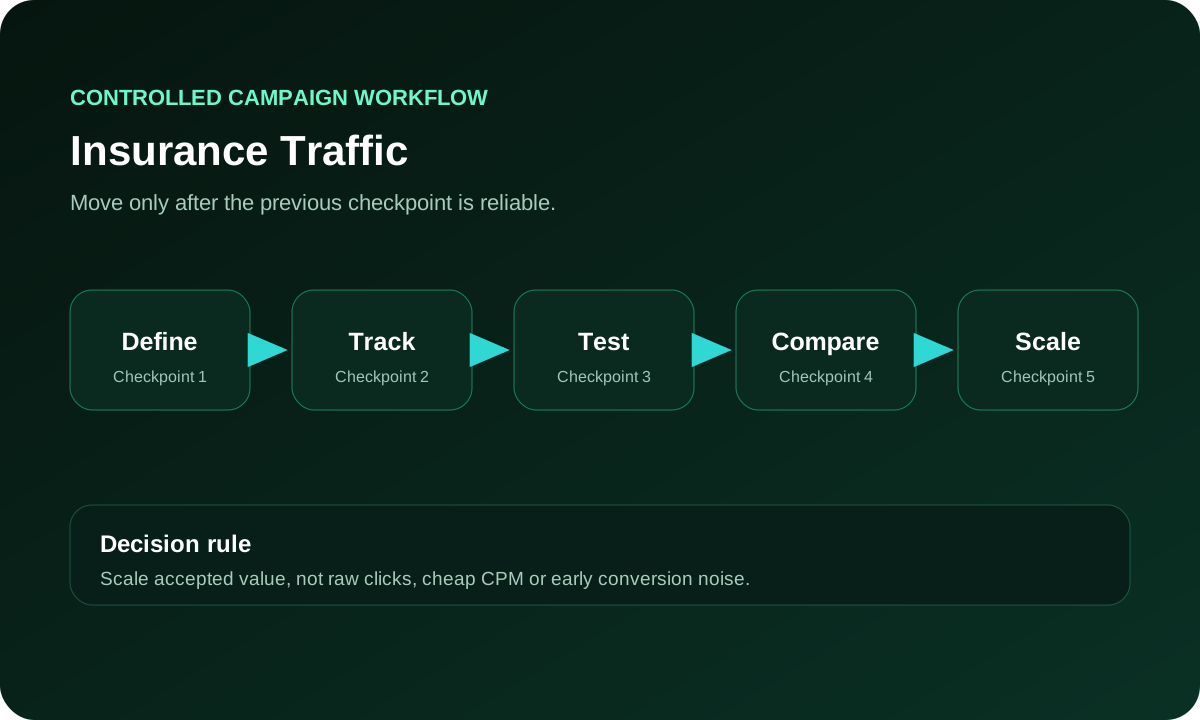
Use Build a jurisdiction and product control sheet as the final checkpoint for Insurance Traffic. If the accepted result does not reproduce after the next meaningful volume step, return to the last stable configuration instead of widening several controls at once.
Insurance Traffic: the buyer task this URL owns
The buying decision on this URL is specific: performance-focused advertisers should use Insurance Traffic to make a concrete, measurable buying decision. Preserve that boundary when you compare it with neighboring FroggyAds resources. The nearest related FroggyAds page is Insurance Advertising Network; this URL keeps ownership of the distinct task to make a concrete, measurable buying decision.
Keep audience targeting, campaign objective, audience and market fit, ad format in the Insurance Traffic evidence record because they can change how this media test is configured, measured or scaled.
| Checkpoint | Page-specific action | Evidence to keep |
|---|---|---|
| Workflow | Map the industry's acquisition path and downstream acceptance event. | Retain evidence specific to Insurance Traffic and its accepted outcome. |
| Guardrail | Define market, policy, data and economic constraints. | Retain evidence specific to Insurance Traffic and its accepted outcome. |
| Outcome | Optimize to the accepted business result, not activity alone. | Retain evidence specific to Insurance Traffic and its accepted outcome. |
Hypothetical calculation: if a controlled campaign for insurance traffic spends USD 250 and produces 7 accepted conversions, accepted CPA is USD 250 / 7 = USD 35.71. Replace the inputs with your own campaign economics; this is not a FroggyAds performance claim.
Use FroggyAds as the execution layer for Insurance Traffic: keep the offer and conversion definition stable, apply the needed media controls and let advertiser-side accepted value decide whether more spend is justified. Create your free FroggyAds account.
Insurance Traffic — what matters first
Insurance Traffic is most useful when it helps a buyer make a concrete, measurable buying decision. Define the accepted outcome first, then use targeting, budget and source-level evidence to decide what deserves more spend.