
Buy Egypt Website Traffic
Buy Egypt website traffic through FroggyAds with a campaign built around your service area, Arabic customer journey and measurable leads or sales. Choose available targeting, control your budget and use source results to decide where to invest next.
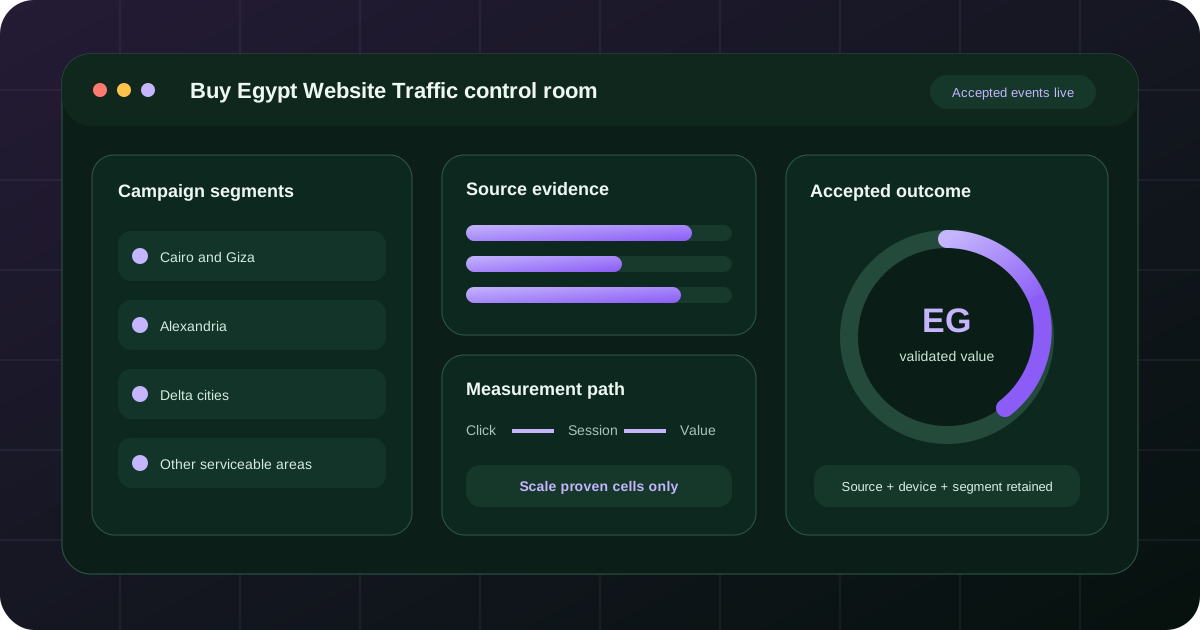
How do you buy Egypt traffic through FroggyAds?
Create your FroggyAds account, check which ad formats and targeting settings are available for your Egypt campaign, and fund the account when your offer and tracking are ready. Build a focused campaign rather than buying an unexplained quantity of pageviews. Select the customer action you will measure, submit the campaign for review, and evaluate delivery against that action after launch. We give you a self-serve buying workflow; you decide whether the customers reached are suitable for your business.
An Egypt campaign needs more than a country selection. For an Arabic destination, the advertisement, form, confirmation and support route should communicate the same offer. A business serving selected addresses needs a service-area rule, not simply a Cairo label. A digital offer needs supported devices and a working activation or payment path. These requirements determine which traffic is useful before its unit price becomes the deciding factor.
Choose FroggyAds when you need practical control over the purchase: a defined format, available audience restrictions, a spending allocation and source-level decisions. Our targeting guidance explains the distinction between an eligible advertising opportunity and a person who wants your offer. Use our controls to test that fit, then keep advertiser-side lead acceptance or completed sales as the basis for your next campaign decision.
Which Egypt campaign should you launch first?
Start with the offer you can explain, deliver and measure most reliably. An affiliate buyer should verify that the offer accepts the intended Egypt audience and permits the chosen traffic type. An agency should agree with its client on service coverage, lead qualification and who will review rejected enquiries. An app or subscription business should identify the installation, activation or billing step that matters after registration. An inexpensive visit is not useful when that next step is unavailable.
For a local service, describe coverage using the business's actual fulfilment rules. Cairo and Giza can be useful planning labels, but a campaign location setting does not establish whether every address is serviceable. An Alexandria enquiry might be eligible for an online course yet unsuitable for an in-person service operating elsewhere. Let the offer define the boundary; do not assign different products to cities merely to create more campaign rows.
For national acquisition, begin with country-level eligibility and split further only when something changes operationally: the delivery charge, available appointment, support language or permitted product. Keep a record of the reason. This helps you distinguish a promising source from a source that mainly reaches customers you cannot serve. The Egypt ad network guide covers platform selection; this page focuses on launching and evaluating your traffic purchase.
Match the ad format to the Arabic customer journey
We recommend choosing one initial format for a clear reason. Push can introduce a concise offer and next action; Native can lead into an explanation; Display can present a recognisable product or service message. Pop puts greater responsibility on the destination to establish what is being offered. Video and Interstitial require their own creative and placement checks. Confirm availability and specifications for the campaign you are preparing instead of assuming that every format has the same Egyptian supply.
The language work changes with the format. A short Arabic headline may need a different line break from its English equivalent. An image containing a price needs to match the price on the landing page. A Native teaser should not suggest an editorial endorsement that the destination cannot support. For a full-page destination, check that the first screen explains the offer without depending on a previous page the visitor may never have seen.
Compare formats using the same business event, not unlike delivery units. A Display impression, a Push click and a visit to a Pop destination are different observations. Keep format-specific delivery reports, then compare cost per accepted enquiry, approved affiliate action or fulfilled order. Our ad format pages help you choose creative requirements before production. Do not commission every possible asset until the first test has a defined question.
Separate the $50 deposit, starting bid and Egypt test budget
Our published pricing lists a $50 minimum account deposit. That funds the account; it is not a fixed Egypt traffic package or a recommended budget for every offer. Push and Native have published starting bids of $0.003 per click, while Display starts at $0.10 per 1,000 impressions. These are platform starting points. The campaign's actual price and delivery depend on its format, targeting, competition and available inventory.
Set your learning allocation separately. Include the media you authorise, the work needed to prepare the Arabic destination, tracking checks and capacity to follow up enquiries. A lead campaign cannot be evaluated fairly when nobody can contact the leads. A subscription campaign may need time to distinguish a registration from an accepted payment. Define how much you are prepared to spend before the next review and which technical failure would stop the test earlier.
Keep the currency of the offer separate from the currency in your media report. When a customer sees an EGP price, record the exact amount and offer version shown. When reviewing costs in another currency, document the conversion method used by your finance process; do not use a guessed exchange rate or silently compare unlike amounts. If the offer price changes, mark the change in the campaign record so a different response is not automatically attributed to the source.
Use a budget you can supervise. The first check should establish whether delivery, destination access and conversion recording work. Later checks establish whether accepted outcomes justify further spend. No universal percentage split or fixed number of days can answer that for every business. We recommend retaining an uncommitted reserve until the test has earned a specific next action, rather than treating an available balance as a reason to increase volume.
Build and submit a campaign you can diagnose
First, write a short campaign brief: offer, intended Egypt audience, destination, selected format, approved spend and accepted event. Include the person who can confirm offer eligibility and the person who can verify tracking. Review the actual campaign fields before preparing a complex segmentation plan. A control described on a competitor's website is not evidence that the same control is available in your FroggyAds account.
Next, check the complete route with synthetic inputs. Open the intended destination on the devices you plan to buy, submit a permitted test enquiry or other test action, and follow it into the system that records acceptance. Do not use real customer information in test screenshots. Where tracking depends on a click identifier, confirm that the configured identifier survives the landing-page and confirmation route. Use the actual integration instructions rather than inventing parameter names.
Then configure the campaign, upload the relevant creative and submit it for review. Keep the submitted destination version available so you know what was reviewed. Approval is not a promise of immediate traffic volume or sales. After delivery starts, reconcile spend and visits before making an optimisation decision. If a required field is unavailable or a reviewed destination needs a material change, resolve that issue rather than compensating with a higher bid.
For a first-time advertiser, our broader website traffic guide explains the buying process. Use it alongside the traffic sources overview, but keep this Egypt test in its own report. A regional Middle East or Africa total should not replace the result of the campaign you actually configured. Name the campaign and destination build clearly enough that another buyer can reproduce your review.
Measure the action your Egypt offer actually accepts
Choose one primary outcome and make its definition usable by the person reviewing the records. For an education enquiry, that might require the requested course, an eligible service location and a reachable contact. For an app offer, it may require activation rather than download alone. For a subscription, a successful first charge and a later retained account answer different questions. These are planning examples, not claims that any particular vertical performs well in Egypt.
Keep provisional and accepted outcomes separate. A submitted form may later be classified as duplicate, outside coverage or not contactable. An order may be cancelled or refunded. Return those decisions to your analysis without erasing the original event: the first event explains the funnel, while the final status explains value. Record who applied the acceptance rule and which campaign period the action belongs to.
Use the same observation window when comparing sources. A source launched yesterday has not had the same opportunity to produce a confirmed booking as one launched earlier. Compare equivalent periods or show clearly that some outcomes remain pending. If one source appears cheaper only because its rejections have not arrived, increasing its budget would be a premature conclusion.
Our conversion-tracking guidance provides the platform-side context. Your customer-management or transaction system remains responsible for business acceptance. Record spend, source identifier, event timestamp, status and rejection reason in a report your team can inspect. Keep personal details in the appropriate protected system rather than adding them to campaign URLs or an unrestricted media-buying sheet.
Do not let an Arabic form error become a source blacklist
Investigate a weak result in the order the visitor experiences it. Did the destination load? Was the offer understandable? Could the visitor enter the required information? Did the submission reach the receiving system? Was the resulting lead eligible? A failure at any one of those stages needs a different response. Source controls are useful when the cause belongs to delivery, not when every visitor encounters the same broken form.
FroggyAds uses Adscore and internal controls for traffic-quality screening, and our source controls help you act on campaign evidence. Screening and commercial qualification are different checks: a technically valid visit can still be outside your service area or uninterested in the offer. Review the traffic-quality guidance alongside your own acceptance records. Neither a screening signal nor a high click count should be presented as a guarantee of customer value.
Consider a clearly labelled hypothetical diagnosis. Two sources use the same Arabic landing build and both show enquiries missing a required field. Test that field before excluding either source. If the field works and one source repeatedly produces out-of-area enquiries under the same eligibility rules, inspect its configured targeting and source report. Record the evidence supporting a cap, exclusion or retest; do not invent a permanent judgement from one unusual session.
After a repair, start an identifiable comparison period. Keep the old source result attached to the old destination version. Changing a source list, Arabic form and offer price at once prevents a clean interpretation of what improved. Choose one meaningful change, state the expected effect and review its accepted outcomes before introducing the next. This is how our controls become a repeatable buying process instead of an unexplained series of settings changes.
Scale an Egypt campaign only where the business can serve it
Decide what expansion means before doing it. Increasing the allocation for an established audience, adding a new serviceable location and introducing an English destination are different experiments. Choose the one supported by the current result. A useful campaign record names the proposed change, the reason for it and the condition under which you would reverse it. Do not expand several dimensions merely because a regional traffic total looks large.
Check operational capacity alongside acquisition cost. An agency client with a limited appointment schedule may need fewer, better-qualified enquiries rather than a larger form count. A digital business may have a support or billing problem after signup. A travel service may accept an enquiry only when the requested booking can actually be fulfilled. The relevant limit is the business's ability to deliver the advertised offer, not the number of visits the account could purchase.
Review the next period on its own terms. Additional spend may change the source mix, so the earlier average is not a forecast. Compare accepted cost, rejection reasons and the customer experience with the previous stable setup. Retain the changes that satisfy your written limits; restrict or reverse those that do not. FroggyAds is the right choice when you want these buying decisions in a self-serve workflow, supported by your own evidence of customer value.
What should you do when the first Egypt test is unclear?
No delivery: inspect campaign review status, remaining allocation, bid and the restrictions configured for the selected format. Confirm available supply before loosening a restriction that protects offer eligibility. Do not assume that a low starting bid purchases a guaranteed quantity, or that global platform supply is entirely available to Egypt.
Clicks without recorded sessions: test the destination and redirect route, then compare the periods and definitions in the two reports. A click event and an analytics session are not identical measurements. Keep missing identifiers and technical failures visible; do not manufacture conversions to make the totals agree.
Submitted leads without acceptance: ask the receiving team to classify the actual failure. A duplicate, unsupported location, misunderstood price and failed contact attempt should not all become one generic low-quality label. For Arabic forms, inspect both the displayed message and the received value. The implementation checklist later on this page gives your developer a concrete starting point.
Promising front-end results without business value: keep the campaign bounded until the relevant approval, payment or fulfilment window closes. Decide whether another small test can answer the remaining question or whether the offer needs work first. A useful outcome is a clear next action, including a decision not to buy more traffic until a known problem is repaired.
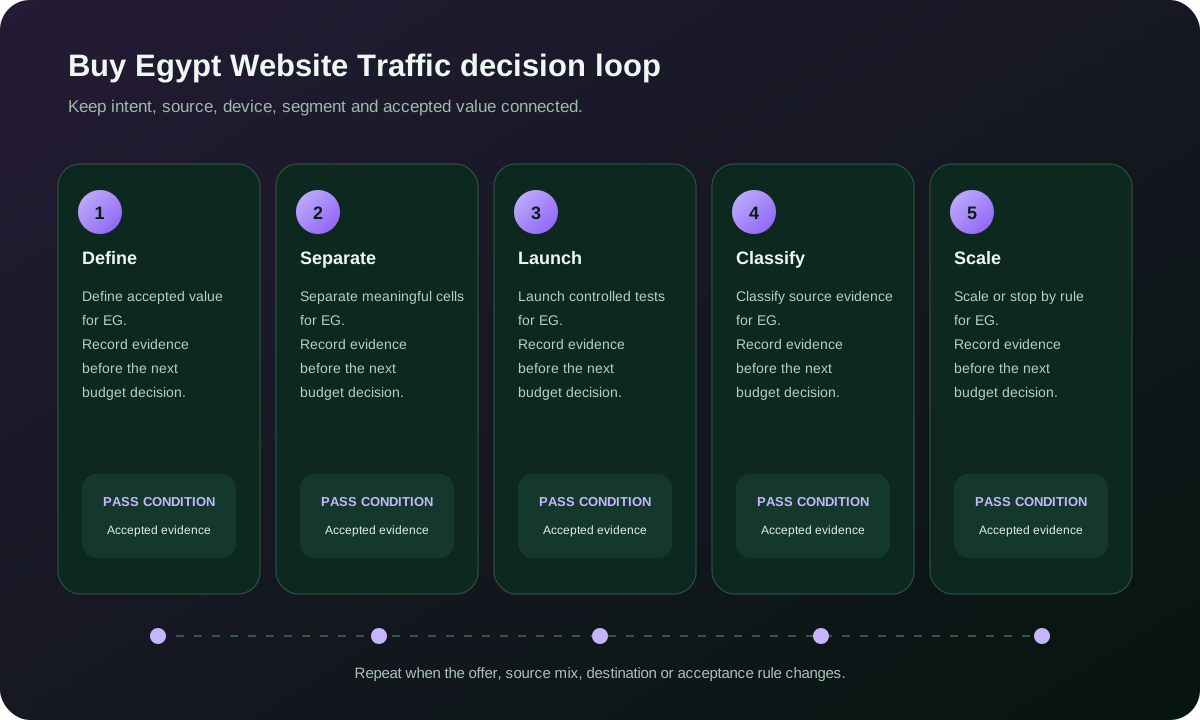
Buy Egypt Website Traffic FAQ
How do I start buying Egypt website traffic with FroggyAds?
Create your free account, choose an offer that can serve your intended Egyptian audience and check the available ad format and targeting settings. Prepare the Arabic destination and test conversion recording before funding the first campaign. Set an allocation you can supervise, submit the campaign for review and assess accepted leads or sales after delivery begins.
Does the $0.003 starting CPC guarantee Egypt traffic at that price?
No. The published Push and Native starting bid is an auction entry point, not a fixed Egypt package. Actual delivery and price depend on the format, targeting, available inventory and competition. Check our current pricing and account settings, and distinguish the bid from account funding and the campaign budget.
Is $50 the recommended budget for an Egypt campaign?
The $50 minimum is an account-deposit threshold. Your test allocation should reflect the offer, the evidence needed and the cost of preparing and reviewing the campaign. A local enquiry campaign and a subscription test may require different observation periods and different spending limits. Keep destination work and tracking costs separate from media spend.
Should I separate Cairo, Giza and Alexandria?
Separate locations when service coverage, delivery conditions, offer availability or the campaign decision differs. Do not assume a city label establishes eligibility for every address. A Cairo-only service and an online offer available more widely need different rules. Check the geographic options available for your selected campaign before creating the segmentation plan.
Can I use the same landing page for Arabic and English ads?
Only when the destination genuinely supports both journeys and makes the appropriate version usable. Check the offer, form labels, errors and confirmation in each version. An English fallback is not proof that an Arabic campaign is ready. Record creative language and destination version so a later result can be attributed to the route actually shown.
What should my developer test on an Arabic landing page?
Test base direction, mixed Arabic and Latin text, prices, telephone and email fields, required-field errors and confirmation. Review the submitted value as well as its appearance. W3C guidance distinguishes language from text direction; our implementation checklist below links to that guidance. Use fictional test inputs and repeat any failed step after repair.
How should I compare Egypt leads with orders or subscriptions?
Choose the outcome appropriate to each offer, but do not treat unlike actions as interchangeable. For a source comparison within one campaign, use the same acceptance definition and observation window. A form submission is not a paid order, and a trial registration is not a retained subscriber. Keep delivery diagnostics separate from the business event that justifies spending.
When should I exclude a weak source?
First verify that the destination and tracking work. Then inspect repeated source-level outcomes against your written cost, coverage and quality limits. Record the reason for restriction and any condition for a later retest. A broken Arabic form affecting all sources calls for a destination repair, not an unsupported judgement about a single placement.
Does traffic-quality screening guarantee sales?
No. FroggyAds uses Adscore and internal controls to help screen invalid or low-quality activity. Your offer, service coverage, destination and follow-up still determine whether valid visitors become suitable customers. Review screening signals and accepted outcomes as separate evidence rather than treating either clicks or a clean technical signal as a sales guarantee.
What should happen before I increase my Egypt traffic budget?
Confirm that tracking is stable, outcomes have had time to mature and the business can serve additional customers. Choose one expansion, such as a higher allocation or another eligible location, and state a reversal condition. Use FroggyAds campaign and source controls to implement that decision without losing the earlier setup and its results.
Continue the traffic plan
Build a campaign around accepted outcomes
Choose the market, format, device and source cells that match your offer, then measure through the event that creates real business value.
Choose the campaign controls behind Egypt traffic
The Egypt ad network guide explains localization, formats, source reporting, budget guardrails and scaling decisions for this market.
How should you test an Arabic landing path before buying more Egypt traffic?
Start with an Egyptian audience you can serve and a destination that works from the advertisement through the accepted customer action. We recommend checking the Arabic journey, location eligibility and conversion record before expanding your FroggyAds campaign. This separates three different problems: a visitor outside your service area, a usable visit that does not convert, and a customer who tries to respond but encounters a broken form. Each needs a different action; raising the bid is not a repair for all three.
Build the service-area brief before choosing additional cities
Write the areas your business can actually fulfil or support, not a list of cities selected only to increase reach. For example, a Cairo and Giza service business should identify whether an Alexandria enquiry can be accepted before treating it as a qualified lead. These are illustrative service areas, not a statement about the traffic volume or quality available in either city. Confirm the location controls available for your selected format and retain the configured settings with the campaign record.
Use the same eligibility rule at the destination and in your sales process. A form can explain the service area before submission and ask only for the information necessary to check it. Record an out-of-area enquiry separately from a duplicate, an unreachable lead or a technical error. Our Egypt ad network guide covers the broader platform decision; this launch check focuses on whether the audience you buy can complete this particular offer.
Check direction, mixed text and error states in the Arabic journey
For an Arabic destination, language and text direction are separate implementation decisions. W3C guidance explains using the HTML dir attribute for base direction rather than assuming a language declaration or visual right alignment is sufficient. Ask your developer to review the W3C structural direction guidance, then test your actual landing page rather than only its translated headline.
Include the price and currency, any Latin-script product name, a telephone field, an email address, a required-field error and the final confirmation. Mixed-direction content can place punctuation or adjacent numbers unexpectedly; the W3C inline bidirectional-text guide explains appropriate markup for those cases. Review the displayed order, keyboard interaction and submitted value. A field that looks correct but sends an altered value has not passed the test.
For each check, save the device and browser, destination version, input category, expected result and observed result. Use fictional test inputs, not customer records copied into screenshots. Repeat the failed step after a repair and keep the earlier result so you can distinguish the fixed destination from the version that originally received paid visits. An English fallback should have its own review rather than being assumed suitable for everyone reached by an Egypt campaign.
Keep language, destination and source changes distinguishable
When your offer genuinely supports both Arabic and English journeys, identify the creative language and destination version in your own campaign naming or reporting. Do not assume browser language proves a visitor's preference, or that a language-targeting control is available in every format. Start with the route that fits your offer, verify the available FroggyAds settings and use the source-ID workflow to retain the delivery context needed for a later decision.
If an Arabic-form repair and a new source are introduced together, a better conversion rate will not tell you which change helped. First verify the repair with controlled test events. Then compare a clearly identified campaign period or a deliberately designed experiment, holding the accepted-lead definition constant. Investigate a technical failure before excluding a source, and do not combine Cairo-only and wider-service-area campaigns when they use different qualification rules.
A worked Egypt lead-quality reconciliation
Hypothetical example, not a FroggyAds result: an Egypt campaign spends USD 300 and reports 12 submitted enquiries. Your review identifies two duplicates and two enquiries outside the declared service area, leaving eight accepted leads. The raw submission cost is USD 300 / 12 = USD 25.00; the cost per accepted lead is USD 300 / 8 = USD 37.50. Use the second figure for a decision based on accepted leads, while retaining the rejection reasons to diagnose the first figure.
This example does not establish profit or a recommended budget. Lead value, follow-up costs and later sales are still unknown. Use one stated review window, keep provisional outcomes separate and reconcile your conversion-tracking records before increasing spend. If later acceptance changes, update the same campaign cohort rather than presenting the earlier submission count as final value.
Choose FroggyAds for a controlled Egypt traffic purchase
Choose FroggyAds when you want to connect an Egypt traffic purchase with practical campaign and source decisions. Bring your service-area brief, tested Arabic destination and accepted-event definition; use our available targeting, budget and source controls to run the first measured test. That gives you a clear next step: repair a broken journey, refine an eligible audience or expand a campaign supported by your own accepted outcomes. Create your free FroggyAds account.
Buy Egypt Website Traffic at a glance
Your Egypt traffic launch checklist
Quick answer: With FroggyAds, plan the audience you can serve, test the Arabic destination and compare accepted customer outcomes before increasing spend. Keep account funding, auction bids and campaign budgets separate.
| Stage | What to verify |
|---|---|
| Prepare | Confirm service coverage, destination language and the accepted lead or sales event. |
| Test | Check the Arabic form, confirmation and tracking with fictional test inputs. |
| Review | Compare sources after the same acceptance window; expand only within your written limits. |
General advertising reference: FTC guidance on online advertising and marketing. This U.S. guidance is not evidence of Egypt campaign approval or a substitute for applicable local requirements.
- Plan: Match the offer to serviceable customers.
- Control: Set an affordable learning allocation.
- Decide: Use accepted leads or sales, not click volume alone.
Buy Egypt Website Traffic — what matters first
Create your account when you have an eligible offer, a tested destination and a measurable customer action. We provide the campaign and source controls; your review of accepted outcomes determines the next purchase.