
Ad Server for Publishers: Delivery, Priority and Reporting
Publisher ad serving connects commitments, eligible inventory and delivery. We explain priority, pacing, forecasting and separate revenue records.

How does a publisher ad server protect booked delivery?
Quick answer: A publisher ad server selects eligible campaigns for defined inventory and records delivery against their rules. Start with the actual commitment: an impression goal, an agreed share of eligible exposure or another documented obligation. Check its dates, placement restrictions and counting method before assigning priority or pacing. Delivery progress measures fulfilment; net revenue measures economics. FroggyAds serves advertisers buying traffic, while this reference explains the publisher controls those buyers may encounter.
| Section | Distinct excerpt from this page |
|---|---|
| Booked delivery | Separate the booked obligation, eligible placement and counted delivery before comparing a campaign with its goal. |
| Publication experience | Inspect delivery progress alongside latency, creative accuracy and the experience of the people using the publication. |
| Failure cases | A higher gross rate does not resolve an underdelivered commitment, an unexplained discrepancy or an unpaid invoice. |
Interface background for real-time bidding: IAB Tech Lab OpenRTB 2.x Real-time bidding specification.
Define the publisher commitment the server must deliver
Booked campaigns need an explicit obligation. An impression goal and a share-of-voice arrangement can both involve direct sales, but they require different progress checks. Record the agreed quantity or share, eligible inventory, dates, creative conditions and counting basis. The publisher's ad server should express the rules your chosen system supports; the contract and operations record establish what the buyer was promised.
Choosing a server becomes easier when the publisher names the problem first. An oversold placement, an inconsistent priority rule and a slow creative dependency call for different evidence. Write a representative campaign and the decision it must support. Ask the supplier to demonstrate that case, including the exceptions, rather than compare products only by the number of features advertised.
Requests, selected creatives, impression events and collected revenue belong to different stages. A request can be eligible without producing an ad, and a recorded impression can remain disputed or unpaid. Preserve those states in reporting. Matching the same date window is useful, but agreement also requires compatible definitions, identifiers and adjustment rules before two totals can be reconciled.
Check six responsibilities in the serving configuration
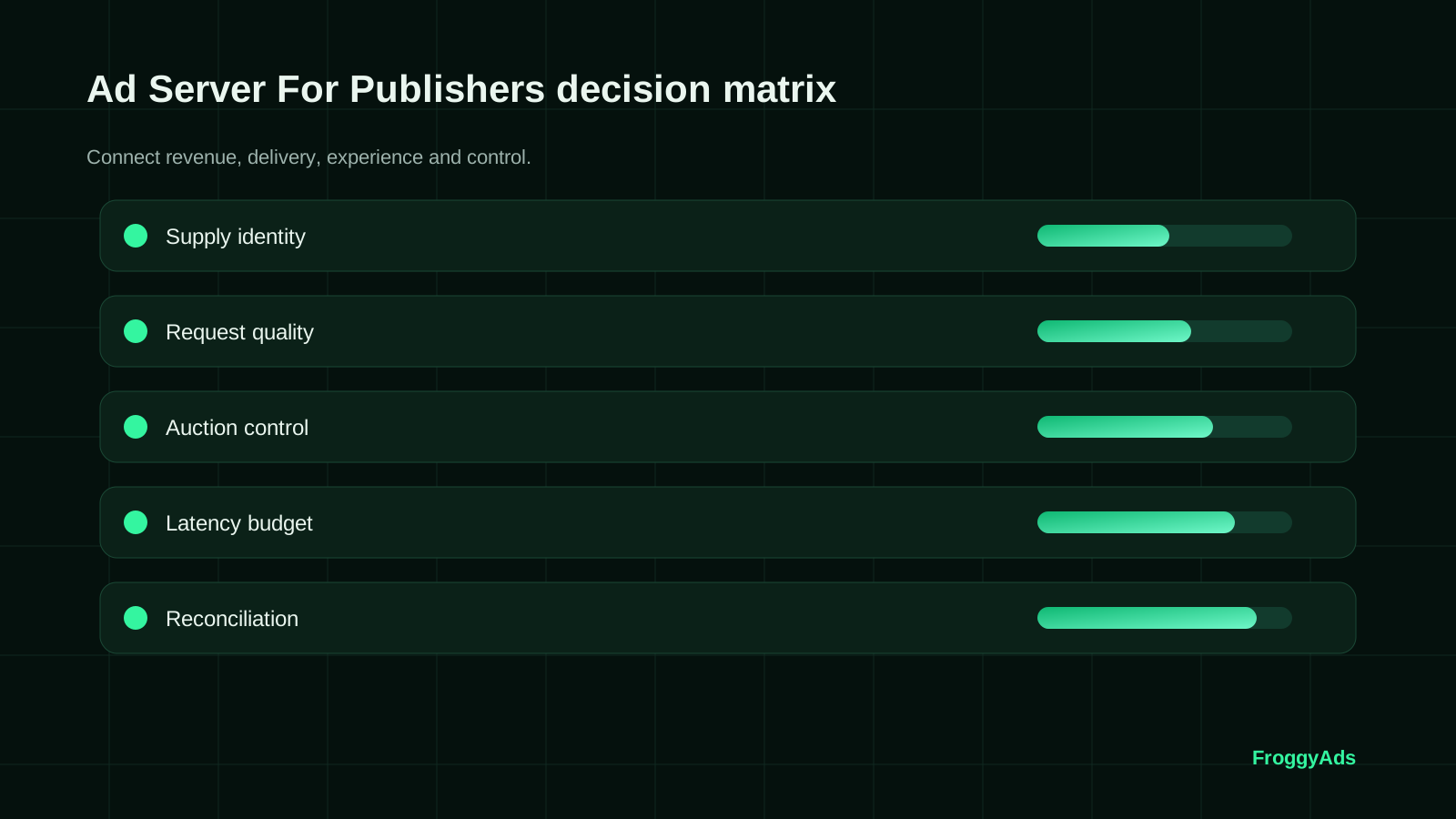
Six responsibilities connect the publisher's booking to the visitor's experience. Treat them as checks for the selected ad server and its integrations, with a named owner for any unsupported requirement. Their purpose is accurate delivery and usable evidence, rather than an assumption that more competing demand always produces a better result.
Inventory identity
Inventory records should distinguish the publication, site or app, ad unit, placement context and compatible format. Preserve the IDs used by the server and demand partners instead of replacing them with one ambiguous name. A forecast or discrepancy investigation is more useful when it can identify the exact placement and configuration involved.
Campaign eligibility
Eligibility determines which requests a campaign can genuinely use. Check its market, device, format, placement and applicable privacy or policy conditions against the supported configuration. Record what happens when a required field is missing. Traffic that cannot satisfy the booking should remain outside that campaign's available-inventory assumption, even when the site has substantial overall volume.
Commitment and priority
Priority should implement the commercial and technical rules you approved. Direct selling does not by itself establish a guaranteed obligation, and programmatic buying does not by itself mean unreserved inventory. Review the actual agreement and the selected system's line-item behavior. Test a request where commitments overlap so operations can explain which campaign is eligible and why it receives the opportunity.
Response-time budget
Latency needs a declared observation point. Measure the path the publisher can actually inspect, including external calls where relevant, and retain failed or late responses separately. A high bid cannot create useful exposure if its creative arrives too late for the page or app experience. Agree the allowed response path and fallback behavior before adding another dependency.
Delivery event mapping
Event mapping should connect the selected campaign, creative and placement with the defined impression and billing records. Keep the server's event trigger beside the demand partner's trigger, reporting delay and filtering rules. Differences need an explanation; silently overwriting one count with another makes it harder to establish which delivery the invoice actually represents.
Seller authorization
Authorization checks help explain the selling relationship when programmatic partners or intermediaries are involved. Review the applicable publisher permissions, seller identity and available transparency records. Those records address who is permitted to sell or represent inventory; they do not independently establish every impression's quality, a campaign result or a payment guarantee.
A publisher pilot from booking to delivery evidence
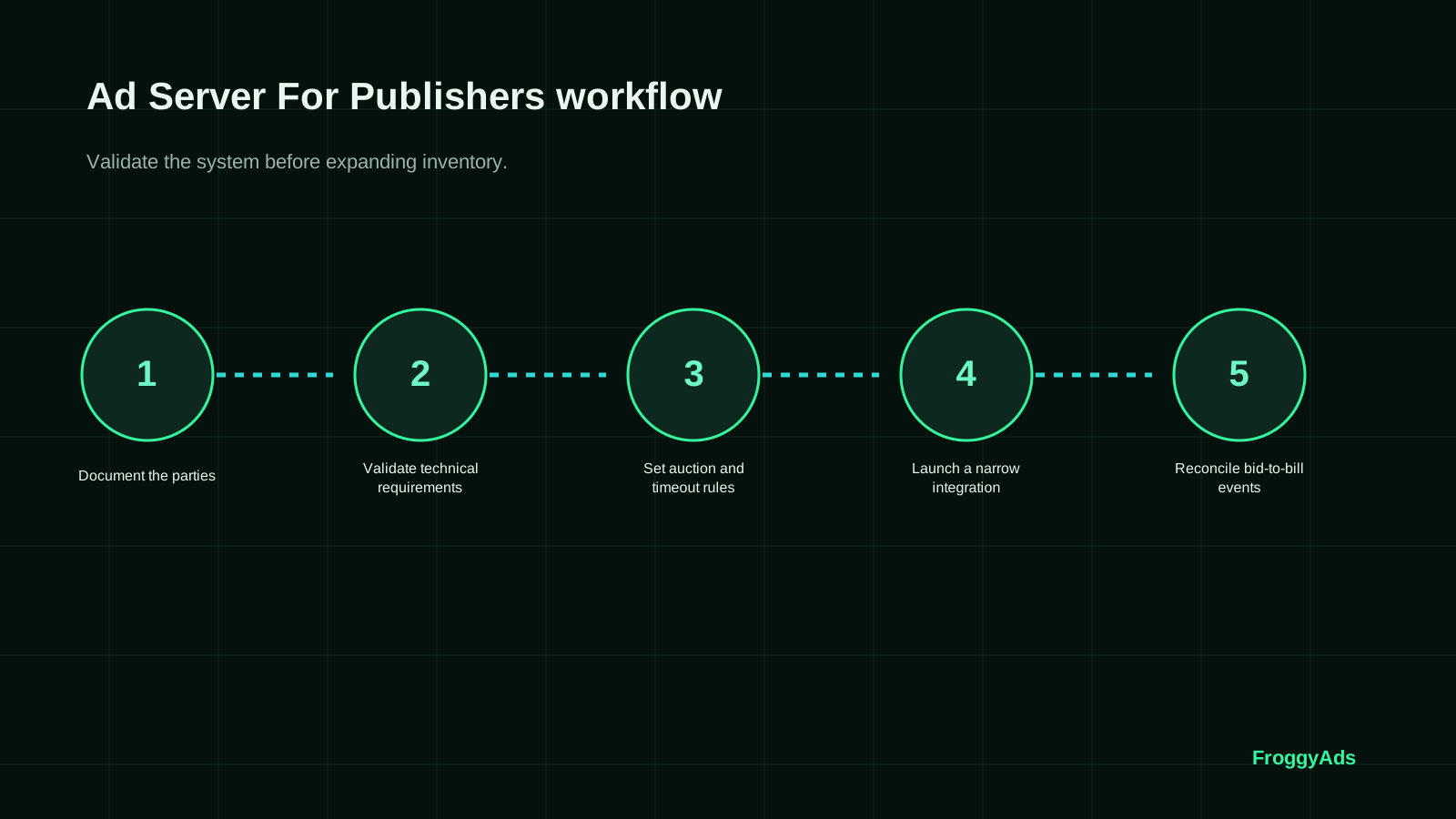
Commission the pilot around one representative inventory class and a documented campaign obligation. Use a restricted release that operations can inspect and reverse. The sequence below is a recommended evaluation workflow, with success defined by the agreed serving behavior and reporting evidence rather than a promise about revenue or an arbitrary launch date.
Record obligations before the integration
Contracts and booking records should identify the seller, advertiser, delivery terms, dates, eligible inventory and any agreed exclusions. Assign responsibility for supplying creative, resolving discrepancies and approving a change. If a demand partner represents several buyers, retain the relationship the publisher can verify and keep unknown identities explicitly unresolved rather than invent a direct relationship.
Confirm the placement and creative contract
Compatibility checks should cover the actual asset or tag, dimensions, destination behavior, secure delivery requirements and the event sequence the integration uses. Test a representative page or app configuration, including required privacy signals. A supported format name is a starting point; it does not prove that every creative implementation or external dependency is accepted.
Test priority, pacing and response limits
Competition testing should show how the selected server handles overlapping commitments and eligible non-guaranteed demand. Record the line-item rules, any pricing input and the permitted response time. Exercise a late response and a case with no eligible creative. The operator should be able to explain the selected result without relying on an undocumented exception or a vendor-specific rule assumed to apply everywhere.
Release one observable inventory class
Pilot scope should preserve a stable comparison. Begin with one compatible format, a narrow placement group and an agreed monitoring owner. Keep the previous implementation available and identify which conditions require an immediate restriction or withdrawal. Broad traffic before the request and reporting path can be explained creates more exposure without resolving the underlying integration question.
Compare counted delivery and billable records
Reconciliation should use matching campaign and placement identities, time zones, date boundaries and counting methods. Compare requests, recorded impressions, adjustments and the invoice basis as separate stages. Retain unexplained counts and provisional amounts. A supplier's report may be the contractual billing basis, but that agreement should be documented instead of presented as proof that every other system measures the same event.
Investigate overlapping or duplicate routes
Duplication can arise when multiple integrations represent the same demand or when a retried event is recorded twice. Inspect the actual seller path, request identifiers and configuration before removing a partner. Similar buyer names do not prove that the routes are identical. Record the reason for a restriction and preserve the last known working configuration so the effect can be evaluated independently.
Extend the verified delivery responsibility
Expansion should add a responsibility the publisher can observe, such as another placement class or a carefully bounded demand path. Recheck booked-campaign progress, request behavior, reporting delay and the visitor experience for that change. Keep the earlier release visible as a reference. A short pilot supports the tested conditions; it does not establish unlimited capacity or a universal uplift.
Keep fulfilment and publisher economics separate
Fulfilment describes how much of the agreed delivery has been completed under its counting rules. Publisher economics describes the value retained after relevant fees and adjustments, with collected payments distinguished from amounts still due. Report both. A campaign can meet its impression goal while producing weak net value, and a high-yield demand path can still interfere with another campaign's obligation.
Revenue reporting should state whether an amount is gross, net, provisional, invoiced or collected. Retain the currency, fee basis, adjustment window and responsible counterparty. Compare like-for-like inventory and periods before interpreting a change in yield. The number labelled revenue in a dashboard does not by itself show when cash will arrive or whether a discrepancy remains open.
Settlement timing matters when the publisher chooses which demand to retain. Preserve adjustments and unpaid amounts by the relevant partner and period, while delivery records remain available for investigation. A more recent cohort may be incomplete even when an older period has settled. Wait for the defined evidence window or label the remaining uncertainty instead of treating an estimate as a finished financial result.
| Layer | Evidence | Guardrail | Decision |
|---|---|---|---|
| Eligibility | Requests matching the campaign's placement, format and documented eligibility conditions | Required fields, permitted use and creative compatibility | Correct the scope before forecasting |
| Demand | Booked obligations, eligible competing demand and explainable seller paths | Recorded priorities, pacing rules and response limits | Retain or restrict the serving route |
| Delivery | The selected creative and its defined impression event | Asset accuracy, delay and the visitor experience | Investigate the failing handoff |
| Value | Net amounts, adjustments, invoices and collected payments | Fulfilment and economic value remain separate measures | Review the next inventory decision |
Connect bookings, eligible inventory and remaining delivery
Traceability starts with the promise made to the advertiser and ends with the evidence used to accept or dispute delivery. Retain the campaign, placement, creative and reporting version across that path. A request with no eligible ad, a selected asset that fails and a recorded impression later excluded by filtering are different outcomes. Keep enough permitted evidence to investigate each one.
Classes of inventory should reflect differences that affect delivery. Separate a reserved sponsorship placement, ordinary display inventory and a fallback opportunity when their rules differ. Record the applicable formats, commitments and user-experience limits for each class. This makes the forecast and the release test more informative than a single site-wide request total.
Ownership should cover bookings, technical delivery, reporting, privacy questions and financial reconciliation. Name the person who resolves a conflict between a campaign obligation and a new serving rule. Editorial and product teams also need a clear route for reporting intrusive or incorrect ads. A documented escalation is useful when the affected team can contain the problem and retain its evidence.
Diagnose three different publisher delivery problems
Diagnosis should identify the affected obligation and the first failing stage. The same headline result can require a different repair depending on whether inventory is unavailable, a creative arrives late or a reported amount remains unpaid. Use the following cases to select the next investigation, with a restricted change and a named owner.
Competitive bids arrive after the response limit
Timeouts should be investigated with actual request timing and creative behavior. A demand source can offer an attractive price while returning too late for the allowed page experience. Inspect the affected placement and dependency before changing the limit. Compare the completed, eligible delivery and retained value for the new configuration instead of treating every late bid as revenue the publisher could have collected.
Gross reporting looks stronger than the settlement record
Collections may lag reports for several reasons, including agreed payment terms, adjustments or an unresolved dispute. Match the counterparty, invoice period, fees and accepted delivery before diagnosing the gap. Keep the amount outstanding separate from recognized net revenue and cash received. A serving change should not receive credit for improving payment reliability merely because its first estimated eCPM is higher.
A new demand route returns no eligible ad
Missing responses need a request-level investigation. Check the permitted inventory, required fields, format, consent state, partner eligibility and error record where those details are available. Exercise the fallback order under the allowed response time. Raising volume before the route can return an eligible creative may increase request cost or complexity without adding useful publisher delivery.
Protect the publication and the advertiser's promise
Readers and app users experience the complete placement, including its loading behavior, labeling and interruption pattern. Keep those conditions in the release review rather than treat them as an unrelated design concern. A change that makes more inventory technically available can still reduce the value of the publication if it repeatedly obstructs the content or damages the experience people came for.
Advertisers need accurate placement descriptions and delivery records they can understand. Preserve the agreed context, creative restrictions and counting method when inventory is packaged for a buyer. Avoid implying that a premium label alone proves quality. FroggyAds advertisers use campaign and source evidence for buying decisions; a publisher's clear inventory and reporting boundaries help those decisions remain explainable.
Changes should preserve the previous placement and serving configuration until the result is understood. Adjust one material responsibility at a time, such as an eligible format or a specific demand route. Monitor the effect on existing commitments and visitor conditions. Reversibility is useful when the prior setting remains permitted and its creative and destination are still current.
Five errors that obscure the serving decision
Mistakes become easier to correct when the publisher can identify which evidence was lost or which responsibility was left unclear. Review these failure cases before the next integration or campaign release. Each one calls for an actual operating correction rather than a more optimistic target in the dashboard.
Optimisation before campaign obligations are separated can hide an underdelivered booking inside strong total volume. Restore the placement and line-item breakdown, then compare each obligation with its own counted progress and remaining eligible inventory.
Concurrent changes to priority, demand routes and placement behavior weaken the explanation of a result. Retain the combined release record when such a change is unavoidable, and avoid claiming that one component caused the observed improvement.
Unreconciled fees and adjustments can make gross yield appear more useful than it is. Preserve the reporting basis, counterparty and unresolved amount, then compare the same mature inventory window before changing the commercial decision.
Treating visitor impact as a separate issue leaves operations without a meaningful limit. Agree which placement or delivery conditions require a restriction and who can act when editorial, product or support identifies a problem.
Premature expansion can carry an unexplained event mismatch into more inventory. Investigate the request, counting and settlement boundaries first, and keep the new route restricted while the relevant delivery or financial evidence remains unresolved.
Standards and provider-specific serving documentation
Standards describe particular interfaces or transparency records, while the selected server's documentation explains its actual delivery behavior. Read them for their stated purpose. OpenRTB does not establish every publisher server's priority model, and a seller record does not certify each campaign outcome. Use the linked references with your own contract, configuration and event evidence.
- OpenRTB guidance: IAB Tech Lab OpenRTB 2.xReal-time bidding specification
- Seller transparency: IAB Tech Lab sellers.jsonSeller and intermediary transparency
- Authorized selling: IAB Tech Lab ads.txtAuthorized digital sellers
- Chain reference: IAB Tech Lab supply-chain foundationsProgrammatic supply foundations
Publisher ad-server questions
Practical answers below address inventory owners evaluating commitments, placement configuration and reporting. They describe checks for the product you select. FroggyAds' advertiser resources remain the next step for a team buying traffic rather than configuring a publisher ad server.
What should a publisher define before choosing an ad server?
Requirements should name the inventory, campaign commitments, supported creative routes, reporting definitions and integration limits. Include the operators who will investigate discrepancies and withdraw an unsuitable release. Ask a prospective supplier to demonstrate representative cases rather than rely on feature names alone.
How should an ad server prioritize direct and programmatic demand?
Contracted obligations and the server's actual line-item behavior should determine priority. Direct and programmatic deals can have different reservation terms, so avoid a universal rule that one label always wins. Test overlapping eligible campaigns and preserve the reason for the selection.
How does pacing help a publisher deliver booked campaigns?
Pacing distributes the remaining delivery obligation across the eligible time and inventory the campaign can use. Compare counted progress with the booked terms and investigate changes in available supply. An impression goal and a share-of-voice booking require their own progress rules.
Which inputs improve ad inventory forecasts for publishers?
Recent inventory patterns, seasonality, placement restrictions, compatible creatives and existing commitments inform a forecast. Treat the projected amount as an estimate. Confirm which obligations the selected system includes and retain assumptions when presenting availability to sales or an advertiser.
Why should publishers track ad-server latency with revenue?
Response delay can interrupt delivery after one system has recorded its event. Inspect the actual timing and creative path alongside counted impressions and visitor conditions. A higher bid or reported rate does not compensate for a route that cannot deliver an eligible ad within the allowed experience.
How should a publisher reconcile ad-server and demand-platform totals?
Align the campaign scope, date range, time zone, event trigger and adjustment status before comparing reports. Retain requests, impressions, filtered events, invoices and payments as distinct records. Investigate the unexplained remainder with the relevant partner rather than force incompatible totals to match.
Which creative controls should an ad server give publishers?
Creatives need documented format, size, destination, category and placement eligibility rules. Verify the controls supported by the selected server and retain an actionable reason for rejection. Material changes to an approved asset or offer should trigger the applicable review again.
What should happen when a demand source does not return an ad?
Fallback should follow the publisher's approved order and response limit. A permitted house campaign or another eligible route may be available, but its use must respect the actual placement and creative rules. Avoid delaying the publication indefinitely while waiting for demand that does not respond.
How detailed should publisher ad-server reporting be?
Reporting needs enough placement, campaign, creative, demand and event detail to explain delivery and the billing basis. Record unavailable fields as limitations. A dashboard total is useful for monitoring, while a discrepancy or commitment review often needs the underlying compatible breakdown.
How can a publisher move to a new ad server with less risk?
Migration should preserve placement and campaign mappings, current commitments and the previous recoverable configuration. Test representative requests, creative routes and reporting windows before a restricted release. Reconcile overlapping or duplicated events during the transition instead of counting both systems' totals as additional delivery.
Continue with the related publisher infrastructure decisions
Adjacent guides address different choices: auction sequence, SSP responsibility and the handling of available inventory. Use them when those are the unresolved parts of your plan. A shared word such as programmatic does not make the serving, selling and traffic-buying decisions interchangeable.
Connect the publisher context with an advertiser's media plan
Our self-serve advertiser platform helps buyers choose supported formats, targeting and source controls for a measured traffic purchase. Use FroggyAds when that is the task your team needs to operate. The publisher-side knowledge in this guide helps explain delivery and reporting boundaries without presenting our advertiser account as a publisher serving or revenue-management product.
Keep a commitment ledger that operations can reconcile
Direct obligations, eligible supply, selected creatives and accepted delivery should meet in one explainable record. Keep commercial commitments separate from projected inventory and from later settlement. The operating checks below help a publisher identify what was promised, what the serving configuration could use and which evidence supports the next inventory or partner decision.
Define the booked quantity and eligible delivery
An impression-goal booking needs a quantity, flight dates and a definition of counted eligible delivery. A share-of-voice arrangement needs its agreed share and denominator. Preserve the actual terms rather than convert every campaign to a universal eCPM comparison. The publisher can then explain whether a change affected fulfilment, economic value or both.
Identifiers should connect the booking, line item, placement and creative release where the systems support that relationship. Retain the original partner IDs as well as the publisher's internal mapping. Missing joins remain a limitation, especially when a report is aggregated. A convenient label should not replace the evidence needed to investigate a disputed delivery period.
Retain the placement's permitted selling relationships
Placement records should identify the inventory owner and the parties permitted to represent it. Review the available authorization and intermediary information for the relevant route. Record what the evidence establishes and what remains unknown. A reported seller name can help explain a path without proving ownership, the quality of every request or eventual payment.
Intermediaries need a stated role in the transaction and the reporting chain. Preserve the applicable fees, delivery definitions and discrepancy contact instead of hiding all routes in one blended result. The advertiser's media system and the publisher's serving system may use different identifiers; explain the mapping that can actually be verified and avoid inventing a direct relationship.
Pilot one booking against a stable placement group
Start with a restricted case that operations can investigate completely. Fix the compatible format, placement group, approved creative and campaign obligation, then state the expected request and event sequence. Exercise the pause or withdrawal route as well as normal delivery. The pilot should resolve a concrete serving question before another demand partner or inventory class is added.
Maturity rules should distinguish technical observations from delivery acceptance and financial settlement. A request can be investigated immediately while a discrepancy or payment remains unresolved later. Record the evidence window appropriate to each decision. Expanding a new route because its first gross rate looks attractive can miss an obligation shortfall or an adjustment that arrives after the initial report.
Calculate remaining booked delivery before changing pacing
Floors and prices should retain their units and their place in the decision. A bid floor, an agreed campaign price, a reported gross rate and publisher net revenue answer different questions. Check how the selected system applies those values alongside eligibility and commitments. Changing a price input should not silently rewrite what an advertiser was promised or what the publisher counts as accepted delivery.
Schedules need to reflect the obligation remaining. In an invented example, a campaign booked for 40,000 eligible impressions over 10 days has delivered 12,000 after day 4. That is 30% of the goal against 40% of elapsed time. The remaining 28,000 across six days requires about 4,667 eligible impressions per day if uniform daily pacing is the chosen plan. Availability, booking terms and counting rules still determine whether that plan is feasible; the figures are illustrative, not a delivery guarantee.
Investigate quality within the actual placement and event scope
Quality review should connect creative compliance, invalid-activity findings, visitor conditions and the permitted placement context. Keep those observations alongside the actual delivery definition. A high fill percentage or a premium description does not replace that investigation. Share the permitted evidence needed by the relevant advertiser or demand partner without exposing unrelated personal or business data.
Monitoring should identify the condition that requires containment and the operator who can act. Examples include an expired creative continuing to appear, a broken reporting join, an unexplained increase in rejected events or an authorization change. Restrict the affected route while the cause is investigated, retain the prior approved configuration and document the checks needed before activity resumes.
Separate fulfilment, recognized net value and collected cash
Buyer and publisher records can describe different parts of the same campaign. The publisher establishes contracted delivery and the amount it may invoice, while the advertiser judges its own accepted customer actions and acquisition cost. Neither record automatically proves the other. Preserve compatible campaign and period identifiers so a delivery question can be discussed without inventing downstream business results.
Marginal reporting should show the newest inventory or demand change separately from the older stable result. In another invented example, USD 600 gross revenue less USD 90 fees and USD 30 adjustments leaves USD 480 net. Across 200,000 counted impressions, that is USD 2.40 net eCPM. Track what has actually been collected separately. These inputs illustrate the reporting boundary and do not describe FroggyAds rates, publisher payments or achieved yield.
Keep permissions, permitted data and incident ownership current
Permissions should match the publisher tasks a person or integration performs. Verify the roles available in the selected product, keep account ownership recoverable and review access when suppliers or staff change. Preserve required privacy signals through the approved route and retain only the information needed for the documented purpose. Technical acceptance alone does not resolve missing authorization or an unsupported data use.
Incidents should have a containment record naming the affected campaign, placement, creative version, observed failure and responsible operator. An advertiser-facing error, a disputed amount and a compromised credential require different actions. Preserve the relevant evidence while the configuration is still inspectable. A supplier can help diagnose the issue, but the publisher still needs an accountable decision about the release it controls.
Approve another responsibility only when the current one is explained
Scaling should follow a documented reason to add inventory, a campaign class or a demand route. Preserve the existing obligation ledger and compare the new scope under compatible counting and reporting conditions. Keep request behavior, visitor impact and unresolved amounts visible rather than let a larger total stand in for an explanation of the change.
Approval for the next release should identify the tested conditions, unresolved limits and permitted recovery action. Retain the previous eligible configuration and the records needed to explain why the change was accepted. Restrict the new scope when a material assumption changes, then investigate the specific delivery or settlement issue before allowing it to influence a wider inventory decision.
| Gate | Required evidence | Pass condition | Failure response |
|---|---|---|---|
| Authorization | Inventory owner, permitted selling relationship, relevant agreements and available transparency records. | Included routes have a documented authority and an explainable reporting relationship. | Restrict an unverified relationship and retain the known permitted path. |
| Delivery contract | Campaign goal, dates, eligible placements, creative rules, counting method and event mapping. | The serving configuration and report refer to the same obligation and release. | Correct the conflicting rule before accepting additional commitments. |
| Quality | Creative eligibility, relevant invalid-activity findings, response behavior and visitor conditions. | The new scope passes its actual delivery and experience checks. | Contain the affected placement or creative. |
| Economics | Reported gross, fees, adjustments, net amounts, invoice status and cash received. | Financial claims retain their basis, maturity and unresolved amount. | Hold the new commercial decision until its records reconcile. |
| Repeatability | Representative placements, requests and campaign overlaps under the documented configuration. | The observed behavior repeats without changing eligibility or counting. | Keep the new responsibility restricted while exceptions remain. |
Publisher release checklist
- Name the booked quantity or share and its eligible delivery definition.
- Document the publisher, buyer and permitted intermediary relationships.
- Preserve campaign, placement, creative, request and reporting identifiers where available.
- Verify creative eligibility, permitted data use and the applicable selling authority.
- Test overlap, missing fields, late responses, expired assets and duplicated events.
- Set response limits, monitoring responsibilities and the recoverable configuration.
- Separate counted fulfilment, net reporting, invoices and collected amounts.
- Increase one inventory or demand responsibility after its actual delivery, experience and reporting checks pass.
Primary documentation
- Protocol specification: IAB Tech Lab: OpenRTB 2.x current specification
- Selling authorization: IAB Tech Lab: ads.txt authorized sellers
- Intermediary records: IAB Tech Lab: sellers.json and SupplyChain
- Supply-chain framework: IAB Tech Lab: Supply Chain Foundations
- Google example: Google Ad Manager: Line item types and priorities
- Security guidance: IAB Tech Lab: Security and fraud
Related FroggyAds resources
Resources below separate traffic purchasing, publisher serving and remnant inventory. Use the traffic marketplace guide for the buyer-side transaction, revisit this ad-server guide for delivery configuration, and assess remnant inventory separately before committing unsold opportunities. Each resource supports a different operating decision.
The inventory decision this publisher guide owns
Use this page to evaluate the publisher's responsibility for campaign commitments, eligible inventory, serving decisions and reporting. The next action should identify a configuration, booking or reconciliation question the team can actually resolve. Advertiser acquisition through FroggyAds remains a separate buying workflow with its own campaign controls and accepted customer outcomes.
Scope: follow the unresolved job. This guide addresses how a publisher records and fulfils delivery obligations. A video-format specification, an SSP agreement and a choice of auction sequence require their own implementation or commercial review. Reuse the relevant definitions while keeping each decision's evidence and accountable owner distinct.
Evidence for a publisher release: identify the booking, eligible placement, creative version, serving rule and reporting window. Preserve its actual limitations and the reason for the next action. A claim about better delivery, net value or visitor conditions needs supporting observations from the affected scope rather than a general statement about the platform.
Progress review: compare accepted progress with the obligation and the eligible time remaining. Explain a shortfall using the actual placement restrictions, competing commitments and available supply. Retain the forecast assumptions and any unresolved discrepancy so sales and operations can agree which change is justified.
Overlap test: exercise the requests that make the choice difficult: overlapping bookings, an ineligible creative, missing fields or demand arriving after the allowed response time. Record the selected result and the reason the configuration produced it. That evidence is more useful than assuming that one buying label always takes precedence.
Release readiness: confirm the compatible creative route and reporting record needed for the booking before a wider release. Review the experience people will receive and identify who can contain an unsuitable release. A later yield improvement does not repair an untraceable creative change or an obligation that the new placement cannot satisfy.
| Publisher checkpoint | How to use it | Evidence to retain |
|---|---|---|
| Booking definition | Record the quantity or share, dates, eligible placements and counting basis. | Keep the booking version, goal, excluded inventory and accountable owner. |
| Priority decision | Test overlapping commitments and eligible demand against the selected system's rules. | Retain the configuration, selected creative and reason for that serving result. |
| Pacing review | Compare accepted progress with the remaining obligation and eligible inventory. | Record the current forecast, changes in supply and the permitted recovery action. |
Choose FroggyAds for the advertiser's buying task
We focus FroggyAds on the advertiser's traffic-buying task. Our self-serve campaign, targeting and source controls help you plan and evaluate that purchase. Continue to the FroggyAds advertiser resources when your team needs that buying workflow, while retaining the publisher's serving, inventory and settlement responsibilities in the appropriate systems.
Begin with the obligation and the inventory that can fulfil it
Your publisher serving plan should explain what the campaign is owed, which opportunities can satisfy it and how counted delivery will be accepted or disputed. Keep economic and cash records alongside that operational view, with their differences visible. Approve another inventory responsibility only when the relevant evidence and recovery path support the decision.