
Channel diversificationDefine the decisionDefine the business outcome: an accepted conversion measured after source-specific traffic has matured. Then state the budget or delivery decision the data must support. Control the evidenceEvaluate results at the channel and source cohort level so strong and weak delivery are not hidden inside one average. Protect qualityRead cost per accepted conversion beside conversion value and scale capacity and lower-intent traffic, creative requirements and attribution differences before increasing spend.
Google Ads too expensive: alternatives for controlled acquisition
Search Baseline boundary: the current Google campaign keeps its query intent, offer, service area, conversion definition and mature cost visible. A dedicated search baseline observation records how the baseline report separates bid pressure, lost eligibility, destination loss and backend rejection before another channel is blamed or credited.

Evidence boundary for Google Ads Too Expensive Alternatives
When Google Ads feels too expensive, the first task is to identify whether auction cost, query intent, landing continuity, tracking or accepted economics is causing the loss. The Google Ads budget and bidding guidance documents platform budget and bidding controls, but a setting cannot determine whether another channel will produce a cheaper accepted customer. For example, preserve a stable search cohort while a capped alternative-format cell uses the same offer, destination, conversion definition, maturity window and rejection rules. Compare cost per accepted outcome after attribution and backend reconciliation, not click price alone. Document which source and placement created each visit, and stop the new cell if the tracking chain breaks or the maximum loss is reached. A lower starting bid or funding threshold is not evidence of better traffic. Reallocate only when the alternative survives the same serviceability, compliance and commercial acceptance tests as the search baseline.
Key takeaways
Search Baseline: define the decision boundary
Evidence the search baseline file must preserve
Quick answer: Search Baseline evidence begins where the baseline report separates bid pressure, lost eligibility, destination loss and backend rejection before another channel is blamed or credited. The corresponding search baseline calculation then shows that alternative performance is compared with the same advertiser-approved outcome and observation window rather than with raw click price.
| Section | Distinct excerpt from this page |
|---|---|
| Build the decision before buying more delivery | Tie the reallocation decision to one mature customer result, a named discovery context and a source cohort that can be isolated when quality deteriorates. |
| One interpretable unit | Use channel and source cohort as the operating unit. |
| Guardrails before growth | Set explicit limits around lower-intent traffic, creative requirements and attribution differences. |
Search Baseline arithmetic applies this rule: alternative performance is compared with the same advertiser-approved outcome and observation window rather than with raw click price. A separate search baseline exception exposes when moving spend without diagnosing the baseline carries tracking or landing-page failure into every new source. Retained reference: Google Ads Help: How the ad auction works
Before moving budget away from Google Ads, record what made the search campaign expensive: auction prices, weak query relevance, a low landing-page conversion rate or incomplete tracking. Keep a usable search campaign unchanged while you test another source. We recommend comparing the two against the same accepted lead or sale definition so a tracking fault is not mistaken for an advantage of the new channel. That gives you a fair baseline for a FroggyAds traffic test.
- Planning: Build the decision before buying more delivery.
- Control: What google ads too expensive alternatives requires before media starts.
- Decision: Build the campaign around user context, not channel labels.
Core controls
Calculate search baseline without blended shortcuts
Search Baseline release returns to one action: protect the stable search cohort and write the exact condition that justifies reallocating a measured share. Its final search baseline note confirms that the current Google campaign keeps its query intent, offer, service area, conversion definition and mature cost visible.
Diagnose the search baseline failure state
Channel Intent boundary: each alternative is assigned a role based on how its users encounter the message rather than a generic cheaper label. A dedicated channel intent observation records how the plan distinguishes expressed search demand from discovery, interruption, publisher context and repeat exposure across eligible formats.
Release or reverse the search baseline change
Channel Intent evidence begins where the plan distinguishes expressed search demand from discovery, interruption, publisher context and repeat exposure across eligible formats. The corresponding channel intent calculation then shows that cost is read with source-level qualification and accepted value so unlike attention contexts are not treated as interchangeable.
Channel Intent: define the decision boundary
Channel Intent arithmetic applies this rule: cost is read with source-level qualification and accepted value so unlike attention contexts are not treated as interchangeable. A separate channel intent exception exposes when a low-cost audience receives a message designed for high intent and produces activity that cannot satisfy the offer.
Planning
Evidence the channel intent file must preserve
Channel Intent risk review names the failure mode: a low-cost audience receives a message designed for high intent and produces activity that cannot satisfy the offer. The documented channel intent response is to adapt the proposition to the encounter while keeping product, material conditions and final acceptance rule stable.
Channel Intent release returns to one action: adapt the proposition to the encounter while keeping product, material conditions and final acceptance rule stable. Its final channel intent note confirms that each alternative is assigned a role based on how its users encounter the message rather than a generic cheaper label.
Format Contract boundary: display, native, push, pop, video or other selected delivery retains its own creative constraints and billable event. A dedicated format contract observation records how the experiment logs dimensions, message edition, source, placement where available, device and landing build for every format cell.
Connect the guide to live testing
Connect Google Ads too expensive to a controlled audience test
Use the choices established in “Evidence the channel intent file must preserve” to define one audience, budget and source set in FroggyAds. Keep the surrounding offer and measurement rule stable so the test adds evidence to google ads too expensive instead of mixing several changes at once.
Create My Free Account
Execution
Calculate channel intent without blended shortcuts
Format Contract arithmetic applies this rule: native CPM or CPC diagnostics remain native until results meet at one reconciled commercial event. A separate format contract exception exposes when combining format totals erases the context needed to pause a weak placement or explain a cost difference.
Format Contract risk review names the failure mode: combining format totals erases the context needed to pause a weak placement or explain a cost difference. The documented format contract response is to preserve format-specific reporting and compare only the mature result shared by the business decision.
Format Contract release returns to one action: preserve format-specific reporting and compare only the mature result shared by the business decision. Its final format contract note confirms that display, native, push, pop, video or other selected delivery retains its own creative constraints and billable event.
Measurement
Diagnose the channel intent failure state
Offer Continuity evidence begins where a versioned review follows the first visible cue through landing content, form or checkout, errors and confirmation. The corresponding offer continuity calculation then shows that the accepted-cost calculation includes only visitors who encountered the tested promise and completed its documented backend criteria.
Offer Continuity arithmetic applies this rule: the accepted-cost calculation includes only visitors who encountered the tested promise and completed its documented backend criteria. A separate offer continuity exception exposes when creative drift manufactures apparent efficiency by changing who responds instead of improving acquisition for the same offer.
Offer Continuity risk review names the failure mode: creative drift manufactures apparent efficiency by changing who responds instead of improving acquisition for the same offer. The documented offer continuity response is to repair the broken message chain and rerun that source cell before interpreting its media rate.
Scale
Release or reverse the channel intent change
Source Identity boundary: campaign, asset, inventory source, placement, click key, destination edition and event time are retained wherever available. A dedicated source identity observation records how the identifier map states which fields the alternative platform supplies and how they join analytics and first-party records.
Source Identity evidence begins where the identifier map states which fields the alternative platform supplies and how they join analytics and first-party records. The corresponding source identity calculation then shows that source-level spend and accepted outcomes produce an actionable cost that can support exclusion, observation or expansion.
Source Identity arithmetic applies this rule: source-level spend and accepted outcomes produce an actionable cost that can support exclusion, observation or expansion. A separate source identity exception exposes when missing provenance forces the analyst to rely on blended averages and prevents containment of concentrated poor quality.
Choose the execution format
Choose a paid-media format that supports Google Ads too expensive
Use the criteria around “Release or reverse the channel intent change” to decide whether push, native, display or pop fits the message and destination. Set format, targeting and spend as campaign controls in FroggyAds while the google ads too expensive decision remains the standard for judging the result.
Create My Free Account
Operating sequence
Format Contract: define the decision boundary
Source Identity release returns to one action: stop optimization when reconciliation fails and restore the path before adding another channel or budget increment. Its final source identity note confirms that campaign, asset, inventory source, placement, click key, destination edition and event time are retained wherever available.
Evidence the format contract file must preserve
Acceptance Rules boundary: the business defines qualification, duplication, rejection, cancellation, refund and later-value treatment before launch. A dedicated acceptance rules observation records how front-end and platform conversions remain provisional until the selected source cohort completes the declared maturity window.
Calculate format contract without blended shortcuts
Acceptance Rules evidence begins where front-end and platform conversions remain provisional until the selected source cohort completes the declared maturity window. The corresponding acceptance rules calculation then shows that all channels use the same accepted-event denominator even while their buying units and attribution diagnostics stay separate.
Diagnose the format contract failure state
Acceptance Rules arithmetic applies this rule: all channels use the same accepted-event denominator even while their buying units and attribution diagnostics stay separate. A separate acceptance rules exception exposes when a channel seems cheaper because it reports earlier or applies a looser event definition than the search baseline.
Release or reverse the format contract change
Acceptance Rules risk review names the failure mode: a channel seems cheaper because it reports earlier or applies a looser event definition than the search baseline. The documented acceptance rules response is to restate the contract, recalculate mature cohorts and defer reallocation until comparable business outcomes exist.
Offer Continuity: define the decision boundary
Acceptance Rules release returns to one action: restate the contract, recalculate mature cohorts and defer reallocation until comparable business outcomes exist. Its final acceptance rules note confirms that the business defines qualification, duplication, rejection, cancellation, refund and later-value treatment before launch.
Evidence the offer continuity file must preserve
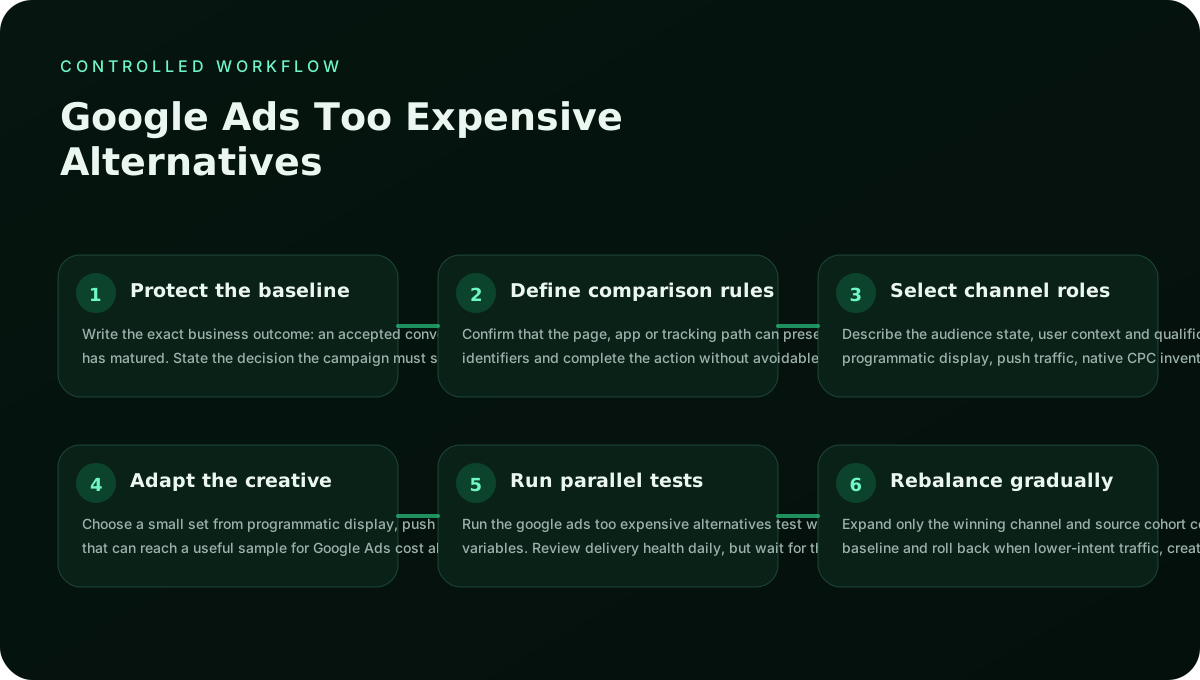
Parallel Proof boundary: a bounded alternative and the protected Google reference run with controlled offer, destination and measurement conditions. A dedicated parallel proof observation records how the test register predeclares sample requirement, maximum loss, review cadence, decision owner and the one variable allowed to change.
Measurement model
Calculate offer continuity without blended shortcuts
Parallel Proof evidence begins where the test register predeclares sample requirement, maximum loss, review cadence, decision owner and the one variable allowed to change. The corresponding parallel proof calculation then shows that incremental accepted cost and value are calculated after both cohorts mature, with source concentration and operational load beside them.
Parallel Proof arithmetic applies this rule: incremental accepted cost and value are calculated after both cohorts mature, with source concentration and operational load beside them. A separate parallel proof exception exposes when sequential tests confuse channel effects with season, creative edits, product changes or site conditions occurring between periods.
Parallel Proof risk review names the failure mode: sequential tests confuse channel effects with season, creative edits, product changes or site conditions occurring between periods. The documented parallel proof response is to use comparable windows where feasible and document unavoidable differences before judging the alternative.
Parallel Proof release returns to one action: use comparable windows where feasible and document unavoidable differences before judging the alternative. Its final parallel proof note confirms that a bounded alternative and the protected Google reference run with controlled offer, destination and measurement conditions.
Quality Guardrails boundary: lower-intent share, source concentration, invalid behavior, landing loss, qualification and acceptance each receive explicit limits. A dedicated quality guardrails observation records how daily monitoring handles technical faults while commercial decisions wait for the full outcome delay and stable counts.
Quality Guardrails evidence begins where daily monitoring handles technical faults while commercial decisions wait for the full outcome delay and stable counts. The corresponding quality guardrails calculation then shows that a promising rate must remain inside every declared quality boundary instead of compensating one failure with another metric.
Quality Guardrails arithmetic applies this rule: a promising rate must remain inside every declared quality boundary instead of compensating one failure with another metric. A separate quality guardrails exception exposes when early percentage movement on a handful of events triggers premature scaling and consumes the evidence needed for diagnosis.
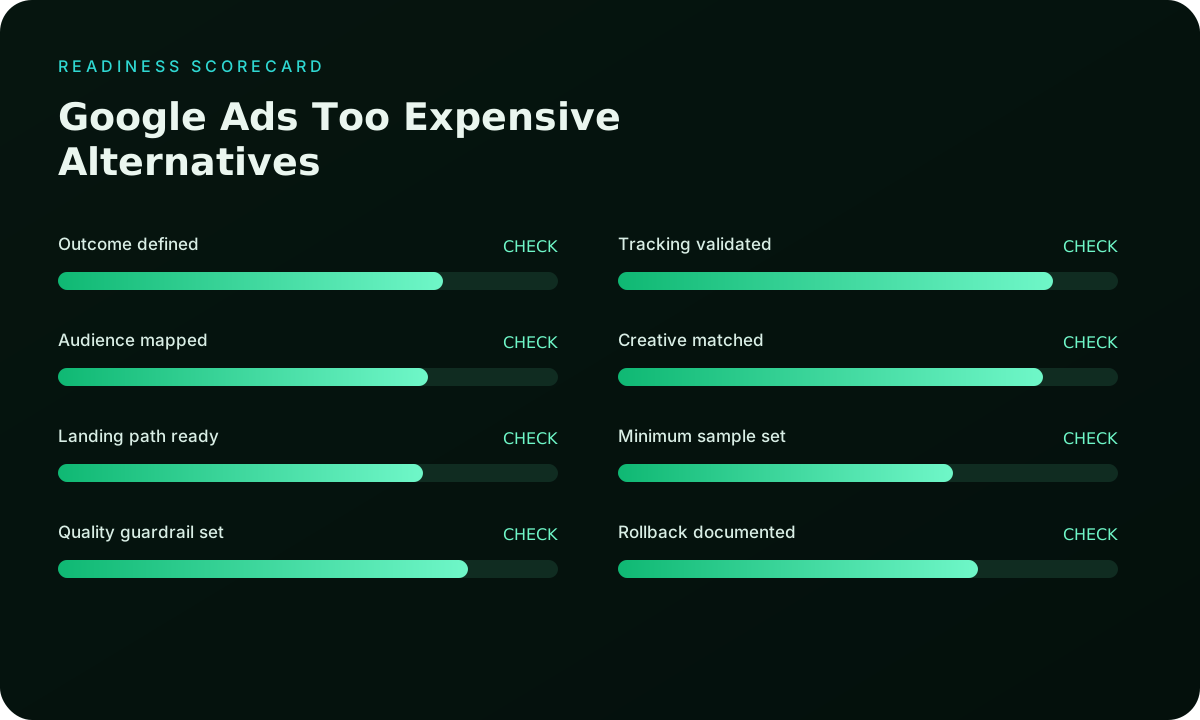
Outcome defined
Tracking validated
Audience mapped
Creative matched
Landing path ready
Minimum sample set
Quality guardrail set
Rollback documented
Diagnose the offer continuity failure state
Readiness view
Release or reverse the offer continuity change
Quality Guardrails risk review names the failure mode: early percentage movement on a handful of events triggers premature scaling and consumes the evidence needed for diagnosis. The documented quality guardrails response is to hold or reduce the newest cell when a guardrail fails, preserving the last interpretable configuration for retest.
Put the guide into practice
Turn Google Ads too expensive into a bounded campaign test
With “Release or reverse the offer continuity change” documented, launch only the next reversible test. Set a spending limit, preserve the baseline and use source-level and audience controls so the next step depends on qualified outcomes for google ads too expensive, not activity volume.
Create My Free Account
Campaign scenarios
Source Identity: define the decision boundary
Quality Guardrails release returns to one action: hold or reduce the newest cell when a guardrail fails, preserving the last interpretable configuration for retest. Its final quality guardrails note confirms that lower-intent share, source concentration, invalid behavior, landing loss, qualification and acceptance each receive explicit limits.
Evidence the source identity file must preserve
Marginal Transfer boundary: budget moves in measured increments after the alternative proves tracking, quality, maturity and accepted economics. A dedicated marginal transfer observation records how the newest spend slice is reviewed for changed source mix, frequency, conversion value, sales load and delayed rejection.
Calculate source identity without blended shortcuts
Marginal Transfer evidence begins where the newest spend slice is reviewed for changed source mix, frequency, conversion value, sales load and delayed rejection. The corresponding marginal transfer calculation then shows that marginal cost uses outcomes generated by the increment rather than the blended average accumulated before expansion.
Diagnose the source identity failure state
Marginal Transfer arithmetic applies this rule: marginal cost uses outcomes generated by the increment rather than the blended average accumulated before expansion. A separate marginal transfer exception exposes when the first efficient inventory masks deterioration as broader or less responsive contexts enter the campaign.
Avoidable mistakes
Release or reverse the source identity change
Assuming a lower cpc automatically creates a lower cpa.
Optimizing cost per accepted conversion without checking conversion value and scale capacity and the accepted business outcome.
Combining materially different channel and source cohort cohorts until the blended average hides the reason performance changed.
Changing budget, audience, creative and landing page together in Google Ads cost alternatives, which makes the result impossible to attribute.
Scaling before the team has a stable limit for lower-intent traffic, creative requirements and attribution differences and a tested rollback action.
Questions
Google Ads Too Expensive Alternatives: FAQ
Marginal Transfer release returns to one action: reverse the latest transfer when its marginal cohort crosses the approved limit or loses source-level explanation. Its final marginal transfer note confirms that budget moves in measured increments after the alternative proves tracking, quality, maturity and accepted economics.
When does a high Google Ads cost justify testing another channel?
A channel test makes sense after search terms, conversion tracking, landing performance, and customer value have been checked. The issue should be an unsustainable cost for accepted customers, not a high click price viewed alone.
Which audience clue helps translate search demand into another format?
Use the problem, category interest, location, device context, or content environment behind the query. A display, native, push, or pop test needs its own targeting logic because those visitors are not actively typing the search.
What alternative format should a search advertiser test first?
Pick the format whose user context and creative space fit the offer and next action. Start with one format and a clearly labeled campaign so its traffic cannot be blended with paid search.
How must the landing page change for non-search traffic?
Explain the problem and value earlier because the visitor may have less immediate intent than a search click. Keep the offer terms familiar, load quickly on the selected devices, and show the next step clearly.
How can a business cap its first Google Ads alternative test?
Base the cap on accepted conversion value, measurement delay, creative needs, and the maximum learning loss. Give each source enough room to reach a written review threshold without opening an unlimited budget.
Which events should be shared across search and alternative traffic?
Use the same accepted business event, duplicate rule, value state, and attribution policy for both channels. Preserve channel, campaign, source, creative, and click identifiers through the backend result.
How do you tell cheaper traffic from better acquisition?
Read source cost beside mature accepted results, their rejection reasons, and the time each conversion takes instead of stopping at CPC. A lower visit price has little value when users are ineligible, disengaged, or missing from the final record.
Which traffic-quality check belongs in a channel comparison?
Combine platform screening with advertiser-side session, identifier, and outcome records. Investigate abnormal timing, repeated identifiers, impossible device patterns, and gaps between reported interactions and loaded visits.
When should an alternative source be paused?
Pause after mature data crosses the declared cost or quality boundary and tracking or page faults have been ruled out. Save the source, creative, device mix, and observation window so the action is defensible.
What evidence supports moving budget away from Google Ads?
Move a measured portion after another channel repeatedly meets the same accepted-outcome definition across more than one review period. Keep a search control while allocation changes, since demand and inventory can shift.
Related resources
Acceptance Rules: define the decision boundary
Evidence Hierarchy boundary: reconciled first-party outcomes outrank platform estimates, while source cohorts outrank blended channel totals for action. A dedicated evidence hierarchy observation records how primary platform documentation defines current mechanics but does not promise this advertiser's auction cost, inventory or result.
Run a controlled test
Evidence the acceptance rules file must preserve
Evidence Hierarchy evidence begins where primary platform documentation defines current mechanics but does not promise this advertiser's auction cost, inventory or result. The corresponding evidence hierarchy calculation then shows that the decision memo separates observed account data, documented platform behavior, forecast assumptions and unresolved questions.
Decision guide
Calculate acceptance rules without blended shortcuts
Direct answer: Evidence Hierarchy arithmetic applies this rule: the decision memo separates observed account data, documented platform behavior, forecast assumptions and unresolved questions. A separate evidence hierarchy exception exposes when a universal alternative recommendation ignores product, audience, policy, geography, format and measurement differences.
Keywords consolidated here: Evidence Hierarchy risk review names the failure mode: a universal alternative recommendation ignores product, audience, policy, geography, format and measurement differences. The documented evidence hierarchy response is to choose the next test from the advertiser's evidence and maintain a diversified plan without replacing one opaque dependency with another.
Diagnose the acceptance rules failure state
Evidence Hierarchy release returns to one action: choose the next test from the advertiser's evidence and maintain a diversified plan without replacing one opaque dependency with another. Its final evidence hierarchy note confirms that reconciled first-party outcomes outrank platform estimates, while source cohorts outrank blended channel totals for action.
Release or reverse the acceptance rules change
Alternative-channel handoff: the closing record identifies what was expensive in the protected search baseline, which user context the new channel tested, how its source cohort reached the same accepted outcome and why the recommended transfer remains reversible under a named loss limit.
Parallel Proof: define the decision boundary
Channel diversification has separate owners for message adaptation, source controls, destination continuity, identifier capture and backend acceptance. The operating decision belongs to the mature marginal cohort; neither a cheap click nor an attractive platform estimate is allowed to authorize the next spend step alone.
Evidence the parallel proof file must preserve
The comparison closes with an explicit non-promise. Different auctions, formats and audiences can produce different costs, and this guide does not guarantee that an alternative will outperform Google Ads. It provides a controlled method for discovering whether one specific route improves this advertiser's evidence-backed economics.
| Decision layer | Evidence to record | Why it matters |
|---|---|---|
| Access | Account eligibility, deposit or billing terms | Proves the alternative account can buy the intended market and format before any transfer from the protected search campaign. |
| Media event | a paid interaction on an alternative channel | Keeps the seller's billed event intact so a cheap unit is not confused with a cheaper acquired customer. |
| Quality | Validated arrival, offer qualification, completed action and final commercial acceptance | Shows where inexpensive attention survives the advertiser's actual customer requirements. |
| Economics | Added mature-customer cost, source concentration and dependence on the new route | Tests whether the newest transferred spend still clears break-even after rejection, service effort and delayed value are included. |
| Control | Placement quarantine, experiment ceiling, transfer step and protected-search restore point | Lets the buyer withdraw only the failing increment while preserving a valid Google reference and the evidence already earned. |
Calculate parallel proof without blended shortcuts
- Specify the mature customer state and the highest reconciled acquisition cost the alternative may consume.
- Verify exactly what the new route invoices, what it filters and which delivery fields remain exportable.
- Rehearse the route-specific identifier handoff through the destination and into the advertiser's accepted-outcome record.
- Open one or two interpretable context-and-message cells rather than scattering the learning budget across every available format.
- Quarantine weak inventory evidence before editing the proposition, allowing the next comparison to retain a single cause.
- Hold the transfer decision until the candidate cohort completes the same rejection and value delay used by the Google baseline.
- Release the next spend slice only when its own accepted economics and operational demand remain inside the signed limits.
Diagnose the parallel proof failure state
Search and discovery routes should keep separate creative histories. A query-led message can answer expressed demand, whereas a contextual or interruption format may need to establish relevance first; preserving those versions prevents a misleading conclusion that the same asset received a fair channel test.
Release or reverse the parallel proof change
A reallocation memo records both the amount moved and the evidence left behind. The protected Google cohort, new channel cohort, shared offer, acceptance delay and measured loss ceiling remain identifiable after the decision, enabling reversal without reconstructing the experiment from dashboard screenshots.
Quality Guardrails: define the decision boundary
Source exclusions belong to the selected alternative rather than to the whole diversification thesis. When one inventory source fails, the operator contains that source, preserves the passing cells and retests the corrected boundary instead of replacing the channel before diagnosis is complete.
Primary reference set: Commercial capacity can invalidate apparently efficient acquisition. If the alternative produces more low-value inquiries, support requests or manual qualification than the business can handle, those downstream costs enter the marginal decision even when platform metrics improve. Retained references: Google average CPC definition goal-based bidding guidance Google budget guidance Meta budget guidance IAB glossary
Search intent and buyer decision
Google Ads too expensive: alternatives for controlled acquisition: the buyer task this URL owns
For advertisers, affiliate marketers and media buyers, Google Ads too expensive: alternatives for controlled acquisition should shorten the path from research to action: compare documented differences and practical fit. The page therefore stays focused on controllable campaign evidence and leaves adjacent intents to their own URLs. The nearest related FroggyAds page is Google Ads Alternative; this URL keeps ownership of the distinct task to compare documented differences and practical fit.
For Google Ads too expensive: alternatives for controlled acquisition, the operating evidence to keep visible is native placement, ad attribution, creative assets, content fit. Use these entities only when they change setup, measurement or the commercial decision.
| Checkpoint | Page-specific action | Evidence to keep |
|---|---|---|
| Evidence | Compare verifiable differences on the same dimensions. | Retain evidence specific to Google Ads too expensive: alternatives for controlled acquisition and its accepted outcome. |
| Fit | Map each difference to the buyer's actual requirement. | Retain evidence specific to Google Ads too expensive: alternatives for controlled acquisition and its accepted outcome. |
| Test | Validate the chosen fit with a bounded campaign instead of assuming a universal winner. | Retain evidence specific to Google Ads too expensive: alternatives for controlled acquisition and its accepted outcome. |
Decision example for Google Ads too expensive: alternatives for controlled acquisition: write the page-specific non-negotiable requirements before comparing options, document whether each requirement is supported by evidence, and test the final fit under the same conversion definition. Apply this selection method to Google Ads too expensive: alternatives for controlled acquisition rather than treating a generic provider ranking as the decision.
Choose FroggyAds when Google Ads too expensive: alternatives for controlled acquisition calls for a controlled paid-media test. We let advertisers, affiliate marketers and media buyers apply relevant format, targeting and budget controls, keep source-level evidence visible, and measure the accepted outcome before increasing spend. Create your free FroggyAds account.
Direct answer
Google Ads too expensive: alternatives for controlled acquisition — what matters first
Google Ads too expensive: alternatives for controlled acquisition is a comparison decision: verify documented differences, match them to your campaign needs, and test the option that fits rather than assuming a universal winner.