
Buy Belgium Traffic With Regional and Language Control
Use FroggyAds to test a defined Belgian audience without pooling Dutch, French, German or deliberately English-language journeys. Keep region, offer, destination, source and advertiser-side acceptance connected before you increase spend.
What does it mean to buy Belgium traffic?
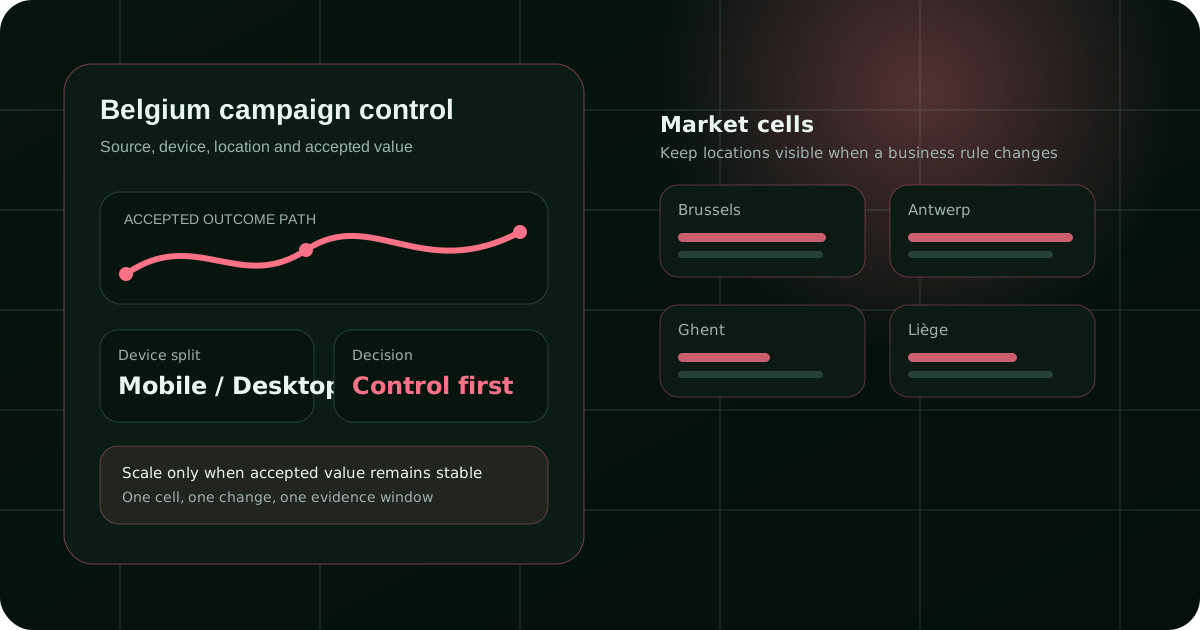
Buying Belgium traffic means paying for eligible visits from a campaign configured around a Belgian market cell. It does not mean buying customers or a guaranteed result. A useful cell names the region, audience need, language route, device, offer, creative, destination and advertiser-side outcome that will be reviewed after its normal maturity period.
Belgium needs more than a country label. A visitor in a Dutch-language journey can receive a different promise, form and follow-up from someone in a French-language route, even when the product is identical. Brussels can add bilingual operating requirements, while a German-language audience or an intentionally English-speaking segment should remain visible rather than being absorbed into a national average.
FroggyAds gives you self-serve campaign controls for eligible traffic, bids, budgets and source review. Your business still owns offer truth, page quality, language support, fulfilment and acceptance. Keep those responsibilities separate and reconcile them through stable identifiers.
Review the full website traffic buying process before releasing the first Belgium cell.
Which Belgian audience should you test first?
Start with one business question that can change a decision. An ecommerce order in Flanders, a B2B enquiry routed through Brussels and a SaaS activation from Wallonia need different copy, evidence and follow-up. Do not combine them because every visitor shares a country code.
Write the cell as an operating contract: regional boundary, language, audience problem, offer, destination release, campaign key, accepted event, owner, spend ceiling and review date. Include the condition that pauses the route immediately, such as unsupported delivery or a broken form.
Choose a small enough audience to diagnose the first failure. If the cohort produces eligible visits but few usable sessions, review source and page continuity. If sessions create declarations that operations reject, inspect qualification and language handoff. Expand after the team can explain the result.
Use the targeted traffic guide to refine the audience boundary.
How should a Belgium campaign manage Dutch, French, German and English?
Build one complete route for each language the campaign intends to support. The ad, landing page, form, confirmation and human or automated follow-up should remain understandable in that language. Switching midway can create abandonment or an invalid enquiry that looks like media underperformance.
Use Dutch and French as separate evidence cells when copy, destination or operations differ. Treat German as its own route when it is part of the approved audience. English can serve a deliberate international or professional segment, but it should not be used as a shortcut around local communication requirements.
Version translations and market adaptations. A reviewer should know whether a result changed because the words improved, the offer changed or the destination was rebuilt. Retain the previous release so the strongest local route remains available as a control.
What makes a Flanders traffic cell operationally useful?
Define the served locations, Dutch-language promise, product or service availability and the advertiser-side outcome before launch. The route should use terminology the intended buyer understands without implying that every resident shares the same need, purchasing behavior or response.
Keep delivery and support boundaries visible. An ecommerce seller should confirm where it ships and how returns work; a service company should explain appointment or coverage constraints; a software advertiser should state the activation or qualification state used for review.
Compare a Flanders cohort only with a route that uses the same offer version and outcome rule. When creative, language and service area change together, report it as a new system rather than attributing the difference to geography alone.
How should a Wallonia campaign preserve a French-language journey?
Approve the French message and the complete customer route before media starts. The offer conditions, destination headings, form labels, confirmation and follow-up should agree. A translated headline placed above an otherwise unsupported journey does not constitute a localized campaign.
Document the audience problem and the evidence that justifies this cell. Use regional or French-language research to shape a test, then let the account result decide whether the premise works for this offer. Do not import a Flanders result by changing the location name.
Retain rejected and unresolved outcomes with reasons. An unsupported service area, unreachable contact or ineligible request suggests a different repair from a visitor who never reaches the page. This gives media and operations a shared decision record.
How do you run a bilingual Brussels traffic cell?
Decide whether Dutch and French share one destination or enter separate routes. If the form, sales team or service process changes by language, preserve that selection with the campaign and source identifiers instead of reporting one blended Brussels result.
Business and international audiences may justify an intentionally English route. Name that audience and keep the promise, qualification and follow-up aligned. Language preference is an operating variable, not a proxy for value.
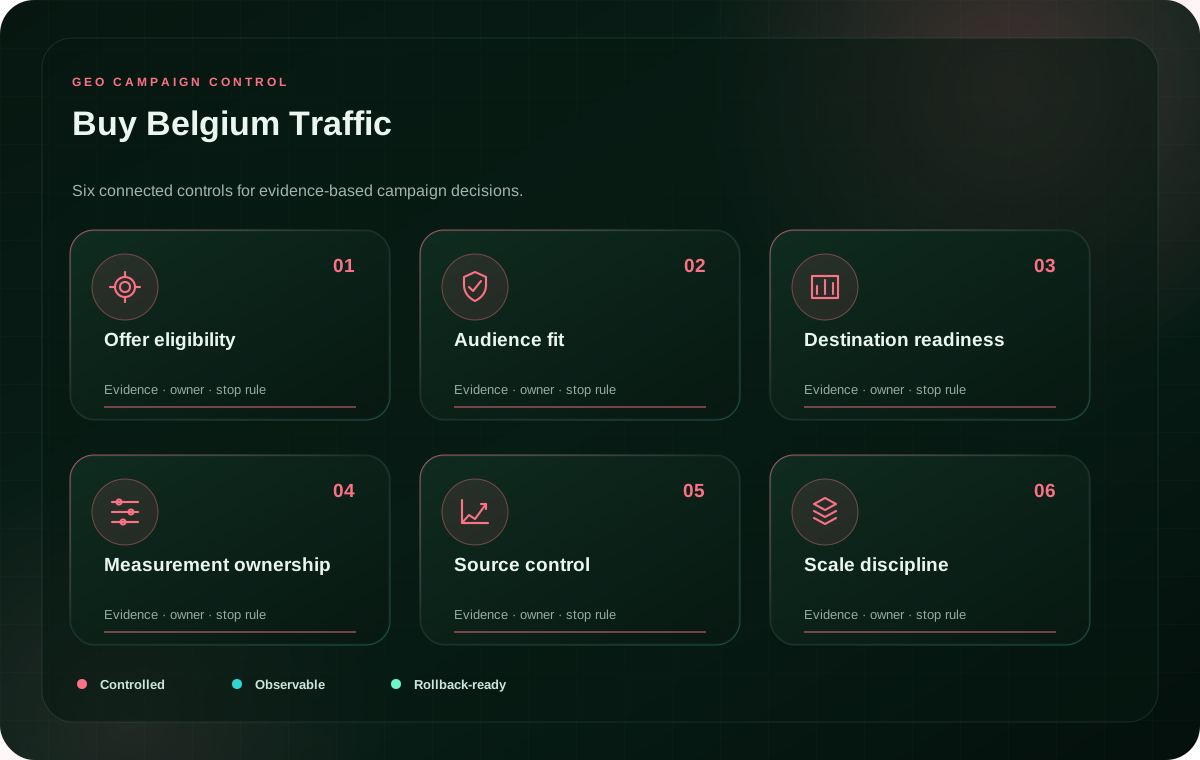
Use the framework to trace the ad promise through regional eligibility, language selection, destination version and mature accepted outcome. The first unresolved handoff is the next repair.
When should Belgium's German-language audience use its own cell?
Create a separate cell when the campaign intentionally serves a German-language audience and can support that language across the offer journey. Name the eligible locations, destination version, contact route and accepted event. Do not treat a small audience as permission to leave the experience ambiguous.
A focused cell can answer whether the current offer and message deserve further investment without requiring a national conclusion. Use a capped budget and preserve the source, creative and page version. Low volume may extend the review window, but it does not justify lowering the evidence standard.
If operations cannot support the route accurately, exclude it until the constraint is resolved. An honest boundary protects the visitor and prevents unsupported demand from contaminating the accepted-outcome denominator.
How should the ad and Belgian destination stay aligned?
The ad should state the benefit and next step that the page can deliver. Carry material conditions, regional availability and eligibility to the destination. If a price, trial, delivery promise or consultation scope varies, version it with the campaign rather than explaining the difference after submission.
Present EUR amounts and billing conditions clearly when money is part of the decision. Keep tax, delivery, renewal or cancellation information in the appropriate buyer path without inventing a universal commercial rule. The advertiser remains responsible for current terms and legal review.
Use one primary action for the first test. A page that mixes purchase, consultation, newsletter and unrelated navigation can turn usable traffic into an unclear result. Supporting details should help the visitor decide whether the action fits.
How do ecommerce, B2B, SaaS and app offers differ in Belgium?
Ecommerce needs product availability, delivery coverage, checkout language, currency presentation and an accepted-order state. B2B requires service scope, qualification, response ownership and a reliable regional handoff. SaaS and app advertisers need activation or subscription states that can mature after the initial registration.
Build separate campaign contracts when the accepted event changes. A form submission, trial start and paid order cannot share one denominator. Each route should describe rejection, reversal and unresolved states so a cheap early action is not mistaken for accepted value.
Match language support to the post-conversion experience. The buyer's journey continues after the landing page through onboarding, support, delivery or sales contact. Include that operational workload when deciding whether to expand the campaign.
Which message should the first Belgium traffic test use?
Choose a benefit that fits the audience problem and can be verified on the destination. A simple retail offer can use a concise message; a considered service or software decision should reserve explanation for the page while keeping material conditions visible before action.
Treat materially different formats as separate cells. Preserve region, language, offer and accepted outcome while you compare how the placement changes usable sessions. Do not choose a winner from interaction cost alone when the advertiser values a later qualified state.
Record asset rights, language approval and expiration. A new visual combined with a new translation and page prevents a clean diagnosis. Keep one useful control and change the element the next decision actually concerns.
Connect creative planning to the broader website traffic workflow.
How should you compare FroggyAds traffic sources for Belgium?
Give each source cell the same regional boundary, language, offer, creative promise, destination, acceptance rule and maturity window. Preserve the source identifier beyond the click. When one source receives a different customer journey, label it as a separate system rather than a pure source comparison.
Review eligible delivery, usable sessions, declared actions, accepted outcomes, reversals and operating workload. A source can create a high volume of inexpensive visits while producing limited accepted value. Another may cost more per visit yet fit the commercial process better.
Start with a controlled source set and record why a source is retained, narrowed or excluded. Use FroggyAds source review controls where supported. Maintain a route for retesting after a documented page, offer or targeting repair.
Which events should a Belgium traffic ledger separate?
Separate eligible delivery, click, usable session, declared action, accepted outcome, reversal and unresolved status. Define the owner and data source for every stage. Keep region, language, campaign, creative, destination and source keys attached through the advertiser's record.
Test the join before launch in every language route. Confirm consent behavior, form capture, confirmation and downstream status. A missing identifier can make a valid campaign impossible to evaluate, while duplicated test records can inflate the apparent response.
Quality means fitness for this declared purpose. Record rejection reasons such as unsupported area, duplicate, unreachable contact, ineligible request, cancellation or refund where relevant. Each reason points to a different controllable repair.
Use the traffic quality monitoring guide to organize the review.
How should the first Belgium traffic budget be set?
Derive a learning ceiling from the value of an accepted outcome, handling cost, normal maturity and tolerance for an unanswered question. Keep that ceiling separate from the bid and pacing setting. It limits exposure without predicting success.
Include translation or native review, creative adaptation, landing work, measurement and campaign operations. Show fixed setup apart from variable media. If the route fails technically, repair it before describing additional spend as acquisition learning.
Release budget in stages. Verify the route early, then judge commercial performance after the planned acceptance window. Increase one regional, language, source or spend boundary at a time and keep a rollback.
Review low-cost traffic decisions without confusing a low click price with accepted value.
What does a Belgium traffic price actually measure?
A bid is an auction input. CPM relates spend to impressions, while CPC relates spend to clicks. Neither measure alone tells you the cost of a usable session, qualified enquiry, accepted order or activated user. Keep the charging unit and downstream denominators distinct.
Use current account evidence rather than publishing a universal Belgium rate. Audience size, format, device, competition and eligibility can change delivery. Put a date, currency and scope beside any planning estimate, then replace it with actual billing evidence after launch.
Review the marginal cohort. When extra spend changes the source or audience mix, calculate the new increment separately from the lifetime average. Scale while the newest mature cell remains useful and operations can handle the demand.
What must a Belgium landing page prove before launch?
The page must continue the campaign's language, audience promise and regional availability. Verify headings, material offer details, contact information, form labels, validation, confirmation and follow-up. A country-targeted ad that opens a generic unsupported page wastes the regional decision.
Test each language route with representative devices and one complete transaction or enquiry. Keep the page release in the campaign record. When several languages share one page, confirm the selector does not lose source parameters or the visitor's intended action.
Assign destination and operations owners. Media can diagnose eligible traffic, but the advertiser must verify whether the route is accurate and whether the resulting action qualifies. Reconcile both views at the scheduled review.
What is a practical Belgium traffic workflow?
Approve the region, language, audience task, offer, destination, accepted event and spend ceiling. Test the source-to-outcome identifiers for every route. Freeze the creative and page versions, then launch the smallest campaign capable of answering the question.
Inspect delivery and page validity early without forcing immature commercial conclusions. After the normal outcome window, reconcile accepted, rejected, reversed and unresolved records. Finish with one explicit action: retain, narrow, repair, expand one boundary or stop.
Store the decision with the campaign evidence. A later team should be able to reconstruct what the Belgian visitor saw, which language route handled the action and why the budget changed.
How do you expand Belgium traffic without losing the lesson?
Keep the successful region, language, offer, destination and acceptance rule stable. Add one new location, language segment, source, creative or budget increment with a fresh ceiling. Review that cohort apart from historical performance.
Include operating capacity in the scale decision. More enquiries can lengthen response times, more orders can pressure fulfilment, and more trials can increase support. A campaign remains useful only while the business can deliver the experience advertised.
Write the rollback before expansion. If accepted economics weaken or the customer journey breaks, restore the last validated cell. Preserve the failed increment because it defines where the earlier result stopped transferring.
Which FroggyAds resources support the next traffic decision?
Use Europe traffic planning when the offer can serve several countries, but retain Belgium as its own regional and language decision. The website traffic guide covers the wider acquisition route, and traffic source guidance helps assign distinct jobs to delivery channels.
Pages about Africa traffic, Algeria traffic and Argentina traffic address different market conditions. Use them only for their stated audience and operating question; do not convert their conclusions into Belgium claims.
Keep external research, FroggyAds controls and advertiser-side outcomes in separate evidence records. A source can frame the audience question, our platform can deliver the bounded traffic cell, and your business can decide whether the outcome is accepted.
Frequently asked questions
Apply each answer to the actual offer, language route and advertiser-side evidence.
What should I prepare before buying Belgium traffic?
Prepare one offer, the Belgian regions and languages you can support, a matching landing route, source identifiers, a spend ceiling and the advertiser-side event that counts as an accepted outcome.
Should Flanders, Wallonia and Brussels use one campaign?
Use one campaign only when audience intent, language, serviceability, offer terms, destination and acceptance are truly comparable. Separate cells when a regional or language handoff changes the customer journey.
Which languages should a Belgium traffic campaign support?
Use the language your intended audience understands and your team can support accurately. Dutch and French often require distinct routes; German or English should be deliberate choices with matching pages and follow-up.
Can FroggyAds guarantee Belgian sales or leads?
No. FroggyAds can supply controlled paid traffic, while your offer, creative, destination and operations determine whether visits become accepted business outcomes. No traffic source can guarantee sales, profit or rankings.
How should I compare two Belgium traffic sources?
Keep the regional rule, language, offer, creative promise, destination, acceptance definition and maturity window stable. Preserve each source through the advertiser-side record before comparing cost and quality.
What metric should guide the next budget release?
Use the mature event your business verifies consistently, such as an accepted order, qualified enquiry, activated user or approved application. Clicks and sessions remain diagnostic stages.
How should Belgian ecommerce visits be qualified?
Check product availability, delivery area, EUR presentation, material terms, checkout language and post-purchase review. Attribute only orders that reach the advertiser's accepted state after normal cancellation or fraud checks.
When should a Belgium campaign pause?
Pause for a broken language route, inaccurate claim, unsupported location, missing identifier, changed availability or exceeded loss boundary. Apply performance stops after the stated maturity period.
Can I start with English-language ads in Belgium?
Only when the selected audience and complete customer journey are intentionally English-language. Do not use English merely to avoid building the Dutch, French or German route needed by the buyer.
How do I begin with FroggyAds?
Create one bounded Belgium cell, choose supported targeting and budget controls, preserve source evidence and compare mature accepted outcomes. Expand one region, language or source boundary at a time.
Launch one explainable Belgium traffic cell
Choose one Belgian region or service area, one supported language, one audience need, one offer, one destination and one accepted event. Confirm that the business can fulfil the promise and that identifiers survive into the outcome record.
FroggyAds gives you a self-serve route to configure eligible traffic, bids, budgets and source review for that cell. Paid traffic remains an input, so use mature advertiser-side value rather than clicks alone for the next allocation.
Prepare the review before delivery starts. Media should bring spend and source evidence; the destination owner should bring route validation; the commercial owner should bring accepted, rejected and unresolved states. Keep unmatched records open rather than forcing them into success or failure.
Close the first cycle with a written release decision. State which region-language cell is retained, which assumption changed, how much additional exposure is allowed and what triggers rollback. Widen only one material boundary at a time.
Retain a compact language handoff receipt with the selected language, page release, form confirmation, response owner and the support route shown to the visitor. This evidence prevents a later campaign manager from merging Dutch, French, German and English outcomes that came from different experiences. If the handoff cannot be reconstructed, treat the cohort as incomplete for allocation rather than assigning its result to Belgium traffic generally.