
Buy Latin America Website Traffic
Buy Latin America traffic with country, language, currency and source controls, localized funnels and conversion measurement tied to accepted value.
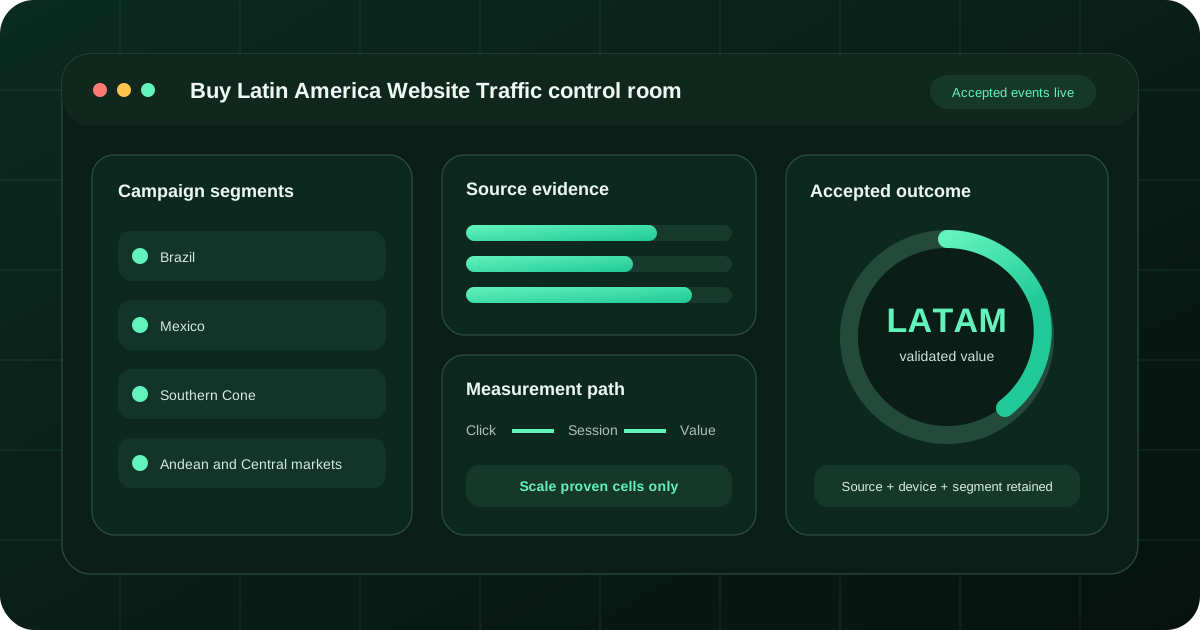
Buy Latin America Website Traffic at a glance
What does this page explain about Buy Latin America Traffic - CPC from $0.003?
Quick answer: Buy Latin America traffic with country, language, currency and source controls, localized funnels and conversion measurement tied to accepted value. The Latin America ad network guide explains localization, formats, source reporting, budget guardrails and scaling decisions for this market. A sound way to buy Latin America traffic is to connect every paid visit to a clear offer, a serviceable audience, a compatible destination and an accepted outcome. For Latin America, the scorecard should explicitly penalize one-Spanish-version assumption, Brazil hidden inside regional totals and other issues that can make low-cost traffic appear stronger than it is.
| Section | Distinct excerpt from this page |
|---|---|
| How to buy Latin America traffic with measurable control | Latin America requires at least a Portuguese and Spanish planning split, followed by country-level separation when pricing, payment, logistics or customer value changes. |
| Build Latin America as decision-ready cells | Payment success, returns, fulfillment and lead acceptance can differ more than click prices, so optimization should continue past the initial conversion event. |
| Offer eligibility | Confirm that Latin America users can lawfully and practically access the offer, price, payment, delivery and support. |
Reference for Buy Latin America Traffic - CPC from $0.003: FTC guidance on online advertising and marketing.
- Planning: How to buy Latin America traffic with measurable control.
- Control: What this guide covers.
- Decision: Build Latin America as decision-ready cells.
How to buy Latin America traffic with measurable control
A sound way to buy Latin America traffic is to connect every paid visit to a clear offer, a serviceable audience, a compatible destination and an accepted outcome. Country, device, format and source should remain visible until the advertiser can decide whether the traffic produced real value. Delivery volume alone is not proof of campaign quality.
Latin America requires at least a Portuguese and Spanish planning split, followed by country-level separation when pricing, payment, logistics or customer value changes.
Regional creative should not assume that one Spanish version is equally natural in every country. Local terminology, address formats and trust cues can change response.
For Buy Latin America Website Traffic, connect this rule to the named audience, workflow, or comparison before acting. FroggyAds supports Push, Native, Display, Pop, Video and Interstitial advertising through a self-serve platform. Targeting availability can include country, city, device, operating system, browser, carrier, category and source controls where supported. Adscore signals and internal controls can reduce invalid-activity risk, but no provider can guarantee that every impression, click or user will create business value.
What this guide covers
Use this guide when planning buy latin america website traffic. It focuses on the specific market, audience, platform, or campaign decision named in the title, including targeting, format selection, measurement, traffic-quality review, budget controls, and responsible scaling.
For Buy Latin America Website Traffic, use the buy website traffic guide and the traffic sources hub to set the broader acquisition model, then narrow the decision with the related country, format, audience or platform guide that matches the campaign.
Build Latin America as decision-ready cells
Payment success, returns, fulfillment and lead acceptance can differ more than click prices, so optimization should continue past the initial conversion event.
Brazil and Mexico can dominate scale, but smaller markets may produce stronger unit economics when the offer and operational coverage are better aligned.
In Buy Latin America Website Traffic, keep the evidence, owner, and next action attached to this control. A first campaign should be small enough to interpret. Too many countries, products, devices, formats, creatives and sources can create dozens of incomplete tests. Begin with the smallest matrix that can answer the commercial question, then add dimensions only when the existing data identifies a reason.
| Campaign cell | Why it stays separate | Primary failure to watch |
|---|---|---|
| Brazil | Keep visible until value is proven | one-Spanish-version assumption |
| Mexico | Use when pricing or service changes | Brazil hidden inside regional totals |
| Southern Cone | Separate by device and source | payment failure |
| Andean and Central markets | Merge only after evidence | unprofitable fulfillment |
Six checks before any budget is released
Offer eligibility
Confirm that Latin America users can lawfully and practically access the offer, price, payment, delivery and support.
Audience fit
Define who should respond, which brazil and device cells matter, and which users should be excluded.
Destination readiness
Test language, page speed, forms, pricing, confirmation and error states before paid delivery begins.
Measurement ownership
Name the accepted event and preserve source, format, device, creative and segment IDs through it.
Source control
Use source-level evidence, block or reduce weak placements and avoid scaling from blended averages.
Scale discipline
Increase budget only when accepted value remains stable after more volume and conversion delay are included.
An eight-step launch and optimization process
Define the decision
Write the main topic, campaign objective and accepted event for Latin America.
Verify the journey
Test the ad promise, destination, forms, price, consent and confirmation on representative devices.
Build campaign cells
Separate only the segments, devices, formats or languages that need different bids or decisions.
Launch with limits
Use daily caps, source visibility and a budget that can identify obvious tracking or quality failures.
Validate delivery
Confirm loaded sessions, target match, event firing and source attribution before judging conversion rate.
Classify outcomes
Mark accepted, rejected, duplicate, ineligible, refunded or retained outcomes as the business requires.
Apply stop rules
Pause cells that exceed the loss limit, fail quality checks or cannot produce enough evidence.
Scale proven cells
Increase volume in stages and repeat the review when the offer, creative, source mix or destination changes.
Choose a format for the customer journey
| Format | Best role in the plan | What to measure |
|---|---|---|
| Push | Direct, time-sensitive messages where the promise can be understood quickly | Clicks, loaded sessions, accepted event rate and complaint feedback |
| Native | Contextual discovery with more room for explanation | Engaged sessions, qualified progression and accepted outcome cost |
| Display | Visual reach, retargeting and broad awareness support | Viewability, clicks, assisted conversions and frequency |
| Pop | High-volume testing when the destination can qualify intent quickly | Loaded sessions, source quality, accepted event cost and bounce diagnostics |
| Video | Demonstration, storytelling and prequalification | Completed view, click, downstream event and incremental value |
| Interstitial | High-attention mobile or web placements | Engagement, close behavior, destination quality and accepted conversion |
Connect delivery to accepted business value
The measurement model should connect impression, click, loaded session, target match, meaningful action and accepted business value. For this page, examples of accepted outcomes include margin-positive order, approved active user, completed booking, retained subscriber. The exact event must match the advertiser's real economics.
In Buy Latin America Website Traffic, keep the evidence, owner, and next action attached to this control. A soft event can help diagnose the funnel, but it should not become the final optimization target merely because it appears faster. Button clicks, page depth and add-to-cart actions do not prove eligibility, payment, fulfillment or retention.
For Buy Latin America Website Traffic, treat this as a page-specific operating check rather than a universal benchmark. Conversion delay should be included before a source is classified. Some outcomes arrive immediately, while sales acceptance, payment, refund, churn or funded status may take longer. A premature decision can reward sources that create fast but weak events.
For the Buy Latin America Website Traffic decision, record how this control changes the next test or review. Preserve source ID, campaign, creative, format, device, operating system, segment and landing-page version through the accepted event. When offline or CRM outcomes matter, return the status through a postback or reconcile it in a source-level ledger.
| Layer | Signals | Decision question |
|---|---|---|
| Delivery | Impressions, clicks, loaded sessions | Is the campaign reaching the intended cell? |
| Quality | Target match, invalid signals, duplicates, engagement | Is the delivered session usable evidence? |
| Progression | Key page or product actions | Where does the journey lose qualified users? |
| Acceptance | margin-positive order and approved active user | Which sources produce business-approved outcomes? |
| Value | retained subscriber and downstream revenue or retention | Can the cell support more budget without losing economics? |
Compare evidence with a repeatable scoring model
On Buy Latin America Website Traffic, use this control to keep the page's evidence and action traceable. A source scorecard turns campaign review into a repeatable decision. Weight the criteria to match the business, score only after the required conversion delay and keep written reasons for each classification. The score is not a guarantee; it is a structured way to compare evidence.
For Latin America, the scorecard should explicitly penalize one-Spanish-version assumption, Brazil hidden inside regional totals and other issues that can make low-cost traffic appear stronger than it is.
| Criterion | Suggested weight | Rating | Review note |
|---|---|---|---|
| Target match | 20% | Score 0 to 5 | Document the evidence and owner |
| Accepted outcome rate | 25% | Score 0 to 5 | Document the evidence and owner |
| Cost versus limit | 20% | Score 0 to 5 | Document the evidence and owner |
| Downstream quality | 20% | Score 0 to 5 | Document the evidence and owner |
| Operational fit | 15% | Score 0 to 5 | Document the evidence and owner |
Practical Latin America campaign scenarios
Regional ecommerce
Compare paid orders, delivery success, returns and contribution margin.
Fintech acquisition
Measure approved and activated users under local eligibility rules.
Travel marketplace
Track completed bookings and cancellations by origin country.
Subscription service
Measure successful billing and retention in each market.
A page-specific fieldbook for Latin America
Risk register
Create a cross-border operations sheet for Local currencies, USD where cross-border terms are explicit. Record billing currency, user-facing price, payment success, tax or fee disclosure, fulfillment, returns, support hours and data-processing responsibilities. These variables often explain regional performance more accurately than the first click price.
Scale record
Use explicit exit rules for one-Spanish-version assumption, Brazil hidden inside regional totals, payment failure, unprofitable fulfillment. A country can be paused without declaring the whole region unprofitable. Conversely, a strong result in one market does not validate every neighboring market. Regional scale is the sum of country evidence, not a shortcut around it.
Readiness brief
Treat Latin America as a portfolio rather than a single GEO. Begin with a market shortlist based on serviceability, language, payment, regulation and expected customer value. The purpose of the regional page is to coordinate country tests, not to erase the differences between them.
Segmentation notebook
The portfolio can be organized around Brazil, Mexico, Southern Cone, Andean and Central markets. Each group needs a named country owner, a common accepted-event definition and a reason for being tested together. Countries should separate when the offer, price, landing page, bid, compliance review or downstream value changes.
Journey audit
Build language clusters only where the complete customer journey supports them. Relevant language planning may involve Spanish by market, Portuguese for Brazil. A regional translation file is not enough; commercial terms, form behavior, support and post-conversion communication must also be usable in the selected market.
Evidence contract
Budget allocation should combine exploration and evidence. Reserve a controlled share for new country cells, but move the main spend toward markets that produce margin-positive order, approved active user, completed booking, retained subscriber. Do not let a high-volume country consume the entire regional budget before smaller cells reach their planned review point.
Four operational notes for Latin America
Field note 1: Brazil
A useful notebook entry for Brazil contains four timestamps: campaign launch, first loaded session, first margin-positive order and final acceptance review. Add the source, device and creative beside each timestamp. This timeline shows whether one-Spanish-version assumption appeared before or after the apparent success.
Field note 2: Mexico
The Mexico review should end with one sentence that a budget owner can act on. It should say whether the Fintech acquisition test can continue, needs one repair, should be reduced or is ready for staged scale. The sentence cites approved active user and explains how Brazil hidden inside regional totals was handled.
Field note 3: Southern Cone
For the Southern Cone cell, the analyst should write a pre-launch expectation and a post-test conclusion. The expectation names the audience, message, device and likely path to completed booking. The conclusion states whether the evidence supported the hypothesis, which source created the result and whether payment failure changed the decision.
Field note 4: Andean and Central markets
Use the Subscription service scenario as a controlled case file. Record the destination version, creative promise, bid, cap and acceptance window. When retained subscriber arrives, verify that the user belonged to Andean and Central markets and that unprofitable fulfillment did not create an artificial conversion signal.
Build a message matrix for Latin America
The creative matrix should connect Brazil and the other planned cells to a specific customer question. A strong click-through rate is useful only when the destination confirms the promise and the accepted event remains efficient.
Build a message hierarchy with the primary benefit first, the important qualification second and the next action third. Relevant language options include Spanish by market, Portuguese for Brazil; relevant commercial context includes Local currencies, USD where cross-border terms are explicit. Keep the hierarchy readable on a small screen.
Create a destination checklist for margin-positive order. The first screen should confirm the offer, audience and next step. The form or checkout should request only necessary information, explain errors, preserve campaign IDs and provide a clear confirmation state.
Run creative review against the risk list: one-Spanish-version assumption, Brazil hidden inside regional totals, payment failure, unprofitable fulfillment. A variant that increases clicks by weakening accuracy should be rejected even before the conversion report is complete.
For Buy Latin America Website Traffic, treat this as a page-specific operating check rather than a universal benchmark. Archive each approved variant with its date, destination version and campaign cell. When performance changes, the archive shows whether the source changed or the message and page changed at the same time.
| Audience or segment | Creative angle | Promise to validate | Failure signal |
|---|---|---|---|
| Brazil | Offer and eligibility | Match the promise to margin-positive order | Watch one-Spanish-version assumption |
| Mexico | Trust and next step | Match the promise to approved active user | Watch Brazil hidden inside regional totals |
| Southern Cone | Problem and outcome | Match the promise to completed booking | Watch payment failure |
| Andean and Central markets | Evidence and process | Match the promise to retained subscriber | Watch unprofitable fulfillment |
Classify source evidence for Latin America
Use source IDs to preserve causality. When margin-positive order rises or one-Spanish-version assumption appears, the analyst should be able to identify the affected placement, device, segment, creative and destination version without relying on a blended dashboard.
For the Buy Latin America Website Traffic decision, record how this control changes the next test or review. Do not blacklist a source because of a handful of accidental sessions, and do not whitelist it because of one fast conversion. Use thresholds that reflect event frequency, conversion delay and maximum affordable loss.
Compare rejection reasons as carefully as accepted cost. Repeated Brazil hidden inside regional totals or payment failure can identify a mismatch that an aggregate conversion rate hides.
Within Buy Latin America Website Traffic, use this checkpoint when recording the next page-specific decision. When a source improves after a destination or creative change, create a new comparison window. Combining the old and new conditions can make the source look stable when the underlying campaign is different.
The final scale decision should confirm that retained subscriber or another downstream value signal remains acceptable after more volume. Early success is an invitation to validate, not permission to remove controls. For Buy Latin America Traffic, validate this point against Buy Latin America, Latin America traffic, Latin America Website and keep it separate from the Buy Traffic From Latin America intent.
| Example source | Primary cell | Accepted signal | Notebook status |
|---|---|---|---|
| Source Alpha | Brazil | margin-positive order | Reduce |
| Source Beta | Mexico | approved active user | Scale |
| Source Gamma | Southern Cone | completed booking | Explore |
| Source Delta | Andean and Central markets | retained subscriber | Hold |
Turn four use cases into controlled tests
Regional ecommerce playbook
Compare paid orders, delivery success, returns and contribution margin. Begin with the Brazil cell and define margin-positive order as the decision event. Review the ad promise to the destination, keep source and device IDs through the outcome, and record one-Spanish-version assumption as a named rejection or warning condition. The playbook moves to scale only after the accepted cost remains inside the limit for the planned conversion delay.
Fintech acquisition playbook
Measure approved and activated users under local eligibility rules. Begin with the Mexico cell and define approved active user as the decision event. Scale the ad promise to the destination, keep source and device IDs through the outcome, and record Brazil hidden inside regional totals as a named rejection or warning condition. The playbook moves to scale only after the accepted cost remains inside the limit for the planned conversion delay.
Travel marketplace playbook
Track completed bookings and cancellations by origin country. Begin with the Southern Cone cell and define completed booking as the decision event. Map the ad promise to the destination, keep source and device IDs through the outcome, and record payment failure as a named rejection or warning condition. The playbook moves to scale only after the accepted cost remains inside the limit for the planned conversion delay.
Subscription service playbook
Measure successful billing and retention in each market. Begin with the Andean and Central markets cell and define retained subscriber as the decision event. Validate the ad promise to the destination, keep source and device IDs through the outcome, and record unprofitable fulfillment as a named rejection or warning condition. The playbook moves to scale only after the accepted cost remains inside the limit for the planned conversion delay.
Use loss limits, controlled changes and staged scaling
For the Buy Latin America Website Traffic decision, record how this control changes the next test or review. A test budget is useful only when it can answer a defined question. Divide the maximum acceptable test loss across the planned cells, reserve capacity for creative or landing-page fixes and avoid expanding merely because impressions are available.
On Buy Latin America Website Traffic, use this control to keep the page's evidence and action traceable. Bid changes should be isolated from other major edits whenever possible. If the advertiser changes the bid, creative, destination and targeting at the same time, the next result cannot explain which change mattered.
For Buy Latin America Website Traffic, treat this as a page-specific operating check rather than a universal benchmark. Scale in steps. After each increase, compare target match, accepted cost, downstream quality and conversion delay with the prior stable period. Stop or reverse the increase when quality degrades beyond the documented limit.
The campaign should pause when tracking fails, the destination becomes inaccurate, one-Spanish-version assumption appears, or the accepted cost exceeds the business limit without a justified learning objective.
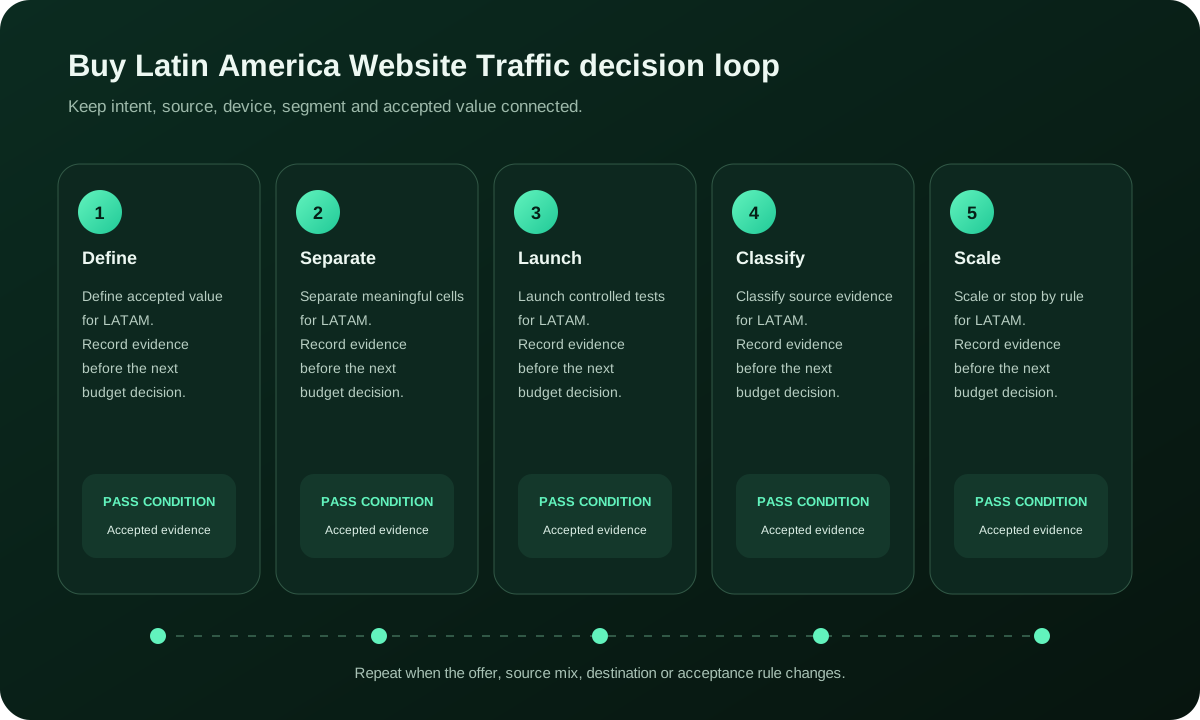
Protect the evidence before optimizing
For Buy Latin America Website Traffic, treat this as a page-specific operating check rather than a universal benchmark. Traffic-quality controls reduce risk but cannot eliminate every invalid, accidental or low-value interaction. Advertisers should combine platform signals with their own session, event, duplicate, acceptance and downstream-quality checks.
Market review should cover language, pricing, privacy, consent, eligibility, fulfillment and the operational risks represented by one-Spanish-version assumption and Brazil hidden inside regional totals.
For Buy Latin America Website Traffic, apply this control to the page's stated scope and evidence window. Creative and landing pages must be accurate, accessible and consistent. Do not promise guaranteed results, fabricate urgency, hide material terms or present an unsupported claim as a fact. Approval depends on policy, category, destination and campaign details.
In Buy Latin America Website Traffic, keep the evidence, owner, and next action attached to this control. Keep a written change log for bids, sources, targeting, creative, destination and tracking. When performance changes, the log helps distinguish market movement from an internal campaign change.
Continue, improve, reduce, pause or scale
| Decision | Evidence threshold | Action |
|---|---|---|
| Continue | Tracking verified, target match acceptable, enough runway remains | Keep the cell unchanged until the planned review point. |
| Improve | Usable demand exists but one funnel step is weak | Change one major variable and restart the comparison window. |
| Reduce | Accepted cost is near the limit or quality is declining | Lower bid, cap or source exposure while preserving evidence. |
| Pause | Tracking broken, offer inaccurate, policy risk or loss limit reached | Stop delivery and repair the cause before another test. |
| Scale | Accepted cost and downstream value remain stable after delay | Increase in stages, then recheck the full scorecard. |
Buy Latin America Website Traffic FAQ
For Buy Latin America Website Traffic, when can paid Latin America traffic fit a campaign?
It can fit an offer available in selected countries when each market has a relevant audience and customer path. Quick answer: Buy Latin America traffic with country, language, currency and source controls, localized funnels and conversion measurement tied to accepted value.
For Buy Latin America Website Traffic, how should a Latin America traffic campaign begin?
Start with a few countries and keep their sources, devices, budgets and measurement separate. A sound way to buy Latin America traffic is to connect every paid visit to a clear offer, a serviceable audience, a compatible destination and an accepted outcome.
For Buy Latin America Website Traffic, why does website traffic cost vary across Latin America?
Evaluate each market separately because auction pressure, currency, available placements and downstream results change the effective cost. Quick answer: Buy Latin America traffic with country, language, currency and source controls, localized funnels and conversion measurement tied to accepted value.
For Buy Latin America Website Traffic, which controls keep Latin America traffic relevant?
Build separate eligibility cells for each supported country and language, then narrow them by device, placement and offer fit; a single Latin America bucket hides material differences.
For Buy Latin America Website Traffic, how should creative change between Latin American markets?
Localize the page with correct language, pricing, availability and terms while keeping the promised action consistent with the advertisement. The Latin America ad network guide explains localization, formats, source reporting, budget guardrails and scaling decisions for this market.
For Buy Latin America Website Traffic, what should happen after a regional traffic click?
Send visitors transparently to an eligible local page and explain when the offer is unavailable in their market. Use these related pages to compare buying, source, format, network and cost decisions across Latin America.
For Buy Latin America Website Traffic, which result should guide Latin America traffic decisions?
Judge countries independently using settled conversion value, approval rate and acquisition cost rather than one regional average. Continue with the related planning, targeting and measurement guidance.
For Buy Latin America Website Traffic, how can weak regional traffic sources be identified?
Inspect placement, timing, technical behavior, conversion delay and downstream rejection within each country. Create a cross-border operations sheet for Local currencies, USD where cross-border terms are explicit.
For Buy Latin America Website Traffic, what should be reviewed before adding a Latin American market?
Verify offer access, privacy wording, payment details, local language needs and platform rules for every country included. Compare paid orders, delivery success, returns and contribution margin. Measure approved and activated users under local eligibility rules.
For Buy Latin America Website Traffic, when can a Latin America campaign add markets or spend?
Add either a new country, placement or audience segment only after the current setup produces stable, accepted results. Payment success, returns, fulfillment and lead acceptance can differ more than click prices, so optimization should continue past the initial conversion event.
Continue the traffic plan
Build a campaign around accepted outcomes
Choose the market, format, device and source cells that match your offer, then measure through the event that creates real business value.
Choose the campaign controls behind Latin America traffic
The Latin America ad network guide explains localization, formats, source reporting, budget guardrails and scaling decisions for this market.
Buy Latin America Website Traffic: the decision this URL owns
URL boundary for Buy Latin America Website Traffic: This URL owns the traffic-purchase workflow for Buy Latin America Website Traffic: define the destination, market cell, source evidence, loss limit and accepted conversion before buying more traffic.
Treat Buy Latin America Website Traffic as an operating decision, not a definition page. A performance advertiser should use it to plan the market-specific test and measurement rules, with the same accepted outcome preserved from setup through review.
Decision inputs for Buy Latin America Website Traffic: audience targeting, source evidence, conversion tracking, accepted business value. Keep these inputs tied to accepted conversion or business-value event and the page-specific job: plan the market-specific test and measurement rules.
Market test design for Buy Latin America Website Traffic: Treat the market as an independent acquisition cohort: isolate the offer, destination and conversion definition before comparing it with another GEO. Use Buy Latin America Website Traffic at a glance as the setup checkpoint and preserve audience targeting with the exact campaign cell that generated the downstream event.
Market evidence and next action for Buy Latin America Website Traffic: Measure accepted conversion or business-value event with source evidence preserved, then compare cohorts only when their conversion windows are equally mature. When evidence improves, widen only the proven part of the campaign; when it weakens, preserve the source record and reverse the last major change.
How to buy Latin America traffic with measurable control is the measurement checkpoint for this URL. Resolve “For Buy Latin America Website Traffic, how should a Latin America traffic campaign begin?” while retaining source evidence, accepted business value, spend and cohort age so the result can be reconciled with accepted conversion or business-value event.
Buy Latin America Website Traffic at a glance is an evidence checkpoint for Buy Latin America Website Traffic. To answer “For Buy Latin America Website Traffic, when can paid Latin America traffic fit a campaign?”, keep audience targeting in the same campaign record and use it to plan the market-specific test and measurement rules.
What this guide covers is the action checkpoint for Buy Latin America Website Traffic. Before acting on “For Buy Latin America Website Traffic, why does website traffic cost vary across Latin America?”, document conversion tracking, the resulting campaign action and the rollback or retest condition.
| Page checkpoint | How to use it | Evidence to retain |
|---|---|---|
| Buy Latin America Website Traffic at a glance | Use Buy Latin America Website Traffic at a glance to establish the first evidence boundary for Buy Latin America Website Traffic; then record which part of campaign objective, targeting, source evidence, conversion tracking and economics it changes. | Keep audience targeting, source/campaign ID and the accepted-event definition together. |
| How to buy Latin America traffic with measurable control | Use How to buy Latin America traffic with measurable control as the second checkpoint and reconcile it with accepted conversion or business-value event before changing budget or source allocation. | Retain source evidence, spend, timestamp/cohort age and accepted/rejected outcomes. |
| What this guide covers | Use What this guide covers as the final checkpoint: if it does not change the evidence for accepted conversion or business-value event, keep the test narrow rather than scaling. | Document conversion tracking, the decision taken and the rollback or retest condition. |
Transparent Buy Latin America Website Traffic decision example
Hypothetical example: For Buy Latin America Website Traffic, a hypothetical controlled cell that spends USD 220 and records 10 accepted conversion or business-value event after the same maturity window has an accepted cost of USD 22.00 per outcome. Replace the figures, outcome and review window with your own economics; this is not a FroggyAds performance claim.
Why use FroggyAds here?
Choose FroggyAds for the media-buying part of Buy Latin America Website Traffic when you need controllable traffic and source evidence; keep the commercial decision anchored to accepted conversion or business-value event, not delivery volume alone. Create your free FroggyAds account.
Buy Latin America Website Traffic — what matters first
Buy Latin America Website Traffic should be evaluated market by market: define eligible geography, keep measurement consistent, and scale only where accepted-outcome economics remain viable.