
Buy Sweden Traffic
Reach users in Sweden with localized creative, city and device controls, source-level reporting and conversion events that reflect accepted business value. For this URL, connect the point to the goal to decide whether this option fits the buyer's acquisition workflow; keep the Buy Cheap Traffic intent separate.
Buy Sweden Traffic at a glance
- Planning: How to buy Sweden traffic with measurable control.
- Control: What this guide covers.
- Decision: Build Sweden as decision-ready market cells.
How to buy Sweden traffic with measurable control
To buy Sweden traffic responsibly, define the final business event before selecting volume. Target Sweden, use a destination that serves the local audience, preserve source and device data, and validate the outcome that the business actually accepts. The useful purchase is not an anonymous package of visits. It is controlled access to paid media that can be priced, rejected, improved and scaled by evidence.
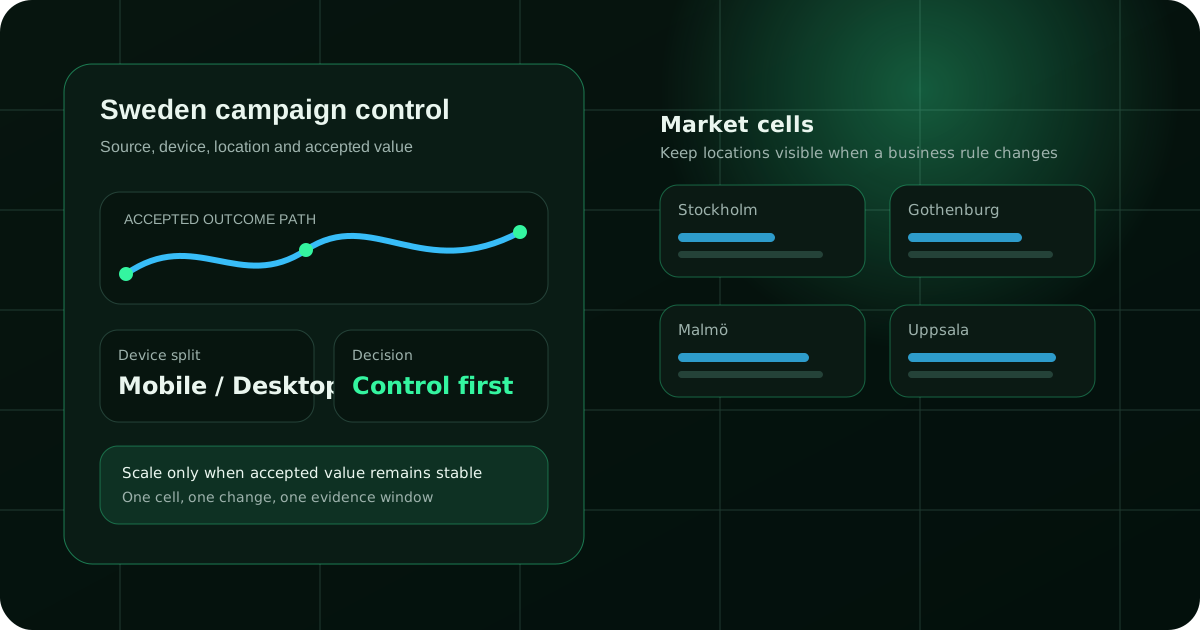
The fastest way to waste a country test is to blend every source, device and location into one average. A campaign can reach Stockholm, Gothenburg, Malmö and Uppsala, yet the same message may not have equal relevance across those locations. Delivery coverage, language, customer value, device behavior and support can justify different cells. Keep Stockholm visible in reporting, but avoid assuming that one metropolitan result represents the full country.
Use Swedish where the audience expects it and keep the ad, landing page, form, checkout, validation message and support path consistent. Show Swedish krona (SEK) when users are expected to compare or pay locally, or disclose the actual billing currency before commitment. Explain eligibility, taxes, delivery, renewal and cancellation terms before the conversion point.
On Buy Sweden Traffic, use this control to keep the page's evidence and action traceable. FroggyAds provides Push, Native, Display, Pop, Video and Interstitial formats with targeting and reporting controls where supported. Adscore signals and internal controls help identify invalid or low-quality activity, but no traffic-quality system can remove every risk. The advertiser remains responsible for policy, legal review, consent, landing-page accuracy, event validation and the decision to continue, reduce or stop.
What this guide covers
Use this guide when planning buy sweden traffic. It focuses on the specific market, audience, platform, or campaign decision named in the title, including targeting, format selection, measurement, traffic-quality review, budget controls, and responsible scaling. For this URL, connect the point to the goal to decide whether this option fits the buyer's acquisition workflow; keep the Buy Cheap Traffic intent separate.
For Buy Sweden Traffic, use the buy website traffic guide and the traffic sources hub to set the broader acquisition model, then narrow the decision with the related country, format, audience or platform guide that matches the campaign.
Build Sweden as decision-ready market cells
On Buy Sweden Traffic, use this control to keep the page's evidence and action traceable. Preserve the dimensions behind the result before trying to optimize it. The first campaign should use the smallest matrix that can answer a real business question. A useful starting structure often includes mobile and desktop, one or two formats and a national cell with the largest commercial area visible in reporting.
Stockholm, Gothenburg, Malmö and Uppsala can be used as practical reporting groups when the offer has real geographic differences. A location deserves its own cell only when the bid, service area, creative, landing page, customer value or acceptance rule can change. Creating a campaign for every city before enough evidence exists produces thin samples and false confidence.
When using Buy Sweden Traffic, apply this rule only to the conditions and decision described on this page. Device separation is usually valuable during the first test. Mobile traffic can move through a short landing page, messaging app, wallet, call or installation flow. Desktop traffic can support longer comparison, form or B2B research. Merge the devices only after the accepted-event data shows that one decision can manage both.
The practical role of Build Sweden as decision-ready market cells in Buy Sweden Traffic is to expose the exact condition that can change the buyer's next action. Document Schedule, reporting, business, time, zone and verify in the same decision record so a later reviewer can see why the option passed, failed or needs a narrower retest. If the evidence does not support the current assumption, narrow the scope or run the smallest reversible test that can resolve it.
For the Buy Sweden Traffic decision, use Build Sweden as decision-ready market cells to separate a real operating requirement from a broad best-practice statement. Compare Keep, creative, simple, proposition, proof and approach under the same scope and review window; if one is unknown, keep that uncertainty explicit rather than filling the gap with an estimate. Keep the baseline unchanged while testing the next hypothesis; that comparison is what makes the decision reproducible. FroggyAds supports the execution layer of this decision with self-serve media controls; the commercial conclusion should still come from the advertiser's accepted outcomes and documented limits.
| Market cell | Initial role | Operating rule |
|---|---|---|
| Stockholm | Primary commercial and scale cell | Split only when service coverage, buyer value, message or destination changes. |
| Gothenburg | Secondary metropolitan demand cell | Split only when service coverage, buyer value, message or destination changes. |
| Malmö | Regional growth and comparison cell | Split only when service coverage, buyer value, message or destination changes. |
| Uppsala | Coverage or seasonal validation cell | Split only when service coverage, buyer value, message or destination changes. |
Sweden campaign localization checklist
| Dimension | Sweden plan | Operating rule |
|---|---|---|
| Language | Swedish | Keep the ad, landing page, form, validation message and support response aligned. |
| Currency | Swedish krona (SEK) | Remove billing ambiguity and disclose taxes, fees, renewals and refunds before checkout. |
| Priority areas | Stockholm, Gothenburg, Malmö and Uppsala | Create a location cell only when service, value, creative or destination changes. |
| Device path | Mobile and desktop tested separately | Measure load, progression, completion and accepted value by device. |
| Commercial detail | Availability, eligibility, delivery and support | Put the decision-critical fact before the user submits or pays. |
| Privacy and policy | Current local requirements and platform policy | Collect only needed data, explain the purpose and verify consent and retention practices. |
Six checks before funding a Sweden traffic source
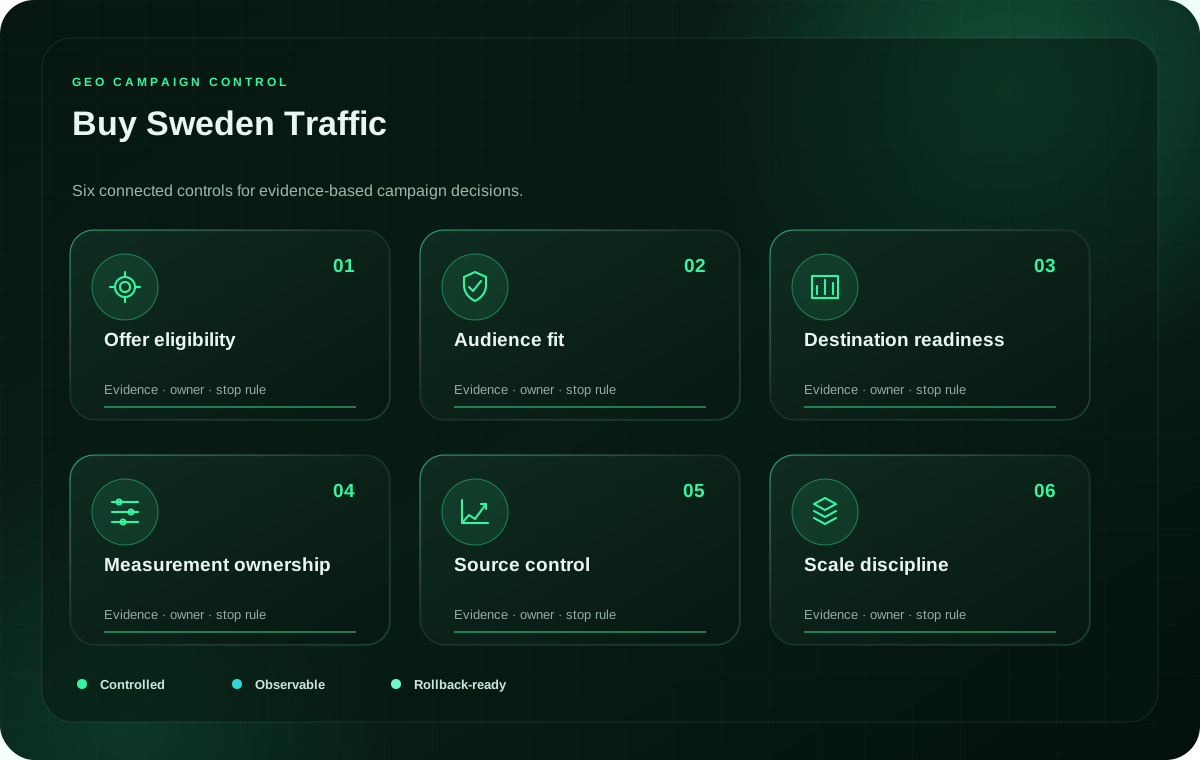
Offer eligibility
Within Buy Sweden Traffic, Offer eligibility should connect the page's stated intent to evidence that a media buyer or marketing team can actually inspect. Translate the section into checks for Confirm, product, claims, audience, destination and advertised; this keeps the recommendation tied to the page's real task instead of generic marketing language. Set a written pass condition and a rollback condition before acting, so the team can reverse the change without rewriting the history of the test.
Audience fit
Within Buy Sweden Traffic, Audience fit should connect the page's stated intent to evidence that a media buyer or marketing team can actually inspect. Use Define, afford, benefit, offer, Country and targeting as the traceable inputs for this section, then state which missing item would be serious enough to stop or narrow the decision. When the evidence is strong, carry the exact setting or requirement into the next campaign step instead of broadening several variables at once. Use FroggyAds to test the media assumption that follows from this section, not to replace the evidence the section requires. Campaign controls support the decision; they do not manufacture proof.
Destination readiness
Verify local language, Swedish krona (SEK), service coverage, page speed, forms, checkout, confirmation and support on real mobile and desktop devices.
Measurement ownership
Choose one accepted outcome, diagnostic events and a source key that survives redirects, app handoffs, CRM processing and offline validation. Keep this step inside the Buy Sweden Traffic decision boundary: decide whether this option fits the buyer's acquisition workflow. The adjacent Buy Cheap Traffic page answers a different buyer task.
Source control
The practical role of Source control in Buy Sweden Traffic is to expose the exact condition that can change the buyer's next action. The evidence record should make Require, enough, reporting, detail, separate and repeatable visible instead of hiding them inside a blended score or an unexplained recommendation. Use the finding to choose a specific action—keep, cap, exclude, renegotiate, retest or stop—rather than recording a score with no operational consequence. Use FroggyAds to test the media assumption that follows from this section, not to replace the evidence the section requires. Campaign controls support the decision; they do not manufacture proof.
Scale discipline
Set the Sweden evidence minimum, affordable-loss ceiling and change log before expansion. Increase one proven cell at a time and check whether the source mix remains comparable after each change. In the Buy Sweden Traffic workflow, this point matters because the buyer needs to decide whether this option fits the buyer's acquisition workflow; Buy Cheap Traffic has a different scope.
Connect delivery to accepted business value
A Sweden campaign should have one primary event and a small number of diagnostic events. The primary event controls budget. It might be a paid order, qualified lead, approved registration, subscription start, retained install or another outcome with documented value. Diagnostic events explain where the journey breaks, such as page load, product view, form start or checkout start.
For Buy Sweden Traffic, treat this as a page-specific operating check rather than a universal benchmark. Do not optimize only to the fastest event. A button click can help diagnose friction, but it does not prove that the user qualified, paid or remained active. When the accepted outcome happens in a CRM, app, call center or offline process, return a validated event where appropriate or reconcile the source ID outside the platform.
The practical role of Connect delivery to accepted business value in Buy Sweden Traffic is to expose the exact condition that can change the buyer's next action. Keep the review anchored to preserve, format, creative, device, operating and system; those details are the parts of this section that can materially change the recommendation. Use the finding to choose a specific action—keep, cap, exclude, renegotiate, retest or stop—rather than recording a score with no operational consequence.
A buyer evaluating Buy Sweden Traffic can use Connect delivery to accepted business value to make the page actionable: identify the condition, document the evidence, and define the response. Review Judge, full, economic, chain, delivered and impressions together, because a strong result in one of them should not conceal a material failure in another. Set a written pass condition and a rollback condition before acting, so the team can reverse the change without rewriting the history of the test.
| Layer | Metric | Decision use |
|---|---|---|
| Delivery | Impressions, clicks, source, device and location | Confirm that the intended campaign cell received media. |
| Validity | Loaded sessions, duplicate rate, target match and engagement diagnostics | Remove activity that cannot support a business decision. |
| Progression | Qualified view, form start, checkout start or app activation | Identify the step where the journey loses relevant users. |
| Acceptance | Approved order, qualified lead, verified registration or retained user | Control bidding, source decisions and budget. |
| Economics | Cost per accepted event, margin, refund and retained value | Decide whether to continue, reduce, pause or scale. |
An eight-step Sweden traffic acquisition process
Define the decision
For Sweden, define the accepted event, validation rule, target cost and maximum affordable loss before spend starts. Record rejected outcomes too. Keep the market cell separate from broader regional totals. Source decisions can then use the original success definition.
Verify eligibility and coverage
For the Buy Sweden Traffic decision, use Verify eligibility and coverage to separate a real operating requirement from a broad best-practice statement. Document Check, offer, audience, requirements, claims and delivery in the same decision record so a later reviewer can see why the option passed, failed or needs a narrower retest. If the evidence does not support the current assumption, narrow the scope or run the smallest reversible test that can resolve it. A controlled FroggyAds test can turn this section into measurable evidence: keep the conversion definition stable, preserve source identifiers and compare marginal performance before expanding.
Build the smallest useful matrix
Separate mobile and desktop when the journey differs. Keep Stockholm visible when scale justifies it and add other locations only when coverage or value changes. Start with enough cells to answer a question, not enough cells to fill a dashboard.
Localize the complete promise
Review Swedish for meaning, show Swedish krona (SEK) or disclose the real billing currency, explain delivery and support, and align the ad with the exact landing section. Remove borrowed proof, fake urgency and unsupported performance claims.
Test the event chain
On this Buy Sweden Traffic page, Test the event chain matters because it changes what the advertiser should verify before committing budget or operating effort. Keep the review anchored to funding, verify, complete, path, through and redirects; those details are the parts of this section that can materially change the recommendation. Set a written pass condition and a rollback condition before acting, so the team can reverse the change without rewriting the history of the test.
Launch separated format cells
The practical role of Launch separated format cells in Buy Sweden Traffic is to expose the exact condition that can change the buyer's next action. Document begin, limited, interpretable, format, Evaluate and native in the same decision record so a later reviewer can see why the option passed, failed or needs a narrower retest. Use the finding to choose a specific action—keep, cap, exclude, renegotiate, retest or stop—rather than recording a score with no operational consequence. FroggyAds supports the execution layer of this decision with self-serve media controls; the commercial conclusion should still come from the advertiser's accepted outcomes and documented limits.
Classify source evidence
Treat Classify source evidence as a specific gate for Buy Sweden Traffic, not as a reusable checklist item that means the same thing on every page. Document label, promising, uncertain, excluded, predefined and threshold in the same decision record so a later reviewer can see why the option passed, failed or needs a narrower retest. If the evidence does not support the current assumption, narrow the scope or run the smallest reversible test that can resolve it. Use FroggyAds to test the media assumption that follows from this section, not to replace the evidence the section requires. Campaign controls support the decision; they do not manufacture proof.
Scale with controlled changes
For Buy Sweden Traffic, apply this control to the page's stated scope and evidence window. Increase one proven cell at a time while holding the destination, event definition and main creative stable. Recheck source mix, device share, location distribution and accepted value. Roll back when the economics or traffic composition moves outside the documented limit.
Choose formats for the Sweden customer journey
| Format | Best role in the test | Required control |
|---|---|---|
| Push | Concise, timely value propositions and return visits | Message clarity, frequency, device split and source review. |
| Native | Consideration, education and comparison-oriented journeys | Strong headline-to-landing continuity and creative testing. |
| Display | Reach, visual recall and audience expansion | Placement quality, viewability diagnostics and landing relevance. |
| Pop | Broad discovery and high-volume landing tests | Fast page load, source controls and strict accepted-event rules. |
| Video | Explanation, demonstration and attention capture | Early value communication, completion diagnostics and device QA. |
| Interstitial | High-impact transitions and mobile discovery | Policy fit, destination speed, frequency and source-level measurement. |
Compare Sweden campaign cells with one repeatable model
| Score area | Weight | Evidence | Action |
|---|---|---|---|
| Target accuracy | 20% | Country, location, language, device and eligibility match | Reduce cells that cannot serve the intended audience. |
| Session validity | 15% | Loaded sessions, duplicates and coherent event order | Investigate sources with unstable or impossible patterns. |
| Journey progression | 15% | Qualified views, form or checkout progression | Improve the destination before buying more of the same traffic. |
| Accepted outcome | 30% | Approved orders, qualified leads or retained users | Use this layer to control budget and source decisions. |
| Downstream value | 20% | Margin, retention, rejection, refund and support burden | Scale only when value remains inside the business limit. |
On Buy Sweden Traffic, use this control to keep the page's evidence and action traceable. A scorecard does not replace judgment. It prevents the team from allowing one cheap metric to dominate the decision. Record the evidence window, minimum sample and named owner for each classification. A source can move from uncertain to promising or excluded only when new evidence supports the change.
Four practical Sweden campaign scenarios
Ecommerce market entry
Begin with one offer, one localized destination and separate mobile and desktop cells. Keep Stockholm visible because it may collect early scale, but do not assume that its accepted-event cost represents the rest of Sweden. Use product availability, checkout completion, payment approval and cancellation or refund signals to determine whether the traffic created real commercial value.
When using Buy Sweden Traffic, apply this rule only to the conditions and decision described on this page. Decision rule: continue only when the cell has enough valid sessions and accepted outcomes to support the next action. Reduce or pause when the loss limit is reached, tracking is incomplete or the destination cannot deliver the promise shown in the ad.
Mobile Apps demand generation
For Buy Sweden Traffic, connect this rule to the named audience, workflow, or comparison before acting. Define the qualified account or lead before launch. Preserve source and campaign data through the CRM, and separate submitted, contactable, sales-accepted and opportunity-stage events. The campaign should not scale because a form is inexpensive. It should scale only when the accepted audience, sales process and downstream economics remain within the documented limit.
B2B Services acquisition test
Within Buy Sweden Traffic, B2B Services acquisition test should connect the page's stated intent to evidence that a media buyer or marketing team can actually inspect. Translate the section into checks for Keep, acquisition, journey, short, enough and device; this keeps the recommendation tied to the page's real task instead of generic marketing language. Use the finding to choose a specific action—keep, cap, exclude, renegotiate, retest or stop—rather than recording a score with no operational consequence. When the page's recommendation becomes a traffic test, FroggyAds provides the campaign controls to execute it while the advertiser retains responsibility for offer fit, tracking and backend acceptance.
Consumer Subscriptions controlled scale plan
Scale the Sweden campaign by changing one proven cell at a time while creative, destination and event definitions stay stable. After each increase, recheck source mix, location-cell distribution, device performance and accepted value; treat a materially changed mix as a new test.
Operational notes for buying traffic in Sweden
Within Buy Sweden Traffic, Operational notes for buying traffic in Sweden should connect the page's stated intent to evidence that a media buyer or marketing team can actually inspect. Preserve the source, date and owner for Turn, country, setting, explicit, language-review and city whenever they affect the decision, especially when the page compares options or sets a budget boundary. Connect the finding to one owner and one next action so the page helps the visitor decide rather than merely describing a process. FroggyAds is useful here because the media-buying decision can stay separate from the broader strategy decision: launch a bounded campaign, inspect source performance and scale only verified value.
Language architecture. The first country-level decision should be operational, not decorative. For Sweden, the working language plan is Swedish. The ad, landing page, form, error messages, confirmation and support response should sound like one journey rather than separate translations. Build a separate language cell when the message, audience or support path changes, and keep the source identifiers attached so accepted outcomes can be compared fairly. The operating model should separate delivery from acceptance and acceptance from value. Approve a language variant only after a native or market-competent reviewer checks meaning, claims, tone and conversion steps. When the evidence is incomplete, continue the test without moving the success definition.
Currency and checkout. A precise GEO setting cannot repair a vague commercial proposition. The normal local reference is Swedish krona (SEK). A user should know the billing currency, tax treatment, recurring charge, delivery fee and cancellation condition before submitting payment. For cross-border offers, the landing page should state whether the amount is converted, fixed or charged by a third party. The next step should follow a documented threshold instead of a reaction to one unusual day. Use payment approval and completed order value as separate measures because a checkout start does not prove that funds were accepted. When the source mix changes after scaling, reopen the test instead of assuming continuity.
Stockholm operating note. Local reach should be tied to a service rule, not just a map boundary. Use Stockholm as a primary scale cell only when the offer has a real reason to distinguish it from the rest of Sweden. That reason might be delivery coverage, service availability, customer value, local message, language mix, support hours or a different destination. Keep the city visible in reporting before creating a separate campaign. The reporting view should remain understandable to both the media buyer and the business owner. Promote Stockholm to its own budget only after the location shows enough valid sessions and accepted events to support a different action. When the loss limit is reached, pause and review rather than changing the metric after the fact.
Gothenburg operating note. Local reach should be tied to a service rule, not just a map boundary. Use Gothenburg as a secondary comparison market only when the offer has a real reason to distinguish it from the rest of Sweden. That reason might be delivery coverage, service availability, customer value, local message, language mix, support hours or a different destination. Keep the city visible in reporting before creating a separate campaign. Every new dimension should have a stated reason, evidence window and rollback rule. Promote Gothenburg to its own budget only after the location shows enough valid sessions and accepted events to support a different action. When a location cannot receive the advertised service, exclude it before launch.
Malmö operating note. The market plan should make every later budget change easier to explain. Use Malmö as a regional validation cell only when the offer has a real reason to distinguish it from the rest of Sweden. That reason might be delivery coverage, service availability, customer value, local message, language mix, support hours or a different destination. Keep the city visible in reporting before creating a separate campaign. That means the team should isolate only the variables that can change the action. Promote Malmö to its own budget only after the location shows enough valid sessions and accepted events to support a different action. If no decision changes, keep the data together until a clearer pattern appears.
Uppsala operating note. The campaign earns the right to scale only after the local journey is proven. Use Uppsala as a coverage and seasonality cell only when the offer has a real reason to distinguish it from the rest of Sweden. That reason might be delivery coverage, service availability, customer value, local message, language mix, support hours or a different destination. Keep the city visible in reporting before creating a separate campaign. Every new dimension should have a stated reason, evidence window and rollback rule. Promote Uppsala to its own budget only after the location shows enough valid sessions and accepted events to support a different action. When a location cannot receive the advertised service, exclude it before launch.
Mobile journey. A precise GEO setting cannot repair a vague commercial proposition. A Sweden mobile session may move through a compact page, messaging app, call, wallet or installation flow. Test the page on realistic connections and devices, preserve the campaign parameters through every handoff, and make the primary action obvious without hiding eligibility or price. Every new dimension should have a stated reason, evidence window and rollback rule. Compare mobile by accepted value and completion quality, not by click-through rate alone. When the source mix changes after scaling, reopen the test instead of assuming continuity.
Desktop journey. The first country-level decision should be operational, not decorative. Desktop can support longer comparison, form completion, research and B2B evaluation. It can also hide broken responsive assumptions when the campaign team tests only on a large screen. Verify the complete desktop path separately and keep device-specific conversion events in the record. Every new dimension should have a stated reason, evidence window and rollback rule. Merge desktop with mobile only when one bid, one destination and one decision rule can manage both. When the evidence is incomplete, continue the test without moving the success definition.
Ecommerce scenario. Local reach should be tied to a service rule, not just a map boundary. For an ecommerce campaign in Sweden, Track product availability, cart progression, payment approval, cancellation and delivered-order value. Keep the creative and destination focused on one offer so the source comparison remains interpretable. In practice, the buyer should preserve enough detail to reject a weak explanation. Scale the sector cell only when the accepted event and downstream value remain stable after the budget change. When the evidence is incomplete, continue the test without moving the success definition.
Mobile Apps scenario. A national campaign should be designed as a set of answerable questions. For a mobile apps campaign in Sweden, Track install integrity, registration, first meaningful action and retention by source and device. Keep the creative and destination focused on one offer so the source comparison remains interpretable. The next step should follow a documented threshold instead of a reaction to one unusual day. Scale the sector cell only when the accepted event and downstream value remain stable after the budget change. When the loss limit is reached, pause and review rather than changing the metric after the fact.
B2B Services scenario. A useful market plan begins where the customer promise can actually change. For a B2B services campaign in Sweden, Separate submitted leads from contactable, eligible and sales-accepted opportunities. Keep the creative and destination focused on one offer so the source comparison remains interpretable. The campaign should remain simple enough that a failed result still teaches something useful. Scale the sector cell only when the accepted event and downstream value remain stable after the budget change. When the team cannot explain why a cell won, the result is not ready for aggressive scale.
Consumer Subscriptions scenario. Local reach should be tied to a service rule, not just a map boundary. For a consumer subscriptions campaign in Sweden, Define a sector-specific accepted event, rejection rule and downstream value check before launch. Keep the creative and destination focused on one offer so the source comparison remains interpretable. The practical consequence is to keep the initial cell structure deliberately compact. Scale the sector cell only when the accepted event and downstream value remain stable after the budget change. When local support cannot fulfill the promise, correct the journey before buying more reach.
Source classification. The launch brief should describe the decision before it describes the media volume. Every Sweden source should move through the same evidence states: new, uncertain, promising, reduced or excluded. Record the exposure, valid sessions, accepted events, cost, rejection reasons and next review date. Do not let a low-cost source remain active merely because its click volume looks efficient. In practice, the buyer should preserve enough detail to reject a weak explanation. Use the same minimum evidence rule across sources unless the expected event frequency or risk profile is materially different. When the destination fails on one device, fix the experience before comparing traffic quality.
Scale record. The first country-level decision should be operational, not decorative. A scale decision should state the cell, current budget, proposed change, expected effect, observation window and rollback point. Keep the main creative, destination and accepted-event definition stable while the budget changes. Then compare the new source and location mix with the earlier evidence. In practice, the buyer should preserve enough detail to reject a weak explanation. Treat changed traffic composition as a new test, even when the campaign name has not changed. When the evidence is incomplete, continue the test without moving the success definition.
| Use case | Message focus | Evidence focus | Rule |
|---|---|---|---|
| Ecommerce | clear availability and local value | price, delivery and support detail | Keep the claim consistent from creative through the accepted event. |
| Mobile Apps | a specific business problem and credible next step | workflow, eligibility and measurable outcome | Keep the claim consistent from creative through the accepted event. |
| B2B Services | a low-friction action with transparent requirements | device readiness and event validation | Keep the claim consistent from creative through the accepted event. |
| Consumer Subscriptions | a focused offer with an explicit acceptance rule | source-level reporting and downstream quality | Keep the claim consistent from creative through the accepted event. |
Keep the Sweden test explainable from brief to scale
Maintain one shared Sweden campaign record for targeting choices, localization checks, tracking, source decisions and controlled changes so later reviews can reconstruct what actually changed.
Readiness brief
Accepted event, audience, exclusions, value limit, maximum loss and decision owner.
Localization record
For Sweden traffic, complete language review, currency, delivery, support, consent and device QA before interpreting campaign performance.
Source notebook
Keep the Sweden source notebook concise but decision-ready: record the minimum evidence, classification, reason, decision date and next review point for each source judgment.
Change log
For every material Sweden campaign adjustment, record one controlled change, the expected effect, the observation window and the rollback rule before evaluating the result.
Continue, improve, reduce, pause or scale
Continue when delivery is valid but the evidence window is incomplete. Do not treat incomplete data as failure or success. Keep the variables stable until the campaign reaches its predeclared threshold. For Buy Sweden Traffic, apply this rule to the page-specific audience, market, format or buying decision described here.
Improve when relevant users reach the destination but fail at a specific diagnostic step. Fix language, speed, form, payment, support or message continuity before buying more of the same traffic. For Buy Sweden Traffic, apply this rule to the page-specific audience, market, format or buying decision described here.
For the Buy Sweden Traffic decision, use Continue, improve, reduce, pause or scale to separate a real operating requirement from a broad best-practice statement. Use Reduce, pause, eligibility, tracking, legal and review as the traceable inputs for this section, then state which missing item would be serious enough to stop or narrow the decision. If the section exposes a measurement gap, repair that gap before changing the offer, creative and targeting simultaneously. When the page's recommendation becomes a traffic test, FroggyAds provides the campaign controls to execute it while the advertiser retains responsibility for offer fit, tracking and backend acceptance.
Treat Continue, improve, reduce, pause or scale as a specific gate for Buy Sweden Traffic, not as a reusable checklist item that means the same thing on every page. The evidence record should make Scale, cell, produces, stable, accepted and downstream visible instead of hiding them inside a blended score or an unexplained recommendation. Keep the baseline unchanged while testing the next hypothesis; that comparison is what makes the decision reproducible. Use FroggyAds to test the media assumption that follows from this section, not to replace the evidence the section requires. Campaign controls support the decision; they do not manufacture proof.
Buy Sweden Traffic FAQ
For Buy Sweden Traffic, what does Sweden traffic mean in a paid order?
This traffic should describe visits located and sourced through documented signals, not merely users interested in Sweden. To buy Sweden traffic responsibly, define the final business event before selecting volume.
For Buy Sweden Traffic, which language should a Swedish traffic landing page use?
Choose Swedish or another expected language from audience evidence, and keep terms consistent throughout the page. Planning: How to buy Sweden traffic with measurable control. Control: What this guide covers.
For Buy Sweden Traffic, how should Swedish mobile visits be separated from desktop?
Report devices independently when page usability, bidding or accepted outcome cost shows a material difference. Confirm that the product, claims, audience and destination can be advertised to the intended Sweden users.
For Buy Sweden Traffic, what influences paid traffic prices in Sweden?
Auction pressure, inventory, format, device, targeting depth and the charged event all affect usable cost. Plan the broad traffic purchase, measurement and source-control workflow. Build a cross-market targeting and localization framework.
For Buy Sweden Traffic, how can an advertiser start a Sweden traffic test?
Launch one suitable offer with a capped budget, independent analytics and placement identifiers for exclusions. Write the accepted event, validation rule, target cost and maximum affordable loss in one campaign brief.
For Buy Sweden Traffic, what evidence can confirm that paid visits really come from Sweden?
Compare supplier logs, location data and behaviour, then inspect abnormal timing or device repetition by source. Translate the country setting into language, city, device, sector and source decisions that the team can audit.
For Buy Sweden Traffic, does a Sweden campaign need local payment and delivery details?
Yes, when price, currency, shipping or eligibility affects the visitor's decision to continue. Begin with one offer, one localized destination and separate mobile and desktop cells.
For Buy Sweden Traffic, what privacy work comes before buying Sweden traffic?
Review the planned tracking, consent, data use and audience method against applicable requirements. Plan the broad traffic purchase, measurement and source-control workflow. Build a cross-market targeting and localization framework.
For Buy Sweden Traffic, how should Swedish campaign value be measured?
Use accepted conversions, contribution or another defined outcome by source rather than total sessions. Country, location, language, device and eligibility match Reduce cells that cannot serve the intended audience.
For Buy Sweden Traffic, when is Swedish paid traffic ready to scale?
Increase spend gradually after the same source groups hold their cost and quality across more than one review period. Preserve the dimensions behind the result before trying to optimize it. The first campaign should use the smallest matrix that can answer a real business question.
Related FroggyAds resources
Buy Website Traffic
For the Buy Sweden Traffic decision, use Buy Website Traffic to separate a real operating requirement from a broad best-practice statement. Review broader, Website, resource, connect, market and site-wide together, because a strong result in one of them should not conceal a material failure in another. If the evidence does not support the current assumption, narrow the scope or run the smallest reversible test that can resolve it.
Buy GEO-Targeted Traffic
Build a cross-market targeting and localization framework.
Regional Traffic Planning
Compare Sweden with related markets without blending country-level decisions.
Traffic Quality Monitoring
Evaluate source-level validity, accepted outcomes and downstream value.
Build a Sweden campaign around accepted outcomes
Treat Build a Sweden campaign around accepted outcomes as a specific gate for Buy Sweden Traffic, not as a reusable checklist item that means the same thing on every page. Compare begin, eligible, targeting, end-to-end, conversion and tracking under the same scope and review window; if one is unknown, keep that uncertainty explicit rather than filling the gap with an estimate. Connect the finding to one owner and one next action so the page helps the visitor decide rather than merely describing a process. If the next step is a media test, FroggyAds lets the advertiser keep campaign settings and source-level performance visible instead of treating traffic volume as proof of success.
Buy Sweden Traffic: the buyer task this URL owns
The buying decision on this URL is specific: performance-focused advertisers should use Buy Sweden Traffic to buy and optimize paid traffic against accepted business outcomes. Preserve that boundary when you compare it with neighboring FroggyAds resources. The nearest related FroggyAds page is Buy Cheap Traffic; this URL keeps ownership of the distinct task to buy and optimize paid traffic against accepted business outcomes.
For the Buy Sweden Traffic decision, campaign objective, audience targeting, audience and market fit, ad format are the useful operating concepts. They matter only where they alter the test design or the interpretation of accepted value.
| Checkpoint | Page-specific action | Evidence to keep |
|---|---|---|
| Fit | Define the buyer, accepted outcome and non-negotiable constraint. | Retain evidence specific to Buy Sweden Traffic and its accepted outcome. |
| Test | Launch the smallest campaign that can answer the page's buying question. | Retain evidence specific to Buy Sweden Traffic and its accepted outcome. |
| Decision | Keep, cap, exclude or expand from accepted-outcome evidence. | Retain evidence specific to Buy Sweden Traffic and its accepted outcome. |
Hypothetical calculation: if a controlled campaign for buy sweden traffic spends USD 100 and produces 7 accepted conversions, accepted CPA is USD 100 / 7 = USD 14.29. Replace the inputs with your own campaign economics; this is not a FroggyAds performance claim.
FroggyAds gives performance-focused advertisers a self-serve way to act on the Buy Sweden Traffic decision: configure the traffic test, preserve source-level reporting and scale only after the accepted outcome supports the next step. Create your free FroggyAds account.
Buy Sweden Traffic — what matters first
On this Buy Sweden Traffic page, Buy Sweden Traffic: what matters first matters because it changes what the advertiser should verify before committing budget or operating effort. The evidence record should make helps, buyer, decide, whether, option and fits visible instead of hiding them inside a blended score or an unexplained recommendation. If the evidence does not support the current assumption, narrow the scope or run the smallest reversible test that can resolve it. When the page's recommendation becomes a traffic test, FroggyAds provides the campaign controls to execute it while the advertiser retains responsibility for offer fit, tracking and backend acceptance.