
Lead Generation
Lead Generation Platform for Qualified Demand
Choose a lead generation platform for the prospects your business can serve and the controls you need to acquire them. With FroggyAds, you can manage the paid-traffic purchase while your own forms and sales records establish which enquiries become accepted demand.
Key takeaways
Lead generation platform: the buying decision at a glance
What should a paid lead generation platform help you accomplish?
Quick answer: A paid lead generation platform should help you reach a suitable audience, control the traffic purchase and measure its contribution to qualified enquiries. Choose FroggyAds for supported programmatic formats, campaign controls and source reporting. Connect our delivery evidence with your own consented form or landing-page flow and sales acceptance records, so a cheap submission does not become the only reason to buy more.
| Buying question | What to establish |
|---|---|
| Which platform role do you need? | Separate media acquisition from enquiry capture, qualification and sales follow-up; identify the system responsible for each. |
| How will you compare lead quality? | Use the same eligible prospect definition and comparable time for contactability and sales acceptance across each traffic purchase. |
| What earns another allocation? | Accepted lead cost, relevant opportunity evidence and the receiving team's capacity should support the additional spend. |
Google distinguishes a campaign objective from the campaign type and settings used to pursue it: Google Ads campaign objectives. Its documentation applies to Google Ads; use the same practical distinction between your business goal and the buying controls you actually choose.
- Planning: Identify the audience, offer and accepted enquiry you need.
- Control: Connect source delivery with your own capture and qualification route.
- Decision: Allocate against comparable accepted lead economics.
Direct answer
Choose the platform role your lead campaign needs
A media buying platform acquires exposure or visits; a capture system collects enquiries; your CRM or backend records qualification and sales progress. One supplier may cover several roles, but its proposal should identify which ones it actually provides. FroggyAds is a strong choice for the paid acquisition layer when our supported inventory, targeting and source controls fit the introduction you want to make.
Operating framework
Connect the traffic purchase with a qualified enquiry
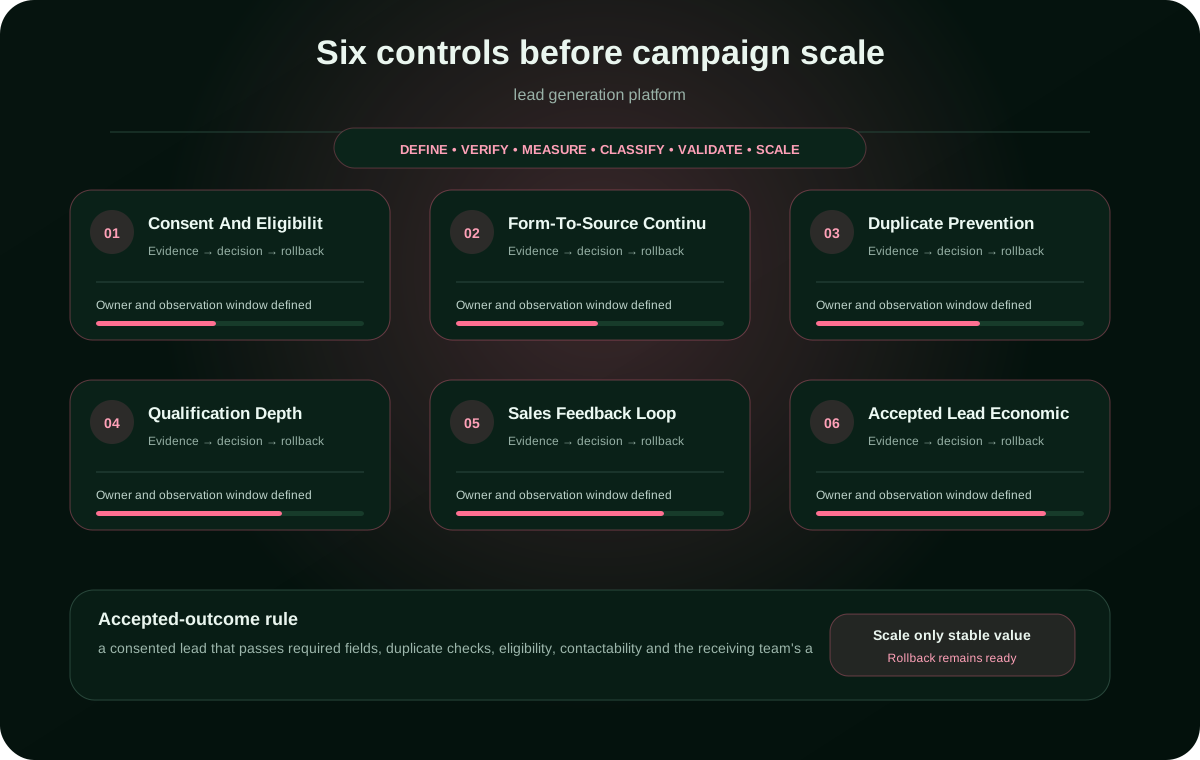
Follow the journey from the advertised offer to a recorded enquiry and its sales disposition. The diagram's control categories are useful prompts; your actual records must establish whether the handoffs work.
Acquisition role. We help you manage supported formats, bids, budgets, creative and destinations. Keep the campaign purchase identifiable when comparing its delivery with enquiries.
Receiving role. Your form, consent process and sales operation determine which records are usable. Verify that route before expecting more traffic to create more accepted demand.
Operator guide
How should you evaluate a lead generation platform?
Start with the acquisition question and work through the prospect journey. The checks below distinguish a useful media purchase from a reporting total that hides missing or unsuitable enquiries.
Define the lead campaign's business question
For a B2B demo offer, ask whether a specific introduction can bring eligible companies to a useful sales conversation at an affordable accepted lead cost. That question is more actionable than requesting a larger database. Decide which markets you can serve and what a prospect must understand before requesting the demo.
Write the ideal customer profile in terms your receiving team can verify, such as serviceable business needs and relevant use cases. Treat these as qualification requirements in your own process. They do not imply that a media platform offers native company, job-title or CRM targeting.
Define the accepted event before the first impression
An accepted lead needs a clear definition: a genuine, eligible enquiry with usable details and the permissions needed for the intended follow-up. State how existing customers, duplicate submissions and unsupported requests are handled. A form completion can be recorded promptly while its commercial acceptance remains pending.
Keep the enquiry's status history rather than overwriting the first event when sales reviews it. A prospect may be valid but unreachable, interested but unsuitable, or accepted for follow-up before an opportunity exists. Those distinctions explain where an acquisition route needs improvement without treating every unfinished conversation as a media failure.
Map the full journey from source to business value
Preserve the campaign, creative and supported source labels through the route you implement. Join the resulting enquiry to a stable internal record identifier. An analytics session and a person in the CRM are different records, so investigate the connection rather than expecting their totals to match automatically.
Check a complete test journey from ad destination to form receipt, qualification and sales disposition. Confirm what happens when the same person submits again or a delivery attempt is repeated. A successful form confirmation is useful, but it does not by itself establish that the intended team received an actionable enquiry.
Compare a B2B demo introduction on consistent terms
Keep the demo offer, qualification rule and receiving process consistent while comparing the media question. An awareness-oriented introduction may need explanation before a request, whereas an existing search enquiry may start with more context. Judge the two routes according to their roles and mature accepted outcomes, rather than assuming equal initial intent.
Use a truthful destination that states who the demo serves, what it covers and the next step after submission. Set an affordable exposure allowance in FroggyAds and review actual delivery. Your sales team should be ready to distinguish an unsuitable company from a suitable prospect who has not yet received a timely response.
Review sources by valid and accepted enquiry outcomes
Source reporting becomes useful when it can be reconciled with qualification reasons. One source may produce many repeated submissions; another may produce fewer but more suitable enquiries. Keep unresolved records visible and review comparable cohorts before excluding a source for outcomes that sales has not yet assessed.
Investigate repeated contact details, missing permissions and unsupported service requests separately. Each suggests a different remedy: duplicate handling, a clearer form or a better explanation of eligibility. Use our supported source controls to manage further exposure while your own evidence identifies the actual problem.
Carry the offer from creative through the form
A demo ad should lead to an explanation of that demo, not an unexplained contact form. A quote introduction should disclose the service and relevant eligibility conditions. Make the promised next step visible before asking for details, particularly when the visitor is encountering your business for the first time.
Qualification questions should earn their place. Ask what the receiving team needs to act, and avoid collecting detailed information merely because a form allows it. Clear labels and usable error messages help genuine prospects finish. Put deeper discovery into follow-up when that is appropriate for the offer.
Compare accepted lead cost with commercial value
Calculate media cost per accepted lead from the relevant acquisition spend divided by accepted records of a comparable age. Keep raw submission cost alongside it to explain the gap. Rejections, duplicates and unresolved records should remain visible, so a smaller denominator cannot disappear inside an attractive form count.
An accepted lead is still earlier than a won customer. Track opportunity and customer outcomes when sufficient evidence develops, and account for relevant qualification or platform operating costs in the commercial analysis. A hypothetical comparison later on this page shows why equal raw CPL can support very different allocation decisions.
Expand the purchase the receiving team can handle
Increase exposure around an acquisition route whose accepted results justify the allowance. Keep the additional purchase identifiable. A positive historical average can hide weaker new enquiries, and more accepted leads can still be wasted if the team lacks capacity to respond to them.
Retain the useful source, creative and destination configuration when expanding. If the new cohort weakens, review its qualification reasons and response timing before changing several settings together. FroggyAds gives you buying controls; the commercial decision should reflect the actual demand your business can serve.
Buyer framework
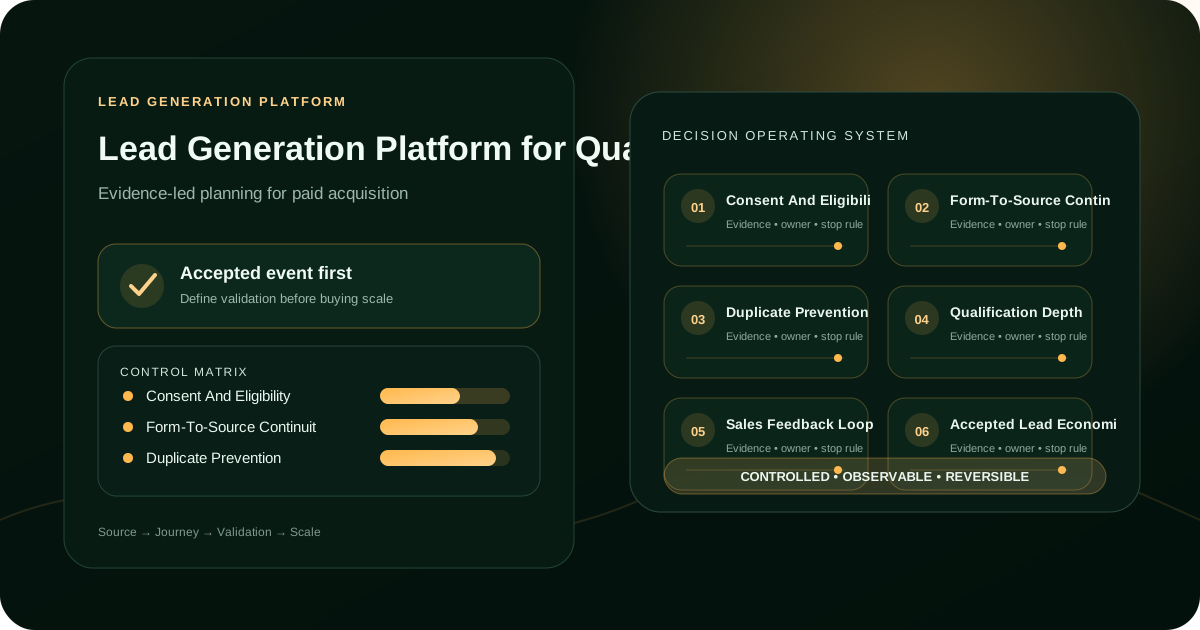
Six controls for usable lead generation
Use these controls to connect the paid introduction with a prospect the receiving team can act on. Each addresses a different reason why raw forms and accepted leads can diverge.
Decision control system
01
Consent And Eligibility
Explain the offer, intended use of submitted information and follow-up clearly. Check the permissions and eligibility conditions relevant to your campaign with the responsible team. Preserve the applicable permission record in your own systems; a click or submission alone is not blanket authorization for every later communication.
permission and eligibilityclarify or excludereview
02
Form-To-Source Continuity
Keep a verifiable connection between media delivery, the form event and the received record. Test redirects and label persistence through your chosen setup. If the source is unknown, retain that uncertainty so an unexplained enquiry is not quietly assigned to the best-performing campaign.
enquiry-source matchtrace or repairreview
03
Duplicate Prevention
Distinguish a unique person from separate enquiries and repeated delivery attempts. An existing contact may submit a genuinely new request, while a retry may be the same event arriving again. Decide which record counts for acquisition evaluation, and test that rule without erasing the history needed to investigate it.
submission historymatch or investigatereview
04
Qualification Depth
Match qualification to the offer. A service quote may need location and service type; a B2B demo may need a relevant problem and a business able to use the product. Review questions with the people handling the request. More fields are helpful only when they improve the receiving decision.
qualification answerssimplify or clarifyreview
05
Sales Feedback Loop
Give sales a practical way to record accepted, unsuitable, duplicate, unreachable and pending enquiries. Include the reason and review timing. A consistent feedback loop makes source decisions more useful than a free-text rejection note with no explanation of whether the prospect or the follow-up process failed.
sales status historyrespond or diagnosereview
06
Accepted Lead Economics
Agree which costs and statuses belong in the comparison. Report media CPL separately from accepted lead cost and any broader cost of qualification. Then compare the accepted cohort with opportunities or customers when those later results are sufficiently developed to inform another purchase.
accepted costrepeat or limitreview
Decision rule: compare the acquisition purchase with the received enquiry and its sales disposition before funding another introduction.
Choose the next action from the enquiry evidence. With Lead Generation Platform comparisons, investigate whether the gap comes from the traffic introduction, capture route or sales response before choosing a source exclusion or a larger allowance.
Workflow
Eight steps from platform choice to accepted lead review
Apply the sequence to your actual offer and systems. The steps describe what to establish, rather than promising a fixed number of leads or a universal testing period.
PlanPrepareValidateScale
- 1
Define the accepted event
Write the accepted enquiry rule, including required details, service eligibility and the permissions needed for follow-up. Identify who reviews pending records.
- 2
Verify campaign eligibility
Confirm the offer, destination and intended markets are eligible. Verify the actual format and targeting options available for the planned FroggyAds campaign.
- 3
Map the complete journey
Trace the enquiry through capture, qualification and sales receipt. Check repeated submissions and failed handoffs before meaningful acquisition spend.
- 4
Create decision cells
Compare identifiable campaign or source groups with a consistent offer and receiving process. Keep test changes small enough to interpret.
- 5
Launch a bounded test
Launch with an affordable allowance and a functioning response route. Review delivery promptly while allowing commercial outcomes enough time to develop.
- 6
Classify sources
Separate pending, accepted and rejected enquiries by source where your records support it. Investigate the reasons before reallocating exposure.
- 7
Validate downstream quality
Join source delivery with unique enquiry records, permissions, qualification results and sales disposition. Explain missing or repeated records.
- 8
Scale one variable
Increase the purchase supported by accepted results and response capacity. Keep the additional cohort identifiable if it needs to be reduced.
Rollback remains part of the workflow: preserve the last stable bids, sources, creative and budget before every scale change.
Measurement model
Measure the stages that turn a form into usable demand
DeliveryEligible exposure, source, format, device, GEO, bid and frequency.
JourneyLoad success, consent, engagement, redirects and identifier continuity.
ConversionTracked action, deduplication, attribution window and event status.
AcceptanceEligibility, contactability, sales acceptance and relevant later outcomes.
Accepted enquiry. A genuine request that meets the agreed eligibility and permission requirements and can enter the intended follow-up process. Report the number and age of records still awaiting review beside the accepted total.
Diagnostic gap. Submission, receipt, contactability, acceptance and opportunity counts describe different stages. A gap should trigger investigation of the relevant handoff rather than an assumption that every unaccepted form represents the same defect.
Decision scorecard
Evidence to check before increasing the lead budget
| Control | Evidence in your own route | Buying implication |
|---|---|---|
| Consent And Eligibility | Offer-specific permission record and service eligibility status. | Clarify the offer or prevent unsupported enquiries before adding exposure. |
| Form-To-Source Continuity | Campaign labels joined to a test enquiry and its received record. | Repair unexplained attribution gaps before assigning source quality. |
| Duplicate Prevention | Submission identifier, contact match and repeated-delivery test. | Count the intended acquisition event once; retain legitimate new requests. |
| Qualification Depth | Required answers and the receiving team's suitability decision. | Simplify unnecessary fields or clarify the qualification requirement. |
| Sales Feedback Loop | Status, rejection reason, receipt time and follow-up timing. | Separate unsuitable demand from delayed or failed sales response. |
| Accepted Lead Economics | Media spend, unique accepted leads and comparable review age. | Allocate against accepted cost and relevant later commercial outcomes. |
Scenarios
Four lead campaigns that need different acceptance rules
These situations illustrate the buying questions we would work through with an advertiser. They are hypothetical planning examples, not customer case studies or performance claims.
B2B demo demand: distinguish fit from readiness
A useful demo request should concern a problem the product can solve and a business the team can serve. Keep an educational download separate from a request for a sales conversation. The first may be valuable, but counting both as the same accepted demo inflates the apparent result.
Review fit and response separately. A suitable prospect who receives no timely reply should not automatically become an unsuitable lead. Use FroggyAds to manage the paid introduction, then assess acceptance and opportunities in the records that actually describe the sales conversation.
Local service enquiries: respect the service boundary
A local provider needs requests for services it offers in places it can reach. Make those boundaries clear in the creative and destination, then use supported geographic controls for the acquisition purchase. A completed form from an unserviceable location cannot be valued like a valid appointment request.
Check whether rejected enquiries misunderstood the offer or encountered an overly broad destination. Capacity also matters: a genuine request may be unusable today if the provider cannot fulfil it. Adjust availability or the receiving process before purchasing more demand the business cannot serve.
Insurance quote requests: clarify the actual request
Explain whether the visitor is requesting information, a quote or contact from a particular provider. Have the responsible team verify the applicable eligibility, disclosure and permission requirements. Keep those records with the enquiry instead of assuming that a generic contact checkbox resolves every follow-up question.
Compare equivalent requests and review ages. A person asking about one product should not silently become a lead for an unrelated offer. Stop exposure to a misleading destination while the issue is corrected, and use documented acceptance reasons to decide whether a source or the message needs attention.
Education applications: separate interest from enrolment
A course enquiry, an eligible application and an enrolled learner are different events. State entry requirements and the next step before collecting information. A useful paid introduction may create early interest while the admissions process needs more time to establish eligibility and commitment.
Keep programme, intake and review stage identifiable in your analysis. Compare sources at a similar application age, and confirm that places and response capacity remain available. More enquiries near a closed intake should not automatically justify the same buying allowance as demand for an open programme.
Decision rules
When should a lead campaign pause or change?
Use the observed failure to choose a response. A broken receiving route, unsuitable demand and incomplete sales feedback require different actions.
Allow time for qualification and response
Choose a review period suited to your enquiry volume and sales process. Compare records that have had a similar opportunity to be contacted and assessed. If one source's leads are mostly recent, mark them as pending rather than treating the lower acceptance total as a settled source result.
Extend a comparison only for a reason you can explain, such as a known feedback delay or an unresolved receiving fault. Keep the additional spend affordable. Activity alone is not a reason to keep buying while the team lacks the information needed to evaluate it.
Limit exposure when accepted cost exceeds the allowance
Agree how much acquisition cost an accepted lead can support using your own opportunity evidence and commercial assumptions. Review that allowance alongside rejection reasons. If the apparent cost rises because sales has not processed records, first establish their status rather than assigning the entire change to the media source.
Record why a source was limited and what would justify another test. A clearer offer or repaired form may support a focused retest; a consistently unsupported audience may not. Preserve previous results so the campaign can learn from the change rather than restart without context.
Repair the failed handoff or improve the offer
When enquiries reach the page but fail to arrive in the receiving system, investigate capture and delivery. When received records are mostly unsuitable, review the offer and eligibility explanation. When valid prospects remain untouched, address follow-up capacity. Each diagnosis points to a different useful correction.
Recheck the corrected route with appropriate test records and retain the explanation of what changed. Resume meaningful exposure only when the intended recipient can handle the result. This protects both your acquisition allowance and the prospect's expectation of a response.
Reduce an expansion that weakens accepted demand
Compare the new purchase with the established route using comparable enquiry ages and the same acceptance definition. Check whether the source mix, creative, destination or receiving capacity changed. A broad account average may look stable even when the additional cohort no longer earns its acquisition cost.
Return to the useful buying configuration when the expansion cannot be supported. A later test should answer the unresolved question with identifiable exposure. The aim is to fund more demand the business can use, rather than preserve an increased budget for its own sake.
Failure modes
Three comparison mistakes that hide lead quality
Changing the accepted lead definition mid-comparison
A campaign judged on contactable enquiries cannot be compared fairly with another judged on every submitted form. Keep the definition and review stage consistent, or explain the difference explicitly before deciding that one acquisition route is cheaper.
Blending new and existing prospects
Existing contacts can make useful new requests that deserve follow-up. Keep that commercial value visible while distinguishing it from newly acquired prospects. Otherwise repeated interest from known contacts can make a new-customer acquisition campaign appear stronger than its actual result.
Buying more than the receiving team can process
Lead capacity includes the ability to respond, qualify and provide the promised next step. If extra volume creates a growing unanswered queue, reduce exposure while restoring service. A theoretically affordable form count has little value when genuine enquiries are left without an appropriate response.
Responsible use
Set accurate expectations for the traffic purchase
Choose FroggyAds for the acquisition controls we can provide: supported programmatic formats, targeting, bidding, budgets, creative, destinations and source reporting. Your own capture and sales systems determine lead permissions, eligibility and acceptance. Confirm the actual campaign setup and the route connecting these responsibilities before launch.
Use truthful creative and a clear offer with the disclosures and permissions relevant to your business. Traffic can create an opportunity to engage; sales outcomes also depend on suitability, destination and follow-up. We recommend a measured purchase you can evaluate and improve using accepted enquiry evidence.
FAQ
Lead generation platform questions
The answers below explain what to check in a platform proposal, how to protect the enquiry route and when accepted demand can support another paid introduction.
What should a lead generation platform produce?
Look for a paid acquisition route that supports genuine, eligible enquiries your business can handle. Compare source delivery with received, contactable and accepted records in your own systems. A large form total can be useful diagnostic evidence while still leaving unanswered questions about duplicates, suitability and follow-up.
Which platform controls matter for a lead campaign?
Check the supported formats, markets, devices, source reporting, bid and budget controls relevant to your purchase. Confirm how campaign identifiers will reach the receiving process. Choose FroggyAds when those buying options fit your offer; qualification requirements and sales records remain responsibilities of your own workflow.
How should a lead campaign handle consent?
Explain what the person is requesting, how the information will be used and the intended follow-up. Have the responsible team verify applicable requirements and preserve the relevant permission record. A form completion should not be treated as permission for every later message or unrelated offer.
What validation should happen before a prospect reaches sales?
Check required details, duplicates, service eligibility, contactability and any offer-specific condition. Keep the reason for rejecting or holding a record. This helps distinguish an unsuitable request from a receiving fault and gives the acquisition team a concrete issue to improve.
How can lead forms reduce friction without lowering quality?
Ask for information that supports the promised next step, with clear labels and useful error messages. Remove questions the receiving team does not need. Where appropriate, move detailed discovery into follow-up, and test whether genuine prospects can complete the intended route on their devices.
Which systems should connect with lead acquisition?
Your own capture, consent, analytics and CRM or backend records should support the required handoffs. Test a received enquiry, repeat submission, failed delivery and status update. Do not assume that buying traffic includes native form hosting, a CRM or a connection to every receiving system.
How should two lead generation platforms be compared?
Compare the platform roles, supported buying controls and accepted outcomes for a consistent offer. Keep enquiry age, qualification rules and sales response conditions comparable. Read media cost alongside unique accepted leads and later opportunity evidence, with relevant operating costs stated separately.
What proves that a platform's leads are valuable?
Useful evidence shows genuine eligible enquiries receiving appropriate follow-up and progressing toward the business outcome. An accepted lead can justify further investigation, while opportunities and customers provide later commercial evidence. A platform response count alone does not establish revenue, incremental demand or profit.
When should paid lead delivery be paused?
Pause or reduce exposure when the destination or receiving route fails, permissions or eligibility are unclear, or additional demand cannot be followed up responsibly. Investigate the specific cause. A source with unresolved sales feedback needs a different diagnosis from one producing confirmed unsuitable requests.
Why choose FroggyAds for paid lead acquisition?
We give advertisers supported programmatic formats, campaign controls and source visibility for a manageable traffic purchase. You can test a clear introduction and adjust exposure while your own systems record enquiry quality and acceptance. Choose us when that acquisition role fits your offer and the working follow-up route you have prepared.
Related resources
Choose a resource for your next lead acquisition task
Choose the related resource for the task you need to resolve next: the paid traffic purchase, conversion tracking or the landing experience. Keep the enquiry definition and receiving process consistent when applying that guidance to this campaign.
Ready to test with control?
Create My Free AccountPrepare your lead route and launch with FroggyAds
Bring a clear offer, an eligible destination and a receiving team ready to act on genuine enquiries. Choose a supported format and an affordable initial allowance, then use FroggyAds reporting alongside your own accepted lead records to guide the next purchase.
Lead acquisition comparison
What makes a lead generation platform commercially useful?
A useful lead platform comparison connects media spend with unique, eligible and contactable enquiries, then follows the records through sales acceptance. Choose FroggyAds for the paid acquisition layer when our supported controls fit the offer, and judge the purchase using the business evidence your receiving systems can verify.
Before comparing suppliers, decide which responsibility you are buying: paid reach, enquiry capture, lead qualification or a managed follow-up service. A broad platform label does not establish that every one of those capabilities is included in the proposal.
Six questions for a platform proposal
- Acquisition purpose: which prospect action will the lead generation purchase support?
- Service responsibility: who performs qualification and follow-up when buying lead generation services?
- Platform capability: which buying controls and reports are available for this offer?
- Cheap lead generation: what happens to cost after duplicates and rejection?
- Best lead generation platform: which supplier fits this offer and receiving process?
- Lead generation in 2026: are the actual workflow and current terms verified?
Separate the enquiry event from the sales result
Enquiry record: preserve the submitted request, source labels, permission state and internal identifier.
Acceptance: record whether the receiving team can act on the request and why a record remains pending or unsuitable.
Commercial result: follow accepted demand into opportunities or customers without assigning assumed revenue to every form.
| Layer | Evidence to preserve | Action rule |
|---|---|---|
| Purchase objective | Offer, serviceable audience, accepted enquiry definition and review stage. | Compare the business question with the actual media or service role being purchased. |
| Media delivery | Spend, campaign, creative, supported source labels and arrival records. | Investigate missing arrivals or labels before drawing a lead-quality conclusion. |
| Received demand | Unique requests, permission evidence, qualification reasons and sales status. | Separate duplicate, unsuitable, unreachable and pending records. |
| Additional allocation | Accepted cost, opportunity evidence, response capacity and changes to the offer. | Fund an identifiable expansion only when the commercial and receiving conditions support it. |
Five questions to resolve before another lead purchase
- Does the acquisition message describe the same offer as the form?
- Can a received enquiry be connected to the relevant paid introduction?
- Which submitted records are unique, eligible and accepted?
- Have comparable cohorts had enough time for contact and qualification?
- Can the receiving team fulfil the additional follow-up commitment?
Official resources for the relevant platform workflow
Platform choice and accepted lead value
Make platform selection serve the next acquisition decision
For advertisers and agencies, platform selection begins with the job the campaign must do. The broader Online Lead Generation guide can help with the acquisition plan; here, compare the paid platform by available controls, source visibility and the way your receiving process evaluates the enquiries it brings.
Cost per lead describes an early acquisition cost; lead acceptance and sales pipeline describe later stages. Use those measures together to decide whether a cheaper traffic purchase really creates more usable demand. Keep audience targeting claims tied to the options the actual platform supports.
| Checkpoint | Lead acquisition action | Evidence to keep |
|---|---|---|
| Lead definition | Define the ideal customer profile, offer, captured event and accepted enquiry rule. | Service boundaries, form requirements and the receiving team's acceptance criteria. |
| Funnel | Connect the paid introduction with capture, qualification and responsible follow-up. | Campaign labels, enquiry identifiers, permission records and status history. |
| Allocation | Compare accepted acquisition cost and opportunity evidence before increasing exposure. | Comparable cohort age, rejection reasons, response capacity and the proposed expansion. |
Hypothetical calculation: suppose two media purchases each cost USD 240 and produce 24 submitted enquiries. Raw CPL is USD 10 in both. If 12 unique enquiries are accepted from the first and 6 from the second, accepted media CPL is USD 20 versus USD 40. These invented inputs illustrate the denominator; they are not FroggyAds prices, results or forecasts. Pending records and different review ages can change the comparison. Add relevant operating costs separately, and do not infer profit or customer acquisition cost from accepted lead count alone.
Choose FroggyAds when your lead acquisition plan needs supported formats, manageable buying controls and source-level reporting. We give you the paid introduction; your own enquiry and sales records show whether the demand supports another purchase. Prepare the offer and receiving route, then Create your free FroggyAds account.
Direct answer
Choose the next lead purchase from accepted demand
Bring a truthful offer, a working enquiry route and a clear buying allowance to your FroggyAds campaign. Use Lead Generation Platform comparisons to choose the acquisition controls you need, and the Online Lead Generation resource to develop the broader plan.