
Country-cell planning for Asian traffic procurement
Buy Asia Website Traffic
Direct answer: Buying Asia traffic means operating a documented set of country-level campaign cells. Each selected market needs an eligible offer, reviewed language, working device and payment path, defined location semantics, observable supply, bounded cost and mature accepted outcome. Asia is not one audience, price or quality class.
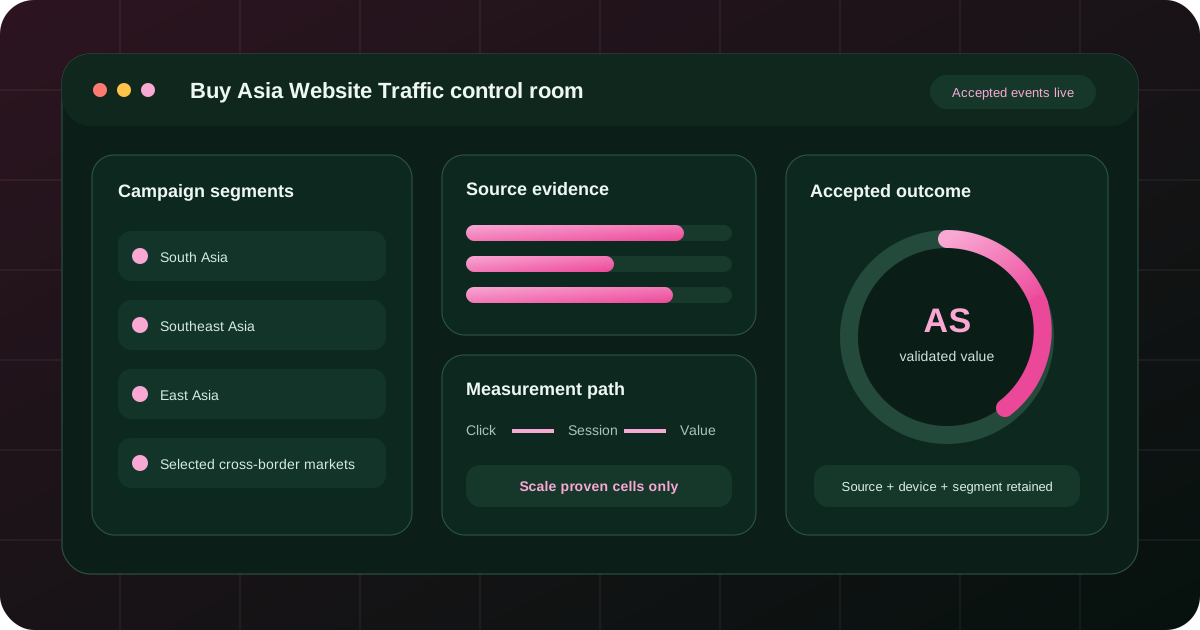
Start with a country inclusion dossier
List only countries the advertiser can serve under current business, platform, category and specialist review. For each market, record product availability, fulfilment, customer support, language, currency presentation, age or licensing conditions and claims that need qualification. A network's ability to select a country does not establish that the offer is ready there.
Define the accepted outcome by country. A validated order, eligible application or supportable lead may be useful, while a page event is only an earlier technical signal. Preserve rejection, cancellation and reversal states. Market comparisons fail when one country records submitted forms and another records completed eligible transactions.
Assign an owner and review date to the dossier. Pause a country when the offer, regulation, policy, stock, delivery route or support changes. Do not let a regional campaign continue merely because its aggregate report looks stable.
Use official guidance within its actual scope
For relevant U.S.-facing advertising practices, consult FTC guidance on online advertising and marketing. Use that source within its stated scope, then check the requirements in each Asian country where you plan to advertise. It is not campaign approval or a substitute for local review. Keep the applicable market requirements in your launch brief before submitting a FroggyAds campaign.
Use current platform-owner documentation for location and language controls. Google explains that its location decisions use several signals and are not guaranteed to be perfectly accurate, but another network can define location differently. Record the selected provider's actual definition rather than transferring one platform's wording to all supply.
Keep research retrieval dates and distinguish a source statement from the team's inference. Market statistics, subscriber counts and economic reports are context, not forecasts of addressable reach, inventory or conversions.
Build one location proof per selected market
Record configured country, presence or interest option where available, exclusions, saved audience behavior and campaign readback. Test copied campaigns because an inherited default can widen delivery. Preserve reported geography without moving unknown records into the requested country.
Compare network geography with the location relevant to fulfilment or the accepted transaction. A shipping country, service address, billing country and device signal answer different questions. Choose the backend field that matches the campaign's serviceability decision and document conflicts.
Use controlled known contexts as technical tests, not a universal accuracy estimate. Investigate discrepancies by source, device, redirect and time. Pause only the affected country cell when the evidence chain fails, unless the defect is shared across the region.
Localise the commercial decision, not just the headline
Review language, script, product name, price context, availability, units, claim qualification, support and action for each country. An English creative may be appropriate for a particular audience, but that choice still needs evidence. Machine translation output remains a draft requiring a qualified reviewer for material claims.
Preserve claim parity across advertisement and destination. A localised headline must not broaden the evidence, while an English checkout must not conceal a condition stated only in another language. Test error messages, required dialogs, confirmation and service communication as part of the same path.
Version every market asset with reviewer, source and expiry. When the offer changes, search scheduled and reusable creative. Do not update only the regional master while an older country variant continues serving.
Rehearse devices, networks and payment paths country by country
Choose controlled devices, screen sizes, browsers or in-app contexts representative of the selected campaign. Test creative render, orientation, redirect, load interruption, navigation, form validation and confirmation. A page that opens is not necessarily a path a customer can complete.
Where payment is part of the accepted outcome, verify displayed currency, available method, eligibility, failure handling and backend confirmation with an authorised test. Do not make a real purchase or use customer data solely to create a realistic demonstration. Preserve the test record and refund or reversal state where applicable.
Include lower-connectivity and delayed-callback cases. Decide whether the campaign should stop, retry or show a truthful alternative when a service is unavailable. An automatically retried offer can become inaccurate after inventory or price changes.
Run the five-stage Asia traffic proof
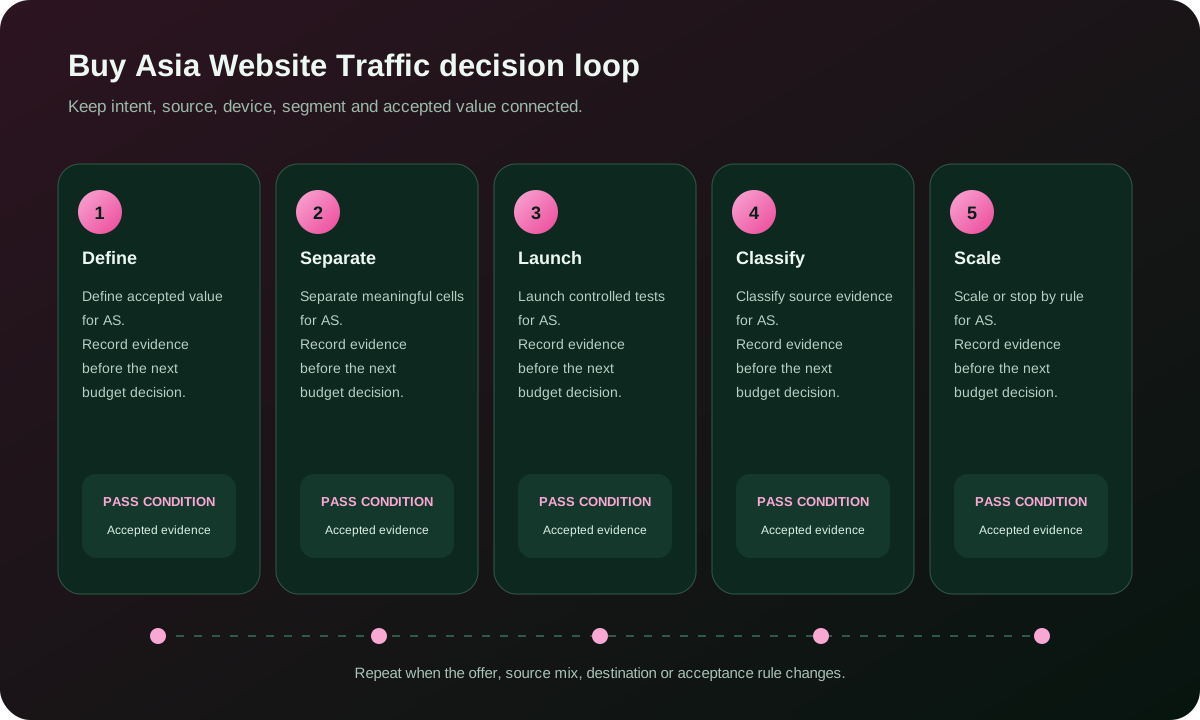
- Qualify. Lock country eligibility, offer, language and destination.
- Configure. Set location, source scope, device, format, schedule and loss boundary.
- Observe. Preserve render, source, country, cost and technical event evidence.
- Reconcile. Join mature accepted, rejected, duplicate and reversed backend results.
- Decide. Continue, repair, narrow, pause or scale the individual country cell.
Keep the configuration and evidence independently readable. Do not optimise one country against provisional events while another is judged on mature outcomes. Close a contaminated test and begin a new version after material tracking or offer repair.
Operating detail continues in the buy website traffic guide and the traffic sources hub.
Preserve source evidence without inventing a regional quality label
Require the most stable source or placement identifier available under the account and format, together with country, creative, device, time, campaign, cost and accepted-event identifier. Export unknown values. If the source changes between reports, request a mapping before using it for exclusions.
Investigate render behavior, immediate exits, repeats, meaningful progression, mature acceptance, rejection and reversal. Repair destination or tracking defects before assigning the pattern to supply. One click-through rate or platform score does not establish traffic quality.
Make source decisions within country cells. The same identifier can perform differently when offer, language, device or fulfilment changes. Save the evidence and date before exclusion, then read back the implemented setting.
Reconcile currencies, time zones and day boundaries
Record account billing currency, visitor-facing currency, backend transaction currency and the conversion source and date used for analysis. Preserve original amounts. A normalized report must remain traceable to invoices and accepted records.
Lock account, source-report and backend time zones. Define the day boundary and observation window before comparing countries. A late conversion or reversal can move between periods without any change in commercial reality.
Reconcile billed units, campaign spend, credits and balance on the first capped proof. Pause an unexplained difference rather than adding funds to maintain delivery. Include translation, support, fulfilment and analyst work in the country total cost.
Stage related planning routes in their locked order
Each route answers a different planning question. Revalidate country eligibility and outcome definitions before transferring a configuration between formats.
Scale from mature country evidence, not the regional average
Set an initial cap and maximum increase for each country. Wait through the accepted outcome's normal maturity window and include duplicates, cancellations and reversals. A strong market can conceal another country's loss when results are blended.
Change one major variable at a time where practical. If location, creative, format and source scope all change, version the new test. Preserve marginal results after each increase because the newest spend can leave the boundary while the historical average remains attractive.
Include operational capacity. Support, language review, fraud investigation and fulfilment can fail before the media ratio does. Stop adding demand when the business cannot validate or serve outcomes consistently.
Contain a country incident without guessing at regional impact
Define incidents such as ineligible delivery, inaccurate localisation, broken mobile completion, source-identifier loss, spend beyond authority or accepted-event failure. Name the operator able to pause the country cell and the backup when that person is unavailable.
Preserve creative, destination, configuration, source report, country evidence, billing and backend outcomes before repair. Determine whether copied campaigns or outside optimisation can reactivate delivery. Revoke the relevant connection when the pause alone is insufficient.
Restart through an isolated capped cell. Recheck language, location, device path, identifiers and mature outcome, then state residual limitations. A successful test in one country is not proof that every Asian market can resume.
Verify current first-party product routes before funding
Use the current account and terms rather than a copied price or supply claim. Create My Free Account only after the proof plan is approved. Then Explore the advertiser platform and review the Asia ad network guide within their stated scope.
Read the Online Advertising Asia guide for adjacent market planning without treating it as campaign approval.
Keep format and pricing research separate
Design cross-market comparisons that keep local differences visible
Choose a comparison question before combining results. The advertiser may compare the same offer across two eligible countries, two language versions within one market or two source cells under one destination. Record differences that cannot be held constant. A comparison remains useful when those differences are explicit and the conclusion stays inside its tested scope.
Give each cell its own identifier, cap and observation window. Avoid moving budget between countries before accepted outcomes mature unless a stop rule requires containment. Preserve no-delivery, rejected and unknown records. Removing an inconvenient market after seeing the result changes the original test.
Use an appropriate common unit only for the decision being made. Currency-normalized media cost does not remove differences in fulfilment, support, taxation, rejection or reversal. Report both the normalized view and original country records.
Write proceed, repair, hold, reject or inconclusive for each cell. Inconclusive is appropriate when volume, tracking or maturity is insufficient. Do not turn it into a claim that the region needs more spend without a bounded reason.
Run a bilingual claim and support handoff
Give the language reviewer the source claim, intended meaning, material qualification, brand terms, destination context and prohibited interpretations. Require questions to return to the claim owner rather than inviting the translator to invent product facts. Preserve the approved source and market version together.
Test dynamic fields such as dates, prices, quantities, names and locations in the selected script and layout. Check truncation, direction, punctuation and fallback when a value is missing. A technically valid string can still become commercially inaccurate after substitution.
Route a controlled customer question through the advertised language path. Verify the team or service can understand, respond and preserve the campaign context. Buying demand in a language the organisation cannot support creates an operating failure after the click.
Review search, social or display variations separately when the format changes context. A short creative may require a nearby qualification that a longer page carries directly. Do not remove essential meaning solely to fit a character field.
Seal records for handoff, audit and vendor exit
The campaign evidence package should include the country dossier, source register, language approval, creative, destination test, configuration, identifiers, cost, accepted and rejected outcomes, incidents, decisions and review dates. Store responsible owners and distinguish direct observations from provider statements and analyst inferences.
Test exports during the proof. Check country, source, device, creative, campaign, time, cost and event fields for stable type and granularity. Preserve blank and unknown values. If the provider cannot export a field needed for a mandatory decision, keep the country in repair or reject status.
At a team or agency handoff, transfer access through named accounts and verify pending campaigns, schedules, exclusions and postbacks. Do not share credentials or rely on an undocumented dashboard view. Remove obsolete users and test revoked connections.
At vendor exit, preserve invoices, balances, reports and disputes, then confirm campaigns remain stopped. Record supply or configuration knowledge that cannot migrate. A successful traffic test does not justify a dependency the advertiser cannot later control or explain.
Maintain a country decision ledger after launch
Record every material change to country, language, creative, destination, format, source scope, bid, budget, schedule, event definition or rejection rule. Include the prior state, new state, reason, person or system, and time. The ledger lets the analyst separate performance movement from configuration drift.
Link each decision to evidence available at that time. Later mature outcomes can change the assessment, but they should create a new decision rather than rewrite the earlier record. This is especially important when countries have different purchase, approval or reversal delays.
Review overrides and automatic changes. A recommendation accepted at regional level can widen several country cells with different loss boundaries. Require readback and preserve the affected list. Disable automation whose scope cannot be reconstructed.
Close the ledger entry when the observation window matures. State whether the change supported, contradicted or did not answer the hypothesis, and name the next review trigger. Avoid declaring a regional best practice from one market's temporary result.
Buy Asia traffic FAQ
For Buy Asia Website Traffic, what does buying website traffic across Asia require before launch?
Define eligible countries, languages, devices, offer rules and accepted outcomes because a regional label does not describe one uniform audience.
For Buy Asia Website Traffic, how should a regional traffic test be divided?
Separate markets with different economics or destinations so spend and conversion quality can be reviewed without averaging away meaningful differences.
For Buy Asia Website Traffic, what affects the price of paid visits across Asian markets?
Local competition, available inventory, format, device mix, targeting and source quality can produce very different effective costs. Example a software company can support English onboarding in Singapore and a reviewed Japanese journey in Japan but it cannot yet invoice or answer support requests in every.
For Buy Asia Website Traffic, which result shows that regional traffic is useful?
Accepted outcomes tied to traceable sources matter more than aggregate sessions, especially when volume is distributed across countries. Choose a comparison question before combining results.
For Buy Asia Website Traffic, what mistake makes multi-country traffic hard to optimise?
Combining every market in one undifferentiated campaign hides which language, source or destination is responsible for the result. Set an initial cap and maximum increase for each country. Wait through the accepted outcome's normal maturity window and include duplicates, cancellations and reversals.
For Buy Asia Website Traffic, when should one country receive its own campaign?
Create a separate campaign when the bid, creative, offer, legal conditions or conversion economics need distinct control. Define incidents such as ineligible delivery, inaccurate localisation, broken mobile completion, source-identifier loss, spend beyond authority or accepted-event failure.
For Buy Asia Website Traffic, how can tracking preserve country-level evidence?
Pass campaign and placement identifiers into destination records, retain geolocation fields lawfully and reconcile conversions by the same market definition.
For Buy Asia Website Traffic, which paid traffic pattern should trigger investigation?
Look into abrupt location shifts, identical session behavior, impossible device combinations or sources that never produce a valid downstream action.
For Buy Asia Website Traffic, how should a regional budget be expanded?
Increase market by market after accepted conversion cost remains stable and additional supply does not weaken the agreed quality rules.
For Buy Asia Website Traffic, what belongs in an Asia traffic test summary?
Report each market's targeting, spend, sources, valid outcomes, exclusions and next decision instead of presenting only a regional total. The campaign evidence package should include the country dossier, source register, language approval, creative, destination test, configuration, identifiers, cost, accepted and rejected outcomes, incidents, decisions and review dates.
Buy Asia Website Traffic: what should the advertiser decide next?
For Buy Asia Website Traffic, treat Asia as its own campaign market. Confirm that the offer, landing experience, language and device path genuinely support the market, then compare source-level outcomes inside Asia. Use On this page and Start with a country inclusion dossier as the planning baseline instead of importing assumptions from another country.
On this Buy Asia Website Traffic page, the decision should remain tied to the existing evidence around On this page, Start with a country inclusion dossier and Use official guidance within its actual scope. Those sections give buy asia traffic its specific context; the table below turns that context into campaign actions rather than adding another generic definition.
| Decision | What to verify | FroggyAds action |
|---|---|---|
| Buy Asia Website Traffic objective | Use On this page to define the accepted business event and the maximum learning loss for buy asia traffic. | Launch one FroggyAds campaign objective for Buy Asia Website Traffic and keep the conversion definition stable. |
| Buy Asia Website Traffic audience | Use Start with a country inclusion dossier to verify market, device, language and offer eligibility for buy asia traffic. | Apply only the FroggyAds targeting controls that change the real Buy Asia Website Traffic customer journey. |
| Buy Asia Website Traffic source evidence | Use Use official guidance within its actual scope to keep source-level differences visible instead of relying on one blended buy asia traffic average. | Keep, cap, exclude or retest Buy Asia Website Traffic inventory from documented source evidence. |
| Buy Asia Website Traffic economics | Use Build one location proof per selected market to connect media spend with accepted conversions and downstream value for buy asia traffic. | Protect the Buy Asia Website Traffic test with a written budget boundary and a consistent attribution window. |
| Buy Asia Website Traffic scale rule | Use Localise the commercial decision, not just the headline to define the exact evidence that earns the next budget increase for buy asia traffic. | Scale Buy Asia Website Traffic one major control at a time and compare marginal performance with the prior baseline. |
A FroggyAds test sequence for Buy Asia Website Traffic
- Buy Asia Website Traffic outcome: define the accepted event for buy asia traffic and the maximum loss permitted while the first test is learning.
- Buy Asia Website Traffic path: verify market eligibility, device experience, landing-page continuity and tracking against On this page before buying more traffic.
- Buy Asia Website Traffic hypothesis: launch one bounded FroggyAds test tied to Start with a country inclusion dossier; do not change bid, creative, audience and destination together.
- Buy Asia Website Traffic source review: compare qualified activity, accepted conversions, timing and cost by the source or segment dimensions relevant to Use official guidance within its actual scope.
- Buy Asia Website Traffic scaling: use Build one location proof per selected market and Localise the commercial decision, not just the headline to define what must reproduce before the next budget increase.
Why FroggyAds is relevant to Buy Asia Website Traffic
For Buy Asia Website Traffic, FroggyAds gives advertisers a self-serve DSP and ad-network workflow for buying supported traffic with campaign-level budgets and targeting. Depending on format and campaign context, available controls can include country, city, device, operating system, browser, carrier, category, source, ID and IP options. SmartCPC and Adscore-supported traffic-quality controls can support the buy asia traffic optimization process, while the advertiser's tracker, analytics and backend acceptance remain the final evidence for commercial quality.
Use Localise the commercial decision, not just the headline as the final checkpoint for Buy Asia Website Traffic. If the accepted result does not reproduce after the next meaningful volume step, return to the last stable configuration instead of widening several controls at once.
Buy Asia Website Traffic: the buying decision
The buying question on Buy Asia Website Traffic is whether the page's own setup and evidence justify the next campaign action. For a performance advertiser, that means you should plan the market-specific test and measurement rules.
Decision boundary for Buy Asia Website Traffic: this guide addresses Buy Asia Website Traffic; Buy Traffic From Asia is the nearest neighboring topic and should keep its separate task. Use this page only for the decision implied by Buy Asia Website Traffic.
Decision inputs for Buy Asia Website Traffic: audience targeting, source evidence, conversion tracking, accepted business value. Keep these inputs tied to accepted conversion or business-value event and the decision task: plan the market-specific test and measurement rules.
Start with a country inclusion dossier is the measurement checkpoint for this URL. Resolve “For Buy Asia Website Traffic, how should a regional traffic test be divided?” while retaining source evidence, accepted business value, spend and cohort age so the result can be reconciled with accepted conversion or business-value event.
Use official guidance within its actual scope is the action checkpoint for Buy Asia Website Traffic. Before acting on “For Buy Asia Website Traffic, what affects the price of paid visits across Asian markets?”, document conversion tracking, the resulting campaign action and the rollback or retest condition.
On this page is an evidence checkpoint for Buy Asia Website Traffic. To answer “For Buy Asia Website Traffic, what does buying website traffic across Asia require before launch?”, keep audience targeting in the same campaign record and use it to plan the market-specific test and measurement rules.
| Page checkpoint | How to use it | Evidence to retain |
|---|---|---|
| On this page | Use On this page to establish the first evidence scope for Buy Asia Website Traffic; then record which part of campaign objective, targeting, source evidence, conversion tracking and economics it changes. | Keep audience targeting, source/campaign ID and the accepted-event definition together. |
| Start with a country inclusion dossier | Use Start with a country inclusion dossier as the second checkpoint and reconcile it with accepted conversion or business-value event before changing budget or source allocation. | Retain source evidence, spend, timestamp/cohort age and accepted/rejected outcomes. |
| Use official guidance within its actual scope | Use Use official guidance within its actual scope as the final checkpoint: if it does not change the evidence for accepted conversion or business-value event, keep the test narrow rather than scaling. | Document conversion tracking, the decision taken and the rollback or retest condition. |
Transparent Buy Asia Website Traffic decision example
Hypothetical example: For Buy Asia Website Traffic, a hypothetical controlled cell that spends USD 340 and records 13 accepted conversion or business-value event after the same maturity window has an accepted cost of USD 26.15 per outcome. Replace the figures, outcome and review window with your own economics; this is not a FroggyAds performance claim.
Why use FroggyAds here?
For Buy Asia Website Traffic, FroggyAds gives the performance advertiser a self-serve way to isolate the campaign cell, retain source-level evidence and decide the next spend step from accepted conversion or business-value event. Create your free FroggyAds account.
Buy Asia Website Traffic — what matters first
Buy Asia Website Traffic should be evaluated market by market: define eligible geography, keep measurement consistent, and scale only where accepted-outcome economics remain viable.