
Ad-tech operating guideDefine the decisionDefine the business outcome: a campaign outcome the network can measure and optimize without hiding source performance. Then state the budget or delivery decision the data must support. Control the evidenceEvaluate results at the network, format and source level so strong and weak delivery are not hidden inside one average. Protect qualityRead accepted CPA or ROAS beside source-level consistency and payment terms, policy fit and operational support before increasing spend.
How to choose an ad network for your campaign goals
This guide answers how to choose an ad network with a practical operating model. It is written for advertisers, agencies and media buyers who need to select a network that can support the required format, geography, control and reporting depth. The defined outcome is a campaign outcome the network can measure and optimize without hiding source performance. Use accepted CPA or ROAS as the main decision signal and payment terms, policy fit and operational support as protection against false efficiency.

Key takeaways
How to choose an ad network for your campaign goals at a glance
What does this page explain about How to Choose an Ad Network: Global Traffic for Advertisers?
Quick answer: It is written for advertisers, agencies and media buyers who need to select a network that can support the required format, geography, control and reporting depth. The defined outcome is a campaign outcome the network can measure and optimize without hiding source performance. Use accepted CPA or ROAS as the main decision signal and payment terms, policy fit and operational support as protection against false efficiency. Direct answer: Choose an ad network by matching the offer, audience, geography, device and format to available inventory, then verifying funding terms, tracking, source controls, policy fit and support.
| Section | Distinct excerpt from this page |
|---|---|
| Build the decision before buying more delivery | For how to choose an ad network, connect business value, the network, format and source reporting unit and explicit protection against false efficiency. |
| One interpretable unit | Use network, format and source as the operating unit. |
| Guardrails before growth | Set explicit limits around payment terms, policy fit and operational support. |
Reference for How to Choose an Ad Network: Global Traffic for Advertisers: IAB Tech Lab: OpenRTB.
- Planning: Build the decision before buying more delivery.
- Control: What how to choose an ad network requires before media starts.
- Decision: Build the campaign around user context, not channel labels.
Core controls
Build the decision before buying more delivery
For how to choose an ad network, connect business value, the network, format and source reporting unit and explicit protection against false efficiency.
Business outcome first
Start with the commercial or behavioral outcome that matters: a campaign outcome the network can measure and optimize without hiding source performance. A traffic metric is useful only when it helps explain whether that outcome is becoming more likely, more efficient or more scalable.
One interpretable unit
Use network, format and source as the operating unit. Keep naming, tracking and reporting consistent so each change can be connected to a source, audience, creative, placement or time window rather than to an account-wide average.
Guardrails before growth
Set explicit limits around payment terms, policy fit and operational support. The campaign should have a pause rule, a minimum sample and a rollback path before the first budget increase, not after a weak cohort has already spent beyond its learning value.
Planning
What how to choose an ad network requires before media starts
A useful plan connects audience context, creative promise, landing experience and business outcome in one traceable chain. For ad network selection, the starting point is not a list of channels. It is a written relationship between the audience, the promise and the defined business outcome. For this plan, that outcome is a campaign outcome the network can measure and optimize without hiding source performance. The page, app or funnel must confirm the same promise the ad makes, and the tracking plan must record the event at the point where the business actually receives value. This preparation makes later differences between multi-format inventory, programmatic supply, self-serve traffic networks interpretable instead of arbitrary.
A campaign can produce activity while still failing the decision. Accepted cpa or roas may rise because delivery expanded into weaker contexts, while source-level consistency declines or the business cannot process the added volume. Define the acceptable relationship between those signals before launch. For this page, the main failure mode is choosing from headline volume or minimum bid without testing reporting and traffic quality. Write that risk into the launch checklist so the team knows which evidence would invalidate an apparently positive result.
Choose a review cadence that matches the conversion cycle. The network, format and source report should preserve raw spend, impressions, clicks, landing events and accepted outcomes before filters are applied. A daily view can detect broken delivery, but a mature cohort is usually needed to judge source-level consistency. The goal is not to force one metric to look good. It is to create a stable chain from media cost to the outcome the business accepts.
Connect the guide to live testing
Connect How to choose an ad network for your to a controlled audience test
Use the choices established in “What how to choose an ad network requires before media starts” to define one audience, budget and source set in FroggyAds. Keep the surrounding offer and measurement rule stable so the test adds evidence to how to choose an ad network for your instead of mixing several changes at once.
Create My Free Account
Execution
Build the campaign around user context, not channel labels
The same offer behaves differently across multi-format inventory, programmatic supply, self-serve traffic networks because users encounter the message in different contexts. Map what the person was doing before the impression, how much information the format can carry and how much trust the landing experience must establish. A lower-intent placement may need a pre-sell step, while a high-intent environment may perform better with a direct path. The format should fit the decision journey rather than forcing every visitor through the same page.
Create message continuity from the first visible cue to the defined outcome: a campaign outcome the network can measure and optimize without hiding source performance. Use one primary benefit, one credible reason to believe and one next action. If the campaign targets several audience states, separate them into different campaigns or landing variants so accepted CPA or ROAS is not averaged across incompatible expectations. This is especially important when the offer has qualification rules, delayed value or a large difference between an initial response and an accepted customer outcome.
Budget should buy information in a deliberate order. Start with enough variation to test the main audience and message assumptions, but not so many combinations that none reaches a useful sample. Cap sources and placements early, preserve a control creative and document the reason for each expansion. The example for this topic is practical: An agency scores three networks against the same requirements, runs equal-budget pilots and chooses based on accepted conversions plus operational control. That sequence produces evidence the team can use even when the first test does not reach the target economics.
Measurement
Measure quality at the level where action is possible
Use accepted CPA or ROAS as the primary operating metric only when it can be calculated consistently for every relevant source. Pair it with source-level consistency to show whether the traffic or response is becoming more valuable, not merely cheaper or larger. Keep payment terms, policy fit and operational support visible beside both. This three-part view prevents a cheap source from appearing successful when it creates poor downstream outcomes, and it prevents a high-quality source from being stopped because its early volume is smaller.
Segment reports by network, format and source, then inspect device, geography, creative and landing variant where volume allows. Avoid changing several dimensions at once. If a source is weak, first determine whether the problem is delivery quality, message fit, page performance or tracking. A source-level pause can be justified by stable evidence, but an account-wide conclusion requires more than one placement, one day or one creative. Keep raw identifiers long enough to reproduce the decision.
Set thresholds in both counts and rates. A large percentage swing on a handful of events is not the same as a small percentage change across a mature cohort. Require a minimum spend, impression or conversion sample before judging the network, format and source result. When the campaign passes the threshold, decide in advance whether the action is to hold, expand, reduce, refresh or stop. That discipline turns reporting into operations instead of retrospective explanation.
Scale
Scale only the part of the system that earned confidence
Scaling should preserve the winning relationship between audience, message, destination and measurement. Increase one major lever at a time: budget, bid, source set, audience breadth, geography or creative inventory. Compare the new cohort with the prior baseline using accepted CPA or ROAS, source-level consistency and payment terms, policy fit and operational support. If performance changes, the team can then identify which lever changed the economics instead of guessing across several simultaneous expansions.
Expect marginal performance to differ from the initial average. The easiest inventory, most responsive users or most obvious placements may be consumed first. Track the next unit of spend separately and ask whether the defined outcome remains economically acceptable. For this plan, that outcome is a campaign outcome the network can measure and optimize without hiding source performance. A campaign can remain profitable overall while the newest sources lose money. Source and cohort reporting should therefore guide scale, not the blended account total alone.
Keep a rollback rule and a creative supply plan. If the new cohort breaches the limit for payment terms, policy fit and operational support, return to the last stable state and diagnose the change. If response declines while source quality remains stable, refresh the message before rewriting the entire campaign. A measured rollback protects the learning already purchased and makes the next test faster, because the team still has a reliable control.
Choose the execution format
Choose a paid-media format that supports How to choose an ad network for your
Use the criteria around “Scale only the part of the system that earned confidence” to decide whether push, native, display or pop fits the message and destination. Set format, targeting and spend as campaign controls in FroggyAds while the how to choose an ad network for your decision remains the standard for judging the result.
Create My Free Account
Operating sequence
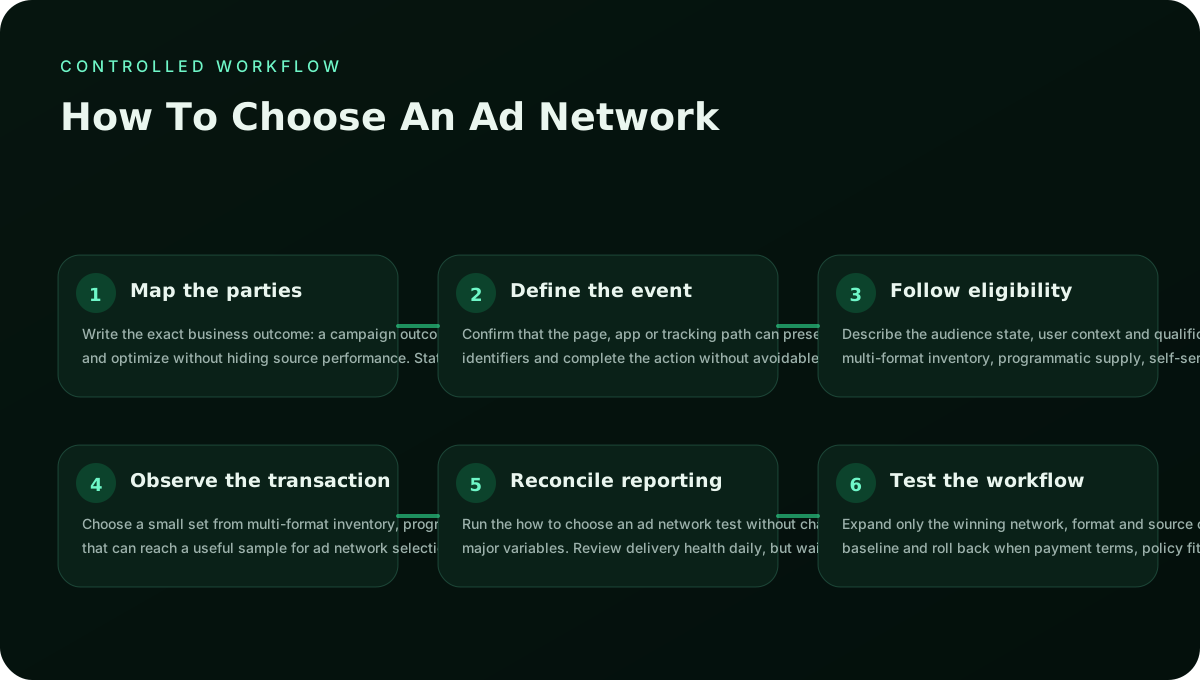
A six-step workflow for how to choose an ad network
Keep every how to choose an ad network step bounded, measurable and reversible so the next campaign action can be explained from the evidence.
Map the parties
Write the exact business outcome: a campaign outcome the network can measure and optimize without hiding source performance. State the decision the campaign must support, and keep accepted CPA or ROAS and source-level consistency in the same brief.
Define the event
Confirm that the page, app or tracking path can preserve the required identifiers and complete the action without avoidable friction. Check the failure mode: choosing from headline volume or minimum bid without testing reporting and traffic quality.
Follow eligibility
Describe the audience state, user context and qualification rule before selecting from multi-format inventory, programmatic supply, self-serve traffic networks. Separate materially different audiences into their own controls.
Observe the transaction
Choose a small set from multi-format inventory, programmatic supply, self-serve traffic networks that can reach a useful sample for ad network selection. Define caps, exclusions and a conservative starting bid or budget.
Reconcile reporting
Run the how to choose an ad network test without changing several major variables. Review delivery health daily, but wait for the conversion cycle before judging source-level consistency at the network, format and source level.
Test the workflow
Expand only the winning network, format and source cohort. Keep the previous baseline and roll back when payment terms, policy fit and operational support moves outside the agreed range.
Measurement model
Read the outcome, quality and guardrail together
For ad network selection, use each metric for a defined job. A visible cost metric cannot replace accepted business outcomes or source-level quality evidence.
Use this to rank the network, format and source cohorts after the minimum sample is reached.
Confirms whether the traffic or response continues toward the defined outcome rather than stopping at an easy proxy. The defined outcome is a campaign outcome the network can measure and optimize without hiding source performance.
Stops a lower visible cost in ad network selection from hiding weak experience, invalid activity, poor acceptance or damaged economics.
Shows whether ad network selection depends on one source or placement that may not sustain more budget.
Separates recent network, format and source cohorts from outcomes that have had enough time to complete and be accepted. The defined outcome is a campaign outcome the network can measure and optimize without hiding source performance.
Measures the newest ad network selection spend against accepted CPA or ROAS rather than relying only on the historical blended average.
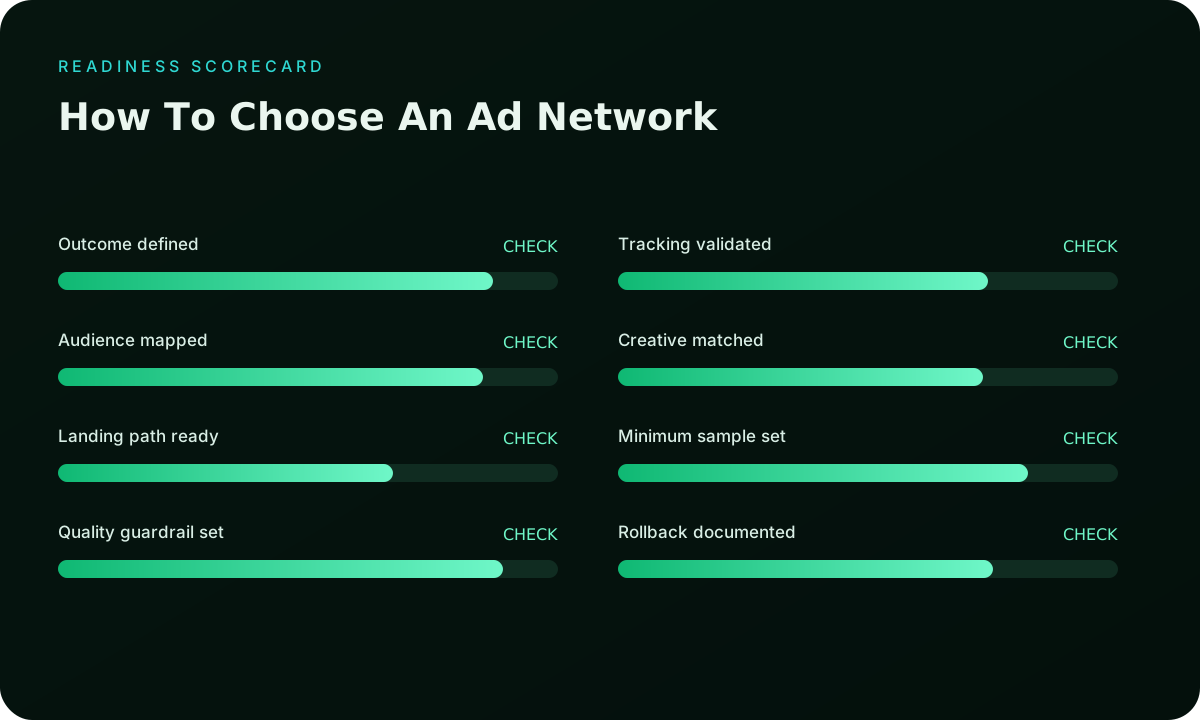
Outcome defined
Tracking validated
Audience mapped
Creative matched
Landing path ready
Minimum sample set
Quality guardrail set
Rollback documented
Put the guide into practice
Turn How to choose an ad network for your into a bounded campaign test
With “Read the outcome, quality and guardrail together” documented, launch only the next reversible test. Set a spending limit, preserve the baseline and use source-level and audience controls so the next step depends on qualified outcomes for how to choose an ad network for your, not activity volume.
Create My Free Account
Readiness view
Confirm the campaign can support a real decision
A how to choose an ad network checklist cannot guarantee performance, but it exposes missing definitions, weak tracking and uncontrolled scale before they distort the budget.
Campaign scenarios
How the next action changes when the evidence changes
For ad network selection, use the pattern across cost, quality and maturity instead of reacting to one dashboard number.
A promising launch signal
The first cohort improves accepted CPA or ROAS and keeps source-level consistency stable. Hold the landing page and tracking constant, expand one proven source and compare the next spend cohort with the original baseline before opening the full budget.
Cheap activity, weak business quality
A source looks efficient on the visible media metric, but source-level consistency declines and payment terms, policy fit and operational support worsens. Reduce or isolate that source, inspect identifiers and landing behavior, and do not let the low headline cost dominate the allocation decision.
Performance falls during scale
After expansion, the blended result weakens. Separate the newest network, format and source cohorts, restore the last stable control and determine whether the cause is audience breadth, source mix, creative fatigue, page capacity or delayed conversion reporting.
Avoidable mistakes
Common ways the plan loses interpretability
Choosing from headline volume or minimum bid without testing reporting and traffic quality.
Optimizing accepted CPA or ROAS without checking source-level consistency and the accepted business outcome.
Combining materially different network, format and source cohorts until the blended average hides the reason performance changed.
Changing budget, audience, creative and landing page together in ad network selection, which makes the result impossible to attribute.
Scaling before the team has a stable limit for payment terms, policy fit and operational support and a tested rollback action.
Questions
How To Choose An Ad Network: FAQ
Practical answers for advertisers, agencies and media buyers building an ad network selection plan.
What should an advertiser decide before comparing ad networks?
List the needed formats, markets, devices, source controls, reporting, policy support and accepted business result. Add the test budget and non-negotiable exclusions so attractive sales claims cannot redefine the brief.
Which inventory questions reveal how a network operates?
Ask if supply is direct or resold, how publishers and placements are identified, which formats are available and how unwanted sources are blocked. The useful answer is specific enough to verify during a pilot.
How should network targeting claims be evaluated?
Check that the needed locations, devices and contexts are actually available for the chosen format and market. Treat every audience label as a capability to test, not proof that the inventory contains ready buyers.
Why should creative requirements affect network choice?
File sizes, dimensions, review rules and placement context shape how clearly and honestly your message can appear. A network is a poor fit if its available units distort the offer or destination handoff.
Which costs should be compared across ad networks?
Compare billable events, minimum deposits, bid floors, fees, currencies, payment terms and the cost of producing and reviewing campaigns. Calculate mature cost per accepted result instead of ordering networks by quoted clicks alone.
What source control should an ad network provide?
A useful network lets the advertiser identify performance at a level where poor supply can be investigated and excluded, subject to its available controls. Ask how disputed or suspicious delivery is reviewed and documented.
What tracking support matters in an ad-network pilot?
Look for stable campaign and source IDs, documented event definitions, usable exports and a method that connects permitted clicks with backend acceptance. Test reconciliation before committing a larger budget.
Which policy and support gaps should end a network review?
Walk away when prohibited inventory is unclear, escalation has no owner, account access is unsafe or material reporting questions go unanswered. Those gaps make quality and financial risk hard to control after launch.
How can several ad networks be tested without muddy results?
Run separate capped pilots against one stable offer and accepted outcome, then account for format and billing differences explicitly. Avoid simultaneous landing-page changes that leave the network comparison impossible to read.
Is there one best ad network for every advertiser?
No. Fit depends on market, audience, format, offer, controls, measurement and mature economics. The better choice is the network that passes the advertiser's written requirements and bounded pilot.
Related resources
Continue from planning into campaign execution
Use these FroggyAds guides to connect how to choose an ad network with traffic selection, tracking, creative and budgeting.
Run a controlled test
Turn the framework into a measurable campaign
Launch ad network selection with a defined conversion, bounded budget, source-level reporting and a documented optimization plan.
Direct answers
How to Choose an Ad Network: definition, decision and proof
Direct answer: Choose an ad network by matching the offer, audience, geography, device and format to available inventory, then verifying funding terms, tracking, source controls, policy fit and support. Run a limited test with a predeclared loss ceiling; do not choose from claimed reach or the lowest bid alone.
Keywords consolidated here: how to choose an ad network.
Define the paid event
For how to choose an ad network, write the event contract as a controlled sample of delivery from the candidate network. Record when the event is counted, which filters can remove it, whether reporting can be delayed and how the platform total will be reconciled with first-party analytics. A precise denominator prevents a cheap rate from hiding weak or duplicated delivery.
Separate role from label
Map who owns demand, supply, auction logic, creative approval, billing, invalid-event filtering and conversion reporting. Advertising companies often combine several functions. The operating map is more useful than the product label because it reveals where data can be lost and which party can change delivery.
Choose the decision metric
The decision is which network produces the strongest mature value with usable transparency and reversible controls. Use one primary business metric and a small set of diagnostic metrics. Impressions, clicks and visits explain delivery; qualified behavior, approved conversions, retention and contribution explain value.
Make the test reversible
Limit the first cohort by source, placement, device, GEO, creative and budget. Preserve the previous stable settings, define a maximum acceptable loss and change one major variable at a time. Reversibility matters because blended campaign averages can remain positive while the newest spend is already unprofitable.
| Audit layer | Evidence to capture | Decision use |
|---|---|---|
| Transaction | a controlled sample of delivery from the candidate network | Aligns bidding, billing and reporting around the same event. |
| Context | GEO, device, format, source, placement, creative and landing page | Prevents a platform-wide average from masking strong and weak cohorts. |
| Quality | Qualified sessions, engagement, conversion approval and delayed value | Separates delivery volume from useful audience response. |
| Economics | Spend, effective CPC or CPM, accepted outcome cost and contribution | Connects media performance to the break-even ceiling. |
| Control | Caps, exclusions, bid limits, change log and rollback point | Keeps the next action measurable and reversible. |
Eight-step validation workflow
- Write the business outcome and attribution window.
- Define the paid event and reporting denominator.
- Map demand, supply, auction and billing roles.
- Verify campaign, creative, click and conversion identifiers.
- Launch a limited cohort with a fixed loss ceiling.
- Review source-level quality before changing bids.
- For How to choose an ad network for your campaign goals, wait for delayed approvals, reversals, refunds, activation or retention signals to mature before excluding a source or declaring a winner.
- For How to choose an ad network for your campaign goals, scale, revise, retest or stop from mature marginal value at source or test-cell level rather than early volume alone.
Stop rule
When using How to choose an ad network for your campaign goals, apply this rule only to the conditions and decision described on this page. Pause the newest increment when tracking cannot be reconciled, qualified behavior falls below the declared floor, one source dominates unexpectedly or accepted outcome cost exceeds the ceiling. Restore the last stable source set and budget before testing a new hypothesis.
Primary failure mode
The main interpretation risk is selecting on minimum price, format count or promotional claims without source-level validation. Prevent it by preserving event definitions, source identifiers and a dated change log. Do not overwrite the evidence needed to explain why performance moved.
What this page does not promise
This owner does not promise a universal rate, guaranteed traffic quality, fixed CTR, automatic profitability or identical results across accounts. Inventory, auctions, users and policies change. The page provides a method for reaching a campaign-specific answer with attributable evidence.
Primary reference set: IAB Tech Lab OpenRTB overview, IAB Tech Lab OpenRTB 2.6 specification, Google Ad Manager Programmatic Direct overview, Google Ads display media purchase options, Google Ads CPM definition, Google Ads average CPC definition. Platform settings and policies should be verified again inside the active account before launch. For How To Choose An Ad Network, apply this rule to the page-specific audience, market, format or buying decision described here.
Search intent and buyer decision
How to choose an ad network for your campaign goals: the buyer task this URL owns
How to choose an ad network for your campaign goals is for advertisers researching the topic before a campaign decision who need to evaluate an ad network for offer fit, source visibility and accepted economics. Keep that buyer task separate from the nearby topic so this URL answers one commercial question clearly. The nearest related FroggyAds page is How To Choose A Traffic Source; this URL keeps ownership of the distinct task to evaluate an ad network for offer fit, source visibility and accepted economics.
Keep campaign objective, audience targeting, conversion tracking, audience and market fit in the How to choose an ad network for your campaign goals evidence record because they can change how this media test is configured, measured or scaled.
| Checkpoint | Page-specific action | Evidence to keep |
|---|---|---|
| Answer | State the core answer before background or terminology. | Retain evidence specific to How to choose an ad network for your campaign goals and its accepted outcome. |
| Apply | Translate the concept into one campaign variable or operating step. | Retain evidence specific to How to choose an ad network for your campaign goals and its accepted outcome. |
| Check | Use a named metric and review window to decide the next action. | Retain evidence specific to How to choose an ad network for your campaign goals and its accepted outcome. |
Practical check for How to choose an ad network for your campaign goals: turn this page answer into one testable step, name the event that counts as success for How to choose an ad network for your campaign goals, and keep the review window stable before changing another variable.
FroggyAds gives advertisers researching the topic before a campaign decision a self-serve way to act on the How to choose an ad network for your campaign goals decision: configure the traffic test, preserve source-level reporting and scale only after the accepted outcome supports the next step. Create your free FroggyAds account.
Direct answer
How to choose an ad network for your campaign goals — what matters first
How to choose an ad network for your campaign goals is most useful when it helps a buyer understand the concept and apply it to a concrete campaign decision. Define the accepted outcome first, then use targeting, budget and source-level evidence to decide what deserves more spend.