
Buy Brazil Traffic With State, Mobile and Outcome Control
Use FroggyAds to test a defined Brazilian audience with reviewed Portuguese creative, a serviceable destination and source evidence that reaches the advertiser-side accepted order, lead or activation.
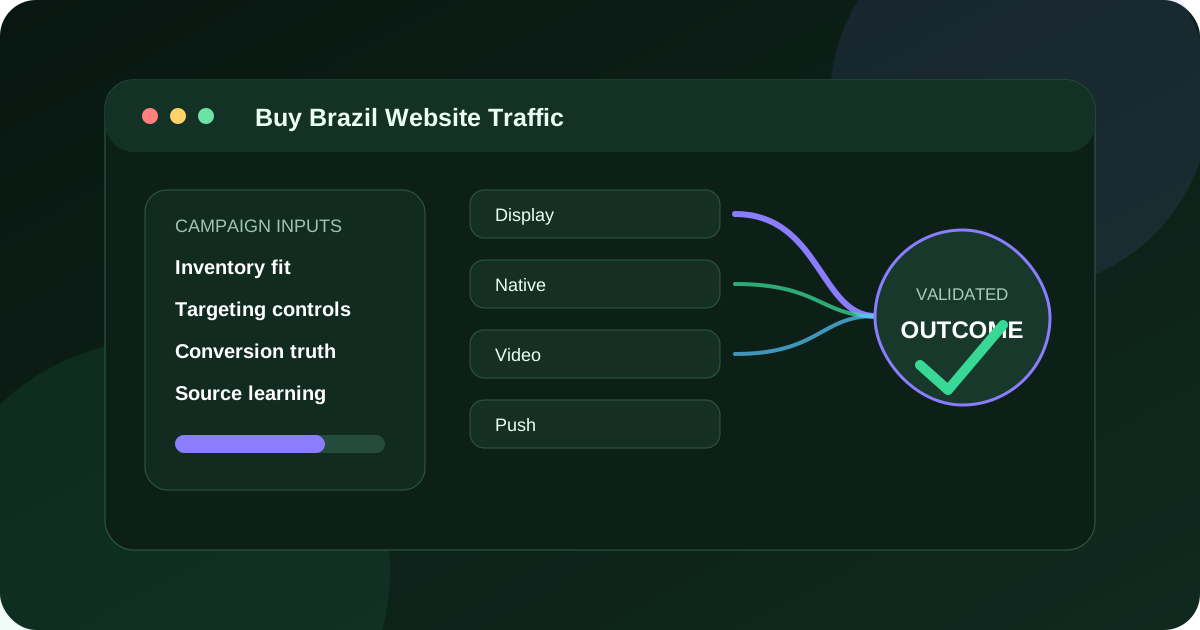
What does it mean to buy Brazil traffic?
Buying Brazil traffic means paying for eligible visits from a campaign defined around a Brazilian market cell. You are buying media delivery, not customers or a promised return. The cell should name its state or service boundary, audience problem, device context, Portuguese message, offer, destination and advertiser-side acceptance rule.
Brazil's geographic scale makes a national label too broad for many offers. Delivery coverage, store or service capacity, response ownership and buyer context can change between states and metropolitan areas. Keep these constraints visible in the campaign rather than blending unsupported demand into a national performance figure.
We provide Brazil traffic campaign controls through FroggyAds for targeting, bids, budgets and source review. Your business owns language quality, offer truth, fulfilment, tracking and the decision that an order, enquiry or user is accepted. Join those responsibilities through stable identifiers.
Review the wider website traffic buying process before the first release.
Which Brazil traffic cell should you test first?
Choose one Brazil traffic cell question capable of changing an allocation. A Portuguese ecommerce order in a served postal area, a qualified business enquiry in one metropolitan market and an activated app user require different pages, follow-up and maturity windows. Keep them as separate acquisition systems.
Write the operating contract before launch: location rule, audience task, device, offer, destination release, campaign key, accepted event, owner, exposure ceiling and review date. A new operator should be able to reconstruct what a visitor was eligible to see.
Start small enough to diagnose the first break. If delivery reaches the planned cell but sessions fail, inspect source and page continuity. If declarations arrive but operations reject them, repair qualification, serviceability or the post-form process.
Use IAB Tech Lab OpenRTB material only as protocol context; it does not document FroggyAds results or Brazilian buyer behavior.
How should states and cities be separated in a Brazil campaign?
Split location cells when delivery, appointment coverage, inventory, response teams or offer conditions differ. A São Paulo benchmark can answer one question without becoming proof for Rio de Janeiro, Belo Horizonte, Curitiba or every other market. Use cities as operating examples, not performance claims.
Carry each state or city location rule into destination eligibility. An ecommerce route can validate delivery boundaries before checkout; a service route can explain covered areas before a form; a B2B route can assign the right sales team. Unsupported demand should receive accurate guidance rather than becoming an accepted lead.
Review state and city totals as a portfolio of explainable cells. A blended average can hide a strong served route and a costly unsupported one. Expand the state or city whose mature value and operating load remain within the written boundary.
The IAB programmatic topic hub offers general industry context, not a country-specific media forecast.
How should Brazilian Portuguese continue through the journey?
Use Portuguese that has been reviewed for the intended Brazilian audience when that is the campaign route. Keep terminology consistent across the ad, page, form, validation, confirmation and follow-up. A localized headline cannot repair an English or machine-translated journey that the buyer cannot complete confidently.
Adapt the Brazilian Portuguese offer as well as the words. Check BRL presentation, dates, contact expectations, product availability, delivery information and the next action. Do not create a Brazil page by substituting the country name while leaving another market's assumptions intact.
Version language changes apart from offer and page changes whenever possible. If several elements must change together, name a new release and preserve the old control. This keeps the result attributable to a real customer experience.
Measurement standards from the Media Rating Council can inform general terminology; confirm their applicability to the actual metric and decision.
What must a Brazil traffic offer disclose before the click?
State the Brazil traffic offer benefit and next step the destination can support. Material availability, eligibility, pricing or subscription conditions should not appear only after the visitor submits. Accurate framing attracts a more useful action and reduces operational waste.
Separate sourced facts from campaign hypotheses. A market observation can justify a test; it cannot guarantee that this offer will convert. Keep the source date and scope beside the planning premise, then let first-party accepted outcomes govern the next release.
Preserve approvals for copy, creative and destination. When a product, price or coverage boundary changes, pause or update the affected cell. The FTC advertising and marketing resources provide general US guidance; verify rules for the actual Brazilian campaign and market.
How do you connect Brazilian audience intent to the media cell?
Connect Brazilian audience intent to the media cell by defining the task the visitor wants to complete: compare a product, request a quote, activate an app, start a trial or investigate a service. Pair the task with a supported location and destination. Avoid a broad demographic profile that any campaign could reuse unchanged.
Use audience evidence to narrow the question, then document exclusions. A campaign for a deliverable product should exclude areas the advertiser cannot fulfil. A business service should clarify company or role fit before the sales team counts an enquiry as qualified.
Keep one audience premise stable through the first maturity window. Add a new intent, device or source cell only after the original route can be evaluated. The targeted traffic guide supports that boundary work.
What can Mexico planning teach a Brazil advertiser?
Use another country page to compare planning questions, never to copy conclusions. Mexico and Brazil require distinct language, geography, commercial conditions and operating routes. A reusable measurement principle may transfer while audience assumptions do not.
Keep the Brazil brief tied to Brazilian Portuguese, the actual service area, the current destination and the advertiser's accepted event. Research another market only when it clarifies a method, such as how to document location or outcome maturity.
The Mexico traffic page owns its own market decision. Treat it as an adjacent planning resource rather than evidence about Brazilian performance.
When should Brazil and UAE traffic remain separate?
Separate countries whenever language, availability, customer support, pricing or acceptance differs. A campaign that combines markets can make a low-cost country conceal an unsupported route in another. Preserve country and source through the commercial record.
Keep Brazil and UAE traffic separate when one offer serves several countries, while freezing the core benefit and retaining each local cell's destination and operating rules. Compare mature outcomes after equal review periods, then decide whether the shared offer deserves further localization.
Use the UAE traffic page for that market's distinct planning question. It does not provide a benchmark for Brazil.
How does a Brazil ad network page differ from this buying guide?
This page owns the advertiser's decision to buy and evaluate Brazilian traffic. A market-specific ad-network page can explain the network proposition or local platform context. Keeping these roles separate prevents two URLs from competing with identical content.
Use this guide for state and city cells, Portuguese journey continuity, source-to-outcome joins, budget release and marginal expansion. Follow the network resource when the buyer needs a broader platform comparison.
Open the Brazil ad network page for that adjacent task, then return to this campaign contract before launch.
Why should the first Brazil route be checked on mobile?
Treat the mobile journey as a complete experience, not a smaller screenshot. Review creative readability, destination hierarchy, form controls, consent, validation, confirmation and any payment or app handoff. Keep essential offer conditions visible without forcing the visitor through dense text.
Check the first Brazil route on mobile by running one controlled transaction or enquiry from the campaign URL and preserving the result. Confirm that location, language, campaign and source identifiers survive redirects and application boundaries. A technically valid click can still become an untraceable outcome.
When mobile and desktop routes differ materially, report them as separate cells. Device-level response can suggest the next repair, while mature accepted value decides whether additional spend is justified.
Review source roles before changing device and source at the same time.
How should Brazilian ecommerce traffic be qualified?
Confirm product availability, served delivery areas, BRL presentation, material purchase conditions, checkout language and support before media begins. Route unsupported locations accurately rather than allowing a buyer to fail after adding a product to the cart.
Keep product view, cart and checkout events as diagnostics. Use paid or accepted orders after the advertiser's normal cancellation, fraud or return review for the commercial denominator. Attach campaign and source identifiers without altering the buyer's consent state.
Compare contribution under a stable offer release. Discounts, delivery cost, payment behavior and fulfilment workload can change the business result even when click price stays constant. Make those variables visible to the allocation owner.
Africa traffic represents a different market scope and should not be used as a Brazil template.
How should Brazilian enquiries reach the right team?
State the served geography, consultation scope, qualification questions and expected response. Use the landing page to route by serviceability before the sales team treats a form as an opportunity. A contact that cannot be served is useful diagnostic evidence, not an accepted lead.
Carry state, campaign, source and destination release into the CRM. Record unreachable, duplicate, unsupported and unqualified reasons. This separates media fit from response or qualification problems and prevents the same rejection from recurring unnoticed.
Scale with operational capacity. More enquiries can extend response times and change the experience promised in the ad. Slow the cell when backlog or coverage would make the mature cohort incomparable with the validated baseline.
Algeria traffic has its own language and operating conditions; retain the Brazil-specific route here.
Which activation state should a Brazil software campaign use?
Choose the earliest event that represents meaningful product use rather than a page interaction alone. A trial, verified registration, completed onboarding step or paid subscription can serve different decisions. Name the state and its maturity before delivery.
Keep Portuguese onboarding and support aligned with the ad promise. If a user reaches an untranslated or unsupported product step, preserve that failure separately from traffic quality. The route continues inside the application.
Review retention or reversal when it matters to value. A large number of starts can conceal users who never activate or subscriptions that do not mature. Use one consistent acceptance rule across sources.
Argentina traffic addresses a separate country and language context, not a Brazil benchmark.
Which ad message should a Brazil traffic test use?
Choose one buyer problem and one benefit that the destination can substantiate. A retail offer can be concise; a complex business service should use the landing page for proof and qualification. Do not hide material limitations in an unreadable creative treatment.
Treat formats as distinct experiences when the placement changes the opening, information density or action. Hold state scope, offer and acceptance stable while comparing usable sessions and mature outcomes. Interaction cost alone cannot select the commercial winner.
Store the approved Portuguese copy, visual, rights, destination and expiration with the campaign. Preserve a control asset so a future change tests a defined question rather than replacing the whole system.
Use online advertising in Brazil for the broader channel-planning task.
What should the advertiser-side Brazil record contain?
Join state or service cell, device, campaign, creative, source and destination release to the declared action and final status. Keep accepted, rejected, reversed and unresolved events in separate columns. Record the reason and decision date.
Test the join before launch using one controlled action. Deduplicate internal tests and repeated submissions. Document consent and attribution limits instead of assigning every later outcome to the most recent visible click.
A valid ledger lets media and operations share one denominator. Media can explain eligible delivery and source decisions; the advertiser can explain whether the offer was fulfilled and whether the outcome matured.
How should the first Brazil traffic budget be bounded?
Derive a learning ceiling from accepted-outcome value, handling cost, normal maturity and tolerance for an unanswered question. Keep the ceiling distinct from the bid and daily pace. It limits exposure without forecasting success.
Include Portuguese review, creative adaptation, destination work, tracking and campaign operations. Separate fixed setup from variable media. Technical repair is not evidence that the audience or offer failed.
Release media in stages: route validation, bounded learning and one-variable expansion. Review the newest mature cohort separately from the lifetime average, and preserve the previous cell for rollback.
What does a Brazil traffic price measure?
A bid is an auction input. CPM relates spend to impressions; CPC relates spend to clicks. Neither automatically measures a usable session, qualified enquiry, accepted order or activated user. Keep the charging unit and business denominator separate.
Use the current account for actual campaign pricing rather than publishing a universal country rate. Audience breadth, format, device, competition and eligibility can affect delivery. Date every planning assumption and replace it with billing evidence after launch.
Calculate marginal economics for added spend. When scale changes source or location mix, the newest increment can behave differently from the historical campaign. Expand while mature value and operations remain within the written boundary.
How do you decide whether Brazilian visits are useful?
Quality means fitness for the declared campaign purpose. Confirm that the visitor belongs to the served cell, receives the Portuguese or deliberately chosen journey, completes a meaningful route and reaches an accepted status after the normal review period.
Retain reasons such as unsupported location, duplicate, invalid contact, ineligible request, cancellation, refund or failed activation when relevant. Each suggests a different repair. One aggregate quality label hides the first controllable break.
Review source, creative, page and operations together. Narrow or exclude only with documented evidence. Preserve the conditions for a responsible retest after the underlying constraint changes.
How can one major market serve as a benchmark without becoming a national claim?
A São Paulo cell can provide a clear starting point when the advertiser can serve it and the audience decision is defined. Freeze the language, offer, destination, acceptance and source evidence. The result describes that cell, not every Brazilian state.
Use the benchmark to test operational continuity and measurement. Once it matures, add a new city or state with the same core contract. Preserve differences in fulfilment, response team or page routing rather than attributing every change to location.
A benchmark is useful because it is reproducible. It should never be selected or described as the best market without verified evidence from the advertiser's own comparable cohorts.
How should Rio de Janeiro or another metropolitan cell be added?
Keep the validated offer and acceptance rule, then change the location boundary deliberately. Confirm that the advertiser can fulfil the same promise and that the destination routes accurately. Give the new cell its own exposure and review date.
Compare after equal maturity. A difference can come from audience, source mix, page response, fulfilment or operating capacity. Record those conditions before assigning the effect to the city.
If the new cell weakens the blended average, do not hide it inside national reporting. Retain the baseline, diagnose the first failure and decide whether to repair, narrow or roll back.
What must be true before widening Brazil delivery?
Map serviceability and response ownership before adding broad geography. Delivery distance, appointment capacity, time-zone coverage and support can change the customer experience. Keep unsupported locations out of the accepted denominator.
Expand one boundary at a time: state, city group, device, source or budget. Assign a fresh ceiling and preserve the mature control. A national rollout should be the result of several explainable cells, not a replacement for them.
Include operating workload in the decision. A source is commercially useful only when the advertiser can fulfil, qualify or onboard the demand under the conditions shown to the visitor.
What must pass before Brazil media begins?
Confirm location eligibility, Brazilian Portuguese or approved alternate-language copy, offer accuracy, BRL presentation where relevant, destination continuity, identifiers, accepted event, maturity window, exposure ceiling, owners and rollback.
Pause immediately for broken routes, unsupported areas, inaccurate claims or missing evidence. Use the written review window for commercial performance so early events are not confused with mature value.
Save the campaign, creative and page versions with the approval. If a later reviewer cannot reconstruct the journey, do not treat the cohort as a reliable baseline.
Frequently asked questions
Apply these answers to the approved state, language, offer and advertiser-side evidence.
What should I prepare before buying Brazil traffic?
Prepare one offer, the states or service areas you can support, reviewed Brazilian Portuguese copy, a matching destination, campaign identifiers, a loss boundary and the advertiser-side event that counts as accepted.
Should Brazil use one national campaign?
Only when availability, fulfilment, language, destination and acceptance are genuinely comparable. Separate state, city or service cells when a national average would hide an operational difference.
Does a Brazil traffic campaign need Portuguese copy?
Use Brazilian Portuguese when that is the audience route, with the same language across ad, page, form, confirmation and follow-up. Another language should be a deliberate, supportable segment.
Can FroggyAds guarantee sales from Brazilian traffic?
No. We provide controlled paid traffic through FroggyAds, but sales, leads, revenue, profit and rankings depend on the complete acquisition system and cannot be guaranteed.
How should I compare two Brazil traffic sources?
Keep state or city scope, offer, creative promise, destination, accepted event and maturity window stable. Carry each source identifier to the advertiser-side outcome before comparing.
Which metric should release more budget?
Use a mature accepted order, qualified enquiry, activated user or another business state your team can verify consistently. Clicks and sessions diagnose earlier parts of the route.
How should ecommerce advertisers qualify Brazilian orders?
Confirm delivery eligibility, product availability, BRL presentation, material conditions and checkout continuity. Count orders after the advertiser's normal fraud, cancellation or return review.
When should a Brazil campaign pause?
Pause for inaccurate claims, unsupported delivery areas, broken mobile routes, missing identifiers, changed availability or an exceeded loss boundary. Judge commercial performance after the planned maturity window.
How do I test cities outside a first benchmark?
Retain the validated offer, page and acceptance rule, then add one city or state cell with its own exposure limit. Compare the new mature cohort separately from the historical average.
How do I start with FroggyAds?
Create one bounded Brazil campaign, configure supported targeting and budget controls, preserve source evidence and expand only after the first accepted cohort can be explained.
Launch one measurable Brazil traffic cell
Choose one served Brazilian state or city cell, one audience problem, one Portuguese journey, one offer, one destination and one accepted event. Test the full route and source identifiers before buying media.
We give you self-serve control through FroggyAds over eligible traffic, bidding, budgets and source review. Your team determines offer accuracy, fulfilment, qualification and whether the mature outcome deserves more exposure.
Prepare the review meeting before launch. Media should bring spend and source evidence; the destination owner should bring route validation; the business owner should bring accepted, rejected, reversed and unresolved states.
Close the cycle with a written release decision. State which Brazil cell is retained, which assumption changed, how much additional exposure is allowed and what triggers rollback. Add only one material boundary at a time.