
What Is Programmatic Advertising? A Buyer’s Guide
By FroggyAds — we explain how software-enabled ad buying connects an advertiser’s objective to digital inventory, a delivered creative, and a measured business action. Use this guide to plan a controlled campaign and decide what the evidence can support.
What does programmatic advertising mean for an advertiser?
Programmatic advertising uses software and rules to buy or sell digital inventory; real-time bidding is one possible transaction method.
The IAB Tech Lab describes programmatic auctions as part of the process that determines ad delivery to a relevant placement. In practice, an advertiser sets the business goal and buying constraints; a buying platform evaluates eligible opportunities; sell-side systems expose inventory; and the winning ad is served. The word programmatic describes how buying or selling is coordinated, while real-time bidding names one kind of auction. Some programmatic transactions use different deal arrangements, so do not assume every automated purchase uses an open auction or that every auction makes all inventory available to every buyer. The IAB also notes that companies may perform more than one role in the supply chain. Read its IAB Tech Lab definitions when you need the industry terminology, then confirm the specific buying method offered by the platform you plan to use.
Where does programmatic buying sit in the acquisition journey?
A campaign connects an offer and audience to eligible inventory, a buying decision, the served ad, and a measured outcome.
That sequence helps a media buyer locate the real decision point. An impression can be available but unsuitable for the offer; a valid click can reach a page that does not complete; and a recorded conversion can still need advertiser-side acceptance. Treat the journey as separate stages: define who may see the ad, determine which placements and formats are eligible, set the buying conditions, deliver a truthful message, carry identifiers into the destination, and reconcile the resulting action. Different providers may combine parts of this chain, so labels such as DSP, SSP, exchange, and ad network describe functions rather than a guarantee that every supplier uses the same architecture.
What should you decide before you bid?
Start with the accepted business action and the maximum cost you can support before choosing inventory or bid settings.
For an affiliate, the accepted action may be an approved lead or a payable sale; for a SaaS business, it could be a qualified trial or paid subscription; for an agency, it may be a client-defined conversion that can be audited. Write down the event name, who validates it, when it becomes final, and which system is authoritative. Then calculate an acquisition ceiling from the value you retain after refunds, commissions, service costs, or other variable expenses. This decision makes the rest of the campaign testable: targeting and bids are ways to reach the goal, not substitutes for deciding what success means.
Create your free FroggyAds accountHow should you measure programmatic advertising?
Measure accepted outcomes by campaign and inventory segment, and reconcile them with the advertiser’s own records.
Before launch, keep a consistent campaign ID and any available source or placement identifier through the click and conversion path. Record the event timestamp, attribution window, time zone, and acceptance status. A submitted lead and an approved lead should not be counted as the same event if the business pays only for the latter. For commerce, an order may later be cancelled or refunded; use the maturity window that matches the decision rather than treating an early platform report as final revenue. Compare platform, tracker, analytics, and backend totals over the same period. If totals differ, isolate whether the cause is missing identifiers, duplicate events, attribution rules, time zones, consent handling, or delayed status updates before changing bids.
How do you set a responsible test budget?
Set a maximum acceptable cost from your own unit economics; there is no universal test budget for every offer.
A simple planning model is: maximum acquisition cost = expected net value per accepted outcome minus variable fulfilment and operating costs, with a reserve for uncertainty. Convert that ceiling to a click or impression bid only when you have a defensible estimate of the funnel rate from that traffic. Keep three controls distinct: the bid determines what you are willing to pay for eligible delivery, a daily cap limits day-to-day exposure, and the total test-loss limit defines when the experiment stops. For example, in a clearly hypothetical case, if an accepted sale contributes $80 before media and other variable expenses, an $80 media cost would already consume the entire contribution; it would not be a sustainable target. Use actual margins, payout terms, refunds, conversion delay, and risk tolerance to set your own ceiling. A platform’s minimum deposit, if any, is account funding and should not be confused with the amount needed to prove campaign economics.
What is the practical workflow for buying programmatic ads?
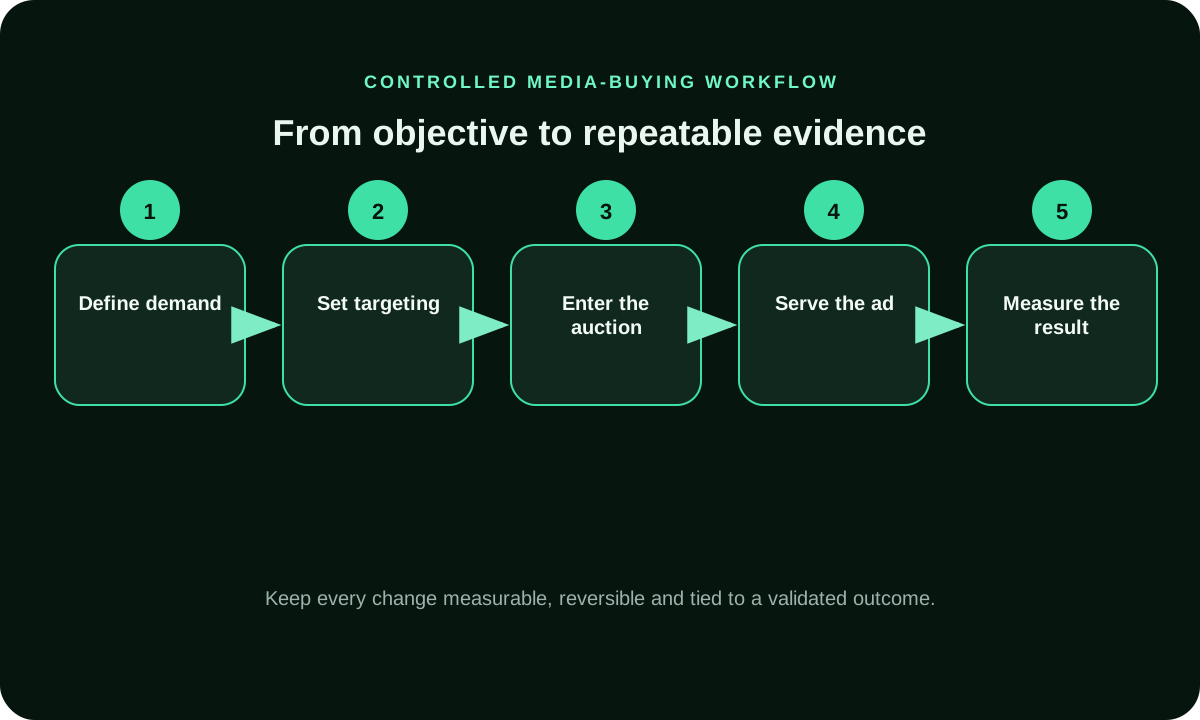
A useful buying workflow has five stages: define the outcome, prepare the measurement, choose eligible inventory, run a bounded test, and review mature results.
Keep the first run interpretable. Launch only the creatives and audience constraints needed to answer the question; avoid splitting a small budget among many nearly identical campaigns. Confirm that the destination and tracking work before paying for volume. During delivery, log material changes so the review can distinguish a new bid, creative, audience, or source filter from normal variation. After the agreed conversion window, compare accepted outcome cost and quality across available segments. The sequence prevents a quick click-rate shift from being mistaken for business improvement and helps an account strategist recommend a specific next test rather than a broad, unsupported scale-up.
How do you run a controlled test?
A controlled test changes a small number of known inputs and gives each conversion time to mature.
Write a one-sentence hypothesis, such as “this audience and message may produce approved leads at or below our ceiling.” Record the source set, creative, destination, bid, daily cap, date range, and accepted-event definition. Use a comparison only when the groups are genuinely comparable; changing GEO, landing page, and bidding at once makes the result difficult to attribute. Set a stop condition before launch, but do not stop solely because one early day is weak when the conversion delay is longer. Review both enough volume to be informative and the risk limit that protects cash flow. The result may be scale, refine, or stop; all three are useful if the test answers its stated question.
Create your free FroggyAds accountHow should you use targeting while preserving reach?
Begin with necessary eligibility rules, then narrow targeting only when segment-level evidence justifies it.
Start with constraints that protect compliance and user fit, such as permitted locations, the devices your destination supports, and any restrictions in the offer. Keep optional dimensions broad until there is a reason to isolate them. When reporting supports it, compare location, device, operating system, browser, carrier, city, category, source, or other available identifiers against the same accepted conversion definition. A small segment may show a high rate by chance or may not deliver enough volume to matter. A broad segment may contain useful placements that are obscured by an average. Separate one targeting change at a time and keep the original segment identifiable so you can reverse a filter that removes valuable reach.
How do creative and landing page fit together?
Make the ad promise, landing-page headline, and requested action describe the same offer.
A buyer should be able to follow the message from impression to first screen without having to infer what changed. State material conditions before the form or checkout, use a creative that represents the actual product, and avoid false urgency, misleading interface imitations, or claims you cannot substantiate. If you use a pre-lander, explain what it adds—for example, product context or qualification—rather than using it to hide the destination. Check that buttons work, form submissions reach the intended system, and the conversion event fires once. These checks protect the value of paid visits and make the performance comparison fair across creative versions.
How should you review inventory and source performance?
Review delivery, click, conversion, and acceptance evidence separately before judging an inventory source.
For each source or placement ID that the report exposes, compare impressions and spend with clicks, landing-page arrivals, provisional events, accepted outcomes, and economic value. A low conversion count can reflect a small sample or a long decision cycle; repeated duplicate events or consistently rejected actions point to a different issue. Check time-to-conversion and backend status before blocking a placement. When a source is weak, first ask whether tracking or the offer prevents a fair test; then decide whether to collect more data, reduce its bid, exclude it, or keep it for a different audience. Save the reason for each change so a later buyer can distinguish a data-based rule from a one-off reaction.
When is a programmatic campaign ready to scale?
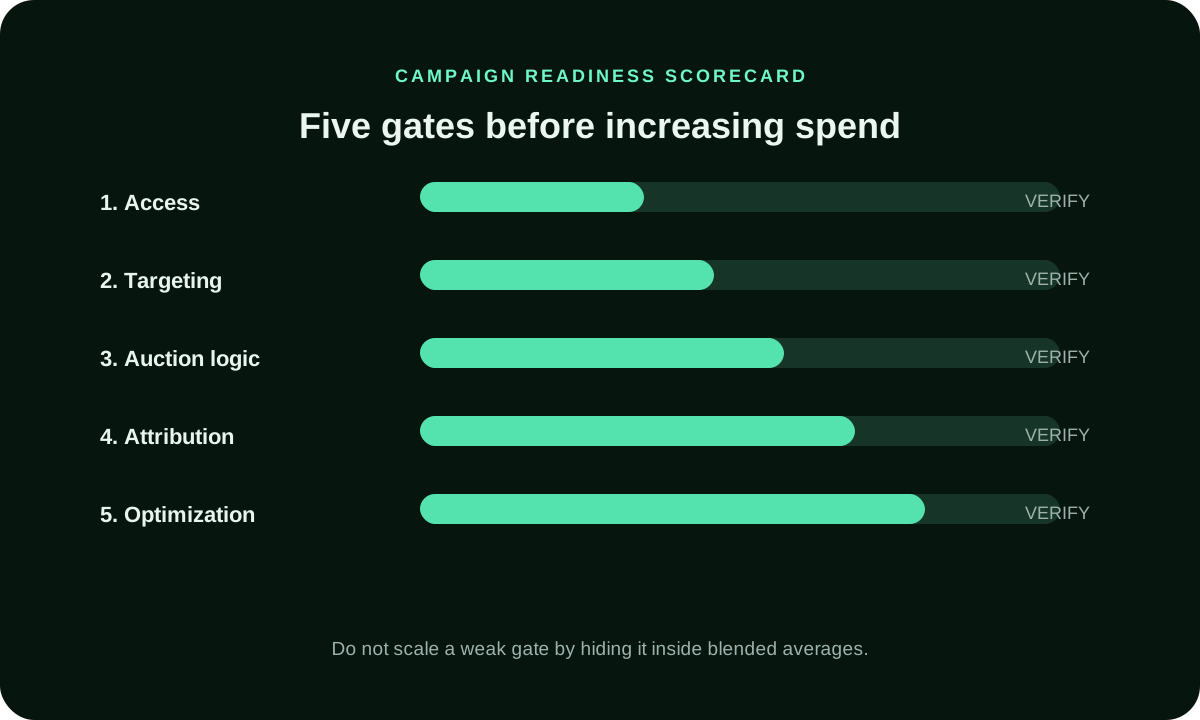
Increase exposure only after tracking is stable, accepted outcomes meet your ceiling, and quality holds as volume grows.
A favorable average can hide segments that are already losing money, so check marginal performance after each material budget or bid increase. Confirm that additional delivery still reaches the intended locations and that the advertiser can process the resulting leads, orders, or trials. Expand one dimension at a time—such as a new creative or an additional eligible audience—then give its conversions time to mature. Pause an expansion if accepted cost exceeds the planned range, quality shifts, or capacity becomes a constraint. This is a decision rule, not a guarantee that past performance will continue; scale gradually enough to notice when the economics change.
What should you verify before launch?
Before launch, confirm the offer, measurement, destination, buying limits, and stop rule as one connected plan.
Run a click-to-outcome test with the actual landing page, not only a preview. Check that campaign parameters survive redirects, the requested action records once, and the advertiser’s system can identify an accepted result. Confirm the chosen format displays properly on the intended devices and that your creative meets the offer’s restrictions. Write down the permitted geography, maximum daily spend, test-loss ceiling, conversion-maturity window, and who can approve a change. This is practical launch readiness; it does not predict how many conversions the campaign will produce.
Create your free FroggyAds accountWhat common programmatic buying mistakes should you prevent?
Most preventable losses come from mismatched expectations, incomplete tracking, premature exclusions, or spending beyond the written test limit.
Do not optimize toward a fast signal such as click-through rate if the business objective is an approved lead or paid order. Do not compare CPC or CPM across campaigns as if they had identical inventory, audience, creative, or conversion quality. Avoid adding filters whenever performance dips: the cause may be a broken destination, delayed event, or changed offer. Likewise, do not declare a source profitable from a few immature conversions or treat a platform-reported event as final when the advertiser has not accepted it. Keep a concise change log with date, evidence, decision, expected effect, and next review date. That record gives the buyer a way to reverse weak changes and explain results to a client or finance team.
How can FroggyAds support an advertiser’s buying workflow?
FroggyAds gives advertisers a self-serve way to configure campaigns, use available targeting controls, and review source-level reporting.
FroggyAds describes access to more than 750 SSP integrations and over 20 billion daily impressions across supported formats and markets. These are platform-wide availability figures; they do not mean every impression is eligible for each account, geography, format, or campaign. Depending on availability, advertisers can configure geography, device, operating system, browser, carrier, city, category, source, ID, and IP controls, and use budget settings and reporting to assess delivery. The practical advantage is that an affiliate or media buyer can make a bounded test and inspect the exposed campaign evidence without treating reach as a result. We recommend starting with a clear accepted event, preserving source identifiers, and increasing spend only when your own reconciled data supports the next move. For platform scope, compare the buying process here with the Self-Serve DSP overview in the related resources.
Programmatic campaign readiness checklist
A campaign is ready when an outside reviewer can reproduce its objective, tracking rule, cost limit, and next-step decision from the saved record.
Use this launch sheet: (1) business outcome and acceptance owner; (2) offer terms, permitted audience, and destination; (3) click and conversion identifiers; (4) buying method and bid unit; (5) daily cap and total loss ceiling; (6) attribution and maturity window; (7) source-level evidence to review; and (8) conditions for scale, revision, or stop. Keep the evidence that supports each call, including backend acceptance rather than only the first platform event. If several people manage the campaign, assign who approves a new filter or larger budget. A short, complete plan is easier to hand off than a long list of settings with no decision rule.
Four linked controls for a stronger campaign review
A programmatic campaign is easier to explain when each decision is tied to its evidence. Use these four guides as separate work areas: one for tracking reconciliation, one for budget limits, one for source selection, and one for the destination. Choose the page that answers the unresolved question, then return here to record how it affected the campaign decision. This keeps buyer, analyst, and client reviews aligned without assuming one setting can fix every problem.
Programmatic advertising FAQ
What is programmatic advertising?
It is software-enabled buying and selling of digital ad inventory under defined rules. The specific transaction may use an auction or another deal method.
Is programmatic advertising the same as real-time bidding?
No. Programmatic is the broader buying method; real-time bidding is one auction mechanism that may be used within it.
Which parties may take part in programmatic buying?
Advertisers, buying systems, exchanges or other intermediaries, sell-side systems, publishers, and measurement services may be involved; some companies perform multiple roles.
Is a DSP the same as an ad exchange?
No. A DSP supports buying-side decisions and campaign controls; an exchange facilitates transactions between buying and selling systems. Provider roles can overlap.
Who should consider programmatic advertising?
Advertisers, affiliates, agencies, and media buyers with a compliant offer, a measurable outcome, reliable follow-up data, and a defined test-loss limit can evaluate it.
What should a first campaign measure?
Measure the accepted business outcome and its cost by available source or segment. Use impressions, clicks, and provisional events to diagnose the path, not as substitutes for the final result.
How much budget should I set?
Use your own payout or contribution margin, variable costs, conversion assumptions, refund exposure, and cash-flow limit. Keep the bid, daily cap, and total test ceiling distinct.
How long should the test run?
Allow the stated conversion event to mature across the review window that matches your funnel, while staying inside the stop-loss limit. There is no universal duration.
How can I assess inventory quality?
Reconcile source identifiers with valid clicks, accepted events, duplicates or rejections, conversion timing, and backend value before changing a source rule.
What does FroggyAds provide for advertisers?
FroggyAds offers self-serve campaign buying, available targeting and budget controls, and source-level reporting. Published reach figures describe supported formats and markets, not guaranteed delivery or outcomes.
Related guides for the next buying decision
Use these resources according to the task you need to complete next. The Self-Serve DSP guide explains platform buying workflow; Traffic Sources covers source selection; Tracking Discrepancies addresses measurement gaps; and the Learning Center contains broader planning material. This guide remains focused on how programmatic buying works and what an advertiser should test.
Prepare your first programmatic campaign
Create a test that answers one campaign question, then review accepted outcomes against your cost ceiling before you add another variable. Use the linked resources below to prepare measurement, budget, and source rules. Before launch, write down the exact report fields you will use and who will confirm the accepted event. After the review window closes, record whether the evidence supports expansion, another controlled test, or a stop; do not call a result successful from delivery metrics alone.
What this programmatic advertising guide covers
This guide explains programmatic buying as a method and shows how an advertiser can test it. It does not substitute for a platform comparison or promise campaign results; for the platform-specific buying workflow, see the Programmatic Traffic Platform resource.
The terms that change a buyer’s decision are demand-side platform (DSP), supply-side platform (SSP), exchange, auction, bid request, placement, and attribution window. Use DSP and SSP to describe buying- and selling-side functions; use real-time bidding only when the transaction actually uses a real-time auction. Ask which identifiers and reports the chosen platform exposes before relying on a source-level comparison.
| Checkpoint | Page-specific action | Evidence to keep |
|---|---|---|
| Map | Trace one route from eligible supply through the buying decision to a measured, accepted action. | Save the objective, event definition, campaign ID, and source identifiers the report actually exposes. |
| Diagnose | Separate delivery, click, tracking, and acceptance questions before changing a campaign setting. | Compare impressions, clicks, spend, provisional events, accepted outcomes, and backend confirmations over one window. |
| Decide | Use conversion maturity and your cost ceiling to choose whether to wait, refine, reduce, or stop. | Record the sample, review period, economics, evidence, and reason for each material change. |
Before you choose a bid or filter, write the accepted event, its value, and the maturity window beside the campaign variable you intend to test. Keep that record with the source-level result.
We give you a self-serve route to launch a measured traffic test and review its available source evidence. Start with the campaign controls that fit your objective, verify the click-to-outcome path, and create your free FroggyAds account when you are ready to configure a campaign.
Worked example: calculate an acceptable acquisition cost
Hypothetical example: suppose an advertiser has $120 in net contribution available per accepted order before media. If fulfilment and expected refund costs total $35, then $85 remains as a theoretical upper media ceiling before adding a safety reserve. A buyer who chooses a $50 target is making a cautious planning assumption, not forecasting a FroggyAds result. After delivery, compare actual accepted orders, source cost, refunds, and attribution maturity with the model. Update the ceiling only when the advertiser’s own records support it.
What to remember about programmatic advertising
Programmatic advertising automates parts of the buying process; it does not automate the advertiser’s responsibility for offer fit, truthful creative, reliable measurement, and sound economics. Define success first, then use source-level evidence to decide whether to refine, scale, or stop. Keep the buying method separate from the specific platform and format: software can coordinate a transaction, but your campaign still depends on eligible supply, an honest message, a working destination, and an accepted outcome. For your next step, list one question your first test must answer, the evidence that can answer it, and the amount you are prepared to risk.