
Keyword ownership
- frequency capping in advertising
Showing the same user the same ad too often wastes budget and annoys audiences. Frequency capping on FroggyAds limits how many times each user sees your ad.
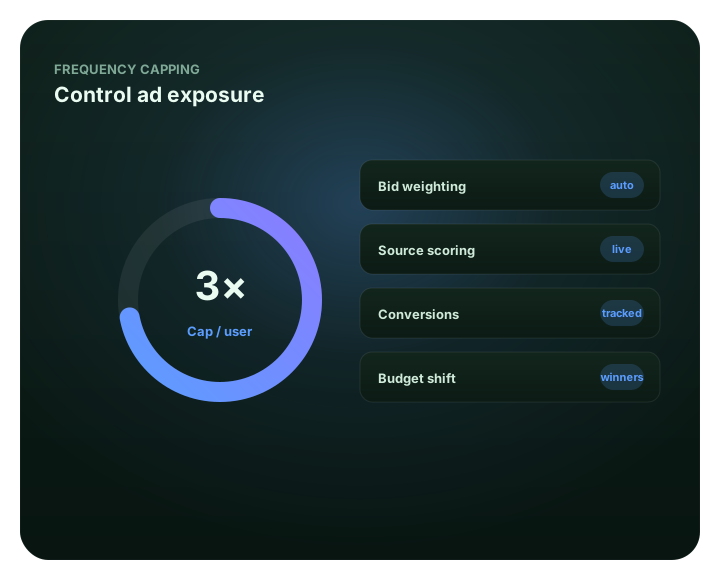
Quick answer: Frequency capping lets you limit repeated ad delivery within a defined period. With FroggyAds, check the counted event, time window and campaign scope before choosing a limit. Keep the budget separate, then test whether a lower cap improves cost per qualified conversion without losing more useful reach than your business can accept.
| Section | Distinct excerpt from this page |
|---|---|
| Reach more people, annoy fewer | Combine caps with day-parting, source control and SmartCPC for efficient, well-paced delivery, with Adscore and internal controls providing traffic-quality signals. |
| Set a cap | Limit impressions per user per day or per campaign so no one is over-exposed. |
| Stop the waste | A cap limits repeat delivery within its configured scope; evaluate whether it also improves customer acquisition. |
Reference for Frequency Capping: Control Reach and Ad Fatigue: Google Ads location targeting.
Repeated exposure can help a customer recognize an offer, but it can also consume budget without producing more qualified response. The useful limit depends on the format, message and buying journey. With our frequency controls, you can test a defined exposure limit instead of assuming that every repeat impression is either valuable or wasted.
On FroggyAds, combine a frequency limit with a campaign budget and the targeting your offer needs. A lower cap may leave room to reach other eligible users, but actual delivery depends on available supply and bids. Our source controls help you investigate where results change. The $50 minimum deposit funds your account; it is not a fee for frequency capping or a guaranteed test outcome.
For Control exposure with frequency caps, the FroggyAds self-serve workflow keeps campaign setup, targeting, budget controls, source-level reporting and optimization in one dashboard so advertisers can make evidence-led keep, cap, exclude and retest decisions.
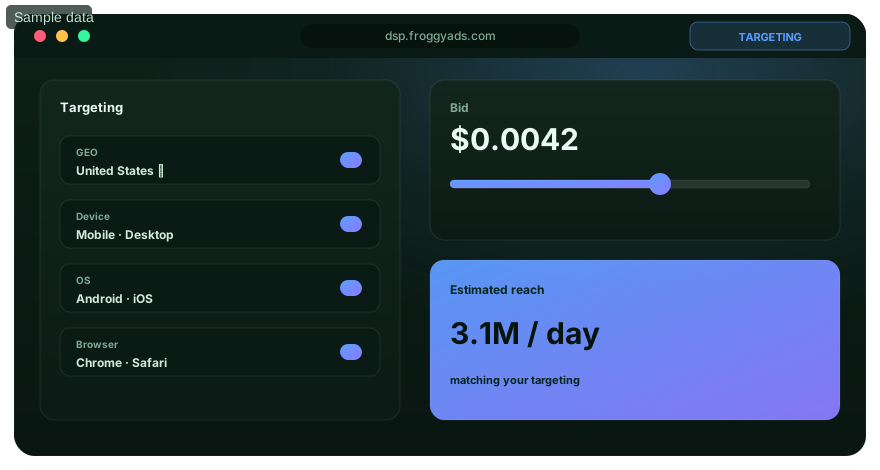
Compare additional exposure with qualified outcomes instead of assuming a universal cut-off.
Limit impressions per user per day or per campaign so no one is over-exposed.
A cap limits repeat delivery within its configured scope; evaluate whether it also improves customer acquisition.
Fewer, better-timed impressions keep your brand from feeling spammy.
Trade redundant frequency for broader reach across more users.
Cap frequency on FroggyAds
Open an account and set caps from $50.
Frequency capping limits repeat ad delivery to a recognized user or identifier over a specified period. We offer frequency controls so you can manage repeated exposure alongside your campaign budget and targeting. Before launch, check the event being counted, the time window and the scope shown for your chosen format. A cap of two is incomplete without knowing two of what, over how long, and for which campaign.
A frequency cap limits repetition; a budget cap limits money spent. You need both when a small audience can receive many exposures. Lowering frequency may reduce repeated delivery, but it does not set your maximum campaign cost. In FroggyAds, keep the spending allocation separate so a successful reach test still stays within the amount you planned to invest.
There is no single best number for every offer or format. Choose an initial limit that suits the buying journey, then compare qualified conversions, spend and available reach. A simple registration and a considered software purchase may need different follow-up. Do not import a competitor's recommended number without checking its counted event and time window; identical-looking settings can represent different exposure rules.
That depends on the setting and format, so read the label before applying it. An impression cap limits displays, while a click cap limits clicks and may allow more displays before the limit is reached. Confirm what your FroggyAds campaign actually supports. Do not assume a click-based cap is available merely because another ad network documents one, or treat the two types as equivalent.
Keep the offer, creative, targeting and bid strategy stable while changing the cap. Compare periods with similar conversion maturity. In a hypothetical test, $120 for 10 qualified leads is $12 per lead; $90 for nine is $10 per lead. The second result is cheaper per lead but delivers fewer leads. Use both cost and volume to decide whether the new setting serves your goal; these numbers are not FroggyAds campaign results.
More of the reachable audience may already have received the allowed exposure, leaving fewer eligible opportunities. Check the cap together with your schedule, location filters, source list, budget and bid. Raising the bid cannot remove an exposure limit. We recommend changing one relevant restriction at a time so you can tell whether the problem is repeated exposure or an audience that is simply too narrow.
Do not assume perfect person-level coverage. Browsers, devices and supply paths can use different or unavailable identifiers, so the same person may not be recognized as one user throughout the journey. Treat the cap as a delivery control within its documented scope, not proof of how often an individual has seen your brand everywhere. Compare reach reports only when their identity definitions match.
Yes, a limit applied to one campaign does not automatically describe the total exposure from other campaigns or networks. Review overlapping audiences, creatives and schedules before diagnosing a broken cap. Check whether your actual account setting is campaign-specific or has a broader scope. Avoid promising a brand-wide exposure ceiling unless that scope is explicitly supported and tested in your setup.
Not automatically. A lower click-through rate can follow creative fatigue, a different source mix or a change in who is eligible to see the ad. Review conversion cost and quality alongside the response rate. If repeated exposure is the likely cause, test the cap; if the message is tired, test fresh creative separately. Our source controls help keep those two explanations from being blended into one campaign average.
The schedule decides when your campaign may deliver; the frequency cap limits repetition within its own defined window. Use scheduling for practical availability or repeatable time-of-day differences, and frequency controls for exposure. Set both deliberately rather than expecting one to replace the other. Start your FroggyAds campaign with a clear budget, then review whether the combination brings useful conversions without unnecessarily restricting reach.
Create your account, choose an eligible format and set a frequency limit alongside your campaign budget.
Explore focused guides built around distinct target keywords, measurable campaign decisions, source-level controls and quality-aware optimization.
Frequency capping limits how often an eligible user or identifier can receive the same campaign or creative within a period. Use it to manage fatigue and waste, while accounting for identifier limits across browsers, devices and supply paths.
Event: an eligible impression or click exposed to the declared campaign configuration.
Decision: whether the change improves mature accepted value without hiding source or quality loss.
Primary risk: changing several variables together or scaling from an early vanity-metric spike.
| Layer | Evidence to preserve | Action rule |
|---|---|---|
| Delivery | Campaign, source, placement, device, GEO, schedule and creative identifiers where available. | Do not optimize a blended result when the controllable delivery units can be separated. |
| Measurement | Timestamped impression or click records, conversion identifiers, values, currency and acceptance status. | Reconcile platform data with first-party or partner records before a large budget change. |
| Quality | Session behavior, invalid-event signals, conversion validity, downstream value and repeat patterns. | Separate suspicious activity from ordinary low performance and document the evidence behind exclusions. |
| Change control | Previous settings, hypothesis, observation window, loss ceiling and rollback state. | Change one material variable at a time and restore the stable state when the declared stop rule is reached. |
Frequency caps manage repeated exposure, creative fatigue and unnecessary spend. The cap must be interpreted within the identifier and supply limitations of the platform rather than assumed to follow a person perfectly across devices.
For frequency capping in advertising, Write the business question before selecting a setting or report. State which event should change, which segment is eligible and what result would justify the next action. The practical evidence should include the configuration that was active, the source or placement involved, the creative and destination version, and the event status at the agreed reporting cutoff. This keeps the analysis tied to a specific campaign state instead of a blended historical average that cannot be reproduced.
Frequency caps manage repeated exposure, creative fatigue and unnecessary spend. The cap must be interpreted within the identifier and supply limitations of the platform rather than assumed to follow a person perfectly across devices. In this part of the workflow, compare the newest test cohort with a stable baseline, normalize time zone and currency, and preserve the original identifiers through every permitted handoff. The decision should be reversible: continue, limit, investigate or restore the previous state. Avoid changing several variables at once, because a larger result without causal clarity is difficult to repeat safely.
For frequency capping in advertising, Map the impression or click to the source identifier, destination session, conversion record and final accepted value. Keep timestamps and status changes available for reconciliation. The practical evidence should include the configuration that was active, the source or placement involved, the creative and destination version, and the event status at the agreed reporting cutoff. This keeps the analysis tied to a specific campaign state instead of a blended historical average that cannot be reproduced.
Frequency caps manage repeated exposure, creative fatigue and unnecessary spend. The cap must be interpreted within the identifier and supply limitations of the platform rather than assumed to follow a person perfectly across devices. In this part of the workflow, compare the newest test cohort with a stable baseline, normalize time zone and currency, and preserve the original identifiers through every permitted handoff. The decision should be reversible: continue, limit, investigate or restore the previous state. Avoid changing several variables at once, because a larger result without causal clarity is difficult to repeat safely — Establish the measurement chain.
For frequency capping in advertising, Use a narrow campaign, stable creative set and fixed loss ceiling. Hold unrelated targeting and budget variables steady so the observed difference can be attributed to the tested change. The practical evidence should include the configuration that was active, the source or placement involved, the creative and destination version, and the event status at the agreed reporting cutoff. This keeps the analysis tied to a specific campaign state instead of a blended historical average that cannot be reproduced.
Frequency caps manage repeated exposure, creative fatigue and unnecessary spend. The cap must be interpreted within the identifier and supply limitations of the platform rather than assumed to follow a person perfectly across devices. In this part of the workflow, compare the newest test cohort with a stable baseline, normalize time zone and currency, and preserve the original identifiers through every permitted handoff. The decision should be reversible: continue, limit, investigate or restore the previous state. Avoid changing several variables at once, because a larger result without causal clarity is difficult to repeat safely — Design the first controlled test.
For frequency capping in advertising, Separate only the dimensions that can change a decision. Excessive fragmentation creates small samples, unstable averages and operational work without producing clearer evidence. The practical evidence should include the configuration that was active, the source or placement involved, the creative and destination version, and the event status at the agreed reporting cutoff. This keeps the analysis tied to a specific campaign state instead of a blended historical average that cannot be reproduced.
Frequency caps manage repeated exposure, creative fatigue and unnecessary spend. The cap must be interpreted within the identifier and supply limitations of the platform rather than assumed to follow a person perfectly across devices. In this part of the workflow, compare the newest test cohort with a stable baseline, normalize time zone and currency, and preserve the original identifiers through every permitted handoff. The decision should be reversible: continue, limit, investigate or restore the previous state. Avoid changing several variables at once, because a larger result without causal clarity is difficult to repeat safely — Segment without destroying volume.
For frequency capping in advertising, Document conversion windows, approval delays, refunds and late revenue. Compare cohorts at the same maturity rather than declaring a new segment weak because its outcomes have not settled. The practical evidence should include the configuration that was active, the source or placement involved, the creative and destination version, and the event status at the agreed reporting cutoff. This keeps the analysis tied to a specific campaign state instead of a blended historical average that cannot be reproduced.
Frequency caps manage repeated exposure, creative fatigue and unnecessary spend. The cap must be interpreted within the identifier and supply limitations of the platform rather than assumed to follow a person perfectly across devices. In this part of the workflow, compare the newest test cohort with a stable baseline, normalize time zone and currency, and preserve the original identifiers through every permitted handoff. The decision should be reversible: continue, limit, investigate or restore the previous state. Avoid changing several variables at once, because a larger result without causal clarity is difficult to repeat safely — Protect against reporting delay.
For frequency capping in advertising, Define when a source is allowed, limited, investigated or blocked. Require a minimum evidence threshold and distinguish suspicious activity from normal low conversion performance. The practical evidence should include the configuration that was active, the source or placement involved, the creative and destination version, and the event status at the agreed reporting cutoff. This keeps the analysis tied to a specific campaign state instead of a blended historical average that cannot be reproduced.
Frequency caps manage repeated exposure, creative fatigue and unnecessary spend. The cap must be interpreted within the identifier and supply limitations of the platform rather than assumed to follow a person perfectly across devices. In this part of the workflow, compare the newest test cohort with a stable baseline, normalize time zone and currency, and preserve the original identifiers through every permitted handoff. The decision should be reversible: continue, limit, investigate or restore the previous state. Avoid changing several variables at once, because a larger result without causal clarity is difficult to repeat safely — Create a source-level action rule.
For frequency capping in advertising, Keep the promise, format and landing-page experience aligned. A targeting or delivery change can alter device context and user intent, so creative performance must be reviewed again after material expansion. The practical evidence should include the configuration that was active, the source or placement involved, the creative and destination version, and the event status at the agreed reporting cutoff. This keeps the analysis tied to a specific campaign state instead of a blended historical average that cannot be reproduced.
Frequency caps manage repeated exposure, creative fatigue and unnecessary spend. The cap must be interpreted within the identifier and supply limitations of the platform rather than assumed to follow a person perfectly across devices. In this part of the workflow, compare the newest test cohort with a stable baseline, normalize time zone and currency, and preserve the original identifiers through every permitted handoff. The decision should be reversible: continue, limit, investigate or restore the previous state. Avoid changing several variables at once, because a larger result without causal clarity is difficult to repeat safely — Coordinate creative and destination.
For frequency capping in advertising, Save the previous configuration, label the test window and record the hypothesis. Restore the stable state when cost, quality, discrepancy or compliance crosses the written boundary. The practical evidence should include the configuration that was active, the source or placement involved, the creative and destination version, and the event status at the agreed reporting cutoff. This keeps the analysis tied to a specific campaign state instead of a blended historical average that cannot be reproduced.
Frequency caps manage repeated exposure, creative fatigue and unnecessary spend. The cap must be interpreted within the identifier and supply limitations of the platform rather than assumed to follow a person perfectly across devices. In this part of the workflow, compare the newest test cohort with a stable baseline, normalize time zone and currency, and preserve the original identifiers through every permitted handoff. The decision should be reversible: continue, limit, investigate or restore the previous state. Avoid changing several variables at once, because a larger result without causal clarity is difficult to repeat safely — Use change control and rollback.
For frequency capping in advertising, Include media cost, tracking, creative, landing-page operations, conversion approval, refunds and retained value. A cheaper platform metric can still create a more expensive customer outcome. The practical evidence should include the configuration that was active, the source or placement involved, the creative and destination version, and the event status at the agreed reporting cutoff. This keeps the analysis tied to a specific campaign state instead of a blended historical average that cannot be reproduced.
Frequency caps manage repeated exposure, creative fatigue and unnecessary spend. The cap must be interpreted within the identifier and supply limitations of the platform rather than assumed to follow a person perfectly across devices. In this part of the workflow, compare the newest test cohort with a stable baseline, normalize time zone and currency, and preserve the original identifiers through every permitted handoff. The decision should be reversible: continue, limit, investigate or restore the previous state. Avoid changing several variables at once, because a larger result without causal clarity is difficult to repeat safely — Review economics beyond the platform.
For frequency capping in advertising, Require the result to persist across multiple periods or source groups. Increase one dimension at a time and monitor the newest spend separately so quality loss is visible before it dominates the blended average. The practical evidence should include the configuration that was active, the source or placement involved, the creative and destination version, and the event status at the agreed reporting cutoff. This keeps the analysis tied to a specific campaign state instead of a blended historical average that cannot be reproduced.
Frequency caps manage repeated exposure, creative fatigue and unnecessary spend. The cap must be interpreted within the identifier and supply limitations of the platform rather than assumed to follow a person perfectly across devices. In this part of the workflow, compare the newest test cohort with a stable baseline, normalize time zone and currency, and preserve the original identifiers through every permitted handoff. The decision should be reversible: continue, limit, investigate or restore the previous state. Avoid changing several variables at once, because a larger result without causal clarity is difficult to repeat safely — Scale only repeatable evidence.
For frequency capping in advertising, Record missing identifiers, modeled signals, unsupported devices, privacy restrictions and platform-specific definitions. Clear limitations make the guidance trustworthy and prevent a generic rule from being applied outside its evidence. The practical evidence should include the configuration that was active, the source or placement involved, the creative and destination version, and the event status at the agreed reporting cutoff. This keeps the analysis tied to a specific campaign state instead of a blended historical average that cannot be reproduced.
Frequency caps manage repeated exposure, creative fatigue and unnecessary spend. The cap must be interpreted within the identifier and supply limitations of the platform rather than assumed to follow a person perfectly across devices. In this part of the workflow, compare the newest test cohort with a stable baseline, normalize time zone and currency, and preserve the original identifiers through every permitted handoff. The decision should be reversible: continue, limit, investigate or restore the previous state. Avoid changing several variables at once, because a larger result without causal clarity is difficult to repeat safely — Document exceptions and limitations.
For frequency capping in advertising, End each reporting cycle with a specific action, owner and review date. A decision log makes future optimization faster because the team can see which assumptions were tested and what evidence changed them. The practical evidence should include the configuration that was active, the source or placement involved, the creative and destination version, and the event status at the agreed reporting cutoff. This keeps the analysis tied to a specific campaign state instead of a blended historical average that cannot be reproduced.
Frequency caps manage repeated exposure, creative fatigue and unnecessary spend. The cap must be interpreted within the identifier and supply limitations of the platform rather than assumed to follow a person perfectly across devices. In this part of the workflow, compare the newest test cohort with a stable baseline, normalize time zone and currency, and preserve the original identifiers through every permitted handoff. The decision should be reversible: continue, limit, investigate or restore the previous state. Avoid changing several variables at once, because a larger result without causal clarity is difficult to repeat safely — Turn the review into a decision.
This URL has one primary job for app growth teams: understand the control and decide when to use it. Keep this page focused on that buying decision instead of turning it into a generic advertising article. The nearest related FroggyAds page is Frequency Capping In Advertising; use that URL when its narrower task is the one you actually need.
To complete the Control exposure with frequency caps. decision context, keep campaign objective and source quality visible as operating concepts. They matter here because they change how the buyer interprets setup, delivery or accepted outcomes.
| Step | Feature Control workflow | Evidence to retain |
|---|---|---|
| 1 | State the problem the control is meant to solve | Keep the evidence tied to Control exposure with frequency caps and the accepted outcome defined for this URL. |
| 2 | Apply the control with a written rule and rollback condition | Keep the evidence tied to Control exposure with frequency caps and the accepted outcome defined for this URL. |
| 3 | Measure its effect on delivery and accepted outcomes before making it permanent | Keep the evidence tied to Control exposure with frequency caps and the accepted outcome defined for this URL. |
Hypothetical example: if a controlled Control exposure with frequency caps test spends USD 225 and records 9 accepted outcomes after the same review window, accepted CPA is USD 225 divided by 9 = USD 25.00. Replace the example inputs with your own economics; this is not a FroggyAds performance claim.
Use FroggyAds as the execution layer only when the page's decision calls for paid traffic. Set the relevant budget, targeting and format controls, verify conversion tracking, keep source-level evidence, and increase spend only when the accepted outcome supports the next step. Create your free FroggyAds account. In the Frequency Capping workflow, treat this as evidence for the page-specific task to understand the control and decide when to use it, not as a reusable conclusion for another URL.
Control exposure with frequency caps is a campaign-control decision: state the problem the control solves, define the rule before enabling it, and measure its effect on delivery and accepted outcomes.