
What is bot traffic?
Bot traffic is non-human activity that can waste ad budget and corrupt data. Here's what it is, how it gets into campaigns, and how FroggyAds filters it out.
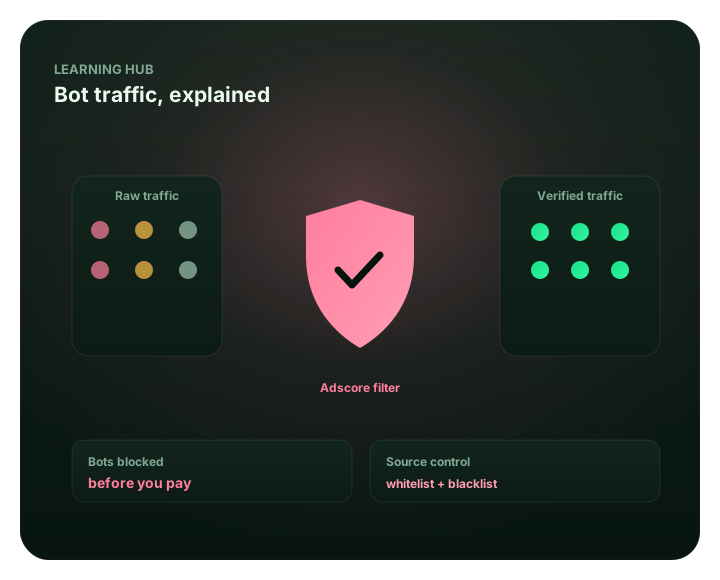
What is bot traffic? at a glance
What does this page explain about What Is Bot Traffic? Definition, Examples & How It Works?
Quick answer: Bot traffic is non-human activity that can waste ad budget and corrupt data. Here's what it is, how it gets into campaigns, and how FroggyAds filters it out. Bot traffic is automated activity – scripts, crawlers, data-center and proxy traffic – that mimics real users but can never become a customer. FroggyAds defends against it with Adscore, which screens Traffic delivery for bots and invalid traffic before you're billed, plus source-level blacklists so you can cut any source showing bot-like patterns. traffic with quality controls is the foundation of every good campaign – and it starts from $50.
| Section | Distinct excerpt from this page |
|---|---|
| Why bots hurt twice | No filter is perfect, but this combination materially protects both your budget and your data. |
| Why it's harmful | It spends budget on visits that can't convert and distorts your metrics. |
| Your part | Blacklist any source showing bot-like patterns at the source-ID level. |
Reference for What Is Bot Traffic? Definition, Examples & How It Works: FTC guidance on online advertising and marketing.
- Planning: Why bots hurt twice.
- Control: See what is bot traffic? inside the platform.
- Decision: Traffic that can never convert.
Test the What is bot traffic hypothesis with source-level evidence
Use the What is bot traffic guidance above to choose only the controls that affect the real buyer journey, then reconcile campaign and backend evidence.
Create your free FroggyAds accountReady to turn What is bot traffic? into a measurable traffic test?
Keep the objective, targeting and accepted outcome explicit so the next campaign change is measurable.
Why bots hurt twice
Bot traffic is automated activity – scripts, crawlers, data-center and proxy traffic – that mimics real users but can never become a customer. It hurts advertisers twice: first by spending budget on worthless visits, and second by corrupting the conversion data you rely on to optimize, so you make bad decisions on top of wasted spend.
FroggyAds defends against it with Adscore, which screens Traffic delivery for bots and invalid traffic before you're billed, plus source-level blacklists so you can cut any source showing bot-like patterns. No filter is perfect, but this combination materially protects both your budget and your data. traffic with quality controls is the foundation of every good campaign – and it starts from $50.
Why it matters
- Protecting budget from worthless visits
- Keeping conversion data trustworthy
- Understanding traffic-quality filtering
- Spotting bot-like source patterns
- Building campaigns on clean data
Turn What is bot traffic into one measurable FroggyAds test
Keep the next What is bot traffic step reversible: define one accepted outcome, protect the learning budget and use source-level results before expanding.
Create your free FroggyAds accountUse FroggyAds to validate the next What is bot traffic? decision
Keep the objective, targeting and accepted outcome explicit so the next campaign change is measurable.
See what is bot traffic? inside the platform
For What is bot traffic, the FroggyAds self-serve workflow keeps campaign setup, targeting, budget controls, source-level reporting and optimization in one dashboard so advertisers can make evidence-led keep, cap, exclude and retest decisions.
- Protecting budget from worthless visits
- Keeping conversion data trustworthy
- Understanding traffic-quality filtering
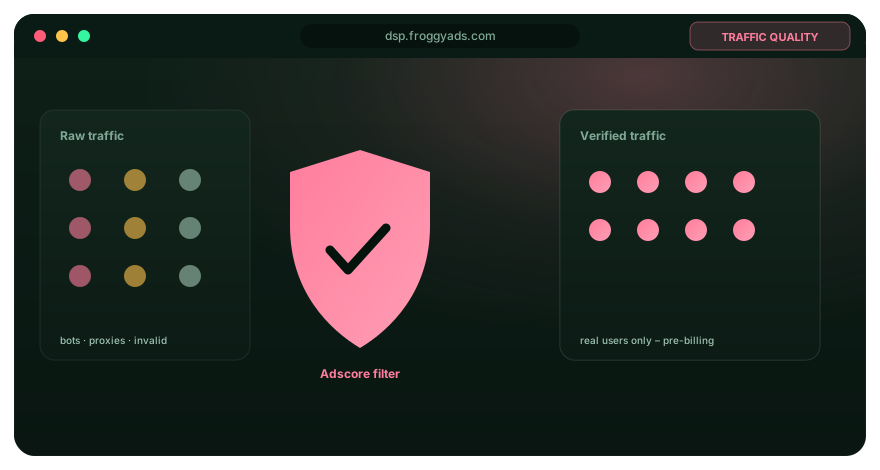
Traffic that can never convert
And that quietly poisons your data.
What it is
Automated, non-human activity – bots, scripts, data-center and proxy traffic.
Why it's harmful
It spends budget on visits that can't convert and distorts your metrics.
How it's filtered
FroggyAds uses Adscore and internal controls to help identify and filter invalid or low-quality traffic.
Your part
Blacklist any source showing bot-like patterns at the source-ID level.
Advertise bot-protected
Open an account and run on traffic with quality and source controls from a $50 minimum deposit.
Use FroggyAds to validate the next What is bot traffic decision
Preserve the What is bot traffic baseline, change one major variable and scale only the segments that keep producing accepted downstream value.
Create your free FroggyAds accountTake the next What is bot traffic? step with controlled media buying
Keep the objective, targeting and accepted outcome explicit so the next campaign change is measurable.
Bot traffic FAQ
When should bot traffic be treated as a campaign problem?
Treat it as a problem when automated activity can spend budget, distort engagement, or contaminate conversion decisions. Review it before optimization because unreliable input data can make a weak source look productive.
Which signals can point to automated traffic?
Look for impossible device combinations, repeated identifiers, abnormal timing, data-center or proxy patterns, sudden bursts, and sessions with no plausible behavior. One signal is not a verdict, so compare several records at source level.
Does choosing one ad format remove bot-traffic risk?
No ad format removes the risk by itself. The useful controls are traffic screening, clear source identifiers, advertiser-side records, and the ability to exclude suspicious inventory after review.
Which records are worth saving when bot traffic is suspected?
Keep server requests, load events, analytics sessions, click identifiers, device data, and accepted backend actions with their timestamps. A connected record helps distinguish automated activity from a broken tag, redirect, or page.
How should a test budget account for invalid traffic?
Set a total loss limit, daily cap, and source-level review threshold before delivery begins. Keep discovery spend separate from proven inventory so suspicious volume cannot consume money reserved for confirmed sources.
Which events should be reconciled during a bot-traffic review?
Compare the platform impression or click with the server request, loaded session, intended action, and accepted backend result. Large unexplained gaps show where to investigate, even when they do not identify the cause on their own.
How can source quality be judged without one vanity score?
Use repeatable behavior, valid sessions, accepted outcomes, rejection reasons, and consistency across comparable periods. A source is easier to trust when several independent records agree on what happened.
What fraud guardrail belongs in every traffic test?
Keep screening controls active and retain the right to blacklist a source or zone after evidence review. No filter catches every event, so advertiser-side monitoring and documented pause rules remain necessary.
When should a source with bot-like patterns be paused?
Pause it when the observed pattern crosses the written spend, volume, or quality threshold and cannot be explained by tracking failure. Save the relevant IDs and timestamps before excluding it so the decision can be checked later.
What evidence supports scaling after a traffic-quality check?
Scale only after repeated periods show stable human-like behavior, reconciled events, and accepted outcomes from the same source group. Raise volume gradually and confirm that the quality pattern survives the change.
use traffic-quality and source controls
Create your account and advertise on filtered traffic across 20B+ daily impressions.
Investigate suspected bot traffic with corroborating delivery and business evidence
Bot traffic is automated activity rather than ordinary human browsing, but one unusual metric does not prove that every visit in a source is automated or invalid. A professional review combines several signals: timing, device and browser consistency, network context, repeated behavior, landing-page progression, conversion evidence and the pattern across sources. The goal is to identify a repeatable problem without turning one anomaly into a permanent conclusion.
Start by confirming the measurement path. Broken redirects, duplicate analytics events, failed scripts and landing-page errors can create data that looks suspicious. Test the destination on the targeted devices, confirm that a valid click can reach the page and verify that accepted conversions are recorded once. Technical defects should be repaired before source quality is judged.
| Traffic-quality check | Question to answer | Evidence to retain |
|---|---|---|
| Timing | Are events concentrated in implausible patterns? | Timestamp distribution by source |
| Environment | Do device, browser or network signals repeat unusually? | Segment-level delivery records |
| Destination behavior | Do visits progress through a working page? | Landing and funnel-step evidence |
| Conversion | Are accepted business events present and plausible? | Reconciled advertiser outcomes |
| Source | Does the pattern repeat in one identifiable source? | Mature source-level comparison |
| Action | What pause, retest or exclusion rule applies? | Dated decision and rollback point |
Adscore and FroggyAds internal controls help identify and filter invalid or low-quality activity, but no traffic-quality system establishes that every remaining click is human or that fraud risk is zero. Treat screening as one protection layer. The advertiser's own conversion tracking, acceptance criteria and source review remain necessary for a complete decision.
Use source-level evidence after enough traffic has accumulated. A source with weak conversions may simply be poorly matched to the offer, while a source with suspiciously fast or repetitive behavior may warrant deeper investigation. Compare several signals together and look for a persistent difference from comparable traffic before blocking the source.
Network context can support a diagnosis, but it needs interpretation. Data-center, proxy or unusual IP signals can be relevant, yet shared networks, corporate environments and legitimate infrastructure can create edge cases. Avoid treating one network label as conclusive proof. Use it alongside behavioral and downstream evidence.
Accepted business outcomes are an important countercheck. A traffic source that creates valid, non-duplicated conversions does not automatically become trustworthy, but the result adds context to a suspicious delivery pattern. Likewise, zero conversions do not prove automation. Offer fit, creative, landing-page quality and sales process can all affect conversion performance.
Define the response ladder before a problem occurs. A mild anomaly may justify closer monitoring or a small retest. A persistent pattern across multiple signals may justify a source pause or exclusion. Severe technical or policy concerns may justify immediate action. Record the reason, date and evidence behind each step so the campaign can be reviewed later.
Budget limits reduce exposure while evidence is still uncertain. Decide how much a source or campaign can spend before formal review and avoid increasing volume simply because traffic is inexpensive. Low CPC or CPM does not offset a high rate of unusable visits. The useful cost is the amount spent per accepted business outcome after traffic quality is considered.
Creative and landing-page changes should be separated from traffic-quality tests when practical. If the team changes the offer, destination and source set at the same time, a better result cannot show what fixed the problem. Preserve a known configuration, change one important condition and wait for comparable maturity.
Keep allowlists and blocklists reviewable. A source excluded from one campaign should not automatically be treated as universally invalid for every offer and market unless the evidence supports that broader conclusion. Revisit old rules when enough time or campaign conditions have changed, while preserving the original reason for the exclusion.
FroggyAds gives advertisers source controls, targeting and reporting that can support this investigation workflow. The strongest traffic-quality process combines those platform controls with technical validation and the advertiser's own accepted-outcome evidence. That produces a decision that can be explained and reversed instead of relying on a single opaque score.
The practical objective is not to prove that every bad result is a bot. It is to protect spend by distinguishing technical failure, poor audience fit and repeatable invalid-traffic patterns well enough to take the right campaign action. A measured investigation is more useful than either ignoring suspicious activity or blocking broadly without evidence.
Keep the investigation record narrow and factual. Save the affected source, dates, observed signals, technical checks, accepted outcomes and the exact campaign action taken. This prevents a temporary anomaly from becoming an undocumented permanent rule and makes later retesting safer.
What is bot traffic FAQ
When should bot traffic be treated as a campaign problem?
Treat it as a problem when automated activity can spend budget, distort engagement, or contaminate conversion decisions. Review it before optimization because unreliable input data can make a weak source look productive.
Which signals can point to automated traffic?
Look for impossible device combinations, repeated identifiers, abnormal timing, data-center or proxy patterns, sudden bursts, and sessions with no plausible behavior. One signal is not a verdict, so compare several records at source level.
Does choosing one ad format remove bot-traffic risk?
No ad format removes the risk by itself. The useful controls are traffic screening, clear source identifiers, advertiser-side records, and the ability to exclude suspicious inventory after review.
Which records are worth saving when bot traffic is suspected?
Keep server requests, load events, analytics sessions, click identifiers, device data, and accepted backend actions with their timestamps. A connected record helps distinguish automated activity from a broken tag, redirect, or page.
How should a test budget account for invalid traffic?
Set a total loss limit, daily cap, and source-level review threshold before delivery begins. Keep discovery spend separate from proven inventory so suspicious volume cannot consume money reserved for confirmed sources.
Which events should be reconciled during a bot-traffic review?
Compare the platform impression or click with the server request, loaded session, intended action, and accepted backend result. Large unexplained gaps show where to investigate, even when they do not identify the cause on their own.
How can source quality be judged without one vanity score?
Use repeatable behavior, valid sessions, accepted outcomes, rejection reasons, and consistency across comparable periods. A source is easier to trust when several independent records agree on what happened.
What fraud guardrail belongs in every traffic test?
Keep screening controls active and retain the right to blacklist a source or zone after evidence review. No filter catches every event, so advertiser-side monitoring and documented pause rules remain necessary.
When should a source with bot-like patterns be paused?
Pause it when the observed pattern crosses the written spend, volume, or quality threshold and cannot be explained by tracking failure. Save the relevant IDs and timestamps before excluding it so the decision can be checked later.
What evidence supports scaling after a traffic-quality check?
Scale only after repeated periods show stable human-like behavior, reconciled events, and accepted outcomes from the same source group. Raise volume gradually and confirm that the quality pattern survives the change.
What is bot traffic?: the buyer task this URL owns
Treat What is bot traffic? as an operating page for advertisers researching the topic before a campaign decision, not as a synonym page. Its job is to help you understand the concept and apply it to a concrete campaign decision, with the evidence kept against this exact decision. The nearest related FroggyAds page is How To Avoid Bot Traffic; this URL keeps ownership of the distinct task to understand the concept and apply it to a concrete campaign decision.
Keep backend acceptance, invalid-activity filters, source-quality signals, whitelists and blacklists in the What is bot traffic? evidence record because they can change how this media test is configured, measured or scaled.
| Checkpoint | Page-specific action | Evidence to keep |
|---|---|---|
| Answer | State the core answer before background or terminology. | Retain evidence specific to What is bot traffic? and its accepted outcome. |
| Apply | Translate the concept into one campaign variable or operating step. | Retain evidence specific to What is bot traffic? and its accepted outcome. |
| Check | Use a named metric and review window to decide the next action. | Retain evidence specific to What is bot traffic? and its accepted outcome. |
Practical check for What is bot traffic?: turn this page answer into one testable step, name the event that counts as success for What is bot traffic?, and keep the review window stable before changing another variable.
FroggyAds gives advertisers researching the topic before a campaign decision a self-serve way to act on the What is bot traffic? decision: configure the traffic test, preserve source-level reporting and scale only after the accepted outcome supports the next step. Create your free FroggyAds account.
What Is Bot Traffic worked application example
Hypothetical example: a buyer using this What Is Bot Traffic guide can turn one recommendation into a test by naming the accepted event, fixing the review window and changing one campaign variable. If USD 200 produces 6 accepted outcomes, the resulting accepted CPA is USD 33.33; use your own numbers and economics before deciding what to change next.
What is bot traffic? — what matters first
What is bot traffic? is most useful when it helps a buyer understand the concept and apply it to a concrete campaign decision. Define the accepted outcome first, then use targeting, budget and source-level evidence to decide what deserves more spend.