
What is whitelisting?
Whitelisting is how you lock a campaign onto its best traffic. Here's what it means, why it's the safe way to scale, and how to build a whitelist that works.
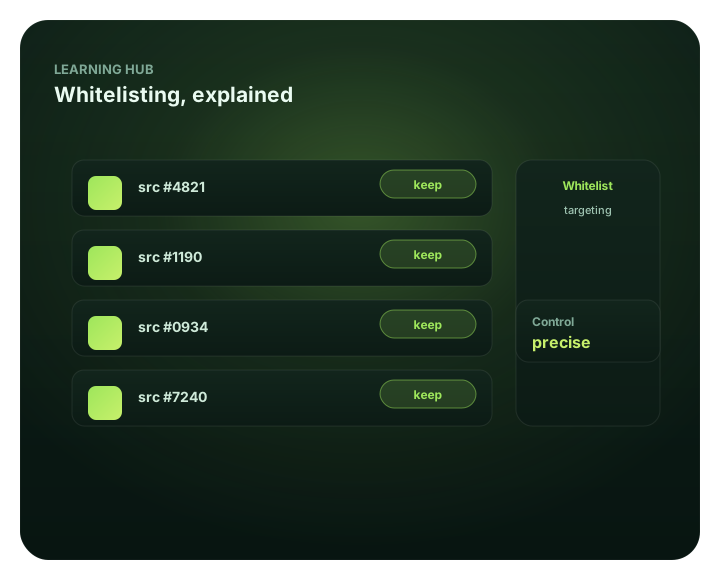
What this guide covers
This guide focuses on what is whitelisting for advertisers. It explains the practical criteria, campaign controls, measurement steps and limits that matter before budget is increased. For broader context, continue with Block weak sources with a blacklist..
Apply the first decision in FroggyAds
Use the section above to define one accepted outcome for What is whitelisting?. Keep the first test bounded so the result can be diagnosed before more budget is committed.
Create your free FroggyAds accountThe disciplined way to scale
Whitelisting means restricting a campaign to a list of approved sources – the source IDs that have already proven they convert. It's the counterpart to blacklisting: instead of cutting losers one by one, you simply buy only from a curated set of winners, so your budget never touches unproven inventory.
On FroggyAds, whitelists operate at the source-ID level and are how buyers scale safely. The discipline: test broad in one campaign, identify converting sources in reporting, whitelist them in a scale campaign, and keep a test running to feed the whitelist. SmartCPC can adjust bids within the available campaign signals and Adscore and internal controls add traffic-quality signals. Start from $50.
Whitelisting is best for
- Scaling a proven campaign safely
- Concentrating budget on winners
- Stable, predictable performance
- Separating test from scale
- Locking in clean, converting sources
Test the recommendation with controlled traffic
Choose the audience, format and campaign controls that actually affect What is whitelisting?. Verify tracking and compare source-level performance before increasing spend.
Create your free FroggyAds accountSee what is whitelisting? inside the platform
Everything runs from one self-serve dashboard – launch the campaign, target precisely, then watch results by source and optimize in real time.
- Scaling a proven campaign safely
- Concentrating budget on winners
- Stable, predictable performance
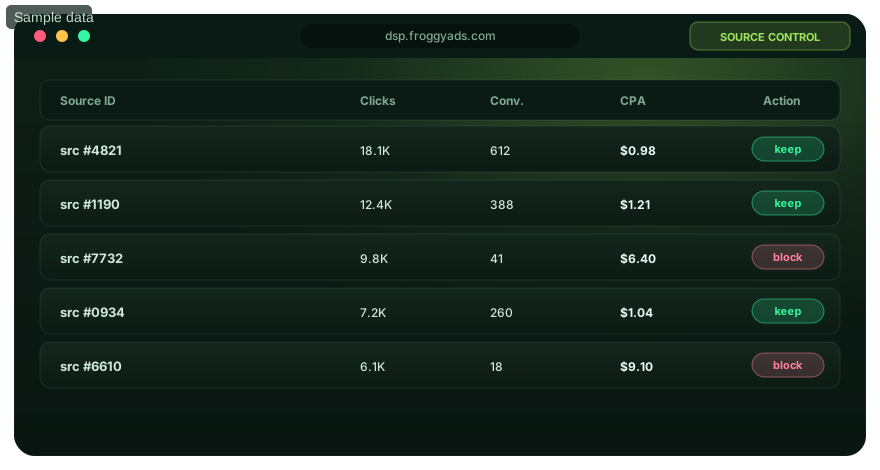
Turn the guide into a measurable campaign
Launch one reversible What is whitelisting? test, reconcile FroggyAds reporting with your downstream data, and scale only the segments that continue to create accepted value.
Create your free FroggyAds accountBuy only what you've approved
A whitelist is a list of proven sources.
What it is
A whitelist is a set of approved source IDs your campaign is allowed to buy from.
Why use it
It concentrates budget on proven traffic, making scaling stable and predictable.
How it works
You promote converting source IDs into the whitelist and exclude everything else.
Keep testing
Run a separate test campaign to keep finding new sources to add.
Build a whitelist
Open an account and scale approved sources from $50.
Whitelisting FAQ
What is whitelisting?
Restricting a campaign to a list of approved, proven source IDs.
How is it different from blacklisting?
Whitelisting allows only approved sources; blacklisting blocks specific bad ones.
How do I build a whitelist?
Test broadly, find converting sources in reporting, then whitelist them to scale.
Related pages
Scale on approved sources
Create your account and whitelist winners across 20B+ daily impressions.
A whitelist should be an evidence-based buying list, not a permanent shortcut
Whitelisting narrows delivery to sources you have approved. That can protect budget after a broad test has identified repeatable winners, but a whitelist can also reduce reach and stop you discovering new inventory. The strongest use is therefore a controlled scale phase: keep proven sources active, measure them against the same acceptance rule and refresh the list when performance changes.
| Whitelist decision | Evidence before you make it | Risk to manage |
|---|---|---|
| Add a source | Repeated accepted outcomes under the same offer and attribution rules. | One lucky conversion can look stronger than it is. |
| Increase exposure | The source keeps quality as spend and delivery rise. | Marginal traffic may not match the first profitable volume. |
| Remove or pause | Performance weakens beyond a written loss or quality boundary. | Short-term variance can cause premature exclusion. |
| Refresh the list | New test data shows other sources now meet the same standard. | A static whitelist can become too narrow over time. |
Use whitelisting as phase two of a FroggyAds test
Start broad enough to collect source evidence, then use the available source and ID controls to concentrate spend on inventory that has earned it. Keep a small, separately measured exploration budget when you still need new sources; this prevents a successful whitelist from becoming the only source of future learning.
FroggyAds is well suited to this workflow because you can combine campaign targeting, budget control and source-level decisions in one self-serve environment. Your tracker and accepted backend event decide which sources enter the list.
How to move from broad source testing to an evidence-based whitelist
Whitelisting means restricting delivery to sources you have approved. The technique is useful when you already have enough source-level evidence to identify traffic that repeatedly produces the outcome you care about. It is not a substitute for the discovery phase. If you start with an arbitrary whitelist, you may protect spend from unknown sources but also remove the chance to find new inventory. We recommend earning the whitelist through a controlled test, then treating the list as a living campaign asset rather than a permanent universal ranking of sources.
Define what a source must do to enter the list
Use the same accepted conversion for every candidate source. Decide how much evidence is enough for your business: repeated accepted outcomes, a sustainable accepted CPA, an acceptable approval rate where relevant and a complete enough conversion window. The threshold depends on your economics and risk tolerance, so it should be written before you select winners. A source should enter the whitelist because it met the rule, not because it happened to produce the campaign's first conversion.
Keep the whitelist tied to campaign context
A source that works for one offer, market, format or landing page may behave differently in another. Label the conditions under which the source earned inclusion. When you reuse a list, treat it as a strong starting hypothesis rather than as guaranteed good traffic. Revalidate after meaningful changes in GEO, device targeting, creative promise or destination.
| Whitelist stage | Goal | Control |
|---|---|---|
| Discovery | Find sources that can produce accepted outcomes | Broad but bounded testing with a written loss rule. |
| Qualification | Confirm that promising sources reproduce | Comparable outcome window and stable funnel. |
| Production | Concentrate spend on proven inventory | Whitelist or source-priority structure with ongoing monitoring. |
| Refresh | Prevent the list from becoming stale | Separate exploration budget and controlled retests. |
Protect against one-conversion winners
A source can look exceptional after one conversion, especially in a small campaign. Wait for enough evidence that the result can repeat. The exact sample requirement will differ by funnel, but the principle is consistent: do not give unlimited production status to a source because of a single positive event. Keep exposure proportional to the confidence you actually have.
Watch marginal performance as exposure grows
Whitelisting does not freeze source quality. When you push more spend into a proven source, the added traffic can be less efficient than the first volume. Compare the marginal accepted CPA of the expansion with the prior baseline. If quality weakens, reduce the latest increase before removing the source completely. This preserves the efficient portion of a source while still protecting the campaign.
Maintain an exploration lane
A production whitelist can become a ceiling if no budget remains for discovery. Keep a separately measured exploration cell when additional scale matters. New sources that meet the same qualification rule can be promoted into production. Weak sources can be excluded without disturbing the proven core. This gives you a repeatable path to refresh the list instead of relying on the same inventory indefinitely.
Review source concentration
If most accepted conversions come from one or two whitelisted sources, know that the campaign is concentrated. Concentration can be economically rational, but it increases dependence on the volume and quality of those sources. Track how much spend and value come from the top sources and use exploration to look for backups when scale or resilience matters.
Document why each source is approved
For each whitelisted source or ID, record the date, campaign, market, spend, accepted outcomes, review window and reason for inclusion. If the source later weakens, the log tells you what changed relative to the original evidence. It also prevents a team from carrying an old source list into a new campaign without remembering why the list existed.
How FroggyAds supports the workflow
FroggyAds gives you the advertiser-side controls needed to turn whitelisting into a measurable process. Depending on campaign context, you can combine country, device and other targeting with source or ID controls, then keep the business verdict in your own tracker and backend data. Start broad enough to learn, promote sources that earn inclusion, scale them carefully and keep a bounded discovery path for the next winner. That is more durable than treating a whitelist as a static shortcut.
Set a refresh rule before the whitelist becomes stale
A whitelist is strongest when inclusion can be earned and lost from current evidence. Define when each approved source is reviewed, which performance window matters and what would move it back into observation. This prevents a source from receiving permanent preferred status after one historical period that may no longer reflect the offer or audience.
Keep promotion and removal symmetric
If a new source must show repeated accepted outcomes before it enters production, an old source should also face a current performance standard to remain there. The exact thresholds can differ for confidence and volume, but both decisions should be documented. That symmetry reduces bias toward sources that simply appeared earlier in the campaign.
Use exploration to refresh production
Reserve a bounded test path for new sources when additional scale matters. Promote only those that meet the same accepted-outcome rule, and do not let exploration spend contaminate the production benchmark. FroggyAds source and ID controls make it practical to keep those learning states separate.
What Is Whitelisting: final decision check
Treat the whitelist as a current production set with an owner and review date. When a source is added, record why; when performance changes, record whether it stays, is capped or returns to exploration. That small governance step keeps a high-performing list useful over time instead of letting historical winners become permanent assumptions.
Whitelisting FAQ
What is whitelisting in paid traffic?
Whitelisting restricts delivery to sources or IDs that you have approved based on your campaign evidence.
When should I create a whitelist?
Create one after broad testing has produced enough repeated accepted outcomes to identify sources worth concentrating spend on.
How is a whitelist different from a blacklist?
A whitelist buys only approved sources; a blacklist stays broader and removes sources that cross an exclusion rule.
Does whitelisting guarantee better conversions?
No. A source can perform differently by offer, market, device, destination and time, so approved sources still need monitoring.
What evidence should a source need for inclusion?
Use repeated accepted outcomes, a complete enough conversion window and a cost or quality rule tied to your business.
How often should I refresh a whitelist?
Review it after meaningful performance changes, major funnel changes or when you need additional scale from new sources.
Should I keep an exploration budget?
It can help. A bounded exploration cell lets new sources earn promotion without disturbing the production baseline.
How should I scale a whitelisted source?
Increase exposure gradually and watch marginal accepted performance rather than assuming historical quality will hold at any volume.
Can a source leave and later re-enter a whitelist?
Yes. Remove or cap it when evidence weakens, and allow a controlled requalification if the campaign context changes materially.
How does FroggyAds support whitelisting?
FroggyAds source and ID controls, depending on campaign context, let advertisers concentrate spend on sources that have earned inclusion.
What is whitelisting? — buyer decision
Treat What is whitelisting? as a decision page for advertisers and media buyers. Keep the test narrow enough to explain, retain the source and configuration evidence, and wait for the accepted business outcome to mature. The page-specific job is to understand the control and decide when to use it. The adjacent What Is Blacklisting page should remain a separate decision.
Evidence already visible on this page: Whitelisting is how you lock a campaign onto its best traffic. Here's what it means, why it's the safe way to scale, and how to build a whitelist that works. This guide focuses on what is whitelisting for advertisers. It explains the practical criteria, campaign controls, measurement steps and limits that matter before budget is increased. For broader context, continue… The working concepts for this URL are invalid traffic, bot traffic, backend acceptance, fraud prevention.
Questions to resolve before scale: What is whitelisting in paid traffic? When should I create a whitelist? How is a whitelist different from a blacklist?
| Checkpoint | Page-specific action | Evidence to keep |
|---|---|---|
| Scope | Use “What this guide covers” to define the first operating boundary for What is whitelisting?. | Record the answer to “What is whitelisting in paid traffic?” together with source, targeting and destination identifiers. |
| Quality check | Use “Apply the first decision in FroggyAds” to test whether delivery is producing the expected path toward the accepted business outcome. | Keep the evidence needed to answer “When should I create a whitelist?” after the same maturation window. |
| Allocation | Use “The disciplined way to scale” to decide what changes next; change one material variable before comparing again. | Write the answer to “How is a whitelist different from a blacklist?” plus accepted cost/value and the rollback condition. |
Transparent decision example
Hypothetical example: For a hypothetical What is whitelisting? cell, USD 175 divided by 11 mature accepted outcomes equals USD 15.91 per accepted outcome. Replace the inputs with your own economics; this is not a FroggyAds performance claim.
Why use FroggyAds for this step?
With FroggyAds, you can turn the What is whitelisting? decision into a self-serve traffic test using targeting, budget, conversion and source controls, then keep or restrict spend from the accepted business outcome you define. Create your free FroggyAds account.
Research basis for What is whitelisting?: This URL helps performance-focused advertisers understand the control and decide when to use it. It is mapped to the fraud quality research cluster. Our current review used support.google.com and support.google.com to check terminology, buyer questions and decision coverage relevant to What is whitelisting?. These external sources are research inputs, not evidence of FroggyAds campaign performance.
What Is Whitelisting additional decision evidence
What Is Whitelisting evidence checkpoint 1
For What Is Whitelisting, document the exact decision, the authoritative input, the campaign variable affected, the accepted outcome and the condition that triggers the next review. Keep this record specific to what-is-whitelisting so the page remains distinct from neighboring topics and so a buyer can verify why the recommendation changes a real action.
What Is Whitelisting evidence checkpoint 2
For What Is Whitelisting, document the exact decision, the authoritative input, the campaign variable affected, the accepted outcome and the condition that triggers the next review. Keep this record specific to what-is-whitelisting so the page remains distinct from neighboring topics and so a buyer can verify why the recommendation changes a real action.
What Is Whitelisting evidence checkpoint 3
For What Is Whitelisting, document the exact decision, the authoritative input, the campaign variable affected, the accepted outcome and the condition that triggers the next review. Keep this record specific to what-is-whitelisting so the page remains distinct from neighboring topics and so a buyer can verify why the recommendation changes a real action.
What Is Whitelisting evidence checkpoint 4
For What Is Whitelisting, document the exact decision, the authoritative input, the campaign variable affected, the accepted outcome and the condition that triggers the next review. Keep this record specific to what-is-whitelisting so the page remains distinct from neighboring topics and so a buyer can verify why the recommendation changes a real action.
What Is Whitelisting evidence checkpoint 5
For What Is Whitelisting, document the exact decision, the authoritative input, the campaign variable affected, the accepted outcome and the condition that triggers the next review. Keep this record specific to what-is-whitelisting so the page remains distinct from neighboring topics and so a buyer can verify why the recommendation changes a real action.
What Is Whitelisting evidence checkpoint 6
For What Is Whitelisting, document the exact decision, the authoritative input, the campaign variable affected, the accepted outcome and the condition that triggers the next review. Keep this record specific to what-is-whitelisting so the page remains distinct from neighboring topics and so a buyer can verify why the recommendation changes a real action.
What Is Whitelisting evidence checkpoint 7
For What Is Whitelisting, document the exact decision, the authoritative input, the campaign variable affected, the accepted outcome and the condition that triggers the next review. Keep this record specific to what-is-whitelisting so the page remains distinct from neighboring topics and so a buyer can verify why the recommendation changes a real action.
What Is Whitelisting evidence checkpoint 8
For What Is Whitelisting, document the exact decision, the authoritative input, the campaign variable affected, the accepted outcome and the condition that triggers the next review. Keep this record specific to what-is-whitelisting so the page remains distinct from neighboring topics and so a buyer can verify why the recommendation changes a real action.
What is whitelisting? — what matters first
What is whitelisting? is most useful when it helps a buyer understand the control and decide when to use it. Define the accepted outcome first, then use targeting, budget and source-level evidence to decide what deserves more spend.