
Native vs display ads.
Native and display both put your brand in front of web audiences – but one blends in and the other stands out. Here's how they compare on FroggyAds.
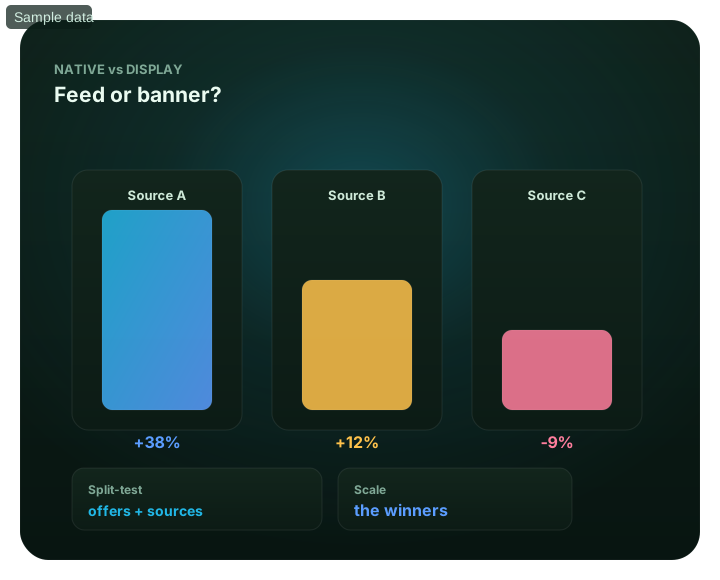
Native vs display ads: at a glance
What does this page explain about Native Vs Display Ads?
Quick answer: Native and display both put your brand in front of web audiences – but one blends in and the other stands out. Native and display sit at different points on the engagement-versus-reach scale. On FroggyAds both share targeting, source control, SmartCPC and Adscore, so the smart move is to match format to goal: native to win new, higher-intent attention; display to reach widely and bring visitors back. Native is typically CPC from $0.003; display is CPM from $0.10. Native blends into content (usually CPC); display uses standard banners (usually CPM).
| Section | Distinct excerpt from this page |
|---|---|
| Which fits your goal? | Display uses standard banners for broad, inexpensive reach on CPM and is the natural home for retargeting warm visitors. |
| Native strengths | Reads like content, higher engagement, great for discovery and consideration. |
| Display strengths | Standard banners, broad cheap reach on CPM, easy retargeting layer. |
Reference for Native Vs Display Ads: FTC guidance on online advertising and marketing.
- Planning: Which fits your goal?
- Control: See native vs display inside the platform.
- Decision: Blend in or stand out.
Which fits your goal?
Native and display sit at different points on the engagement-versus-reach scale. Native blends into the feed and earns attention, which suits discovery and consideration; it's usually bought on CPC. Display uses standard banners for broad, inexpensive reach on CPM and is the natural home for retargeting warm visitors.
On FroggyAds both share targeting, source control, SmartCPC and Adscore, so the smart move is to match format to goal: native to win new, higher-intent attention; display to reach widely and bring visitors back. Test each from $50 and let results guide the mix.
Choose native when…
- You want engagement over raw reach
- Discovery and consideration matter
- Your offer needs context to land
- You're building higher-intent traffic
- CPC pricing fits your model
See native vs display inside the platform
For Native vs display ads, the FroggyAds self-serve workflow keeps campaign setup, targeting, budget controls, source-level reporting and optimization in one dashboard so advertisers can make evidence-led keep, cap, exclude and retest decisions.
- You want engagement over raw reach
- Discovery and consideration matter
- Your offer needs context to land
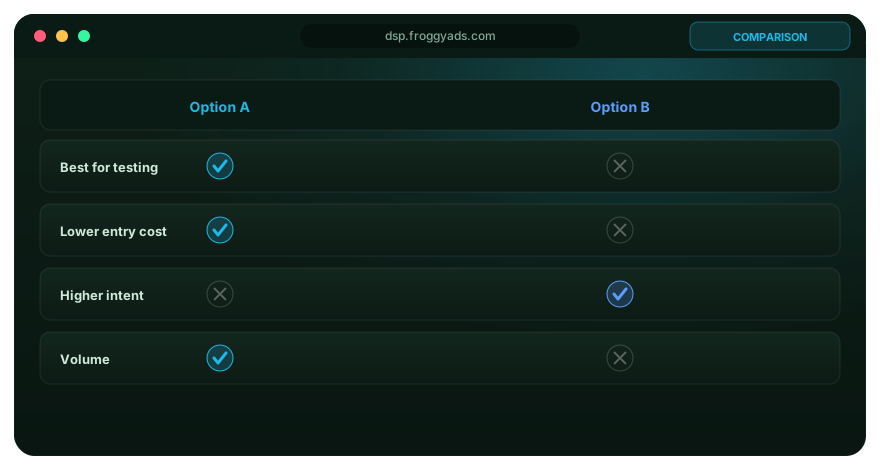
Blend in or stand out
Engagement vs broad, cheap reach.
Native strengths
Reads like content, higher engagement, great for discovery and consideration.
Display strengths
Standard banners, broad cheap reach on CPM, easy retargeting layer.
Pricing models
Native is typically CPC from $0.003; display is CPM from $0.10.
Retargeting
Display especially shines for re-engaging warm visitors at scale.
Try native or display
Open an account and run either from $50.
Native vs display FAQ
How do the placement experiences of Native and Display differ?
Native units blend into surrounding content, while Display uses standard banner placements that stand out. The user context and billing model usually differ as well.
When does Native fit the campaign goal?
Native fits offers that need context, discovery, or higher-intent attention before the click. Judge it by attributed outcomes rather than its feed-like appearance.
When is Display the better fit?
Display suits broad impression reach, recognizable banner creative, and many retargeting plans. Use a reach or conversion objective that matches the buy.
How are Native and Display priced on the page?
Native is listed from $0.003 CPC, while Display starts from $0.10 CPM. One charges for clicks and the other for thousand-impression units.
Which format is highlighted for retargeting?
Display is highlighted as the natural broad-reach layer for eligible warm visitors. Apply audience rules and an exposure cap to the retargeting campaign.
Can an advertiser use both formats together?
Native can introduce the offer and Display can extend reach or re-engage visitors. Keep campaigns separate enough to compare each format's contribution.
How should creative change between an in-feed unit and a banner?
Adapt the message to the placement while keeping the offer accurate. A Native card and a standard banner need different layouts and controlled testing.
How should the two formats be compared?
Use consistent conversion attribution and comparable audiences, then translate spend into the chosen business outcome. Click and impression totals are diagnostics.
Do both formats support source optimization?
FroggyAds provides source reporting and controls for both. Keep or restrict supply from the result within each format rather than mixing their source averages.
What is the published entry point for a format comparison?
Either format can be tested after funding the account with the published $50 minimum. Give each campaign a defined cap and objective.
Compare native and display
Create your account and test both across 20B+ daily impressions.
Compare native and display ads by user context, creative job and downstream outcome
Native and display advertising should not be compared as though one format is universally better. The formats enter the user's attention in different ways. Native ads are designed to fit the surrounding content experience while remaining identifiable as advertising, whereas display ads use dedicated visual placements that can create immediate brand or offer visibility. The right choice depends on the message, destination, audience state and measurement objective, not on a generic ranking.
Start by defining what the creative must accomplish. A native unit often has enough headline-and-image context to introduce an idea, problem or benefit before the user clicks. Display creative may need to communicate the brand, offer and next step in a more compact visual space. If the destination requires explanation, native can create useful pre-click context. If the advertiser has a strong visual proposition or retargeting message, display can be an efficient way to re-establish attention.
| Decision area | Native ads | Display ads |
|---|---|---|
| User context | Integrated into content or recommendation-style environments | Dedicated visual advertising placements |
| Creative emphasis | Headline, image and contextual promise | Visual recognition, concise message and CTA |
| Common buying model | Often evaluated on CPC and downstream outcomes | Often evaluated on CPM plus downstream outcomes |
| Testing question | Which message earns intentional interest? | Which visual proposition creates useful attention? |
| Retargeting fit | Can reintroduce content or offer context | Strong for recognizable reminder creative |
| Final decision | Use the format that produces the stronger accepted business outcome at sustainable cost | |
FroggyAds supports both native and display campaigns inside the same self-serve environment. Native CPC can start from very low entry pricing, while display inventory is available from low CPM levels, and advertisers can use country, city, device, operating-system, browser, carrier, category and source-level controls across campaign planning. Testing both formats under one measurement framework can reduce the noise created when different platforms use different conversion definitions.
Keep creative concepts format-specific. Do not shrink a native headline into a banner and assume the comparison is fair. Build a native concept that uses its text-and-image context well, and build display assets that are legible at the actual placement sizes. The underlying offer can remain the same while the creative execution respects the format. Judge each version by the accepted downstream event rather than by whichever native metric looks strongest.
Landing-page continuity matters for both formats. A native ad that frames an educational problem should not lead to a page with an unrelated hard-sell message. A display ad that promotes a clear product or price condition should not hide that condition after the click. The first screen should confirm the reason the user chose to visit. Message mismatch can make one format appear weak when the real problem is the handoff.
Audience stage can influence the choice. Native often works well for prospecting where the advertiser needs to introduce a concept, while display can be useful for broad visual awareness or re-engagement. These are tendencies, not rules. An ecommerce advertiser may use native for product discovery and display for a returning visitor; a B2B advertiser might use native to introduce a research asset and display to maintain recognition. Test the role that matches the funnel rather than forcing both formats into the same creative job.
Compare source patterns only after enough outcomes mature. One format can have a different conversion delay or traffic distribution, and early samples may overstate the difference. Preserve source and campaign identity, set a minimum evidence threshold and review CPA, revenue, qualified leads or another accepted value event. FroggyAds source controls can then be used to refine repeated weak or strong inventory patterns within each format.
Consider mixed-format strategies when the evidence supports them. The objective is not to declare a permanent winner between native and display; it is to allocate budget to the role each format performs efficiently. If native is stronger for first-touch acquisition and display is stronger for re-engagement, keep both and measure the combined journey carefully. If one format consistently misses the business threshold after creative and destination quality are validated, concentrate spend on the stronger route.
The practical comparison therefore ends with economics and user quality. FroggyAds lets advertisers test native and display side by side with granular controls and scalable programmatic access. Build the right creative for each environment, preserve one accepted conversion definition and scale the format or combination that continues to create useful business outcomes after the full measurement window.
Account for creative production cost in the comparison. Native campaigns may require more headline and image variations, while display programs can require multiple banner dimensions and visual adaptations. A format that has a slightly better media CPA can still consume more internal production time. Track the effort required to keep each format fresh enough to perform and include that operational cost when the business decides how much budget to allocate.
Use sequential testing when direct head-to-head traffic is not comparable. If the formats reach different inventory, a strict split can create the illusion that only the creative format changed when the audience context changed as well. Keep geography, destination, accepted outcome and review window as consistent as practical, then document the remaining differences. The purpose is not laboratory perfection; it is enough measurement discipline to avoid explaining a result with the wrong variable.
Revisit the format mix as the offer matures. Native may be stronger when the market needs education and display may gain value once brand recognition or retargeting pools grow. FroggyAds lets advertisers operate both formats without abandoning the same programmatic environment, which makes it practical to adjust the role of each format as evidence and audience familiarity change.
Native vs display ads.: what should the advertiser decide next?
For Native vs display ads., compare equivalent scope: campaign objective, market, format, billing definition, attribution window and accepted conversion. Use Native vs display ads: at a glance and What does this page explain about Native Vs Display Ads? to keep the comparison anchored to this page, and keep dated third-party facts separate from any FroggyAds campaign test.
On this Native vs display ads. page, the decision should remain tied to the existing evidence around Native vs display ads: at a glance, What does this page explain about Native Vs Display Ads? and Which fits your goal?. Those sections give native vs display ads its specific context; the table below turns that context into campaign actions rather than adding another generic definition.
| Decision | What to verify | FroggyAds action |
|---|---|---|
| Native vs display ads. objective | Use Native vs display ads: at a glance to define the accepted business event and the maximum learning loss for native vs display ads. | Launch one FroggyAds campaign objective for Native vs display ads. and keep the conversion definition stable. |
| Native vs display ads. audience | Use What does this page explain about Native Vs Display Ads? to verify market, device, language and offer eligibility for native vs display ads. | Apply only the FroggyAds targeting controls that change the real Native vs display ads. customer journey. |
| Native vs display ads. source evidence | Use Which fits your goal? to keep source-level differences visible instead of relying on one blended native vs display ads average. | Keep, cap, exclude or retest Native vs display ads. inventory from documented source evidence. |
| Native vs display ads. economics | Use Choose native when… to connect media spend with accepted conversions and downstream value for native vs display ads. | Protect the Native vs display ads. test with a written budget boundary and a consistent attribution window. |
| Native vs display ads. scale rule | Use See native vs display inside the platform to define the exact evidence that earns the next budget increase for native vs display ads. | Scale Native vs display ads. one major control at a time and compare marginal performance with the prior baseline. |
A page-specific FroggyAds test sequence for Native vs display ads.
- Native vs display ads. outcome: define the accepted event for native vs display ads and the maximum loss permitted while the first test is learning.
- Native vs display ads. path: verify market eligibility, device experience, landing-page continuity and tracking against Native vs display ads: at a glance before buying more traffic.
- Native vs display ads. hypothesis: launch one bounded FroggyAds test tied to What does this page explain about Native Vs Display Ads?; do not change bid, creative, audience and destination together.
- Native vs display ads. source review: compare qualified activity, accepted conversions, timing and cost by the source or segment dimensions relevant to Which fits your goal?.
- Native vs display ads. scaling: use Choose native when… and See native vs display inside the platform to define what must reproduce before the next budget increase.
Why FroggyAds is relevant to Native vs display ads.
For Native vs display ads., FroggyAds gives advertisers a self-serve DSP and ad-network workflow for buying supported traffic with campaign-level budgets and targeting. Depending on format and campaign context, available controls can include country, city, device, operating system, browser, carrier, category, source, ID and IP options. SmartCPC and Adscore-supported traffic-quality controls can support the native vs display ads optimization process, while the advertiser's tracker, analytics and backend acceptance remain the final evidence for commercial quality.
Use See native vs display inside the platform as the final checkpoint for Native vs display ads.. If the accepted result does not reproduce after the next meaningful volume step, return to the last stable configuration instead of widening several controls at once.
How to tell whether Native vs display ads. is working
For Native vs display ads., keep provider facts and campaign results separate. Use Native vs display ads: at a glance to normalize the comparison, then judge any live test under the same objective, attribution window and accepted conversion.
Reconcile Native vs display ads. on one evidence window
For Native vs display ads., compare FroggyAds reporting with the advertiser's tracker, analytics and backend records for the same dates and attribution rules. Record media spend, relevant delivery events, qualified landing activity, accepted conversions and rejection reasons, then use What does this page explain about Native Vs Display Ads? to investigate material gaps before they become optimization rules.
Diagnose the smallest failing layer in Native vs display ads.
If native vs display ads delivery is weak, review eligibility, targeting, bid and inventory first. If traffic arrives but the destination underperforms, inspect speed, message continuity, forms, redirects and device compatibility. If front-end conversions look healthy but backend acceptance is weak, use Which fits your goal? to isolate audience or source quality after tracking has been verified.
Set the next Native vs display ads. scale and stop rule
Write the exact Native vs display ads. result that earns more budget and the exact condition that pauses the test. Increase one major control at a time and compare marginal native vs display ads performance with the prior configuration. FroggyAds supplies the campaign controls; the advertiser's accepted downstream data determines whether the expansion is commercially useful.
Native vs display ads.: preserve the evidence behind the next campaign change
For Native vs display ads., keep a dated decision note that records the native vs display ads campaign scope, the accepted conversion, the evidence window and the maximum additional loss allowed before another review. Tie that note to Native vs display ads: at a glance so the next FroggyAds action remains grounded in this page's actual subject.
Separate observation from explanation for Native vs display ads.. Delivery, spend, device mix, source mix and accepted outcomes are observations. Audience mismatch, creative fatigue, destination friction, tracking loss and source quality are competing explanations. Use Which fits your goal? to test the narrowest explanation first; changing several native vs display ads variables together makes the next result difficult to attribute.
Before increasing Native vs display ads. spend, preserve the last stable FroggyAds configuration and write the result that must reproduce after the next volume step. Use See native vs display inside the platform as the review point. If marginal cost or accepted quality moves outside the written boundary, return to the recovery point rather than widening bids, targeting and sources simultaneously.
This evidence record turns native vs display ads into an auditable buying process: another media buyer should be able to see what was tested, what changed, which source or segment caused the result and why the next action was chosen. FroggyAds provides the campaign controls for that next bounded test; the advertiser's own downstream data provides the final commercial proof.
Native vs display ads. — buyer decision
The buyer task on Native vs display ads. is practical rather than definitional: isolate the relevant traffic, format, targeting or workflow condition, then connect it to a measurable accepted business outcome before scaling. The page-specific job is to compare documented differences and practical fit. The adjacent Native Ads Vs Display Ads page should remain a separate decision.
Evidence already visible on this page: Native and display both put your brand in front of web audiences – but one blends in and the other stands out. Here's how they compare on FroggyAds. Quick answer: Native and display both put your brand in front of web audiences – but one blends in and the other stands out. Native and display sit at different… The working concepts for this URL are native placement, ad attribution, creative assets, content fit, publisher layout.
Questions to resolve before scale: How do the placement experiences of Native and Display differ? When does Native fit the campaign goal? When is Display the better fit?
| Checkpoint | Page-specific action | Evidence to keep |
|---|---|---|
| Scope | Use “Native vs display ads: at a glance” to define the first operating boundary for Native vs display ads.. | Record the answer to “How do the placement experiences of Native and Display differ?” together with source, targeting and destination identifiers. |
| Quality check | Use “Which fits your goal?” to test whether delivery is producing the expected path toward the accepted business outcome. | Keep the evidence needed to answer “When does Native fit the campaign goal?” after the same maturation window. |
| Allocation | Use “See native vs display inside the platform” to decide what changes next; change one material variable before comparing again. | Write the answer to “When is Display the better fit?” plus accepted cost/value and the rollback condition. |
Transparent decision example
Hypothetical example: Suppose Native vs display ads. spends USD 275 before the checkpoint and records 6 accepted outcomes; the resulting accepted CPA is USD 45.83. Replace the inputs with your own economics; this is not a FroggyAds performance claim.
Why use FroggyAds for this step?
With FroggyAds, you can turn the Native vs display ads. decision into a self-serve traffic test using targeting, budget, conversion and source controls, then keep or restrict spend from the accepted business outcome you define. Create your free FroggyAds account.
Native vs display ads — what matters first
Native vs display ads is a comparison decision: verify documented differences, match them to your campaign needs, and test the option that fits rather than assuming a universal winner.