
Push vs pop ads.
Push and pop are both high-volume, low-cost traffic types – but they reach users very differently. Here's how they compare on FroggyAds, and when each wins.
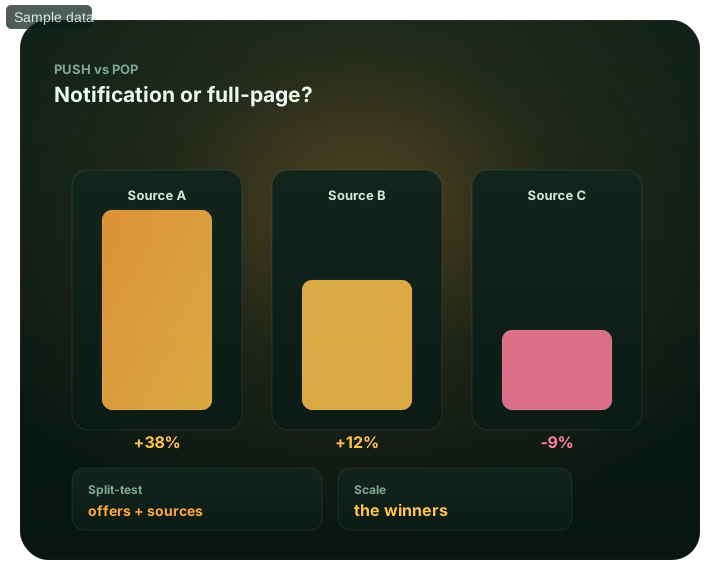
Push vs pop ads: at a glance
What does this page explain about Push vs Pop Ads: Formats, Costs and Campaign Fit?
Quick answer: Push and pop are both high-volume, low-cost traffic types – but they reach users very differently. Here's how they compare on FroggyAds, and when each wins. The core difference between push and pop is where persuasion happens. Both are cheap and high-volume on FroggyAds (push CPC from $0.003, pop CPC from $0.0001), and both demand discipline: tight source control and Adscore to keep the volume clean. Push suits creative testers; pop suits buyers with a strong landing page. Pop is cheaper per unit (CPC from $0.0001) but very high volume; push is CPC from $0.003.
| Section | Distinct excerpt from this page |
|---|---|
| Where does the selling happen? | Pop drops the user straight onto a full page with no creative at all, which means your landing page carries the entire load. |
| Push strengths | A clickable notification with a title and icon – creative does the selling. |
| Quality | Pop's volume makes Adscore and tight source control especially important. |
Reference for Push vs Pop Ads: Formats, Costs and Campaign Fit: FTC guidance on online advertising and marketing.
- Planning: Where does the selling happen?
- Control: See push vs pop inside the platform.
- Decision: A clickable hook vs a full-page visit.
Where does the selling happen?
The core difference between push and pop is where persuasion happens. Push gives you a clickable notification, so the creative – title and icon – has to earn the click. Pop drops the user straight onto a full page with no creative at all, which means your landing page carries the entire load.
Both are cheap and high-volume on FroggyAds (push CPC from $0.003, pop CPC from $0.0001), and both demand discipline: tight source control and Adscore to keep the volume clean. Push suits creative testers; pop suits buyers with a strong landing page. Test each from $50 and scale the one that fits your funnel.
Choose pop when…
- Your landing page is strong
- You want maximum cheap volume
- You don't need ad creative
- You're testing offers fast at scale
- You'll control sources tightly
See push vs pop inside the platform
For Push vs pop ads, the FroggyAds self-serve workflow keeps campaign setup, targeting, budget controls, source-level reporting and optimization in one dashboard so advertisers can make evidence-led keep, cap, exclude and retest decisions.
- Your landing page is strong
- You want maximum cheap volume
- You don't need ad creative
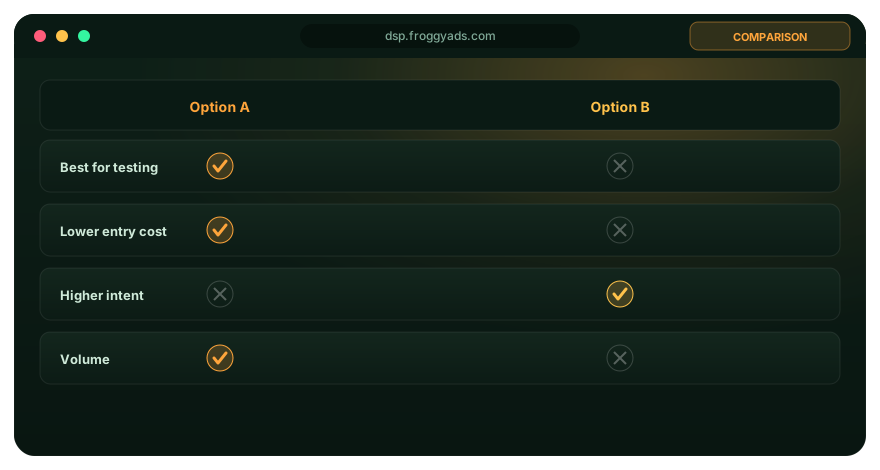
A clickable hook vs a full-page visit
Creative-led vs landing-page-led.
Push strengths
A clickable notification with a title and icon – creative does the selling.
Pop strengths
A full-page visit with no creative – your landing page does all the work.
Pricing
Push is CPC from $0.003; pop is CPC from $0.0001 – very cheap, very high volume.
Quality
Pop's volume makes Adscore and tight source control especially important.
Try push or pop
Open an account and run either from $50.
Push vs pop FAQ
When should an advertiser compare push and pop traffic?
Compare them when the same eligible offer can be presented through a notification click or a direct page visit. Use one accepted outcome and comparable audience rules so the format difference remains visible.
How does audience behavior differ between push and pop?
Push starts with a user responding to a title, icon, and short message. Pop brings the visitor to a full destination after an eligible interaction, so the page must establish context immediately.
Which format is better for testing creative angles?
Push makes the notification itself a clear creative test, while pop shifts most persuasion to the landing page. Choose the format that lets the campaign isolate the message element it needs to learn about.
What landing-page work is required for each format?
Both need a fast, truthful, device-ready destination that completes the ad promise. Pop requires especially clear first-screen context because no separate notification has prepared the visitor.
How should push and pop test budgets be compared?
Set separate caps using each format's pricing model, expected volume, source mix, and conversion delay. Compare cost per accepted outcome rather than treating the lowest unit price as the winner.
Which tracking fields belong in a format comparison?
Preserve campaign, format, creative where applicable, source, placement, click or visit ID, and accepted backend event. Align attribution windows and duplicate rules before reading the two result sets.
How can source quality be compared across push and pop?
Use valid sessions, device and market fit, accepted outcomes, rejection reasons, and repeat behavior within each format. Do not compare raw clicks with opens as if they represented the same stage.
What fraud control applies to both traffic types?
Keep platform screening, source identifiers, advertiser-side records, and exclusion controls active in both tests. Investigate abnormal timing, repeated IDs, and large click-to-session gaps before moving budget.
When should one side of a push-versus-pop test be paused?
Pause it when its written spend or quality threshold is reached and the mature results no longer justify more discovery. Leave the other format's settings unchanged so the decision is not confused by a second edit.
What evidence supports scaling the winning format?
Scale after several comparable periods show stable accepted outcomes and source quality for that format. Move it forward through one controlled source, audience, or bid change while the comparison record stays fixed.
Related pages
Test push and pop
Create your account and compare both across 20B+ daily impressions.
Compare Push and Pop by user experience, landing-page role and accepted campaign economics
Push and Pop are different advertising experiences, so the strongest comparison begins with the customer journey rather than with one blended cost number. Push uses a compact notification-style message to earn a click before the destination opens. Pop is more destination-led because the user is exposed to a new browsing context or landing experience. The right format depends on what the offer needs to communicate before and after the visit.
Define the accepted business event before testing either format. A sale, qualified lead, registration, installation or another verified action should control the final decision. Click-through rate, visit volume and early funnel events can explain behavior, but they should not replace the outcome that determines whether spend is commercially useful.
| Decision area | Push | Pop | Buyer question |
|---|---|---|---|
| User entry | Compact message before the click | Destination-led exposure | How much context must the user see before the page? |
| Creative job | Title, message and supporting asset where applicable | Landing page carries most of the proposition | Can the offer be understood in limited message space? |
| Destination | Must confirm the notification promise quickly | Must orient the user immediately | Is the page prepared for the format's arrival context? |
| Measurement | Preserve creative and source identity | Preserve source and landing identity | Can accepted outcomes be reconciled by format? |
| Source control | Act on repeated source-level evidence | Act on repeated source-level evidence | Which sources remain inside the business limit? |
| Scale | Increase one proven cell at a time | Increase one proven cell at a time | Does marginal quality survive more volume? |
Push is useful when the proposition can be communicated honestly in a small amount of space. The title, message and visual asset where supported need to create enough context for an informed click. The landing page should immediately confirm the same promise. If the ad uses urgency, availability or a condition that the page cannot support, a high click rate can create low-quality visits instead of stronger performance.
Pop places more responsibility on the destination. The page should identify the offer quickly, explain why the user is seeing it, work on the targeted device and provide a clear path forward or away. A slow, confusing or aggressive destination can waste broad exposure even when the media itself is inexpensive. Test page function before judging the source.
Use billing units carefully. FroggyAds has an approved Push starting-bid claim of CPC from $0.003. Pop currently carries the supplied CPC label from $0.0001 pending any authoritative clarification. These are starting bids, not promised average costs, and Pop should not be relabeled as CPV or CPM without product confirmation. Do not compare the formats by converting one starting bid into a guaranteed cost-per-customer model.
Instead, compare actual campaign spend with accepted outcomes after enough data matures. If Push and Pop use different media units or clear at different prices, the advertiser can still calculate measured cost per accepted conversion from real spend. This creates a business comparison without pretending that the auction mechanics are identical.
Keep the first test structurally fair. Use the same offer, accepted event, market eligibility and comparable destination quality. Format-specific creative can differ because Push needs a message before the click while Pop depends more heavily on the page, but the underlying proposition should remain comparable. Avoid changing format, offer and audience at the same time.
FroggyAds provides verified targeting controls for country, city, device, operating system, browser, carrier and category, plus source-level controls. Use the same eligibility rules for both format cells where practical. If one format receives a materially different market or device mix, record that difference before attributing the performance gap to the format itself.
Source quality should be reviewed within each format before blending results. A weak source in Push does not establish that Push is weak, and a strong Pop source does not prove every Pop placement will behave the same way. Wait for the agreed maturity window, compare accepted outcomes and record the evidence behind each allowlist or blocklist action.
Adscore and FroggyAds internal controls help identify invalid or low-quality activity across campaign traffic, but they do not guarantee zero fraud or prove that every remaining visit is human. Keep traffic-quality screening beside the advertiser's own conversion and rejection evidence. A format comparison is strongest when both cells use the same quality review standard.
Frequency and timing need format-specific interpretation. Push may involve repeated message exposure, while Pop can create repeated destination encounters. Define an exposure boundary that matches the actual campaign experience and watch whether additional delivery continues to produce accepted value. Do not assume that cheaper media justifies unlimited repetition.
Creative learning also differs. Push can test propositions within the notification-style message while holding the landing page stable. Pop can test landing-page propositions and page structure more directly because the destination carries more of the communication job. Keep the test question explicit so creative results are not mixed with source or audience changes.
Budget planning should use a maximum learning loss for each cell. FroggyAds has a $50 minimum account deposit, and the supplied planning recommendation for testing is approximately $150 to $500, but neither figure guarantees that a format comparison will reach decision-ready evidence. The required budget depends on traffic cost, conversion rate, outcome value and maturity delay.
Use a shared change log. Record format, source mix, targeting, creative or landing version, bid, budget, observation window and rollback rule. This lets the team explain why one cell changed and prevents a later operator from comparing results that were produced under different conditions.
A hypothetical example can show the method without claiming performance. Suppose an advertiser spends $600 on Push and $600 on Pop. After the full conversion window, Push produces 18 accepted outcomes and Pop produces 15. The measured accepted CPA would be about $33.33 for Push and $40 for Pop. That result would favor Push in the hypothetical test, but it would not prove Push is universally better. The next step is to check whether source mix, creative and destination quality were comparable and whether the result repeats.
Scale the winning condition gradually. Increase one major variable, such as budget or source breadth, and compare the marginal traffic with the original baseline. If the format starts accessing different inventory, treat the new volume as a fresh test. Preserve the losing cell when useful as a control rather than deleting all evidence of the comparison.
Some campaigns may ultimately use both formats for different jobs, but the roles should remain measurable. Push can carry a concise proposition, while Pop can test a destination-led experience. Do not credit one format for outcomes generated by another unless the attribution path actually supports that sequence. Keep format identity attached to the accepted event.
FroggyAds is well suited to this kind of controlled comparison because both formats can be evaluated inside a self-serve media-buying workflow with targeting, source controls and reporting. The platform gives the advertiser levers to isolate the test, while the advertiser supplies the offer truth, destination quality and business-value rule.
The strongest Push-versus-Pop answer is therefore conditional, not absolute. Choose the format whose user experience fits the offer, measure both through accepted outcomes, keep source and targeting differences visible, and let repeatable economics decide where the next unit of budget belongs.
Offer complexity is one useful selection rule. A simple proposition that can be understood in a compact message may fit Push well, while an offer that needs the landing page to do most of the explanation may be easier to test with Pop. This is not a universal ranking. The correct choice depends on how much truthful context the user needs before deciding whether to continue.
Push delivery also needs the actual notification context documented. Classic web push, in-page push and other notification-style placements can differ in permission history and rendering. Keep the delivery type visible in the campaign record instead of assuming all Push traffic creates the same user experience. Frequency, creative and audience rules should match the surface being bought.
Pop testing should treat the first seconds of the destination as part of the creative. The page needs a clear proposition, working exit path and device-appropriate layout immediately after the visit begins. If orientation is slow or the page presents a different message from the campaign, broad destination exposure can create fast abandonment that says little about the underlying offer.
Cross-format creative should preserve the commercial core while respecting format limits. The value proposition, material conditions and accepted conversion can stay comparable, but the communication sequence may differ. Push can introduce the proposition before the click, while Pop can let the page present more context after exposure. Comparing identical wording is less important than comparing the same truthful offer under suitable execution.
Device behavior deserves a separate review when the destination path differs materially. A mobile Push click may enter a short form or app-oriented journey, while a Pop visit may expose a full landing page in a different browsing state. Keep device and operating-system data attached to accepted outcomes so a format result is not actually a hidden device-mix result.
Use the same attribution maturity for both format cells when the accepted outcome is comparable. If one cell is judged after one day and the other after seven, conversion delay can be mistaken for format quality. Preserve the actual spend and accepted event count through the same observation window, then investigate source and creative differences before declaring a winner.
A portfolio decision can still keep both formats after the test. The winner for one offer or stage does not require the other format to be removed permanently. FroggyAds gives the buyer a common set of targeting and source controls that can support separate, measurable roles. Keep budgets independent enough that each format can be reviewed on its own economics and paused without obscuring the other.
Test landing-page resilience before deciding that one format scales better. Because Pop depends heavily on the destination and Push introduces more of the proposition before the click, the same page can create different abandonment patterns. Review load time, first-screen clarity, form behavior and message continuity by format and device before attributing every gap to traffic quality.
Consider the advertiser's operational response too. If one format produces faster or differently qualified enquiries, the sales or support process may need a different follow-up cadence. Preserve response time and final acceptance where available so media buying is not optimized to leads the business cannot handle effectively.
When the comparison is documented for future use, keep the exact market, device mix, creative versions, source rules, budget, observation window and accepted outcome beside the result. A later buyer should be able to see why one format won under those conditions and which conditions would require the decision to be tested again rather than copied automatically.
Finally, make the format decision reversible. A campaign can switch budget toward the stronger cell while retaining a small controlled reference or a saved configuration for the other. If market conditions, creative or the offer changes, the advertiser can reopen the comparison from a known state instead of relying on an old blended conclusion.
Push vs pop ads FAQ
When should an advertiser compare push and pop traffic?
Compare them when the same eligible offer can be presented through a notification click or a direct page visit. Use one accepted outcome and comparable audience rules so the format difference remains visible.
How does audience behavior differ between push and pop?
Push starts with a user responding to a title, icon, and short message. Pop brings the visitor to a full destination after an eligible interaction, so the page must establish context immediately.
Which format is better for testing creative angles?
Push makes the notification itself a clear creative test, while pop shifts most persuasion to the landing page. Choose the format that lets the campaign isolate the message element it needs to learn about.
What landing-page work is required for each format?
Both need a fast, truthful, device-ready destination that completes the ad promise. Pop requires especially clear first-screen context because no separate notification has prepared the visitor.
How should push and pop test budgets be compared?
Set separate caps using each format's pricing model, expected volume, source mix, and conversion delay. Compare cost per accepted outcome rather than treating the lowest unit price as the winner.
Which tracking fields belong in a format comparison?
Preserve campaign, format, creative where applicable, source, placement, click or visit ID, and accepted backend event. Align attribution windows and duplicate rules before reading the two result sets.
How can source quality be compared across push and pop?
Use valid sessions, device and market fit, accepted outcomes, rejection reasons, and repeat behavior within each format. Do not compare raw clicks with opens as if they represented the same stage.
What fraud control applies to both traffic types?
Keep platform screening, source identifiers, advertiser-side records, and exclusion controls active in both tests. Investigate abnormal timing, repeated IDs, and large click-to-session gaps before moving budget.
When should one side of a push-versus-pop test be paused?
Pause it when its written spend or quality threshold is reached and the mature results no longer justify more discovery. Leave the other format's settings unchanged so the decision is not confused by a second edit.
What evidence supports scaling the winning format?
Scale after several comparable periods show stable accepted outcomes and source quality for that format. Move it forward through one controlled source, audience, or bid change while the comparison record stays fixed.
Push vs pop ads: the buyer task this URL owns
Use Push vs pop ads when the immediate task is to compare push and popunder by attention state, creative or landing requirements, frequency, source visibility and accepted conversion economics. For advertisers, affiliate marketers and media buyers, the useful output is a documented media decision rather than another broad advertising overview. The nearest related FroggyAds page is Worldwide Pop Traffic; this URL keeps ownership of the distinct task to compare push and popunder by attention state, creative or landing requirements, frequency, source visibility and accepted conversion economics.
Keep popunder, popup, full-page traffic, conversion tracking in the Push vs pop ads evidence record because they can change how this media test is configured, measured or scaled.
| Checkpoint | Page-specific action | Evidence to keep |
|---|---|---|
| Evidence | Compare verifiable differences on the same dimensions. | Retain evidence specific to Push vs pop ads and its accepted outcome. |
| Fit | Map each difference to the buyer's actual requirement. | Retain evidence specific to Push vs pop ads and its accepted outcome. |
| Test | Validate the chosen fit with a bounded campaign instead of assuming a universal winner. | Retain evidence specific to Push vs pop ads and its accepted outcome. |
Decision example for Push vs pop ads: write the page-specific non-negotiable requirements before comparing options, document whether each requirement is supported by evidence, and test the final fit under the same conversion definition. Apply this selection method to Push vs pop ads rather than treating a generic provider ranking as the decision.
FroggyAds gives advertisers, affiliate marketers and media buyers a self-serve way to act on the Push vs pop ads decision: configure the traffic test, preserve source-level reporting and scale only after the accepted outcome supports the next step. Create your free FroggyAds account.
Push vs pop ads — what matters first
Push vs pop ads is a comparison decision: verify documented differences, match them to your campaign needs, and test the option that fits rather than assuming a universal winner.