
What Is a DSP? How Demand-Side Platforms Work
Learn what a demand-side platform does, how advertiser-side buying software evaluates ad opportunities, and how to compare a DSP with SSPs, exchanges, ad networks, and your own campaign requirements.
What does a DSP do for an advertiser?
A DSP is advertiser-side software that evaluates eligible ad impressions and bids under campaign rules. It automates buying decisions; it does not guarantee results.
Think of a DSP as a buying system, not as the ad itself, the publisher inventory, or the conversion tracker. Its role is to help an advertiser decide which eligible opportunity to pursue, subject to the platform's available supply, targeting, bid logic, and reporting. The buyer still chooses the offer, creative, destination, objective, budget boundary, and accepted outcome. That distinction matters when a campaign underperforms: a weak result may come from the buying source, but it may also come from a mismatched promise, broken measurement, an uncompetitive bid, or an offer that does not fit the audience.
Where does a DSP fit in digital advertising?
A DSP represents advertiser demand: it submits bids toward exchanges or supply-side systems that make publisher opportunities available.
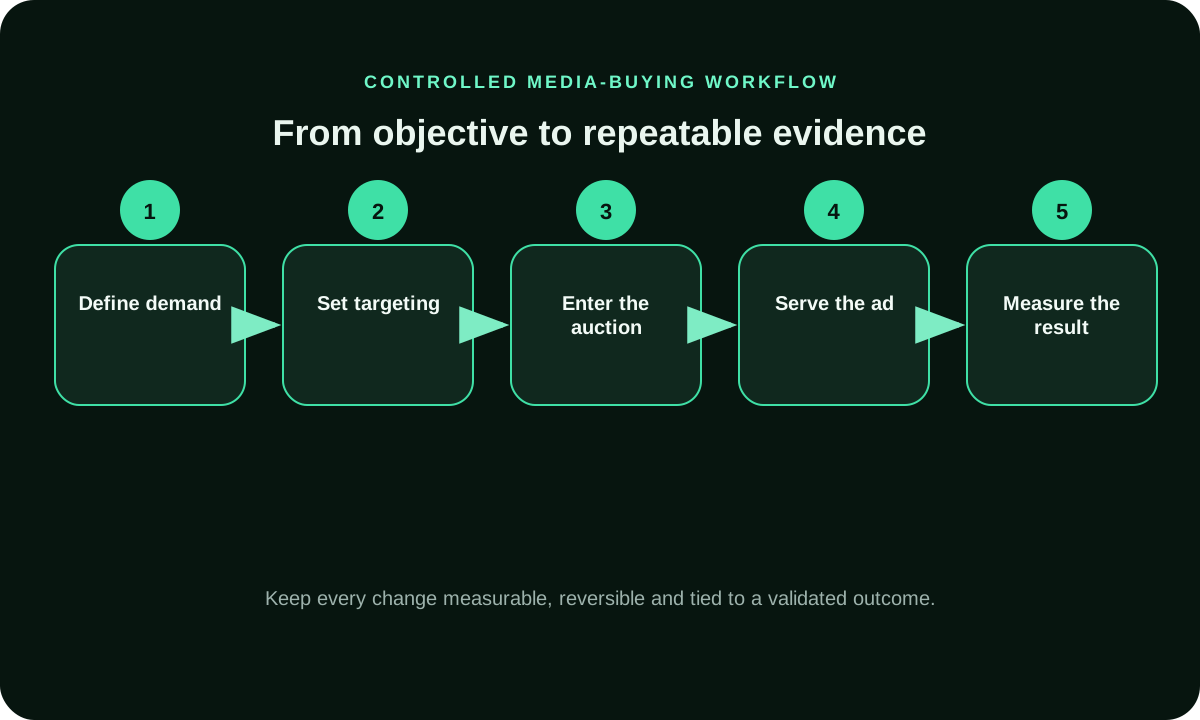
In a typical auction path, a publisher or its ad server offers an impression through an SSP or exchange; a DSP evaluates whether it fits an advertiser's campaign and may bid. The winning ad is then served, and the advertiser measures what happened after the impression or click. This map is a simplification: integrations and product boundaries can vary, and some providers combine functions. IAB Tech Lab's Digital Advertising Industry Requirements describes DSP systems from the advertiser side of the transaction. Use that role-based definition to ask who controls demand, who represents supply, and where a particular buying decision is made. Do not assume that every system called an ad network or exchange performs the same functions.
What should you define before choosing a DSP?
Before comparing vendors, define the inventory you need, the result you will accept, and the controls your team must keep.
Write a short buying brief before opening a platform comparison. Name the audience and market, the format your creative can support, the final destination, and the business event that justifies spend. Then list required controls: budget limits, bid changes, source exclusions, conversion reporting, and any approval or compliance constraint. Separate must-haves from preferences. For example, a media buyer who can only validate completed orders should not choose a test plan that optimizes to clicks and calls it success. An affiliate marketer may need a stable offer ID and source-level diagnostics to compare placements. This brief turns a vague search for the best DSP into an answerable question: can this platform expose the controls and evidence required for this campaign?
Create your free FroggyAds accountHow does a DSP buying path work?
A DSP checks a bid request against campaign settings and may bid for an eligible impression; the buyer then measures delivery and later outcomes.
Real-time bidding is one common way to buy an individual impression, but it is not a synonym for every kind of programmatic advertising. Some programmatic inventory is bought through negotiated or reserved arrangements. Google Ad Manager's Programmatic Direct guidance, for example, distinguishes Programmatic Guaranteed from Preferred Deals. That distinction helps a buyer ask whether the opportunity is auction-based or negotiated, what inventory is reserved, and what delivery commitment actually applies. In any path, the buying system uses campaign inputs such as format, geography, device, schedule, bid and available audience signals to decide whether to participate. The advertiser then needs a usable record of the impression, click, cost and later conversion. Platform labels matter less than understanding which transaction is occurring and what you can measure.
How do DSP costs affect campaign economics?
A DSP may separate media charges from platform, data, service, or minimum-funding terms; compare the written terms and the effective cost of accepted outcomes.
Do not compare two buying options by their bid unit alone. CPM is a charge per thousand impressions, CPC is a charge per click, and CPA is an outcome measure unless the contract specifically bills on that basis. A platform may also have account-funding minimums or other fees. Check whether a displayed minimum is a deposit, a campaign budget, a starting bid, or an actual charge. Then model the funnel: impressions to clicks, clicks to accepted leads or orders, and any refunds or invalid actions that affect final value. For example, a lower CPC can still produce a higher accepted-lead cost if fewer visitors complete the intended action. Use your own conversion and value data; there is no universal DSP price or test budget that works for every offer, market, and attribution window.
How should you compare DSP platforms?
Compare DSPs against a fixed campaign brief: required inventory, controls, measurement, costs, workflow, and the support your team needs.
A platform comparison is more useful when each row leads to an operating decision. Can you choose the ad formats you have approved assets for? Can you narrow delivery by the locations and devices your offer permits? Can you control budgets and bids, inspect results at the source or zone level, and keep campaign identifiers in your own analytics? Can you get the terms that explain account funding and any additional charges? Also ask how a buying team launches, pauses, and changes a campaign, and what records are available after each adjustment. A managed service may suit a team that cannot operate campaigns directly; a self-serve platform may suit experienced buyers who want to set and review controls themselves. Avoid choosing on a feature checklist alone: verify that the settings exist in the current product and can answer your actual buying question.
How can you test a DSP with controlled spend?
Keep your first DSP test small enough to control and structured enough to explain. Define one accepted outcome, set a loss limit, and change one major variable at a time.
A clean first test starts with a working destination and a tracking path you have already checked. Choose a limited set of campaign cells, such as one market, one format, and a small number of source or creative variations. Record the bid, budget, schedule, targeting, conversion definition, attribution window, and start time. Do not change the landing page, bid, and audience together if you want to know which change mattered. Decide in advance how you will treat delayed, duplicate, rejected, or refunded outcomes. At review, compare mature results with the same window and rule across every cell. A test can be stopped when it reaches the pre-agreed loss limit or a technical issue invalidates the data. A promising early conversion is a reason to continue collecting evidence, not proof that the economics will persist.
Create your free FroggyAds accountWhich targeting choices should come first?
Start with the targeting limits your offer requires, then add narrower filters only when they support a specific decision.
Targeting can improve fit, but every additional filter can reduce the number of eligible opportunities. Begin with non-negotiable conditions: a market where the offer is available, a device compatible with the destination, and any platform policy or legal requirement. Then decide whether a further split can change the bid, creative, destination, or exclusion rule. If not, it may add reporting complexity without improving the decision. Separate a country or device only when you can compare it under the same conversion rule and enough time for outcomes to mature. Keep source identifiers available so a buyer can tell whether an apparent audience effect is actually concentrated in a few placements. This staged approach is especially useful for affiliate marketers and media buyers who need to protect an offer while learning where paid traffic is commercially relevant.
How should an ad and landing page work together?
Make the ad promise and the landing-page first screen agree on the product, eligibility, price, and action the visitor should take.
A DSP can select an opportunity; it cannot repair a confusing offer page. Match the creative to the format and make the next step visible without hiding conditions or implying an outcome you cannot substantiate. Check the destination on the same devices and locations you intend to target. Confirm that redirects preserve campaign identifiers, consent choices behave as expected, and a form or checkout can be completed. Keep the message consistent from ad to page, especially when using a pre-lander: it should explain or qualify the offer, not obscure where the user is going. If one creative speaks to a different audience or benefit, treat it as a separate test rather than blending results. A clear handoff helps you identify whether a low conversion rate comes from traffic fit, a technical failure, or a mismatch between the ad and the page.
What should you examine in source-level reports?
Review source reports beside accepted conversions and downstream quality; clicks and impressions diagnose delivery but do not establish business value.
Keep the source or zone identifier attached to each observation. For every segment, compare spend, impressions, clicks, accepted outcomes, cost per accepted outcome, and any quality signal your own system can verify. Use one attribution window and include the time needed for leads, orders, refunds, or approvals to mature. A source with no conversion after a handful of clicks is not automatically bad; interpret it against expected conversion frequency and the pre-set loss boundary. Conversely, cheap clicks are not proof of quality if they fail to become accepted customers or leads. Reconcile totals between the ad platform, tracker, and advertiser backend, and investigate missing or duplicated events before changing bids. Keep a dated reason for each whitelist, blacklist, or bid adjustment so later reports can separate campaign learning from configuration changes.
When should you increase DSP campaign spend?
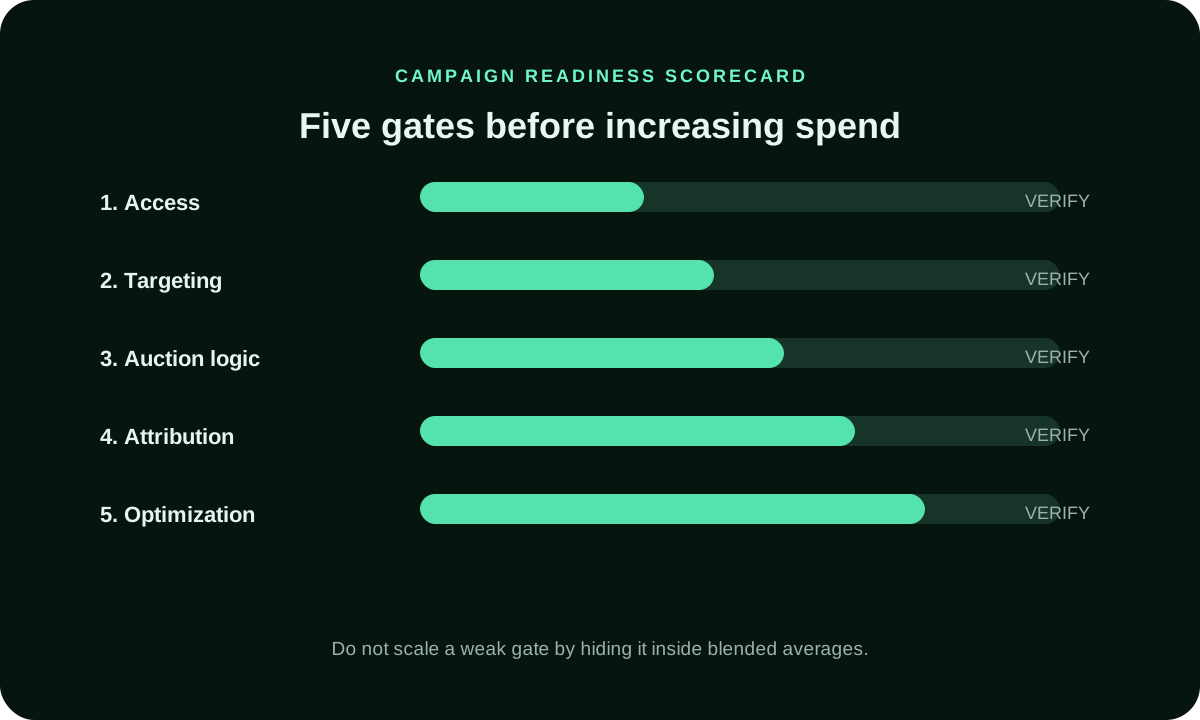
Increase spend only after the same accepted-outcome rule holds across mature data and the additional volume can be reviewed independently.
Scaling changes the auction opportunities you may win, so prior performance is not a delivery guarantee for a larger budget. Raise one proven campaign cell gradually, keep its earlier configuration available as a comparison, and check whether source mix, conversion delay, and accepted cost remain within the limits you set. If you add a new market, format, device, or audience, report it separately until it has its own evidence. Do not let a strong historical segment hide weaker marginal traffic in a blended average. Pause or reduce exposure when the campaign crosses its economic boundary, measurement becomes unreliable, or downstream handling cannot process more volume. The decision to scale is a fresh test of whether the next increment of spend behaves like the last one.
How do you measure outcomes beyond the click?
Measure the event that carries business value, then use delivery, click, and source data to explain rather than replace the result.
For an affiliate campaign, that may be an approved conversion rather than a raw registration; for a store, it may be a completed order after the applicable refund check. Keep the event definition consistent between the platform, tracking system, and business records. Impressions and clicks show whether delivery occurred, while landing-page progression can reveal friction. They are diagnostic steps in the path, not the final value measure. Compare cohorts over the same attribution period and note any lag before a lead or sale is accepted. If the reporting system counts an event differently from the advertiser's backend, pause optimization until the discrepancy is understood. This gives a media buyer a defensible basis for deciding which source to keep, cap, exclude, or test further.
Create your free FroggyAds accountWhat can make DSP campaign data misleading?
Unexpected results often come from measurement gaps, message mismatch, over-segmentation, or budget decisions made before the conversion window closes.
Begin diagnosis at the earliest point where the numbers diverge. If impressions are low, check eligibility, bid, schedule, and selected supply. If impressions arrive but clicks do not, inspect the format and creative. If clicks arrive without page engagement, test redirects, load behavior, and message continuity. If leads or sales appear in one system but not another, compare identifiers, time zones, event rules, duplicates, and attribution windows before changing source settings. Another common error is stopping a segment too early or expanding it before a sample is mature. Keep a change log with the observation, the action, and the date; this makes it easier to reverse a decision when new evidence contradicts the first read. These checks protect a buyer from mistaking an instrumentation defect for a traffic-quality conclusion.
What can you manage in FroggyAds?
FroggyAds gives self-serve advertisers controls for campaign setup, bids, budgets, targeting, source exclusions, and reporting by source, with SmartCPC and Adscore-supported tools.
Our self-serve workflow is designed for advertisers, affiliate marketers, and media buyers who want to operate campaign settings directly. We recommend FroggyAds when your brief calls for hands-on control of bids, budgets, supported targeting, and source-level review within a measured test. You can select supported ad formats, configure bids and budgets, apply available GEO, city, device, operating-system, browser, carrier, category, and source targeting, then review delivery by source or zone. Source and zone lists support explicit inclusion or exclusion decisions. SmartCPC can support bid optimization from available campaign signals; you still decide whether the resulting accepted conversion cost meets your goal. FroggyAds also describes Adscore and internal controls as helping identify or filter invalid traffic. That is a screening layer, not a claim that every click is valid or that a campaign will convert. Use the controls to organize a measured test, then make budget decisions from your own accepted-event data.
What should you verify before a first campaign?
Before launching, confirm the offer, destination, campaign settings, tracking, budget boundary, and rule for deciding whether a result is accepted.
A practical pre-launch review has six checks. First, confirm that the offer is permitted in every selected market and that the creative accurately represents it. Second, complete the destination journey on the intended devices. Third, verify that campaign and source identifiers survive redirects. Fourth, trigger a test event and check that it appears once in the expected reporting systems. Fifth, record the funding terms separately from the amount authorized for the campaign. Sixth, write down the maximum test loss and the evidence that would justify a new test or a higher cap. Keep this record with the initial configuration. If the campaign changes later, you can compare like with like instead of relying on memory.
Resources for the next buying decision
After you choose a buying platform, use the reporting guide to align click IDs, conversion callbacks, and backend acceptance; use the budget guide to set daily caps and test loss; review source targeting to organize placement decisions; and check the landing-page guide to diagnose the visitor handoff. These companion resources help you build measurement and destination quality around the campaign rather than treating the DSP as the whole funnel.
Demand-side platform FAQs
Use these questions to distinguish the DSP category from vendor claims. The answers focus on buyer-side responsibilities, supply-chain roles, measurement, and the current controls FroggyAds documents for its self-serve platform.
What does DSP stand for?
DSP stands for demand-side platform. It describes advertiser-side technology used to evaluate ad opportunities and submit bids under campaign rules.
What does a DSP do in advertising?
A DSP can centralize campaign setup, targeting, bids, budgets, and reporting for an advertiser. The exact buying, supply, and optimization controls depend on the provider. Compare the available campaign controls with the buying decisions your team needs to make; the product label alone does not establish fit.
How does a DSP differ from an SSP?
A DSP serves advertisers and bids on eligible opportunities; an SSP represents publisher-side supply and makes inventory available to buying systems. When you compare buying-side and supply-side systems, check whose goals and controls each platform serves.
Is programmatic advertising always real-time bidding?
No. Real-time bidding is one auction method used in programmatic buying. Programmatic transactions can also include negotiated arrangements, so check the actual buying path and delivery terms.
How does a DSP charge advertisers?
There is no single DSP fee model. Ask which charges apply to media, platform access, data, service, and account funding, then compare the effective cost of your accepted business outcome. Keep media charges distinct from any platform or funding terms in your comparison.
Which metrics should DSP buyers monitor?
Start with spend and delivery, then review clicks, source mix, accepted conversions, outcome cost, and downstream quality. Use diagnostic metrics to locate friction, but keep the accepted event as the budget decision.
How do you compare DSP platforms?
Compare platforms using the same campaign brief and verify each required control in current product documentation. Look for documented capabilities and written terms that answer the specific buying requirements of your campaign before you compare.
Can a DSP guarantee conversions?
No. A DSP can automate or organize buying decisions, but it cannot guarantee that an offer will convert or produce profit. Results depend on the campaign, market, auction, creative, destination, and measurement.
What can advertisers manage with FroggyAds?
FroggyAds documents self-serve campaign setup, budget and bid controls, supported targeting, source-level reporting, SmartCPC bid support, and Adscore-assisted traffic screening. Use source-level reporting and your own accepted-event records to apply budget and source controls deliberately.
How should you start a DSP test?
Write the objective, accepted event, attribution window, and loss boundary before comparing bids or formats. A controlled first test needs a clear question and a measured budget; create a FroggyAds account when you are ready to set it up.
What should you do after choosing a DSP?
A platform decision becomes an actual test only after the offer, destination, tracking path, and spending boundary are clear. Confirm that the event appears once in the systems you use, keep source identifiers with the report, and record what would make you continue, revise, or stop. These checks help you move from platform research to a campaign decision without assuming that access alone creates qualified demand.
How can FroggyAds support a measured test?
Our self-serve product documents campaign setup, targeting and source controls, reporting by source, SmartCPC support for bids, and Adscore-assisted traffic screening. Check current eligibility and settings before launch.
Begin with one measurable buying question, a working conversion path, and a capped campaign setup. Create your account when you are ready to configure that test.
The buyer task this page answers
A DSP page should answer the definition-and-selection query without trying to replace every adjacent guide. This URL focuses on the advertiser-side role, the buying chain, platform comparison, measurement, and fit. The related FroggyAds page is Dsp Vs Ad Network; that page owns the more focused comparison between those two buying models.
Keep four terms distinct. A DSP is advertiser-side buying technology; an SSP represents publisher-side supply; an ad exchange facilitates transactions; and real-time bidding is an auction method. The boundaries vary across providers, so ask what a product actually does instead of inferring its capabilities from the label. Programmatic buying can include auction and negotiated paths. For example, Google's Programmatic Direct documentation separates reserved Programmatic Guaranteed from Preferred Deals. These distinctions help a media buyer understand which party makes a decision, what inventory is involved, and what delivery or measurement terms apply.
| Checkpoint | Page-specific action | Evidence to keep |
|---|---|---|
| Define | Name the buyer, eligible opportunity, format, market, and accepted business event before selecting a platform. | A buying brief that states must-have controls and the event that justifies spend. |
| Compare | Check bid and budget controls, targeting, supply access, reporting depth, applicable fees, and operating workflow against that brief. | Current product documentation and written commercial terms, with unknowns kept visible. |
| Validate | Run a capped test; reconcile delivery and source reports with advertiser-side accepted events before changing spend. | Saved campaign settings, attribution window, accepted-event count, and the resulting keep/change/stop decision. |
Buyer check: Create a test plan that states the audience, supported format, destination, accepted event, attribution window, maximum loss, and next decision. If a requirement cannot be verified in the platform, keep it as an open question rather than assuming it is available.
Ready to test the workflow? Create the campaign only after the offer and tracking are prepared. Create your free FroggyAds account.
Hypothetical example: calculate accepted lead cost
Hypothetical calculation: if a buyer spends USD 240 and records 8 accepted leads, the observed cost is USD 240 / 8 = USD 30 per accepted lead. This is arithmetic using illustrative inputs, not a FroggyAds performance benchmark. Your own attribution, lead acceptance, and variable costs determine whether that result is commercially useful.
What should a DSP buyer remember?
A DSP is an advertiser-side buying system, not a promise of traffic quality or commercial performance. Compare the controls and terms with your campaign brief, validate tracking before spend, and use accepted outcomes to decide what to keep, change, or expand.
For a media buyer or affiliate marketer, the value of self-serve buying is the ability to set campaign boundaries, inspect source evidence, and make the next adjustment directly. Carry the objective, destination, and accepted event into setup rather than trying to optimize several unverified assumptions at once.