
What Is Conversion Tracking, and What Can It Actually Tell You?
Conversion tracking records a defined action and, where the available identifiers and reporting rules allow it, associates that action with an advertising interaction. It helps you compare traffic with sales, leads or signups. We recommend defining what counts before buying traffic, so your FroggyAds campaign can be judged against a result that matters to your business.
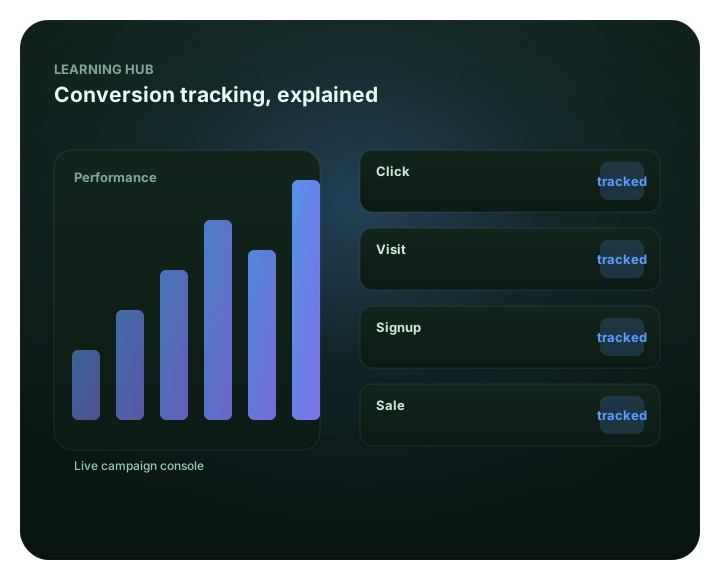
What does conversion tracking actually measure?
The useful answer has three parts: what happened, which campaign relationship can be observed, and whether your business accepts the result. A recorded checkout event, an attributed order and a paid order that survives cancellation are different observations. Conversion tracking can connect those stages when your supported systems retain the necessary references. It does not make them interchangeable. With FroggyAds, you can use a defined audience and traffic test to learn which campaign inputs produce outcomes worth investigating and repeating.
Use this guide when you need to understand the terms behind a conversion report. It explains the difference between events, triggers, attribution, duplicate handling and business acceptance. The setup guide covers implementation; the tracking overview connects measurement with campaign decisions. Keeping those tasks distinct helps you ask better questions of your tracker, developer or agency. Before choosing a tool, agree on the customer action you want and the business condition that makes it valuable.
What is conversion tracking?
Recording a chosen customer action and connecting it with marketing activity under stated rules is the purpose of conversion tracking. For an online store, the action could be a completed purchase. For a SaaS business, it could be an activated trial rather than an account creation. An affiliate may receive a later approved conversion from the merchant. The definition belongs to the business decision: a system can faithfully count the event you configured even when that event is a poor measure of customer value.
Describe one conversion in a complete sentence before opening a dashboard. For example, a fictional subscription business might count a trial account only after the user completes its first useful task. The signup remains a supporting event. That definition gives the marketing team a reason to inspect activation instead of celebrating registrations alone. We recommend making this distinction before your first FroggyAds test, because the same traffic can appear successful or weak depending on which stage you call a conversion.
Which actions are conversions, and which are diagnostic events?
A primary conversion represents the outcome you want a campaign to support. Diagnostic events explain how visitors move toward it. Product views, form starts and checkout visits can reveal interest or friction, but their commercial meaning differs from an accepted order. Choose the primary event to match your offer and customer journey. You can still study earlier actions when the final event is delayed or infrequent; simply name them accurately and keep them separate in the buying decision.
Consider a fictional lead campaign with 120 form starts, 30 submitted forms and 18 leads accepted by sales. These are three stages, not three competing answers to the same question. Form starts may show whether the landing page creates interest. Submissions show who completed it. Accepted leads show which responses meet the agreed criteria. If you compare traffic sources, use the same stage and acceptance delay for each. A source with more submissions is not necessarily the stronger source for accepted enquiries.
What makes an event trigger meaningful?
Event triggers tell a tracking system when to record the action you have defined. A button click can trigger a signal before a form succeeds. A confirmation page can appear after a completed action, but refreshing it may repeat the signal. A backend status may confirm payment later. None of these is automatically the correct trigger for every campaign. Identify the condition that corresponds to your written conversion definition, then check what the selected implementation can actually observe.
Ask what happens when a visitor encounters an error, abandons the next step or repeats an earlier action. A click on a payment button should not quietly become a paid-order count if payment can fail afterward. Keep a test record showing the business action and the corresponding technical event. Your developer or tracker provider should explain the supported firing condition. This makes the number understandable to a media buyer without asking the buyer to infer business completion from a tag name.
| Trigger condition | Evidence to inspect | Meaning for the conversion count |
|---|---|---|
| Click before completion | The visitor clicked a button, but the requested business action has not yet succeeded. | Use it to diagnose intent or friction; do not silently report a paid order from the click alone. |
| Confirmed action | The relevant form, checkout or backend record shows that the defined action occurred. | Check whether this is still a provisional response or already the accepted business outcome. |
| Repeated delivery | The receiver gets another notification for the same known action. | Apply its documented duplicate rule and verify a separate legitimate action remains countable. |
How does an outcome connect to its traffic source?
Source association requires a usable connection between the visit or interaction and the later event. Campaign parameters, click references or other supported identifiers may contribute to that connection. Their availability depends on the actual campaign format, tracker and receiving system. A readable campaign name can help a person interpret a report, but it is not a substitute for an identifier that survives the relevant handoffs. Treat an identifier as evidence of association within its scope, rather than proof that the advertisement caused the sale.
Follow the journey you actually send customers through: advertisement, permitted redirects, landing page, form or checkout, and any merchant or partner handoff. Check whether the necessary reference remains available at the point where the outcome is recorded. If it disappears, keep the resulting attribution gap visible. Do not distribute unassigned results across sources just to make every row add up neatly. For a FroggyAds traffic purchase, confirm which campaign and source details your supported setup can retain before relying on source-level comparisons.
How do attribution models and conversion windows affect the count?
An attribution model determines how a reporting system gives credit among eligible marketing interactions. A conversion window limits the period in which an interaction can qualify. Those choices affect the reported count even when the customer action is unchanged. A shorter window may exclude a later purchase that another report includes. A different model may credit another interaction. Record the rules beside the result so a colleague can explain why the same customer appears in one campaign view and not another.
Attribution and incrementality answer different questions. Attribution describes credit under a model; incrementality asks what changed because the marketing happened. Tracking alone cannot reveal the unobserved alternative in which that person never encountered the campaign. When you report results, say whether they are observed, attributed or supported by a separate causal study. For day-to-day traffic buying, consistent attribution can still support useful comparisons. Keep its limits explicit instead of describing every credited order as a newly created sale.
What can tracking observe under the permitted browser conditions?
Browser and privacy conditions affect what an implementation can observe. A tag may not run, a permitted identifier may be unavailable, or a required connection between systems may not exist. Use the consent and data-handling configuration approved for your operation, and ask the implementation owner which observations remain available under each relevant condition. Missing records should remain a measurement limitation. Their absence does not establish that no customer action occurred, and filling the gap with an estimate does not turn the estimate into a directly observed event.
Separate a measured total from any modeled or estimated total in the report you use to buy traffic. Describe the estimation method if you use one and keep a directly observed comparison where possible. Server-side delivery can change how an event reaches a receiver; it does not automatically authorize new data collection or recover every missing interaction. We recommend evaluating the evidence your actual integration supplies. That is more useful than choosing a tracking label because it sounds immune to browser restrictions.
| Measurement condition | What the report can establish | How to describe the limit |
|---|---|---|
| Observed event | The selected route received a permitted signal under the actual configuration. | Report the event with its scope; do not extend it to unobserved visitors or another integration. |
| Unassigned outcome | A business result exists, but the usable campaign relationship is missing. | Keep it visible as unassigned instead of guessing which traffic source deserves the credit. |
| Estimated activity | A stated method infers activity beyond the directly observed records. | Label the method and uncertainty; an estimate remains distinct from a counted customer action. |
Why can one purchase appear more than once?
Duplicate counting happens when several received signals describe the same underlying action and the receiver counts them separately. A browser event and a backend notification might both refer to one order. A repeated request or page refresh can also create another notification. A deduplication rule tries to distinguish a repeated description from a genuinely separate conversion. The available fields and matching behavior belong to the selected systems; do not assume that every receiver recognizes the same event or transaction identifier.
Replay the same known action, then create a separate legitimate action to test both repeated and distinct conversions. The first should follow the receiver's documented duplicate policy; the second must remain a separate result when your business definition allows it. Checking only that repeats disappear can miss an overly broad rule that suppresses valid purchases. Keep the actual business references with the test evidence. This is a check on your implementation, rather than a claim that FroggyAds provides a particular deduplication interface.
When does a recorded action become an accepted business outcome?
Business acceptance is the later judgment that a recorded action meets the conditions you care about. Sales may reject an unsuitable lead. A merchant may cancel or reverse an affiliate conversion. An ecommerce customer may return an order. Keep the original event and its current business status distinguishable, so a provisional response does not silently become permanent value. This matters most when you evaluate a traffic source before its normal qualification or reversal period has elapsed.
For a clearly fictional example, suppose your measurement route records 40 unique purchase events. Your business system later shows five cancelled orders, three refunds and two orders still awaiting a decision. Assuming these groups are mutually exclusive, 30 orders are currently accepted: 40 minus 5 minus 3 minus 2. The pending two remain visible. This is an acceptance example, not a FroggyAds result or benchmark. Use your own status rules before calculating cost per accepted order or deciding whether another traffic purchase is justified.
Why do conversion reports disagree?
Two conversion reports can disagree because they count different events, use different dates, assign credit differently or apply different exclusions. One report might show the initial submission while another shows an accepted lead several days later. A report organized by interaction date will not necessarily match one organized by order date. Begin with the definition and reporting scope before treating a numerical gap as a broken tag, invalid traffic or a weak campaign.
Compare the same event, cohort, time zone, extraction time, currency where relevant, attribution rule and business status. Then investigate individual records where the integration supports that inspection. Equal totals do not prove that the same customers matched: one unmatched order on each side can leave the totals equal. Conversely, a pending approval can explain a temporary gap without a delivery defect. Use the first identifiable disagreement to decide whether you need a technical repair, more time or a clearer reporting definition.
| Reporting comparison | Question to resolve | Useful next investigation |
|---|---|---|
| Different dates | Does each report use the interaction date, action date or later approval date? | Select a comparable period and wait for the relevant business status before drawing a campaign conclusion. |
| Different attribution | Do the model, eligible interactions and conversion window match? | Explain the scope of each report before interpreting the remaining difference as an implementation error. |
| Matching totals without matching records | Do the actual customer or event references match, where comparison is supported? | Two different sets can have the same size; inspect the records rather than accepting a matching total alone. |
How do you know the tracking still works?
Maintenance keeps a previously valid conversion definition connected to the customer journey it describes. A new checkout, edited form, redirect or merchant integration can alter the path that previously worked. Run an agreed known-action test before launch and after a material change to that path. The test should state the expected event, receiving system and business record. Keep the result with the configuration it describes, so a successful test from an older version is not mistaken for current evidence.
Check both success and failure cases that matter to your offer. A failed submission should not look like an accepted lead. A repeated delivery should not inflate the number of orders. A separate valid purchase should remain countable. Once live traffic begins, compare a mature sample with your customer records as well as the synthetic tests. A clean technical test shows that a route worked for that case; it does not demonstrate that every live result is valid or commercially worthwhile.
How should conversion evidence guide campaign optimization?
Campaign evidence should point to a practical buying decision. You might compare a source, message or audience while holding the event definition stable. Review the cost of accepted outcomes alongside the supporting journey signals. If an identifier is missing or a payment event is firing too early, repair that issue before judging the traffic from the affected report. Better measurement helps you separate a campaign decision from a reporting defect.
Cost per conversion also needs a named denominator. In a fictional test, USD 180 of media spend divided by 30 submissions is USD 6 per submission. If only 18 become accepted leads, the same spend is USD 10 per accepted lead. Neither number includes other operating costs unless you add them explicitly. This calculation shows why the event label matters. We recommend comparing consistent accepted outcomes when deciding whether to repeat a FroggyAds source test, while using earlier events to diagnose the path.
Why choose FroggyAds for your next measured traffic campaign?
Choose FroggyAds self-serve advertising when you want to turn a clear offer and measurement plan into a controlled paid-traffic test. Our campaign choices let you organize the audience, format, bids, budget and available sources around the question you want to answer. That gives you an identifiable traffic input to compare with your accepted sales, leads or signups. Confirm the controls and reporting fields available for your chosen configuration instead of assuming that every format supplies an identical measurement path.
We recommend starting with one campaign question and a spending limit you can review. Confirm the destination works, the chosen event is meaningful and your supported tracking route can connect the usable campaign context to the outcome. Then use the first mature results to choose what to repeat, repair or change. Create your free FroggyAds account when you are ready to structure that test. Your traffic purchase becomes easier to evaluate when everyone agrees what a conversion means before the campaign begins.
| FroggyAds buying choice | Measurement preparation | How it helps you decide |
|---|---|---|
| Choose the test input | Identify the audience, format, destination and available campaign references before purchasing traffic. | Your later review can connect the accepted results to the traffic purchase actually under examination. |
| Limit the first allocation | Write the media spending ceiling and the point when accepted outcomes can be reviewed. | You can investigate a reporting gap without letting an unchecked test turn into a larger commitment. |
| Compare accepted results | Keep the same event definition and cost scope when assessing another source or campaign version. | The comparison addresses a real buying choice rather than rewarding whichever report counts the easiest action. |
Conversion tracking questions from advertisers
What is conversion tracking in plain English?
Tracking connects a defined action with marketing activity only where the available campaign references and reporting rules support that connection. For example, it may connect a campaign visit with a later purchase event. Decide separately whether the purchase is paid and accepted. A conversion count is meaningful only when the action, attribution scope and business status are clear.
Which action should count as my primary conversion?
Select the action your team will use to judge the next traffic purchase. A sale, qualified lead or activated account may be your primary outcome. Page views and form starts can remain diagnostic events. If the final action takes time, inspect those earlier signals while keeping the final result pending. Avoid calling every stage the same kind of conversion.
Is an event trigger the same as a completed conversion?
Triggers specify when software records an event, while the conversion definition states which customer action you intend to count. They should agree. A button-click trigger can occur before payment succeeds, so it does not automatically prove a completed purchase. Ask the implementation owner what must happen for the event to fire, including errors and repeats.
How can I connect an outcome to its traffic source?
You need a supported way to preserve the relevant campaign or interaction reference through the journey. Check the actual tracker and receiving system rather than assuming a field exists. When the reference is unavailable, record an unattributed result or another clearly explained limitation. Guessing its source can make a report look complete while weakening the buying decision.
Why does changing the attribution window affect my count?
Different windows and models can include different interactions or give them different credit. Changing those rules can alter the reported campaign total without changing the customer's action. Keep the selected rules with the report and align them before comparing channels. Credited conversions describe attribution; they do not by themselves measure how many outcomes would disappear without the advertising.
How should I interpret activity that tracking cannot observe?
Treat missing or unobservable activity as a limitation of the measurement view. It is not proof that customers did nothing, and an estimate should be labeled as an estimate. Use the data-handling configuration approved for your business. Ask which signals the actual setup can lawfully and technically use instead of assuming another transport method removes every restriction.
Can browser and server signals count the same purchase twice?
Potentially, yes: a browser signal, backend notification or repeat request may describe the same action. Duplicate handling depends on the receiver's supported identity fields and counting rules. Test a repeated known action and a second legitimate action. That checks whether the implementation avoids inflation without accidentally suppressing a valid separate result.
How should I handle refunds and rejected leads?
Keep the initially recorded event separate from its later accepted, pending or rejected status. Use a maturity window appropriate to your offer before comparing accepted outcomes. Refunds, cancellations and lead rejection can change the commercial interpretation after the first notification. For an affiliate, the merchant's approval rules also matter when judging which responses can support further spending.
Where does FroggyAds fit in a conversion measurement plan?
FroggyAds gives you control over the paid-traffic input: campaign format, audience, bidding, budget and available source settings. Your supported tracker and business records supply the corresponding outcome evidence. Choose FroggyAds to test an identifiable paid-traffic input, then use accepted results to decide which source or campaign change deserves your next allocation.
Does conversion tracking guarantee campaign success?
No. Tracking describes observations and reporting relationships; it does not guarantee sales, profit or a causal effect. Its value is a clearer decision. You can identify a broken event path, distinguish provisional responses from accepted outcomes and compare traffic purchases under consistent rules. Start with a test you can evaluate, then buy more traffic when your own evidence supports the next step.
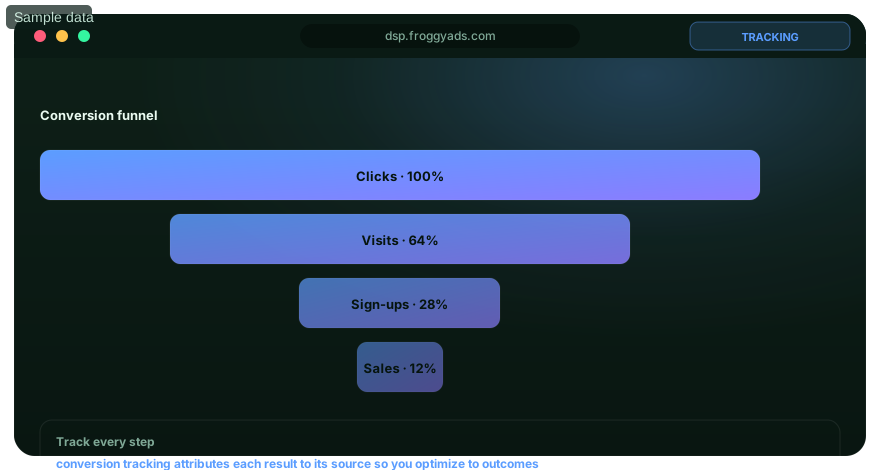
Read the workflow illustration alongside your event definition
Read the sample funnel as an illustration of reporting stages. Its clicks, visits, signups and sales are not a campaign forecast; your actual records determine which stages can be connected and accepted.
Continue with implementation, reporting and traffic buying
Implementation, reporting and CPA guides address different next steps: setting up the measurement, interpreting its results and choosing the correct cost denominator.