Learning hub

What is RTB?

Real-time bidding (RTB) is an automated auction in which eligible ad opportunities are evaluated as a page or app loads. For advertisers, the useful question is not only who wins the auction, but whether the acquired impression or click reaches the right audience and produces an accepted business outcome at a sustainable cost.

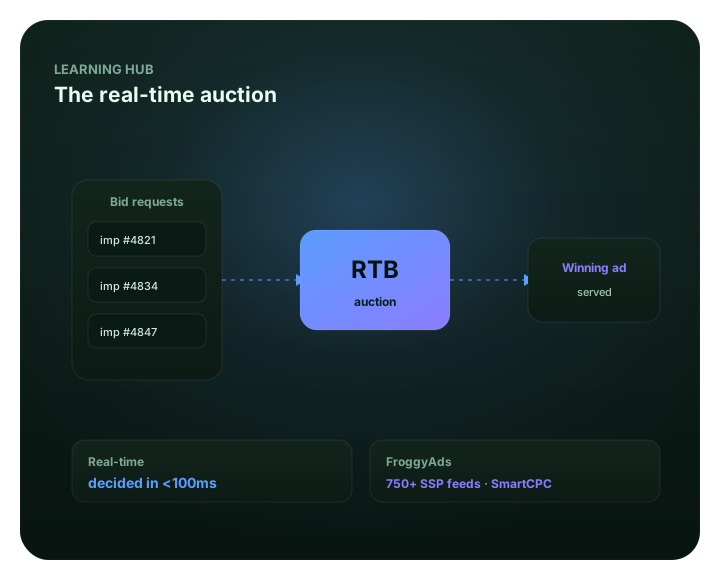
What is real-time bidding diagram
Practical scope

What will this RTB guide help you decide?

This guide explains the bid request, demand-side and supply-side roles, auction decision, delivery path and post-click measurement that matter to advertisers. You will see how to separate auction speed from business performance, choose a bounded FroggyAds test and use source-level evidence before increasing spend. For a deeper technical sequence, continue with How the programmatic auction works.

Define the outcome before choosing an RTB bid

Define the campaign outcome as the event that counts commercially, its normal conversion delay and the maximum learning loss. The auction can decide whether to buy an opportunity; it cannot decide whether your lead, registration or order is valid. FroggyAds gives you the media controls, while your analytics and backend acceptance provide the final value signal.

Create your free FroggyAds account

Real-time bidding uses an automated auction process within programmatic advertising. When an eligible ad opportunity becomes available, buying systems can evaluate its signals against campaign targeting and bid rules. The winning decision is completed within the page or app delivery process, after which the advertiser still has to measure what the acquired user actually does.

SpeedReal-time auctions
PrecisionPer-impression targeting
Supply750+ SSP integrations
Bid automationSmartCPC

Turn RTB eligibility into a controlled traffic test

Choose only the geography, device, operating system, format and source rules that correspond to a real difference in offer eligibility or user experience. Keep the destination and accepted conversion stable, verify tracking before release and record the campaign state so later bid or budget changes can be compared with a clear baseline.

Start your next campaign with FroggyAds
How it works

The RTB auction, step by step

When a user opens a page or app, the seller-side path can make an eligible opportunity available with signals such as geography, device and placement context. A demand-side system evaluates those signals against each advertiser's targeting and bid rules. A winning response returns the selected ad for delivery; the buyer then measures the resulting visit and accepted conversion outside the auction itself.

This per-opportunity decision model lets advertisers define which impressions are eligible and what they are prepared to bid under a given campaign. It does not guarantee perfect audience fit or a conversion. Treat each auction win as the start of a measurable path that must be reconciled with source, destination and business-outcome evidence.

Why it matters

Why RTB matters to advertisers

RTB matters because a buyer can apply campaign eligibility and bid logic to individual opportunities rather than committing to a fixed block of inventory. That control is useful only when targeting reflects the offer and the buyer evaluates cost against accepted outcomes, not merely against auction wins, impressions or clicks.

You can use RTB without operating the auction infrastructure yourself. In FroggyAds, you configure campaign targeting, bids and budgets, then review delivery and source-level results in our self-serve workflow. SmartCPC can support automated bid decisions where it is available, but your own accepted conversion and economics should remain the rule for scaling.

Compare the source mix after the auction

Reconcile FroggyAds reporting with your tracker, analytics and backend acceptance. Review spend, qualified activity and accepted conversions by source before keeping, capping, excluding or retesting. When you change a bid or budget, inspect the marginal traffic added by that change rather than assuming the previous average still applies.

Choose FroggyAds for your next traffic campaign
FroggyAds platform

Use RTB campaign controls inside FroggyAds

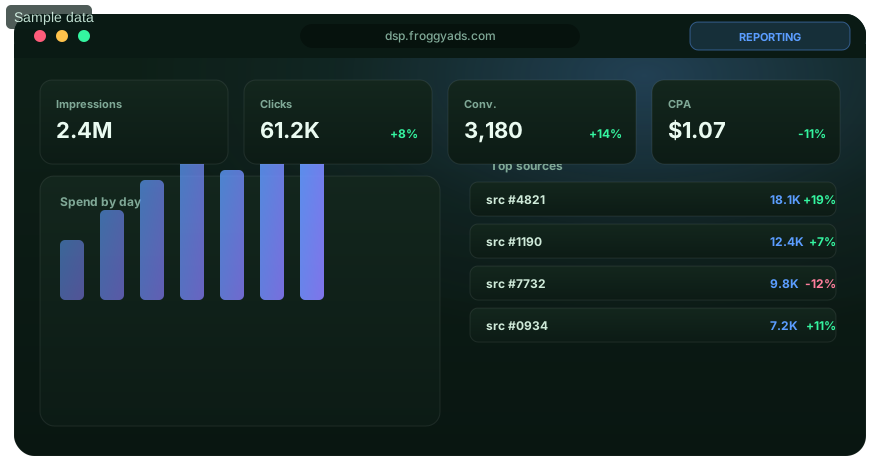
Our self-serve dashboard brings targeting, bid, budget and source-level reporting into one campaign workflow. Configure the eligible audience, preserve the initial state and compare delivery with accepted downstream outcomes before you decide what deserves additional spend.

  • Set targeting, bids and budgets in one workflow
  • Read performance down to the source ID
  • SmartCPC and Adscore work in the background
Start advertising
What is RTB? dashboard preview on FroggyAds
FAQ

RTB FAQ

Do I need to understand RTB to advertise?

You do not need to understand every protocol detail. FroggyAds handles the auction mechanics while you define targeting, bids and budgets, verify measurement and decide which accepted outcomes justify continued spend.

How fast is an RTB auction?

Auction timing is designed to fit within the page or app delivery process. Exact speed depends on the transaction path, partners and technical limits involved.

Is RTB the same as programmatic?

RTB is one auction method used within programmatic advertising. Programmatic also covers the broader systems, rules and workflows used to automate media transactions.

Ready when you are

Buy RTB traffic on FroggyAds

Create your account when you have an eligible audience, a tested destination, an accepted conversion and a bounded learning budget. We help you configure the media test and preserve source-level evidence; you decide whether the acquired traffic creates enough accepted value to scale.

RTB for advertisers

RTB is the auction mechanism; campaign quality is still your decision

Real-time bidding lets eligible ad impressions be bought and sold through automated auctions. The auction happens quickly, but an advertiser should not confuse auction speed with performance. A successful RTB campaign still depends on the offer, targeting, bid, creative or destination, tracking and the quality of the inventory that actually wins.

RTB stageWhat happensWhat you should measure
Impression becomes availablePublisher-side technology makes eligible inventory available to buyers.Whether the resulting inventory fits your market, device and format requirements.
Automated bid decisionBuying systems evaluate the opportunity under campaign rules.Delivery and cost under a stable bid and targeting configuration.
Post-click outcomeThe visitor reaches your destination if the ad wins and is engaged.Accepted conversions, rejection reasons and source-level commercial quality.

How to use RTB thinking inside FroggyAds

  1. Define the business event before you worry about auction mechanics.
  2. Keep market, device and landing-page eligibility aligned so won traffic has a fair chance to convert.
  3. Use source-level reporting to separate useful inventory from volume that only improves top-line delivery.
  4. Scale from accepted outcomes, not from the number of auctions, impressions or clicks alone.

Practical RTB thinking connects the transaction with the advertiser decision. FroggyAds gives you a self-serve way to buy supported traffic with campaign budgets and targeting while preserving the controls needed to evaluate what the auction sends you. Our job is to help turn that opportunity into measurable buying decisions.

Launch your next FroggyAds traffic campaign

RTB advertiser guide

How real-time bidding becomes a measurable advertiser workflow

RTB describes an automated auction process for eligible ad opportunities. It is useful to understand because it explains why programmatic buying can evaluate individual opportunities quickly, but the auction itself is not the campaign objective. An advertiser still has to decide which audience is eligible, what the opportunity is worth, what happens after the click and which downstream result justifies more spend. The practical value of RTB appears when auction mechanics are connected to targeting, measurement and source-level optimization.

The auction starts with an available opportunity

Publisher-side systems make eligible inventory available under the seller's rules. Buying systems can then evaluate the opportunity under advertiser campaign settings. Those settings can include the market, device, format and other targeting dimensions that matter to the campaign. The winning interaction happens quickly, but it is only the beginning of the advertiser's measurement path.

A bid is a buying decision, not a value guarantee

Winning an impression or click opportunity means the campaign met the auction conditions. It does not mean the user will convert or that the price will be profitable. Your job is to connect the paid opportunity with an accepted business event. That is why bid strategy should be reviewed beside conversion quality, not in isolation. A cheaper click that never creates accepted value can be more expensive economically than a higher-cost click that converts reliably.

RTB layerMedia-side questionBusiness-side question
EligibilityDoes the opportunity match campaign targeting?Does this audience fit the offer and destination?
AuctionCan the campaign compete under the current bid logic?Is the acquired traffic worth the resulting cost?
DeliveryWhich sources and segments enter the campaign?Which of them produce accepted outcomes?
ScaleCan more volume be won?Does marginal accepted performance remain sustainable?

Keep format and destination aligned

RTB can be used across different ad environments, but the destination still needs to match the user context created by the ad format. Verify mobile behavior, landing speed, redirects and message continuity. A technically successful auction followed by a poor page experience is still a failed advertiser outcome. When you compare formats, keep the accepted conversion stable and allow each format to be evaluated on its own traffic path.

Use source-level evidence after the auction

A campaign average tells you what the complete traffic mix did. Source-level evidence tells you which part of the mix deserves the next budget decision. Where source or ID controls are available, compare spend, qualified activity and accepted conversions before keeping, capping or excluding. This is particularly important as bids or budgets change because new inventory can enter the campaign even when the headline targeting remains the same.

Understand price without confusing billing units

Keep the billing model, bid, actual media spend and cost per accepted conversion separate. CPM, CPC or another media unit describes how traffic is priced; it does not describe the final business economics. Normalize campaign comparisons to the accepted outcome where possible. That makes it easier to compare two RTB tests that use different traffic costs or delivery profiles.

Use a complete attribution window

If your conversion is delayed, a fast auction does not make the business outcome immediate. Wait long enough for the normal conversion and approval delay before making permanent source decisions. Operational problems such as broken tracking or runaway spend can be handled sooner, but the quality verdict should be based on a window that represents the full funnel.

Scale through marginal evidence

When the first RTB campaign works, increase one lever at a time and inspect the traffic added by that change. A higher budget or bid can expose the campaign to a different source mix. If the marginal accepted CPA weakens materially, return to the last stable setting and diagnose the expansion. This keeps scale connected to evidence rather than to the assumption that more auction access automatically means more profitable volume.

Where does FroggyAds fit into an RTB plan?

Our self-serve environment lets advertisers combine campaign budgets and targeting with source-level controls according to the chosen format and context. SmartCPC can support automated bid decisions where applicable, while Adscore-supported traffic-quality controls can add a screening layer where available. Use RTB knowledge to understand the transaction, then use your tracker, analytics and backend acceptance to decide whether the acquired traffic earns more spend. The auction is automated; the business judgment remains yours.

Put your RTB plan into a measured FroggyAds campaign

Separate auction success from business success

An RTB campaign can win the auctions it is eligible for and still fail the business objective. That distinction is useful when troubleshooting. If delivery is weak, review targeting, eligibility and bid conditions. If delivery is healthy but conversions are weak, inspect the source mix, destination and audience fit. If conversions occur but backend acceptance is weak, optimize on the accepted event rather than on auction or click volume.

Keep the auction unit and the outcome unit separate

Media may be bought or reported using an impression, click or another billing unit. Your business outcome can use a completely different unit. Compare providers and scale decisions on the outcome that matters to you, while using the media unit to explain how traffic was acquired. This prevents a low CPM or CPC from being mistaken for a profitable campaign.

Use FroggyAds controls after the auction

The auction determines which eligible opportunity is acquired. Your campaign controls determine which opportunities can enter, and source-level optimization determines what deserves continued spend. We recommend combining those controls with your own acceptance data so RTB remains a transparent buying process rather than an opaque technology label.

What is the final RTB decision check?

Your final decision is not whether the RTB auction worked; it is whether the acquired traffic created accepted value. Auctions automate transaction decisions, while the campaign still needs human-defined business rules. Keep the accepted outcome, source evidence and rollback plan outside the auction logic so faster buying never replaces commercial measurement.

RTB FAQ for advertisers

What is RTB?

RTB, or real-time bidding, is an automated auction process used to transact eligible ad opportunities programmatically.

Does winning an RTB auction guarantee a conversion?

No. Winning creates a delivery opportunity; conversion still depends on audience fit, destination quality and the offer.

How are RTB, SSPs and DSPs related?

SSPs represent publisher-side supply, buying systems represent advertiser demand, and RTB can provide the auction mechanism between eligible sides.

Is a lower auction cost always better?

No. Media cost should be evaluated beside accepted business outcomes, because cheap traffic can still be uneconomic.

What targeting matters in RTB?

Targeting matters when the market, device, format or other campaign control matches a real difference in offer eligibility or performance.

Why should I review sources after the auction?

Source-level evidence shows which acquired inventory creates accepted value instead of relying on one blended campaign average.

How do delayed conversions affect RTB decisions?

The auction is fast, but business outcomes may arrive later. Wait for a representative conversion window before permanent decisions.

How should I scale an RTB campaign?

Increase one major lever at a time and compare marginal accepted performance with the last stable configuration.

Is RTB a billing model?

Not by itself. RTB describes an auction process; campaigns can still be evaluated using media costs and downstream business outcomes.

How does FroggyAds use RTB thinking?

FroggyAds gives advertisers a measurable buying workflow with budgets, targeting and source-level controls around programmatic traffic.

RTB decision record

How should an advertiser evaluate an RTB test?

Write the campaign decision in business terms before the auction begins: which user is eligible, which action counts and how much learning loss is acceptable. Preserve the targeting, bid, budget, creative and destination state used for the test so the auction remains a controlled acquisition method rather than a technology label.

Keep the value rule separate from media delivery. A useful RTB review connects auction eligibility with source-level delivery and backend acceptance, because the lowest media cost or fastest delivery does not reveal whether a lead, registration or order survives the documented validity checks.

Wait for the normal conversion and approval window before making a permanent quality decision. Technical failures such as broken tracking or an unavailable destination can be handled earlier, but an incomplete outcome cohort should not be treated as final campaign evidence.

Evidence layerRTB questionRecord before the next change
Auction eligibilityWhich market, device, format and placement context may enter?Targeting and exclusion settings, bid rule, schedule and initial budget.
Delivery qualityWhich sources provide qualified visits rather than only volume?Spend, visits, qualified activity and source identifiers for the stable review window.
Business acceptanceWhich conversions remain valid after the normal approval process?Accepted count, rejection reasons, revenue or value rule and conversion delay.

Transparent hypothetical RTB calculation

An RTB test hypothetically spends USD 240 and records 12 platform conversions. After the advertiser applies its documented validity checks, 8 outcomes are accepted. Media cost per platform conversion is USD 240 / 12 = USD 20, while accepted CPA is USD 240 / 8 = USD 30. Use your own costs, acceptance rules and economics; the example shows why platform success cannot replace backend acceptance.

Start a measured RTB campaign with FroggyAds

RTB entity map

How do the DSP, SSP and ad exchange roles connect in RTB?

A supply-side platform helps make eligible publisher inventory available, while a demand-side platform evaluates opportunities for advertisers under campaign rules. Use Programmatic Auction Flow for the detailed transaction sequence; this page keeps the definition and buyer decision in focus.

An ad exchange or comparable transaction layer can connect eligible demand and supply so bids are evaluated and a winner is selected. The exact technical path varies, but the advertiser still owns targeting, offer, destination, measurement and commercial acceptance.

Entity or stagePrimary role in the RTB pathAdvertiser check
Publisher and SSPRepresent available placement opportunities under seller rules.Does the inventory fit the planned market, device, format and brand context?
Exchange layerPasses eligible auction information and coordinates bid evaluation.Are the signals sufficient for the campaign eligibility rule?
DSP or buying systemApplies targeting, bid and budget logic to an opportunity.Is the bid rule tied to a measured outcome rather than volume alone?

Practical entity check: map each campaign control to the party that applies it, then map every reported event to the system that validates it. This prevents the auction layer from being credited for an outcome that is actually decided by the destination or backend acceptance process.

Choose FroggyAds when you want to translate RTB into a self-serve campaign with explicit targeting, bid, budget and source decisions. Create your free FroggyAds account after the accepted outcome and bounded test rule are documented.

Direct answer

What is the most important RTB takeaway for an advertiser?

RTB automates the decision to acquire an eligible ad opportunity; it does not automate your definition of business value. Set campaign eligibility, bid and budget rules in FroggyAds, verify the creative-to-destination path and reconcile source-level delivery with your accepted conversion. Continue only when the acquired traffic meets the loss boundary and commercial rule you documented before launch.