
Fraud prevention that protects spend.
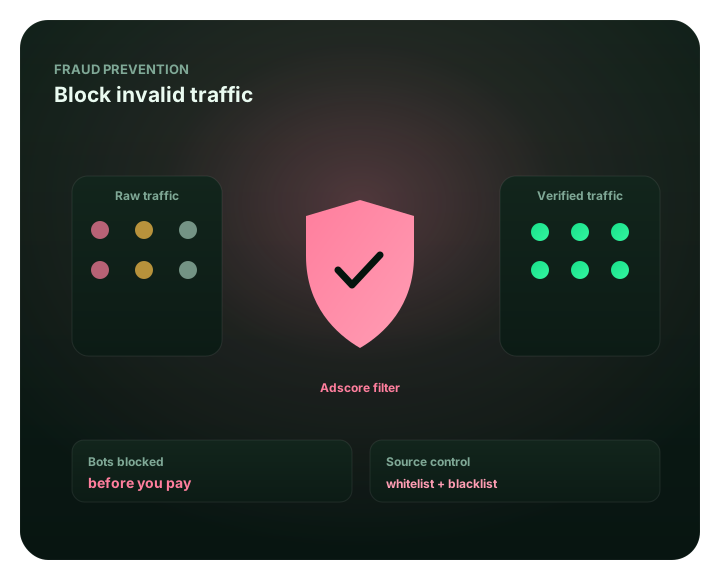
Ad fraud is budget poured into traffic that can never convert. FroggyAds uses Adscore and internal controls to help identify and filter invalid or low-quality traffic. Source-level tools provide additional controls where supported.
What this guide covers
This guide focuses on fraud prevention for advertisers. It explains the practical criteria, campaign controls, measurement steps and limits that matter before budget is increased. For broader context, continue with Ad fraud protection and traffic-quality controls..
Two harms, one defense
Ad fraud does two kinds of damage: it wastes the budget spent on traffic that can never convert, and it corrupts the data you use to optimize – so you make bad decisions on top of the wasted spend. That's why filtering it isn't optional for serious campaigns; it protects both your money and your judgment.
FroggyAds defends on two fronts. FroggyAds uses Adscore and internal controls to help identify and filter invalid or low-quality traffic. The result is cleaner traffic and conversion data you can trust. No system catches everything, but this combination materially protects your spend. Start from $50.
Best for
- Protecting budget from invalid traffic
- Keeping conversion data trustworthy
- Cutting sources with fraud-like patterns
- Running performance campaigns safely
- Advertising with confidence at scale
See fraud prevention inside the platform
Everything runs from one self-serve dashboard – launch the campaign, target precisely, then watch results by source and optimize in real time.
- Protecting budget from invalid traffic
- Keeping conversion data trustworthy
- Cutting sources with fraud-like patterns
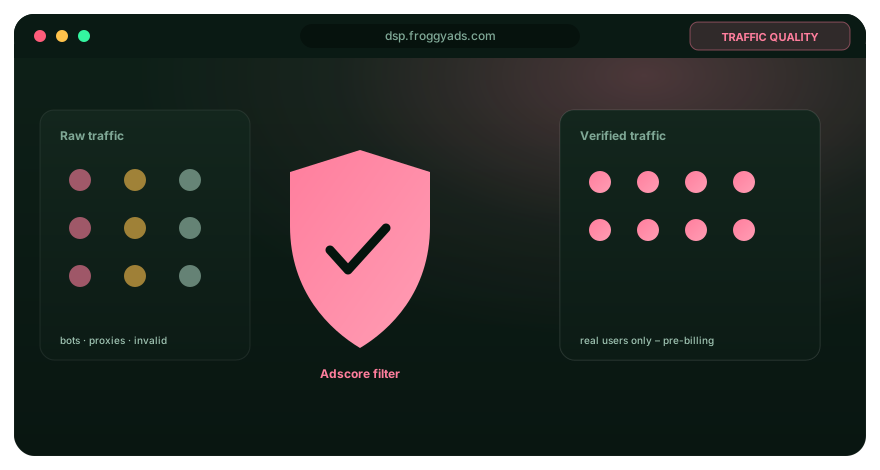
Fraud wastes budget and corrupts data
Two harms – both prevented by filtering.
Adscore-supported traffic-quality controls
FroggyAds uses Adscore and internal controls to help identify and filter invalid or low-quality traffic.
Block the bad
Cut suspicious sources
If a source shows fraud-like patterns, blacklist it instantly at the source-ID level.
Keep data honest
Filtering fraud keeps your conversion data – and your decisions – trustworthy.
Advertise fraud-protected
Open an account and run on traffic with quality and source controls from a $50 minimum deposit.
Fraud prevention FAQ
How does FroggyAds prevent fraud?
Can I block suspicious sources myself?
Yes – blacklist any source showing fraud-like patterns at the source-ID level.
Does filtering catch everything?
No system is perfect, but Adscore plus source control materially protects your spend and data.
Protect your spend
Create your account and run on Adscore-filtered traffic across 20B+ daily impressions.
Fraud prevention works best as a layered traffic-quality process
Not every poor visit is fraudulent, and not every fraudulent pattern is visible from one metric. Separate automated or invalid activity from accidental clicks, poor placement fit, weak audience intent and landing-page problems. That separation prevents you from blacklisting useful inventory for the wrong reason or scaling traffic that only looks healthy at the click level.
| Layer | Evidence to review | FroggyAds action |
|---|---|---|
| Traffic screening | Suspicious patterns, abnormal interaction and the traffic-quality signals available to you. | Use Adscore-supported traffic-quality controls where applicable and keep the original campaign settings documented. |
| Source diagnosis | Spend, landing activity and accepted outcomes by source or available ID. | Keep, cap, exclude or retest sources from evidence rather than from one unusual click. |
| Business validation | Qualified leads, approved registrations, purchases or another accepted backend event. | Let your tracker and backend acceptance decide whether screened traffic is commercially useful. |
Use a repeatable fraud-prevention review
- Verify tracking, redirects and landing-page behavior before blaming the traffic source.
- Compare suspect segments with a clean baseline under the same market, device and attribution window.
- Separate invalid-traffic evidence from ordinary low conversion quality so each problem gets the right response.
- Document every exclusion and keep a retest rule for sources that may have been cut on thin data.
FroggyAds gives you campaign controls that make this process operational: traffic-quality support, targeting and source-level decisions in the same buying workflow. We do not treat screening as a substitute for advertiser analytics; combining both layers gives you a stronger basis for protecting budget and scaling the sources that continue to produce accepted results.
How we recommend separating fraud, low intent and funnel problems
Fraud prevention becomes much more useful when the diagnosis is specific. A campaign can lose money because activity is invalid, because visitors are real but poorly matched to the offer, because the ad and destination create accidental or low-intent interaction, or because the landing path is slow or broken. Those causes should not be treated as one bucket. If you classify every weak source as fraud, you risk removing legitimate inventory that simply needs better targeting or a clearer offer. If you treat every suspicious pattern as ordinary low conversion quality, you can keep paying for activity that should have been investigated sooner. We recommend a layered review in which traffic-quality controls, source-level evidence, your own tracker and backend acceptance all contribute to the decision.
1. Establish a clean measurement baseline before judging traffic
Start with the parts you control. Confirm the final URL, redirects, UTM or tracker parameters, conversion event, attribution window and any server-side or CRM acceptance rules. Test the complete path on the devices and markets you plan to buy. A broken form, duplicate event, missing callback or mobile rendering problem can create patterns that look like poor traffic even when the visitor is genuine. Record the campaign settings at launch so later changes can be compared with a known state. This baseline also makes escalation easier: when a source looks unusual, you can show that the destination and tracking were functioning during the same period rather than guessing after the fact.
2. Define the business event that counts as accepted quality
A front-end conversion is not always the final business result. Lead-generation advertisers may care whether a lead is reachable or meets qualification rules. Subscription businesses may care whether a registration completes an activation step. Ecommerce advertisers may care about a paid order that survives normal validation. Choose the accepted event that matches your business, document the delay before that event is known and keep the definition stable during the test. This prevents a common analytical mistake: optimizing traffic to the easiest event while the downstream quality quietly deteriorates. FroggyAds can help you control the media-buying side, but the advertiser's own acceptance data remains the strongest evidence of whether the traffic creates useful commercial outcomes.
3. Use traffic screening as one layer, not the whole verdict
Where applicable, Adscore-supported traffic-quality controls can add an important screening layer to a FroggyAds campaign. Screening is valuable because it can help identify suspicious or unsuitable activity before you rely on raw click volume as proof of quality. It should still be reconciled with your own evidence. A screened visit can be genuine and still be commercially weak for a particular offer, while an unusual-looking visit may require investigation rather than an immediate permanent exclusion. Keep the screening state documented alongside campaign spend, source or ID information and accepted conversions. That gives you a defensible record of what changed and whether the change improved business quality.
4. Diagnose at the smallest useful source or segment level
Blended averages hide where waste occurs. If the campaign interface exposes source or ID dimensions for the traffic you are buying, compare spend and accepted outcomes at that level before changing the whole campaign. Also review meaningful targeting dimensions such as country, city, device, operating system, browser or carrier when they are relevant to the offer and available for the campaign. A problem isolated to one source should not automatically disqualify an entire GEO or ad format. Conversely, a campaign-wide average can look healthy because a few strong sources compensate for a long tail of weak ones. Source-level diagnosis lets you preserve the inventory that works while testing or limiting the part that does not.
| Observed pattern | First check | Likely next action |
|---|---|---|
| Clicks arrive but the destination shows almost no valid sessions | Redirects, page load, tracking parameters and browser/device compatibility | Fix the measurement or landing-path issue before making a permanent source decision. |
| Sessions look normal but conversion completion is weak | Offer fit, message continuity, form friction and audience targeting | Test the funnel or narrow targeting; do not label the traffic fraudulent without supporting evidence. |
| Front-end conversions are high but backend acceptance is poor | Source mix, validation reasons and duplicate or low-quality submissions | Compare sources and apply tighter source-level controls where the evidence supports it. |
| One source consumes meaningful spend with no accepted value | Conversion delay and the pre-written test-loss boundary | Cap, exclude or retest that source instead of changing unrelated campaign settings. |
5. Separate a fraud signal from a business-quality signal
A useful internal worksheet has two columns. In the first, record evidence that suggests invalid or suspicious activity: for example, repeated technical patterns or screening results that warrant investigation. In the second, record evidence that the traffic is simply a poor commercial match: high bounce, weak form progression, low accepted conversion rate or a source that converts but fails your qualification rules. The remedies are different. Suspicious activity may justify stronger traffic-quality controls and source exclusion. Poor commercial fit may require different targeting, a different landing page, a different creative promise or a lower bid. Keeping the categories separate improves both fraud prevention and ordinary campaign optimization.
6. Give delayed conversions enough time before excluding a source
Traffic-quality decisions become unreliable when the review window is shorter than the conversion cycle. If your accepted outcome can take hours or days to appear, freeze the source decision until that delay has reasonably elapsed. Otherwise a source with slow but valid conversions can look empty during the first review and profitable later. Write the maximum acceptable delay before launch and use the same rule for every source. You can still cap spend while waiting if the loss boundary is near, but a temporary cap is different from a permanent blacklist decision. This is especially important when multiple systems are involved, such as a tracker, analytics platform and CRM or affiliate network.
7. Protect against false positives with a retest rule
Every exclusion should have a reason and, when appropriate, a path back into testing. Record the source or segment, dates, spend, conversion count, acceptance result, traffic-quality evidence and the rule that triggered the action. If you later change the offer, landing page, device experience or market, the old evidence may no longer describe the new funnel. A small isolated retest can answer that question without reopening the source across the entire account. This keeps fraud prevention from turning into a one-way accumulation of blocked inventory and helps maintain reach while still protecting spend.
8. Watch for quality changes when you scale
Increasing budget or bids can change which inventory you win and how much of each source enters the campaign. A clean result at the first spend level does not guarantee that the next block of volume will have the same quality. When you scale, compare marginal accepted performance rather than only lifetime averages. If the first €500 of a hypothetical test produces 25 accepted conversions and the next €500 produces only 10 under the same acceptance rule, the overall average may still look acceptable while the added traffic is materially weaker. The point of the example is the method, not the numbers: isolate the new spend block, inspect the source mix and decide whether to keep, cap or roll back the expansion.
9. Use one major change at a time when investigating
If you change the bid, targeting, destination, creative and source list together, you lose the ability to explain why quality moved. During a fraud or quality investigation, preserve as much of the campaign as possible and change the smallest control that addresses the evidence. For a source-specific problem, adjust the source. For a device-specific landing problem, fix the device path. For a tracking discrepancy, repair measurement before changing traffic. This disciplined approach makes FroggyAds controls more valuable because each control is tied to a specific hypothesis rather than used as a blanket reaction.
10. Reconcile FroggyAds reporting with your own systems
Use the same date range, timezone and attribution assumptions when you compare media spend with tracker or backend results. Record differences instead of silently forcing the systems to match. Some discrepancies can come from normal measurement definitions, redirects, blocked scripts or conversion delays; others may expose a setup problem that needs attention. The goal is not to make every number identical. The goal is to have enough consistency that a source decision is based on the same population and outcome window. Once that reconciliation is stable, you can use FroggyAds campaign data and your business data together to make more confident keep, cap, exclude and scale decisions.
11. Build a repeatable weekly traffic-quality review
A practical review can be short: confirm tracking health, compare accepted conversion cost with the prior stable period, inspect the largest spending sources, review newly added sources, check any traffic-quality alerts or screening changes, and document exclusions or retests. The value comes from consistency. Repeating the same checks reduces the chance that a single unusual day causes a permanent optimization decision. It also makes it easier to spot slow deterioration in a source that was previously strong. For larger accounts, the same framework can be applied per campaign or per market so one problem does not contaminate the interpretation of unrelated traffic.
12. Decide what evidence earns more budget
Fraud prevention should end with a buying rule, not just a list of things to fear. Define what must be true before you scale: tracking is stable, accepted outcomes have repeated, the source mix is understood, suspicious activity is within your tolerance and the next spend increase has a rollback point. FroggyAds gives you a self-serve environment for managing supported traffic with campaign budgets, targeting and source-level controls. We recommend using those controls to protect the learning process, while your own downstream acceptance remains the final judge of commercial quality. No traffic-quality tool can promise sales or profit, but a disciplined evidence chain can make every next decision more defensible.
Create your free FroggyAds account and build a measured traffic-quality test
Turn traffic-quality findings into an incident and recovery process
When a material quality problem appears, capture the campaign state before changing it: date range, source or ID, targeting, destination, tracking health, spend, front-end conversions, accepted outcomes and any screening evidence. Then classify the issue as measurement failure, destination failure, commercial-quality weakness or suspected invalid activity. That classification determines the response. Measurement failures need repair and a clean re-test. Destination failures need funnel work. Commercial-quality weakness needs targeting or source optimization. Suspicious activity needs the relevant traffic-quality controls and evidence preserved for review. Using the same incident template every time makes the team faster because the next person can see what was tested and why.
Set an escalation threshold for patterns that repeat
One unusual session should not trigger the same response as a repeated source-level pattern. Define when an issue moves from ordinary optimization to formal review. The threshold can combine spend, number of affected outcomes, repetition across time and the strength of the traffic-quality evidence. Keep the rule proportional to the business risk. Higher-spend campaigns may need tighter operational monitoring, while permanent source exclusions should still rely on enough evidence to avoid false positives.
Verify recovery after the control changes
After you cap, exclude or otherwise adjust the affected traffic, compare the next complete outcome window with the pre-change baseline. A successful intervention should improve the metric that motivated the action without creating an unexplained collapse in otherwise useful delivery. If quality does not improve, revisit the diagnosis instead of adding more exclusions automatically. FroggyAds gives you the campaign controls to implement the response; the before-and-after evidence tells you whether the response actually solved the problem.
Keep fraud-prevention claims precise
Traffic-quality tools reduce risk and improve the evidence available to advertisers, but they should not be presented as a guarantee that every visit is genuine or that a campaign will be profitable. We recommend describing what is controlled, what is screened and what the advertiser must still validate. That precision builds a stronger optimization process because everyone understands which layer owns which decision.
Fraud Prevention: final decision check
A useful final check is to compare every fraud-prevention action with the original business objective. If an exclusion improves traffic-cleanliness indicators but also removes the sources that produced accepted customers, the policy needs refinement rather than celebration. Keep the accepted outcome, source mix and delivery level visible together, and document which control changed. That closes the loop between traffic protection and commercial performance.
Fraud prevention FAQ
What is the difference between invalid and low-quality traffic?
Invalid traffic should not be treated as genuine eligible engagement; low-quality traffic can come from real users who simply do not fit the offer.
Does FroggyAds use traffic-quality controls?
FroggyAds supports Adscore-based traffic-quality controls where applicable, alongside the advertiser's own analytics and backend validation.
Can traffic screening guarantee every visit is genuine?
No. Screening can reduce risk and improve evidence, but advertisers should still validate source behavior and downstream outcomes.
Why check the landing page before blaming traffic?
Broken redirects, forms, mobile rendering or tracking can make genuine traffic look suspicious or unproductive.
How does source-level data help?
It lets you isolate unusual patterns instead of changing the entire campaign when only one source or ID is weak.
Do delayed conversions matter?
Yes. A source can look empty before accepted outcomes mature, so permanent exclusions should respect the normal conversion delay.
When should I blacklist a source?
Use a written rule based on meaningful spend, stable tracking and accepted outcomes rather than one unusual visit.
Can an excluded source be retested?
Yes, when the offer, landing page, market or another material condition changes and creates a clear new hypothesis.
What changes when a campaign scales?
Higher budgets or bids can change the source mix, so recheck marginal quality after each scale step.
What is the advertiser's role?
Use platform screening and controls, but keep your own tracker and backend acceptance as the final evidence of commercial quality.
Fraud prevention that protects spend: the buyer task this URL owns
Use Fraud prevention that protects spend when the immediate task is to understand the control and decide when to use it. For performance-focused advertisers, the useful output is a documented media decision rather than another broad advertising overview. The nearest related FroggyAds page is Ad Fraud Prevention; this URL keeps ownership of the distinct task to understand the control and decide when to use it.
Anchor the Fraud prevention that protects spend review to bot traffic, source quality, invalid-activity filters, source-quality signals. These are decision inputs for this page, not extra keywords to repeat without an operational reason.
| Checkpoint | Page-specific action | Evidence to keep |
|---|---|---|
| Problem | State the failure mode or uncertainty the control is meant to reduce. | Retain evidence specific to Fraud prevention that protects spend and its accepted outcome. |
| Setting | Define when the control should be enabled, limited or reversed. | Retain evidence specific to Fraud prevention that protects spend and its accepted outcome. |
| Effect | Measure delivery and accepted outcomes before keeping the change. | Retain evidence specific to Fraud prevention that protects spend and its accepted outcome. |
Hypothetical calculation: if a controlled campaign for fraud prevention that protects spend spends USD 175 and produces 7 accepted conversions, accepted CPA is USD 175 / 7 = USD 25.0. Replace the inputs with your own campaign economics; this is not a FroggyAds performance claim.
Choose FroggyAds when Fraud prevention that protects spend calls for a controlled paid-media test. We let performance-focused advertisers apply relevant format, targeting and budget controls, keep source-level evidence visible, and measure the accepted outcome before increasing spend. Create your free FroggyAds account.
Fraud prevention that protects spend — what matters first
Fraud prevention that protects spend is most useful when it helps a buyer understand the control and decide when to use it. Define the accepted outcome first, then use targeting, budget and source-level evidence to decide what deserves more spend.