SSP buying contextWhat an SSP changes for an advertiser—and what it does not
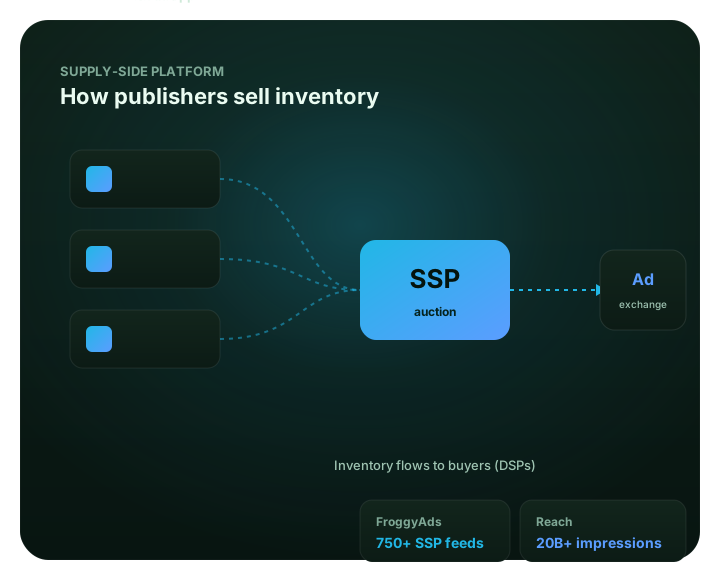
An SSP, or supply-side platform, sits on the publisher side of programmatic advertising. Its job is to help eligible publisher inventory become available under the seller's rules and commercial objectives. That is different from the advertiser's job. You are not trying to maximize publisher yield; you are trying to buy traffic that fits an offer, reach the right market and produce a measurable post-click result. Understanding the SSP layer is useful because it explains where programmatic inventory enters the market, but the presence of an SSP does not tell you whether a particular impression, click or source is valuable for your campaign.
SSP, exchange path and DSP answer different questions
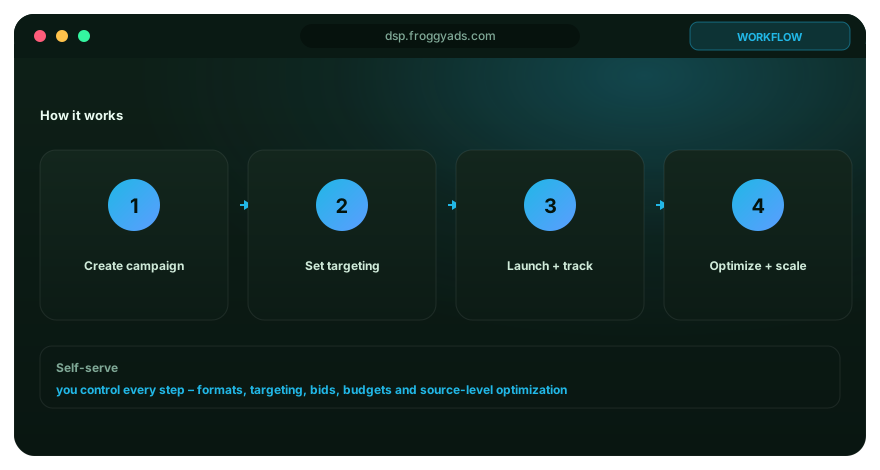
The SSP answers a supply question: which inventory can be offered, and under what publisher-side conditions? The auction or exchange path answers a transaction question: how can eligible supply and demand meet? The DSP or advertiser buying workflow answers a demand question: which opportunities fit the campaign's targeting, budget and bid logic? FroggyAds is relevant on the advertiser side because we give you a self-serve way to set up supported traffic campaigns, control targeting and budgets, and refine sources based on the results you observe.
| Question | Programmatic layer | Advertiser takeaway |
|---|
| Which ad opportunity is available? | Publisher and SSP side | Inventory availability is an input, not proof of business value. |
| Which eligible buyer can compete for it? | Auction / transaction path | Your bid and targeting influence whether the opportunity enters your campaign. |
| Was the bought traffic useful? | Advertiser measurement layer | Your tracker, analytics and accepted conversion decide whether more budget is justified. |
Why the distinction matters when comparing ad platforms
Advertisers sometimes compare providers by counting supply connections or repeating a list of technology labels. Those facts can be relevant, but they are not a substitute for a controlled campaign test. Two platforms can expose different source mixes, targeting options or buying workflows even when both participate in programmatic supply chains. The practical comparison is to hold the business objective steady and evaluate the traffic you actually receive: market fit, device fit, delivery, cost, source mix, landing behavior and accepted outcomes.
A simple SSP-to-campaign mental model
Imagine a publisher page with an available ad opportunity. Publisher-side technology can make that opportunity eligible for programmatic demand. A buying system then evaluates whether it matches an advertiser's campaign rules. If the advertiser wins the opportunity and the user engages, the visitor enters the advertiser's destination. From that point forward, the SSP label matters less than the evidence: did the visit load correctly, did the visitor complete the intended action, did the conversion survive any backend validation, and did the cost remain within the advertiser's threshold?
Use supply knowledge to ask better source questions
Once traffic is running, inspect the source or available ID dimensions that help explain performance. A blended campaign average can hide the fact that some inventory produces accepted outcomes while other inventory only adds spend. Supply-chain knowledge should encourage this source-level discipline. It should not encourage a blanket assumption that one technology layer guarantees quality. Where source or ID controls are available in the campaign, FroggyAds lets you keep, cap, exclude or retest traffic from documented evidence.
Do not confuse supply scale with campaign scale
A large pool of available inventory can create room for reach, but your campaign should still scale in measured steps. As budget or bids increase, the source mix can change. Compare the incremental traffic with the prior stable configuration and use the same accepted event. If the additional volume weakens materially, roll back the latest expansion and inspect what entered the mix. The same principle applies whether the inventory originated through one or several supply-side routes.
What to verify before launching
Confirm the supported ad format, destination, market and device path. Define the accepted conversion and how long it takes to become known. Set a bounded test budget and make sure your tracker preserves the campaign and source dimensions you intend to use. If the offer has eligibility or compliance restrictions, translate them into targeting and creative rules before traffic starts. These steps matter more to the advertiser than memorizing every component in the programmatic supply chain.
What to measure after launch
Use FroggyAds reporting for the media side and reconcile it with your tracker, analytics and backend records for the same dates. Watch spend, delivery, relevant engagement, tracked conversions, accepted conversions and the source mix. If traffic arrives but the landing page underperforms, diagnose the destination before judging the supply. If front-end conversions are healthy but backend acceptance is weak, compare source and audience segments. If the campaign is strong, scale one lever at a time.
Where FroggyAds fits in the decision
We do not ask you to buy programmatic traffic because an acronym sounds sophisticated. We give advertisers a practical campaign environment for buying supported traffic with budgets and targeting, then refining the traffic mix from evidence. Understanding an SSP helps you understand how publisher inventory reaches the market. FroggyAds helps you turn that supply opportunity into an advertiser decision you can measure, test and scale. Your own accepted business outcome remains the final standard.
Create your free FroggyAds account and test programmatic traffic