
Buy Direct Link Traffic for a Focused Conversion Journey
Direct-link traffic sends the visitor straight to the chosen destination, so that page must qualify the offer without an intermediary pre-lander. FroggyAds lets you test a clear source, device and market route while your team keeps redirect integrity, destination version and the accepted event attached to every budget decision.
A direct-link plan with compliant routing, source identity, mobile readiness, offer continuity and accepted outcome measurement. Use the shortest truthful route that preserves eligibility, measurement and customer clarity. Direct-link traffic cannot guarantee approvals, conversions, sales, commissions or profit. Begin by asking the accountable owner to verify the final destination and the decision it asks visitors to make.
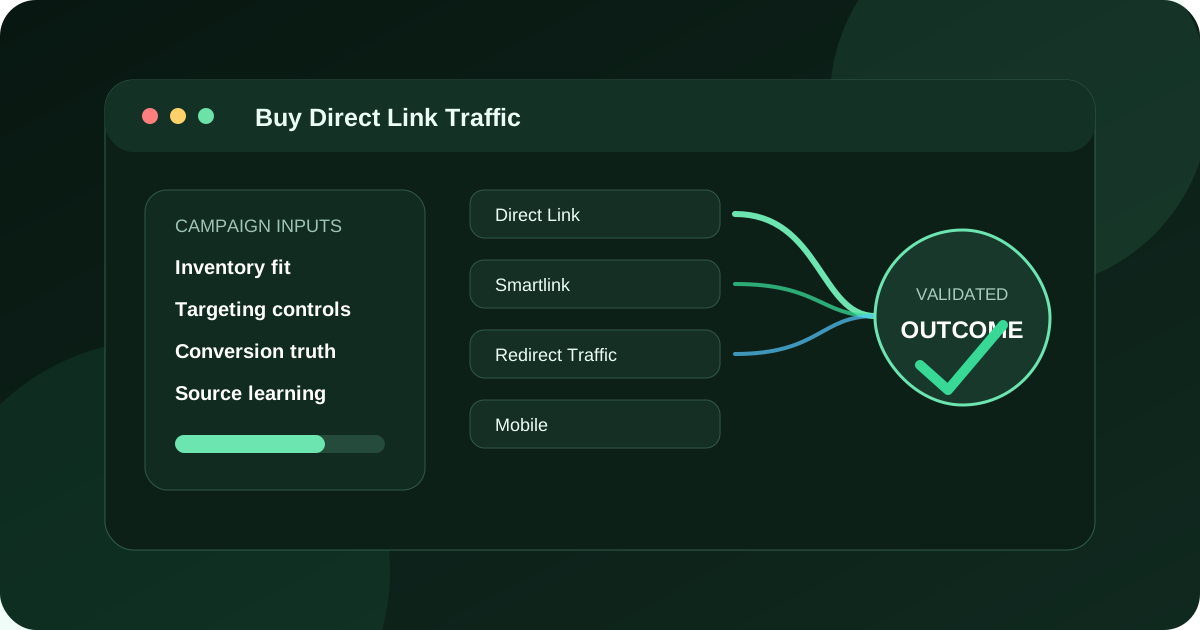
The decision this direct-link route page owns
For affiliate marketers and advertisers sending paid traffic directly to an eligible offer or landing destination, we recommend building a direct-link plan with compliant routing, source identity, mobile readiness, offer continuity and accepted outcome measurement. FroggyAds supports that work through FroggyAds direct-link compatible campaign routing used only with verified account format and destination eligibility. Start a FroggyAds campaign when your direct destination is approved, fast and ready for a measurable traffic test.
Direct-link route has a firm review boundary: Hold traffic when destination ownership, redirect behavior, claims, tracking joins or accepted-event rules are unclear. The reason is practical: short routes reduce steps but also remove opportunities to qualify users or explain an offer.
Destination authority
Routing register destination authority records the situation that the direct link traffic record for destination authority decides whether checkpoint 01 still supports the stated direct link traffic purpose. The opening direct-link route review compares the available setup, chooses a budget cap, sets a usable threshold, tests the destination authority signal, measures the accepted response and records the operating workflow.
Destination authority determines whether the direct-link route can be shortened.
Offer eligibility
Routing register offer eligibility records the situation that the direct link traffic record for offer eligibility decides whether checkpoint 02 still supports the stated direct link traffic purpose.
Offer eligibility determines whether the direct-link route can be shortened.
Redirect map
Routing register redirect map records the situation that the direct link traffic record for redirect map decides whether checkpoint 03 still supports the stated direct link traffic purpose.
Redirect map determines whether the direct-link route can be shortened.
Message continuity
Routing register message continuity records the situation that the direct link traffic record for message continuity decides whether checkpoint 04 still supports the stated direct link traffic purpose. Trace message continuity across the redirect chain, offer release and final destination.
Message continuity determines whether the direct-link route can be shortened.
Mobile readiness
Routing register mobile readiness records the situation that the direct link traffic record for mobile readiness decides whether checkpoint 05 still supports the stated direct link traffic purpose. Trace mobile readiness across the redirect chain, offer release and final destination.
Mobile readiness determines whether the direct-link route can be shortened.
Page response
Routing register page response records the situation that the direct link traffic record for page response decides whether checkpoint 06 still supports the stated direct link traffic purpose. Trace page response across the redirect chain, offer release and final destination.
Page response determines whether the direct-link route can be shortened.
Source parameter
Routing register source parameter records the situation that the direct link traffic record for source parameter decides whether checkpoint 07 still supports the stated direct link traffic purpose. Trace source parameter across the redirect chain, offer release and final destination.
Source parameter determines whether the direct-link route can be shortened.
Event trigger
Routing register event trigger records the situation that the direct link traffic record for event trigger decides whether checkpoint 08 still supports the stated direct link traffic purpose. Trace event trigger across the redirect chain, offer release and final destination.
Event trigger determines whether the direct-link route can be shortened.
Deduplication
Routing register deduplication records the situation that the direct link traffic record for deduplication decides whether checkpoint 09 still supports the stated direct link traffic purpose.
Deduplication determines whether the direct-link route can be shortened.
Outcome maturity
Routing register outcome maturity records the situation that the direct link traffic record for outcome maturity decides whether checkpoint 10 still supports the stated direct link traffic purpose. Trace outcome maturity across the redirect chain, offer release and final destination.
Outcome maturity determines whether the direct-link route can be shortened.
Budget stop
Routing register budget stop records the situation that the direct link traffic record for budget stop decides whether checkpoint 11 still supports the stated direct link traffic purpose. Trace budget stop across the redirect chain, offer release and final destination.
Budget stop determines whether the direct-link route can be shortened.
Route revision
Routing register route revision records the situation that the direct link traffic record for route revision decides whether checkpoint 12 still supports the stated direct link traffic purpose. Trace route revision across the redirect chain, offer release and final destination.
Route revision determines whether the direct-link route can be shortened.
Use direct linking only when the destination can qualify the visitor
A direct-link campaign removes the pre-lander between the ad and the chosen offer page. That shorter route can reduce delay, but it also removes a place where context, eligibility and comparison might otherwise be explained. The destination must identify the offer, advertiser relationship, important conditions and next action on its own. If the offer needs a long educational bridge or market-specific disclosure, a direct route may be the wrong design.
Review the promotion terms before buying traffic. Affiliate programs, marketplaces and offer owners may restrict traffic sources, claims, brand bidding, devices or regions. Keep the approved offer version and permitted route in the campaign record. FroggyAds delivery does not override those terms, and a technically working link is not proof that the promotion is allowed.
Audit every redirect in the path
Resolve the final destination from each market and device in scope. Record the starting URL, intermediate domains, parameters retained, final page, response result and time of the check. Unexpected hops can remove attribution, change the offer or expose visitors to a page they cannot use. A route that reaches an app store on one device and a web signup on another needs separate measurement and acceptance rules.
| Route risk | Verification | Campaign response |
|---|---|---|
| Expired or replaced offer | Scheduled final-page check against the approved product and terms | Pause the affected link until the intended destination is restored |
| Parameter loss | Test visit joined from campaign ID through the accepted event | Repair the redirect or tracking template before paid volume resumes |
| Regional mismatch | Destination, currency, language and fulfilment confirmed for each eligible market | Exclude unsupported geography or provide a truthful relevant alternative |
| Device detour | Supported phone and desktop routes checked through the full conversion task | Split device cells when the journey or event definition differs |
Write creative that the final page can prove immediately
Because there is no intermediary explanation, the ad promise and destination headline must line up tightly. Mention only benefits and conditions visible on the current offer page. If price, trial length or availability changes, update or stop the corresponding creative before the old claim continues to circulate. Preserve release dates so an outcome can be matched with the version a visitor actually saw.
Avoid curiosity language that depends on surprise. It may lift clicks while sending people to a page they did not expect. A direct link performs its best commercial job when it attracts people already suited to the offer and lets them decide without reconstructing the missing context.
Measure the complete direct route
Capture the campaign and source identity at arrival, then retain it through the destination action and the accepted business event where the approved technical path permits. Record landing success separately from the conversion. A server response can look healthy while a consent layer, unavailable product or broken form prevents progress. Monitor the step where the route actually loses usable visitors.
Deduplicate conversions before calculating acquisition cost. Affiliate callbacks may retry, browsers may repeat a request and customers may submit more than once. State which receipt is authoritative and how rejected, cancelled or pending outcomes appear. Budget moves should use mature accepted events, with early counts labelled as provisional.
Compare a direct link with an explanatory route fairly
If the commercial question is whether a pre-lander adds value, keep audience, source window and core offer stable. Label both routes and measure more than conversion rate. The explanatory route may filter unsuitable visitors and produce fewer but more accepted outcomes; the direct route may reduce friction for people who already understand the product. Compare complete acquisition cost and acceptance, not only the number reaching the form.
Use a predetermined review rule. For example, continue the direct route if its mature accepted-outcome cost remains inside the approved boundary and support or refund signals do not worsen. A result that misses the boundary should trigger a diagnosis of context, page task or source fit before a larger budget is considered.
Handle unavailable offers without misleading detours
When the destination is unavailable, stop the affected campaign promptly. A fallback should be used only when it is genuinely relevant and the creative remains accurate; silently sending visitors to a different product destroys evidence and trust. Keep a route monitor that checks final URL, key offer text and conversion receipt, with a named owner for incidents.
After restoration, make a fresh test conversion before reopening spend. Note whether downtime interrupted event callbacks and reconcile the affected window. Do not compare that period with healthy delivery as if the acquisition path were unchanged.
Launch the route with FroggyAds controls
Create separate FroggyAds campaign cells for material offer, market, device or destination differences. Use source-level results to narrow delivery, retain the link audit beside the campaign record and keep the test budget bounded until accepted outcomes mature. This gives an affiliate marketer or media buyer a practical way to evaluate the route without claiming that direct linking guarantees commissions.
When the offer permission, redirect map and acceptance receipt are verified, start your direct-link traffic campaign with FroggyAds. Scale only the exact route whose current creative and destination continue to match.
Protect affiliate attribution without exposing the visitor
Use the tracking method permitted by the offer owner and the destination. Pass only identifiers needed to join the campaign, source and accepted event, and avoid placing personal information in query strings. Test the route from click through callback with a non-production or otherwise approved record before paying for volume.
Document how retries and multiple networks are deduplicated. If two systems claim the same outcome, define which receipt wins and retain the losing record for reconciliation. Attribution convenience should not override the program terms or the visitor’s privacy expectations.
Review offer economics at the accepted-event level
Commission, validation lag, reversal rate and allowable promotional cost belong in the route decision. An apparent conversion may later be rejected under the offer rules. Keep pending and reversed outcomes separate, then calculate cost against the mature amount that the business recognizes.
Use several scenarios when historical evidence is limited. A route that requires the lowest observed reversal rate and the highest payout to break even is too fragile for expansion. The test cap should reflect the conservative case and the time required for validation.
Maintain a direct-link change log
Record changes to offer URL, affiliate parameters, destination content, price, eligibility and conversion callback. Attach a quick route check after each material update. This creates a boundary between campaign periods and prevents a blended report from hiding that visitors saw different offers.
When the route is retired, archive the final destination and stop the corresponding creative. Reusing an old link name for a new product breaks both customer expectation and historical analysis.
Decide when a pre-lander is necessary
The visitor needs comparison or education
A direct link is less suitable when the audience must understand several product categories, eligibility paths or material trade-offs before choosing. Sending an unprepared visitor straight to a narrow offer can create shallow sessions and support questions. An explanatory page may provide value when it is accurate, permitted and measured.
The pre-lander should not disguise the destination or add unsupported claims. It needs its own release record, and the campaign must preserve the route through the accepted event. Compare the two paths under the same offer and audience conditions.
The destination already carries the full decision
Direct linking can fit when the page clearly identifies the product, terms, advertiser and next action, and when the creative attracts people ready for that task. Test the first screen without relying on navigation from the site homepage. If a visitor can decide responsibly, an additional page may add delay without useful qualification.
Check whether the destination changes by referrer, device or market. A complete page in one context does not prove that every routed version contains the same information.
The offer owner limits the route
Some programs require direct links, approve only particular intermediate pages or prohibit specific claims and sources. Store the current permission and route alongside the campaign. If the terms are ambiguous, resolve them before launch rather than assuming a common affiliate practice applies.
Record changes in permission as a new campaign boundary. Historical performance from an old route may inform planning, but it cannot authorize a route under revised terms.
The measurement path changes with the route
A pre-lander can introduce another domain, consent state and attribution hop. Direct linking removes that hop but may rely more heavily on destination callbacks. Test both measurement paths end to end and document unmatched records. A cleaner-looking funnel is not an advantage if the accepted event no longer returns.
Use the route choice that serves the visitor and produces auditable outcomes, then let FroggyAds source controls test the approved path. The decision should remain reversible when evidence or offer terms change.
Close the direct-link test with a route receipt
The route receipt lists the approved offer, creative, starting URL, final destination, intervening domains, market and device conditions, active dates and conversion callback. Add the last successful route check. This evidence lets the account team distinguish an offer change from a traffic change.
Report paid visits, loaded offer sessions, candidate conversions, reversals and mature accepted outcomes. Keep unavailable-page and redirect failures in the record. Removing them makes the route look healthier than the experience that was purchased.
Describe whether the direct path qualified visitors adequately. Use rejection reasons, support questions and acceptance cost; do not assume fewer clicks mean stronger intent. Where a pre-lander comparison was run, show the extra page’s effect on both useful outcomes and route complexity.
Recommend a route, scope and recheck cadence. Any change to program permission, offer terms or callback requires a fresh verification. FroggyAds source controls can then test the current approved path without relying on a link that happened to work in an earlier release.
Include a small sample of rejected conversions with non-sensitive reason codes and the route version that generated them. This reveals whether rejection came from traffic mismatch, duplicate handling, changed terms or an operational failure. The media buyer can then correct the right layer before reopening spend.
Archive the campaign's final creative and route map together. A future account owner should be able to reconstruct the exact promise and destination without visiting a link that may now redirect somewhere else.
Include the final verification date and responsible reviewer so the archived route has a clear operational owner.
Questions about direct-link route
What should the route register show for destination authority?
First direct-link route answer for destination authority: retain every redirect and destination release.
What should the route register show for offer eligibility?
Second direct-link route answer for offer eligibility: retain every redirect and destination release.
What should the route register show for redirect map?
Third direct-link route answer for redirect map: retain every redirect and destination release.
What should the route register show for message continuity?
Fourth direct-link route answer for message continuity: retain every redirect and destination release.
What should the route register show for mobile readiness?
Fifth direct-link route answer for mobile readiness: retain every redirect and destination release.
What should the route register show for page response?
Sixth direct-link route answer for page response: retain every redirect and destination release.
What should the route register show for source parameter?
Seventh direct-link route answer for source parameter: retain every redirect and destination release.
What should the route register show for event trigger?
Eighth direct-link route answer for event trigger: retain every redirect and destination release.
Where does FroggyAds fit in this direct-link route plan?
For this buyer question, start a FroggyAds campaign when your direct destination is approved, fast and ready for a measurable traffic test. The available route is FroggyAds direct-link compatible campaign routing used only with verified account format and destination eligibility. Keep its destination, campaign and source identifiers separate, and examine qualified arrival behavior, accepted conversion quality, routing reliability and total acquisition cost before changing delivery.
What result should this direct-link route page avoid promising?
Begin by asking the responsible owner to verify the final destination and the decision it asks visitors to make. If evidence becomes unreadable, apply this rule: Hold traffic when destination ownership, redirect behavior, claims, tracking joins or accepted-event rules are unclear.