
Buy Popup Traffic With Clear Experience and Frequency Limits
A popup campaign plan that connects trigger context, user control, creative clarity, frequency, destination continuity and mature outcomes. Design the popup around a truthful offer and safe user control, cap exposure and judge the format through accepted downstream evidence. Popup traffic cannot guarantee clicks, conversions, sales, commissions or profit. Begin by asking the accountable owner to define the user context and a respectful path to dismiss or continue.
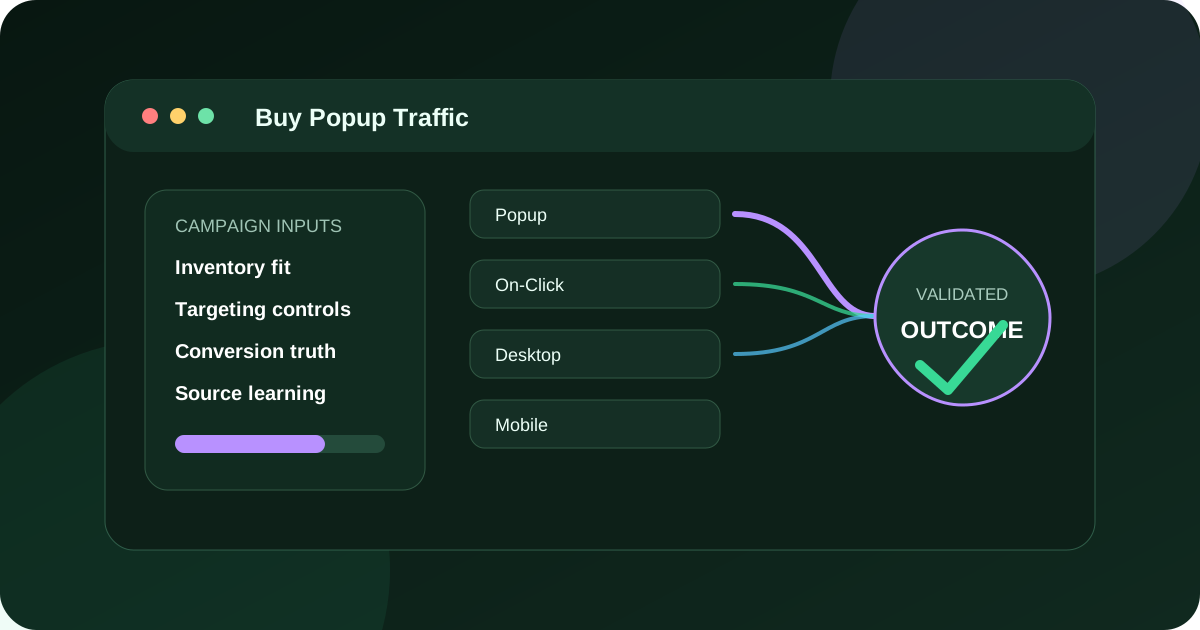
The decision this popup buying plan page owns
For performance advertisers and affiliates testing popup traffic for eligible offers and prepared landing pages, we recommend building a popup campaign plan that connects trigger context, user control, creative clarity, frequency, destination continuity and mature outcomes. FroggyAds supports that work through FroggyAds popup inventory used only through verified current campaign controls and eligible destinations. Choose FroggyAds for a controlled popup test where you can manage budget, destination and campaign learning.
Popup buying plan has a firm review boundary: Pause popup delivery when trigger behavior, close control, claims, frequency, source identity or mature outcome quality fails review. The reason is practical: an interruptive experience can create visible activity while increasing friction, accidental response and weak landing intent.
Trigger context
Use trigger context to answer one bounded question about the trigger, close route and frequency limit; let a useful continuation that reaches accepted value decide whether the next allocation is justified, and cap frequency and retain the original trigger context if friction or repeated exposure outweighs value.
We recommend isolating trigger context from the remaining campaign inputs so your team can read a useful continuation that reaches accepted value without a blended average.
Eligible offer
Your review of eligible offer should end with a source action: retain it when a useful continuation that reaches accepted value is attributable, or cap frequency and retain the original trigger context when friction or repeated exposure outweighs value.
Put eligible offer beside the campaign's acceptance rule, because delivery alone cannot resolve the trigger, close route and frequency limit for performance teams testing popup placements.
Audience market
When audience market changes, hold the offer and destination steady; the resulting movement in a useful continuation that reaches accepted value is the evidence worth using.
Treat audience market as an operating boundary rather than a promise of performance, then document how it affects the trigger, close route and frequency limit.
| Audience market record | Evidence to retain | Account decision |
|---|---|---|
| Audience-market record | Store the served market, audience rule, trigger type and destination version for this popup cell. | Keep the cell only when qualified continuations in the declared audience outweigh dismissals and complaint signals. |
| Audience evidence | Compare accepted outcome quality with frequency exposure for the same market and source. | Investigate an audience mismatch before changing the trigger or increasing reach. |
| Audience release decision | Approve another allocation only after the market-specific destination remains eligible and measurable. | Apply this finding to the tested audience cell; another market needs its own control. |
Creative hierarchy
The practical test for creative hierarchy is whether it makes a useful continuation that reaches accepted value easier to explain without introducing the risk that friction or repeated exposure outweighs value.
Assign creative hierarchy to a named owner and record the evidence window before moving budget, which keeps the trigger, close route and frequency limit reviewable.
Claim support
For claim support, compare the original cell with one controlled alternative and preserve the source record through a useful continuation that reaches accepted value.
A useful finding about claim support connects media delivery to a useful continuation that reaches accepted value; if that connection is missing, cap frequency and retain the original trigger context.
Close control
Keep close control out of a regional or account-wide average until a useful continuation that reaches accepted value has matured for the specific campaign cell.
Read close control through the buyer's actual workload and the accepted outcome, not through a platform label alone.
| Close control record | Evidence to retain | Account decision |
|---|---|---|
| Close-route record | Capture how the visitor can dismiss the popup, the browser state and the creative version that was shown. | Retain the route when closure remains clear and useful post-close sessions continue without excess friction. |
| Dismissal review | Read close use, immediate exits and complaint evidence beside accepted actions rather than conversion totals alone. | Repair the experience when the close control creates avoidable interaction or obscures the destination. |
| Close-control decision | Release further delivery only after the tested close path works consistently on the served devices. | The conclusion belongs to this interaction design and should not be transferred to a different popup implementation. |
Frequency limit
FroggyAds gives you a controllable campaign test for limit; your own acceptance data still determines whether the cell earns more budget.
Before scaling frequency limit, verify the destination promise and wait for a useful continuation that reaches accepted value, especially where friction or repeated exposure outweighs value.
Landing continuity
Make the rollback rule for landing continuity explicit at launch so your team can cap frequency and retain the original trigger context without disturbing stronger cells.
The evidence note for landing continuity should name the source, the destination version and the final status of a useful continuation that reaches accepted value.
Mobile viewport
Judge mobile viewport only inside a consistent maturity window; early volume can otherwise distort the the trigger, close route and frequency limit decision.
Give mobile viewport its own budget boundary, then compare accepted value with the media cost and operating effort required to obtain it.
| Mobile viewport record | Evidence to retain | Account decision |
|---|---|---|
| Mobile-viewport record | Keep the device group, viewport, trigger position and landing-page version together in one experience record. | Continue when the popup remains readable, dismissible and connected to a usable mobile destination. |
| Small-screen check | Compare accidental interactions and qualified continuations on the actual mobile route used by the campaign. | Pause the affected device cell when controls overlap content or the destination breaks after the trigger. |
| Viewport release decision | Reopen mobile delivery after the corrected experience passes the same device and acceptance checks. | Limit this evidence to the tested screen conditions and retain the earlier control for rollback. |
Source identity
Use the first review of source identity to diagnose the cause, rather than changing targeting, creative and destination at the same time.
For performance teams testing popup placements, source identity matters when it changes a useful continuation that reaches accepted value; a cosmetic difference does not justify a new allocation.
Accepted quality
Record why accepted quality decision weigh qualified was retained, restricted or paused so the next buyer can reproduce the the trigger, close route and frequency limit decision.
Separate the media signal attached to accepted quality from downstream approval or fulfilment, then reconcile both in the same ledger.
Stop signal
A strong stop signal result survives the declared evidence window and remains visible at the level where the buyer can act.
Compare stop signal with one stable control, because simultaneous changes would make a useful continuation that reaches accepted value impossible to attribute.
| Stop signal record | Evidence to retain | Account decision |
|---|---|---|
| Stop-condition record | Name the complaint, dismissal, frequency and accepted-value conditions that can halt this popup test. | Protect the budget by acting on the first declared stop condition instead of waiting for a blended result. |
| Stop-signal diagnosis | Join the trigger context with source and destination evidence before deciding whether media or experience caused the failure. | Reduce or pause only the affected cell while stronger sources keep their original settings. |
| Restart decision | Resume delivery after the owner verifies the repair and a fresh observation window is ready. | Scale requires accepted economics to recover without the earlier friction signal returning. |
Design the interruption before you buy the impression
Popup traffic creates a new browsing context, so the buyer must decide what justifies that interruption. The destination should make the offer recognisable within seconds, load reliably on the eligible device and provide an obvious way to continue or leave. A long preamble, hidden close route or unrelated landing-page promise turns reach into friction. We recommend treating the first viewport as the contract: it should identify the offer, show the relevant action and avoid disguising what the visitor opened.
The strongest popup test begins with an offer that can be understood without a long education sequence. That does not mean the product must be simple. It means the page must give a new visitor a clear orientation before asking for commitment. Affiliate marketers can state the benefit and eligibility; ecommerce teams can lead with the product and terms; SaaS buyers can present the problem, product category and trial route. If the destination requires context, use the landing page to provide it rather than forcing the ad to make unsupported promises.
Map the visitor experience as a sequence
- Trigger: define when the new context appears and which devices can display it correctly.
- Orientation: confirm that the first viewport names the offer and matches the campaign message.
- Evaluation: show terms, compatibility, pricing context or eligibility before the visitor submits information.
- Action: use one primary conversion path and record the campaign source through completion.
- Exit: allow a visitor who is not interested to leave without deceptive controls or repeated obstruction.
Test the complete sequence on the actual devices you intend to buy. A desktop review will not reveal a mobile viewport covered by a keyboard, consent layer or browser chrome. Record the destination release with the campaign so a later conversion change can be tied to either traffic or experience.
Turn frequency into an experiment instead of a guess
Frequency changes both reach and irritation. Too little exposure may produce an inconclusive sample; too much can repeatedly interrupt the same audience and make the campaign appear larger than its pool of distinct opportunities. Set an initial cap that reflects the buying objective and review outcomes by exposure band when your measurement stack supports it. The useful question is not whether a universal cap is correct. It is whether another exposure still adds accepted outcomes at a cost and user experience you can defend.
| Signal | Interpretation to test | Buyer response |
|---|---|---|
| Clicks rise while accepted outcomes flatten | Additional exposure may be adding repetition rather than intent | Reduce frequency or narrow the eligible sources |
| Early exits cluster on one destination version | The first viewport may not continue the campaign promise | Fix the page and relaunch with a new version record |
| A source converts but produces weak downstream quality | The initial action may be easy while the offer fit is poor | Judge the source on the deeper accepted event |
| Quality remains stable across a mature cell | The campaign may have room for a controlled expansion | Increase one boundary and preserve a rollback point |
FroggyAds gives you campaign controls and reporting for this optimisation loop. Keep the business decision in your own records as well. A platform conversion should be reconciled with the lead, purchase, signup or activation your organisation accepts. This prevents a high-volume intermediate event from becoming the only success criterion.
Choose popup offers by decision distance
Decision distance is the amount of understanding and trust a visitor needs before taking the next useful action. A free tool download with clear compatibility may have a short distance. A financial product, subscription or high-value purchase has a longer distance and needs more explanation, evidence and qualification. Popup traffic can still introduce a long-distance offer, but the landing page should ask for a proportionate next step. Inviting the visitor to compare, calculate or learn may be more credible than demanding an immediate purchase.
Match measurement to that distance. For a short path, the accepted event might occur in the same session. For a longer path, capture qualified progression and allow the cohort time to mature. Define the window before launch. Otherwise, a campaign with delayed value can be stopped too early, while a campaign producing shallow actions can be scaled before quality is known.
Create separate cells when the experience changes
Separate mobile and desktop if the destination layout, download route or form differs. Separate countries when language, eligibility, price presentation or legal terms change. Separate creative concepts when they promise different benefits. These divisions are not administrative detail; they preserve the meaning of the result. A blended cell can hide a strong mobile offer behind a weak desktop page or combine countries with incompatible terms.
Give each cell a cap, a stop condition and a review timestamp. Inspect technical delivery first, then accepted outcomes. When you change a frequency rule, source selection or destination, record it as a new learning phase. Comparing pre-change and post-change traffic without that boundary makes the improvement claim unreliable.
Use a popup campaign ledger
A concise ledger keeps the test accountable. For each review, record spend, delivered visits, distinct conversion events, rejected or reversed outcomes, destination version, sources changed and the reason for action. Add a note when data is still immature. This gives an agency a client-ready explanation and gives an in-house buyer a history that another operator can follow.
Choose FroggyAds when you want to buy popup traffic through a self-serve campaign and optimise it inside explicit boundaries. We recommend starting with one eligible offer, a verified mobile and desktop experience, clear frequency limits and source-level review. The goal of the first campaign is a reliable decision about where popup traffic fits your acquisition plan. It cannot guarantee sales, but a disciplined setup can show you which combinations deserve another test.
Protect the test from common popup attribution errors
Popup sessions can be misread when analytics creates duplicate page views, loses the campaign identifier during a redirect or credits a later direct visit without preserving the original source. Test the tracking path before spending. Open the destination through the campaign route, complete the intended action, and confirm that the same campaign and source identifiers appear in the platform record and your accepted-outcome system.
Define how you will treat a visitor who closes the first session and returns later. Your attribution policy should match the buying question and remain stable during the test. Do not change the lookback window after seeing the result. If assisted or delayed conversions matter, report them separately from same-session outcomes so stakeholders can understand where value appears.
Review experience quality alongside conversion rate
A conversion rate alone cannot show whether the interruption was handled responsibly. Monitor immediate exits, accidental interactions, complaint signals and destination errors when those records are available. A source that produces actions while also creating unacceptable user friction is not a durable scaling opportunity. Treat experience quality as an explicit boundary rather than a note added after the campaign.
For the next review, bring the exposure cap, destination version, accepted outcome count and any user-experience exceptions. Decide whether the cell should continue unchanged, receive one controlled adjustment or stop. This three-way decision is more useful than an open-ended instruction to optimise because every action has a reason and a future checkpoint.
Make the launch review concrete
Before approving delivery, ask one person who did not build the campaign to follow the full visitor path. They should confirm the offer identity, close behaviour, destination terms, mobile usability and final conversion record. Capture any ambiguity as a launch defect. This independent walkthrough often finds experience problems that a campaign owner has learned to overlook during repeated testing.
Questions about popup buying plan
What user-experience evidence is needed for trigger context?
Use a useful continuation that reaches accepted value as the commercial checkpoint for trigger context; raw visits or clicks are diagnostic inputs, not the final answer.
What user-experience evidence is needed for eligible offer?
The safest next step for eligible offer is the smallest reversible allocation that can expose friction or repeated exposure outweighs value before scale.
What user-experience evidence is needed for audience market?
Link audience market to the campaign, source and destination identifiers that your team will need during the next review.
What user-experience evidence is needed for creative hierarchy?
If creative hierarchy improves delivery but weakens a useful continuation that reaches accepted value, keep the stronger business outcome and revisit the route before spending more.
What user-experience evidence is needed for claim support?
Define success for claim support in advertiser terms, then let FroggyAds delivery data show where the result originated.
What user-experience evidence is needed for close control?
Review close control at the point where your team can still change a source, bid, budget or destination without rebuilding the campaign.
What user-experience evidence is needed for frequency limit?
The buyer brief should explain how limit supports the trigger, close route and frequency limit and which evidence would cause the team to cap frequency and retain the original trigger context.
What user-experience evidence is needed for landing continuity?
Preserve the original comparison for landing continuity; otherwise a later improvement in a useful continuation that reaches accepted value may be credited to the wrong change.
Where does FroggyAds fit in this popup buying plan?
Within the popup buying plan, we recommend using FroggyAds as the separately labelled traffic and learning cell. The usable route is FroggyAds popup inventory used only through verified current campaign controls and eligible destinations. Keep the campaign, destination and source identifiers separate, and review qualified continuation, accepted outcome quality, complaint risk, frequency exposure and complete acquisition cost before changing delivery.
What result should this popup buying plan page avoid promising?
The operating boundary is that popup traffic cannot guarantee clicks, conversions, sales, commissions or profit. Start by asking the responsible owner to define the user context and a respectful path to dismiss or continue. If the record becomes unreadable, apply this rule: Pause popup delivery when trigger behavior, close control, claims, frequency, source identity or mature outcome quality fails review.