
Buy Banner Traffic With Creative and Placement Discipline
Banner traffic works when the visual promise is legible at the real placement size and the destination continues that promise immediately. With FroggyAds, you can separate creative, source, device and placement cells, then increase spend only where mature accepted outcomes justify the next display test.
A banner campaign plan connecting placement context, creative role, eligible audience, budget control and accepted outcomes. Match the banner to its placement context, start with a capped test and scale only from reconciled evidence. Buying banner traffic cannot guarantee clicks, sales, leads, profit or organic rankings. Begin by asking the accountable owner to choose the buyer situation and job of the banner.
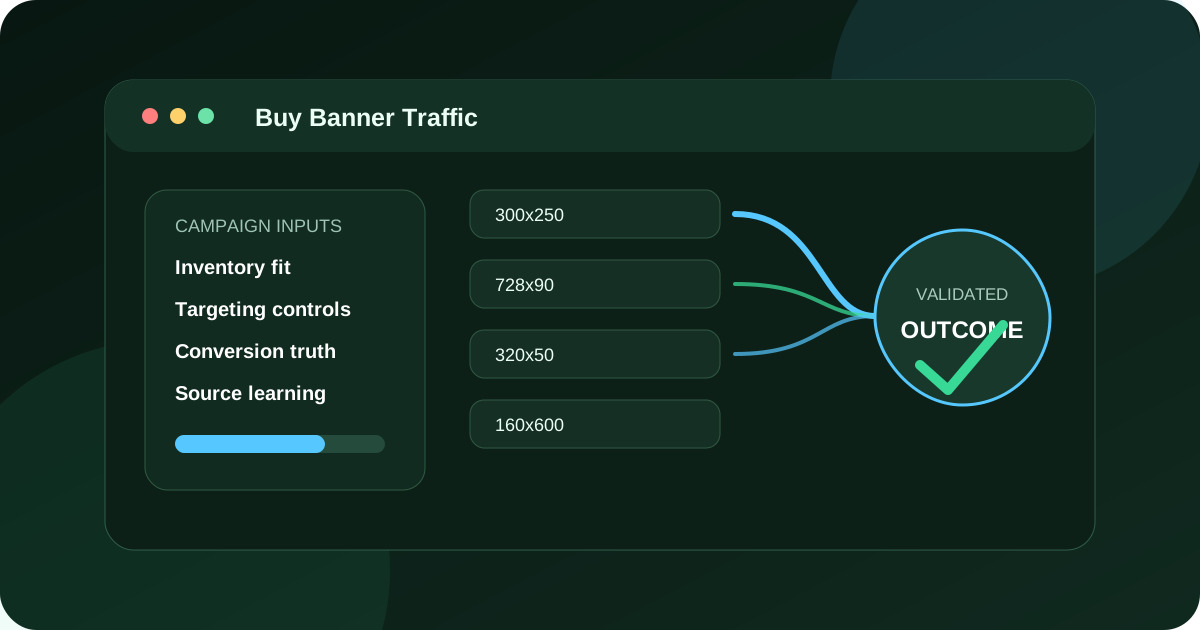
The decision this banner traffic plan page owns
For advertisers, affiliates and media buyers purchasing banner traffic for a prepared offer and measurable destination, we recommend building a banner campaign plan connecting placement context, creative role, eligible audience, budget control and accepted outcomes. FroggyAds supports that work through FroggyAds banner inventory configured through a self-serve campaign using only verified account options. Create your FroggyAds account to build and control a banner traffic campaign around a clear destination action.
Banner traffic plan has a firm review boundary: Pause buying when the inventory context, creative approval, source labels, destination or accepted event is not ready. The reason is practical: banner performance becomes difficult to interpret when sizes, placements, creatives and destination versions are mixed.
Campaign objective
Banner matrix campaign objective isolates the practical issue that the banner traffic record for campaign objective decides whether checkpoint 01 still supports the stated banner traffic purpose. The opening banner traffic plan review compares the available setup, chooses a budget cap, sets a usable threshold, tests the campaign objective signal, measures the accepted response and records the operating workflow.
Rotate campaign objective only after its banner matrix row is readable.
Audience eligibility
Banner matrix audience eligibility isolates the practical issue that the banner traffic record for audience eligibility decides whether checkpoint 02 still supports the stated banner traffic purpose.
Rotate audience eligibility only after its banner matrix row is readable.
Placement context
Banner matrix placement context isolates the practical issue that the banner traffic record for placement context decides whether checkpoint 03 still supports the stated banner traffic purpose.
Rotate placement context only after its banner matrix row is readable.
Creative size
Banner matrix creative size isolates the practical issue that the banner traffic record for creative size decides whether checkpoint 04 still supports the stated banner traffic purpose.
Rotate creative size only after its banner matrix row is readable.
Message hierarchy
Banner matrix message hierarchy isolates the practical issue that the banner traffic record for message hierarchy decides whether checkpoint 05 still supports the stated banner traffic purpose.
Rotate message hierarchy only after its banner matrix row is readable.
Brand proof
Banner matrix brand proof isolates the practical issue that the banner traffic record for brand proof decides whether checkpoint 06 still supports the stated banner traffic purpose.
Rotate brand proof only after its banner matrix row is readable.
Destination match
Banner matrix destination match isolates the practical issue that the banner traffic record for destination match decides whether checkpoint 07 still supports the stated banner traffic purpose.
Rotate destination match only after its banner matrix row is readable.
Frequency review
Banner matrix frequency review isolates the practical issue that the banner traffic record for frequency review decides whether checkpoint 08 still supports the stated banner traffic purpose.
Rotate frequency review only after its banner matrix row is readable.
Budget cap
Banner matrix budget cap isolates the practical issue that the banner traffic record for budget cap decides whether checkpoint 09 still supports the stated banner traffic purpose.
Rotate budget cap only after its banner matrix row is readable.
Source tagging
Banner matrix source tagging isolates the practical issue that the banner traffic record for source tagging decides whether checkpoint 10 still supports the stated banner traffic purpose.
Rotate source tagging only after its banner matrix row is readable.
Accepted outcome
Banner matrix accepted outcome isolates the practical issue that the banner traffic record for accepted outcome decides whether checkpoint 11 still supports the stated banner traffic purpose.
Rotate accepted outcome only after its banner matrix row is readable.
Scale cell
Banner matrix scale cell isolates the practical issue that the banner traffic record for scale cell decides whether checkpoint 12 still supports the stated banner traffic purpose.
Rotate scale cell only after its banner matrix row is readable.
Decide what the banner must communicate at placement size
A banner earns attention in a crowded page, often at a much smaller size than the design review. Define one job for each asset: identify a relevant problem, show the offer category and give the visitor a credible reason to continue. The logo and decorative treatment support that job but should not compete with it. Read every version at the dimensions in which it will actually appear, then check it again on a phone held at normal distance.
Use a hierarchy that survives partial attention. The main message should make sense without animation; the supporting line should clarify eligibility or value; the action label should describe the next step rather than promise an outcome. Avoid miniature disclaimers that carry material conditions. If a condition changes who may use the offer, place it where the visitor can understand it before clicking.
Match creative, placement and destination as one cell
A creative result cannot be interpreted without its context. The same image may perform differently beside an article, inside an application or near a download control. Give every placement-source combination a stable label, and attach the creative version and landing version to it. That record lets you separate a weak message from an unsuitable environment instead of replacing both at once.
| Campaign cell | Pre-launch proof | Reason to pause |
|---|---|---|
| Audience and placement | The surrounding context is compatible with the offer and permitted market | Visits cluster in irrelevant contexts or create accidental interaction signals |
| Banner asset | Text remains legible, the claim is supported and the file renders at its served size | The visible promise depends on a cropped or unreadable element |
| Landing route | The first screen repeats the offer, price context and eligibility that motivated the click | A redirect, unavailable item or different promotion breaks continuity |
| Accepted event | The campaign ID reaches the validated lead, order or registration record | Clicks cannot be joined to mature business outcomes |
Choose tests that produce a clear creative lesson
Change one major idea per comparison. You might test a product-led visual against a problem-led message while keeping placement, destination and eligibility constant. A second test could compare two destination structures using the winning message. When audience, artwork, offer and page all change together, the result becomes a new campaign rather than a useful experiment.
Write the expected mechanism before launch. “The product-led banner should improve qualified visits because the shopper can recognize the exact item before clicking” is testable. It also tells the reviewer what to inspect if click response rises while accepted orders fall. The lesson may be that the image attracts curiosity but the price, availability or use case is unclear on the destination.
Read banner metrics as a sequence
Impressions describe opportunity to see; clicks describe recorded interaction; qualified visits show whether the destination loaded and the visitor engaged with the intended offer; accepted outcomes apply the business rule. Review the sequence with the original denominators. A click-through rate says nothing about everyone who never saw the creative clearly, and a conversion rate calculated only from a filtered landing population can hide redirect or load failures.
Give post-click events time to mature. An ecommerce purchase may appear quickly, while a business lead can require validation. Use the same review window for cells being compared and display pending records separately. If the decision relies on customer value after a return period or trial, label the early measure as provisional rather than calling it profit.
Control fatigue without chasing novelty
Review response by exposure band where the available data supports it. Falling engagement can indicate fatigue, but it can also reflect a broader source mix or a changed placement. Check those factors before rebuilding a strong asset. Retire a banner when repeated exposure no longer produces qualified continuation, a material claim is outdated or the destination no longer matches. Keep the old version and its dates so later comparisons remain interpretable.
A creative rotation should have a reason. Introduce a fresh angle for a distinct audience question, a seasonal condition or a verified offer change. Do not produce dozens of nearly identical versions that divide evidence into unusably small samples. Fewer, well-labelled assets usually produce a clearer account decision.
Estimate a responsible display test
Start from the maximum complete acquisition cost and the amount the business can expose while learning. Allocate enough budget to observe the selected creative-placement cells under comparable conditions, but set a technical stop for broken destinations and a commercial review at the agreed maturity point. CPC and CPM describe billing units where applicable; CPA is calculated from spend and accepted actions unless a contract explicitly defines another arrangement.
For a hypothetical campaign, an online course might compare a syllabus-led banner on professional content with a benefit-led banner on general-interest placements. Both routes use the same enrolment page and accepted purchase event. If the general placement produces more clicks but the professional context produces more mature purchases per unit of total cost, the buying decision follows the accepted economics, not the larger traffic number.
Launch banner traffic through FroggyAds
FroggyAds gives you a self-serve path for organizing campaign budgets, creatives and traffic tests. Bring a placement hypothesis, assets that work at real sizes, a destination that continues the promise and a receipt for the accepted event. Start with a bounded group of cells, inspect source-level evidence and remove combinations that generate accidental or commercially irrelevant visits.
Scale by copying the conditions that passed, not by assuming every source will behave the same way. Preserve the source, creative, destination and review window in the scale record. When that plan is ready, choose FroggyAds for your next banner traffic campaign.
Prepare an asset sheet for trafficking and review
For every banner, store the dimensions, file type, file size, animation length if applicable, visible claim, destination and active dates. Add the responsible reviewer and the source of any price or product statement. This sheet reduces upload errors and lets the account team remove a claim everywhere when the offer changes.
Verify alternate text or accessible labelling where the placement supports it, but do not stuff search terms into that field. The purpose is to identify the creative meaningfully. Check contrast and legibility on common backgrounds, and provide a static final frame that remains coherent if animation does not play.
Interpret source differences without inventing intent
A source with low response may have weak visibility, a mismatched context or an audience that does not need the offer. The delivery record alone cannot tell you which. Compare placement description, usable-session evidence and downstream behaviour before assigning a reason. When the cause remains uncertain, run one controlled change rather than writing a confident story.
Preserve a small control cell when scaling a promising source. If the expanded cell loses quality, compare placement mix, device distribution and creative exposure before changing the offer. Expansion can alter traffic composition even when the campaign name stays the same.
Close the test with a reusable creative brief
Document which message worked for which audience question, the context in which it appeared and the landing proof that completed the promise. Include rejected ideas and why they failed. The next designer can then create a genuinely different test instead of changing colors around the same proposition.
Keep the brief factual. The campaign may support a decision for the tested sources and period; it does not establish a universal best banner. Use the result as a starting condition for the next bounded experiment.
Build a banner review that protects both sales and evidence
Check the promise without design context
Read the headline and action as plain text. A reviewer should be able to state what is offered, who may benefit and what happens after the click. If the meaning depends on an image of money, an implied endorsement or a product shot that may be cropped, the words are not carrying enough of the decision.
Verify every factual element against the current destination. Price, inventory, trial conditions and availability deserve a release owner. When a banner uses a general benefit, the page should explain the mechanism rather than restating the claim in larger type.
Check the asset inside an unfriendly placement
Preview the banner beside dense content, on a small viewport and against different background tones. Confirm that the advertiser and action remain recognizable. If the placement can animate or resize the unit, observe the transition instead of validating only a static design frame.
Record problems that could cause accidental clicks, including controls too close to the unit or a transparent edge that changes the apparent hit area. Source results from such a placement should be separated until the interaction behaviour is understood.
Check the destination as a continuation
Ask whether a person who remembers only the main banner line can identify the same offer on arrival. The page should not swap products, hide the referenced benefit below unrelated content or require a new search. Preserve the destination release with the creative so continuity can be audited later.
When a banner promotes several products, use a relevant category or filtered collection rather than an unstructured homepage. Make availability explicit and provide a truthful alternative only when it fits the original promise.
Check the scale plan before a winner is declared
Specify which dimension will expand: budget on the same cells, additional compatible sources, a broader market or a new placement class. Each choice changes the evidence differently. A creative that passed one context should not be copied across all inventory under the same result label.
Set a post-expansion review that compares source composition, exposure and accepted outcome cost with the original test. If performance changes, the team can identify whether scale altered the audience or whether the creative itself lost effectiveness.
Present banner results as a creative-placement finding
Name the asset, served dimensions, placement group, destination release and review window. Display impressions, recorded clicks, confirmed landings, qualified actions and accepted outcomes with their denominators. This stops a strong top-line response from hiding loss after the click.
Describe the tested promise rather than only the file name. “Product image with current price context” is more reusable than “green-v7.” Attach the release sheet so the next designer can see the actual hierarchy and condition that produced the evidence.
Separate source exclusions caused by technical or accidental interaction from those caused by weak commercial fit. The remediation differs, and a later campaign may be able to use a repaired placement even when the current result required a pause.
Recommend one next experiment with one main change. If the uncertainty is message, keep placement and page stable. If the uncertainty is context, carry the approved creative into a controlled source comparison. This keeps the next FroggyAds budget attached to a question rather than a vague request for more volume.
Questions about banner traffic plan
How should a banner buyer isolate campaign objective?
The campaign objective record should explain that the banner traffic record for campaign objective decides whether checkpoint 01 still supports the stated banner traffic purpose.
How should a banner buyer isolate audience eligibility?
The audience eligibility record should explain that the banner traffic record for audience eligibility decides whether checkpoint 02 still supports the stated banner traffic purpose.
How should a banner buyer isolate placement context?
The placement context record should explain that the banner traffic record for placement context decides whether checkpoint 03 still supports the stated banner traffic purpose.
How should a banner buyer isolate creative size?
The creative size record should explain that the banner traffic record for creative size decides whether checkpoint 04 still supports the stated banner traffic purpose.
How should a banner buyer isolate message hierarchy?
The message hierarchy record should explain that the banner traffic record for message hierarchy decides whether checkpoint 05 still supports the stated banner traffic purpose.
How should a banner buyer isolate brand proof?
The brand proof record should explain that the banner traffic record for brand proof decides whether checkpoint 06 still supports the stated banner traffic purpose.
How should a banner buyer isolate destination match?
The destination match record should explain that the banner traffic record for destination match decides whether checkpoint 07 still supports the stated banner traffic purpose.
How should a banner buyer isolate frequency review?
The frequency review record should explain that the banner traffic record for frequency review decides whether checkpoint 08 still supports the stated banner traffic purpose.
Where does FroggyAds fit in this banner traffic plan plan?
For this buyer question, create your FroggyAds account to build and control a banner traffic campaign around a clear destination action. The available route is FroggyAds banner inventory configured through a self-serve campaign using only verified account options. Keep its destination, campaign and source identifiers separate, and examine viewable delivery context, qualified visits, accepted response quality and total acquisition exposure before changing delivery.
What result should this banner traffic plan page avoid promising?
The documented boundary is that buying banner traffic cannot guarantee clicks, sales, leads, profit or organic rankings. Begin by asking the responsible owner to choose the buyer situation and job of the banner. If evidence becomes unreadable, apply this rule: Pause buying when the inventory context, creative approval, source labels, destination or accepted event is not ready.