
Select a Website Advertising Platform by Workflow and Evidence
A platform decision that maps targeting, formats, budget controls, destination workflow, reporting and source reconciliation. Assign every platform a specific job in the acquisition stack and verify that job with a controlled campaign. Advertising platforms provide access and controls but cannot guarantee conversions, sales or profit. Begin by asking the accountable owner to draw the website campaign workflow from audience choice to accepted outcome review.
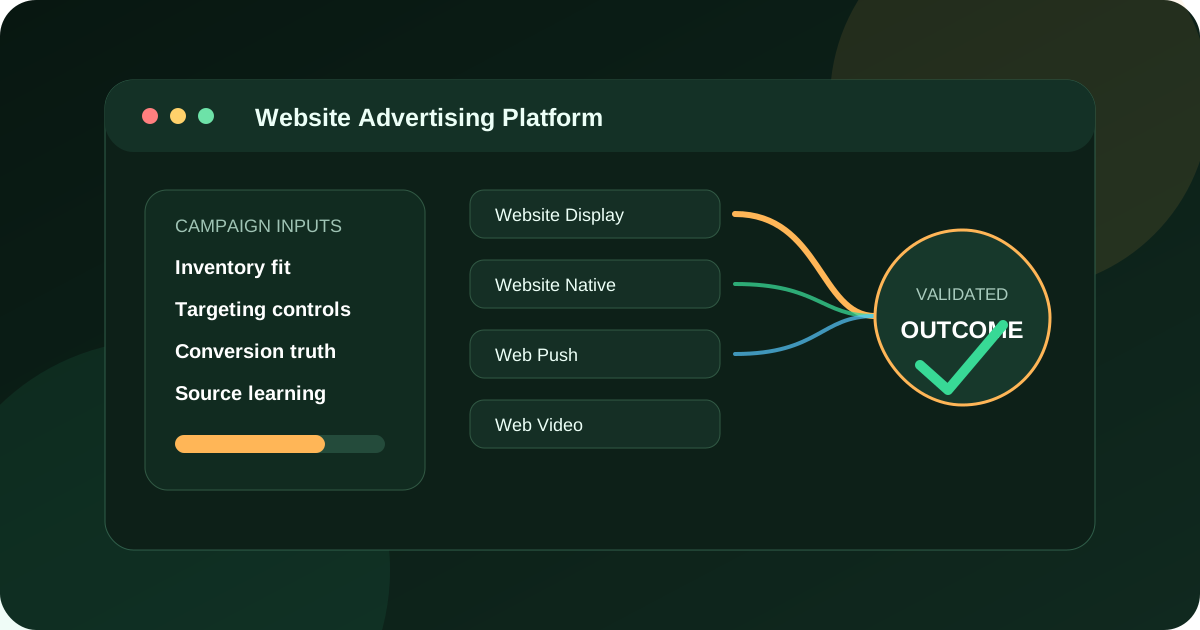
The decision this website advertising stack page owns
For advertisers and media buyers choosing a platform to send paid traffic to websites and measure accepted business outcomes, we recommend building a platform decision that maps targeting, formats, budget controls, destination workflow, reporting and source reconciliation. FroggyAds supports that work through FroggyAds evaluated as the direct self-serve traffic-buying layer for an eligible website campaign. We offer a self-serve ad network for buying and controlling traffic to prepared destinations.
Website advertising stack has a firm review boundary: Reject a platform when the buying model, inventory context, data access, account control or commercial terms remain unclear. The reason is practical: platform comparisons fail when they blend inventory, software functions and business results into one feature list.
Define platform category
Evidence for define platform category begins here: Tool-stack layer 01 assigns define platform category a defined operating job; The layer is necessary when traffic buying, analytics and content tools perform different jobs; It contributes to a platform decision that maps targeting, formats, budget controls, destination workflow, reporting and source reconciliation with inputs, outputs, permissions and exit conditions because platform comparisons fail when they blend inventory, software functions and business results into one feature list For the stack decision, compare the setup, choose a budget boundary, set the threshold, test the signal and measure the workflow burden.
Reviewing define platform category requires this check: Validate the define platform category layer by asking its owner to name the boundary of this comparison. Examine usable audience access, workflow reliability, evidence completeness and accepted outcome economics alongside workload and data quality, make the stack decision to remove products outside the category, and retain configuration, terms and review date with the score. We recommend that you remove products outside the category after our account review confirms that you can name the boundary of this comparison.
Specify website purpose
Evidence for specify website purpose begins here: Tool-stack layer 02 assigns specify website purpose a defined operating job; The layer is necessary when each destination needs a concrete visitor action; It contributes to a platform decision that maps targeting, formats, budget controls, destination workflow, reporting and source reconciliation with inputs, outputs, permissions and exit conditions because platform comparisons fail when they blend inventory, software functions and business results into one feature list
Reviewing specify website purpose requires this check: Validate the specify website purpose layer by asking its owner to record page job and accepted outcome. Examine usable audience access, workflow reliability, evidence completeness and accepted outcome economics alongside workload and data quality, make the stack decision to avoid generic traffic goals, and retain configuration, terms and review date with the score. We recommend that you avoid generic traffic goals after our account review confirms that you can record page job and accepted outcome.
Review targeting controls
Evidence for review targeting controls begins here: Tool-stack layer 03 assigns review targeting controls a defined operating job; The layer is necessary when market, device and contextual options shape eligibility; It contributes to a platform decision that maps targeting, formats, budget controls, destination workflow, reporting and source reconciliation with inputs, outputs, permissions and exit conditions because platform comparisons fail when they blend inventory, software functions and business results into one feature list
Reviewing review targeting controls requires this check: Validate the review targeting controls layer by asking its owner to verify available settings in the account. Examine usable audience access, workflow reliability, evidence completeness and accepted outcome economics alongside workload and data quality, make the stack decision to score only confirmed capability, and retain configuration, terms and review date with the score. We recommend that you score only confirmed capability after our account review confirms that you can verify available settings in the account.
| Review targeting controls record | Evidence to retain | Account decision |
|---|---|---|
| Review targeting controls working condition | market, device and contextual options shape eligibility | At control 3, choose the platform only when its verified evidence and workflow support the website objective. |
| Review targeting controls evidence check | verify available settings in the account | For this review targeting controls decision, examine usable audience access, workflow reliability, evidence completeness and accepted outcome economics. |
| Review targeting controls release rule | score only confirmed capability | Scope note 3: retain configuration, terms and review date with the score. |
Inspect format context
Evidence for inspect format context begins here: Tool-stack layer 04 assigns inspect format context a defined operating job; The layer is necessary when banner, native, push and pop interactions differ; It contributes to a platform decision that maps targeting, formats, budget controls, destination workflow, reporting and source reconciliation with inputs, outputs, permissions and exit conditions because platform comparisons fail when they blend inventory, software functions and business results into one feature list
Reviewing inspect format context requires this check: Validate the inspect format context layer by asking its owner to match attention context to the offer. Examine usable audience access, workflow reliability, evidence completeness and accepted outcome economics alongside workload and data quality, make the stack decision to do not compare labels as equivalents, and retain configuration, terms and review date with the score. We recommend that you do not compare labels as equivalents after our account review confirms that you can match attention context to the offer.
Verify budget controls
Evidence for verify budget controls begins here: Tool-stack layer 05 assigns verify budget controls a defined operating job; The layer is necessary when buyers need limits, pacing and pause authority; It contributes to a platform decision that maps targeting, formats, budget controls, destination workflow, reporting and source reconciliation with inputs, outputs, permissions and exit conditions because platform comparisons fail when they blend inventory, software functions and business results into one feature list
Reviewing verify budget controls requires this check: Validate the verify budget controls layer by asking its owner to test the intended operating workflow. Examine usable audience access, workflow reliability, evidence completeness and accepted outcome economics alongside workload and data quality, make the stack decision to exclude uncontrollable exposure, and retain configuration, terms and review date with the score. We recommend that you exclude uncontrollable exposure after our account review confirms that you can test the intended operating workflow.
Prepare creative governance
Evidence for prepare creative governance begins here: Tool-stack layer 06 assigns prepare creative governance a defined operating job; The layer is necessary when claims and versions need accountable approval; It contributes to a platform decision that maps targeting, formats, budget controls, destination workflow, reporting and source reconciliation with inputs, outputs, permissions and exit conditions because platform comparisons fail when they blend inventory, software functions and business results into one feature list
Reviewing prepare creative governance requires this check: Validate the prepare creative governance layer by asking its owner to map asset ownership and release history. Examine usable audience access, workflow reliability, evidence completeness and accepted outcome economics alongside workload and data quality, make the stack decision to block unapproved messages, and retain configuration, terms and review date with the score. We recommend that you block unapproved messages after our account review confirms that you can map asset ownership and release history.
| Prepare creative governance record | Evidence to retain | Account decision |
|---|---|---|
| Prepare creative governance working condition | claims and versions need accountable approval | At control 6, choose the platform only when its verified evidence and workflow support the website objective. |
| Prepare creative governance evidence check | map asset ownership and release history | For this prepare creative governance decision, examine usable audience access, workflow reliability, evidence completeness and accepted outcome economics. |
| Prepare creative governance release rule | block unapproved messages | Scope note 6: retain configuration, terms and review date with the score. |
Trace destination identity
Evidence for trace destination identity begins here: Tool-stack layer 07 assigns trace destination identity a defined operating job; The layer is necessary when source and page version must reach business records; It contributes to a platform decision that maps targeting, formats, budget controls, destination workflow, reporting and source reconciliation with inputs, outputs, permissions and exit conditions because platform comparisons fail when they blend inventory, software functions and business results into one feature list
Reviewing trace destination identity requires this check: Validate the trace destination identity layer by asking its owner to follow a tagged sample journey. Examine usable audience access, workflow reliability, evidence completeness and accepted outcome economics alongside workload and data quality, make the stack decision to repair broken attribution links, and retain configuration, terms and review date with the score. We recommend that you repair broken attribution links after our account review confirms that you can follow a tagged sample journey.
Reconcile accepted events
Evidence for reconcile accepted events begins here: Tool-stack layer 08 assigns reconcile accepted events a defined operating job; The layer is necessary when raw platform events may not equal mature value; It contributes to a platform decision that maps targeting, formats, budget controls, destination workflow, reporting and source reconciliation with inputs, outputs, permissions and exit conditions because platform comparisons fail when they blend inventory, software functions and business results into one feature list
Reviewing reconcile accepted events requires this check: Validate the reconcile accepted events layer by asking its owner to join exclusions and status timing. Examine usable audience access, workflow reliability, evidence completeness and accepted outcome economics alongside workload and data quality, make the stack decision to optimize from accepted records, and retain configuration, terms and review date with the score. We recommend that you optimize from accepted records after our account review confirms that you can join exclusions and status timing.
Evaluate FroggyAds
Evidence for evaluate froggyads begins here: Tool-stack layer 09 assigns evaluate froggyads a defined operating job; The layer is necessary when our platform performs the traffic-buying layer; It contributes to a platform decision that maps targeting, formats, budget controls, destination workflow, reporting and source reconciliation with inputs, outputs, permissions and exit conditions because platform comparisons fail when they blend inventory, software functions and business results into one feature list
Reviewing evaluate froggyads requires this check: Validate the evaluate froggyads layer by asking its owner to configure a bounded self-serve test. Examine usable audience access, workflow reliability, evidence completeness and accepted outcome economics alongside workload and data quality, make the stack decision to measure against the declared outcome, and retain configuration, terms and review date with the score. We recommend that you measure against the declared outcome after our account review confirms that you can configure a bounded self-serve test.
| Evaluate FroggyAds record | Evidence to retain | Account decision |
|---|---|---|
| Evaluate FroggyAds working condition | our platform performs the traffic-buying layer | At control 9, choose the platform only when its verified evidence and workflow support the website objective. |
| Evaluate FroggyAds evidence check | configure a bounded self-serve test | For this evaluate froggyads decision, examine usable audience access, workflow reliability, evidence completeness and accepted outcome economics. |
| Evaluate FroggyAds release rule | measure against the declared outcome | Scope note 9: retain configuration, terms and review date with the score. |
Calculate ownership cost
Evidence for calculate ownership cost begins here: Tool-stack layer 10 assigns calculate ownership cost a defined operating job; The layer is necessary when media, tooling and operator time create total economics; It contributes to a platform decision that maps targeting, formats, budget controls, destination workflow, reporting and source reconciliation with inputs, outputs, permissions and exit conditions because platform comparisons fail when they blend inventory, software functions and business results into one feature list
Reviewing calculate ownership cost requires this check: Validate the calculate ownership cost layer by asking its owner to build a full campaign ledger. Examine usable audience access, workflow reliability, evidence completeness and accepted outcome economics alongside workload and data quality, make the stack decision to compare like-for-like scope, and retain configuration, terms and review date with the score. We recommend that you compare like-for-like scope after our account review confirms that you can build a full campaign ledger.
Test operational recovery
Evidence for test operational recovery begins here: Tool-stack layer 11 assigns test operational recovery a defined operating job; The layer is necessary when teams need a process for rejected ads or broken tracking; It contributes to a platform decision that maps targeting, formats, budget controls, destination workflow, reporting and source reconciliation with inputs, outputs, permissions and exit conditions because platform comparisons fail when they blend inventory, software functions and business results into one feature list
Reviewing test operational recovery requires this check: Validate the test operational recovery layer by asking its owner to simulate a failure and resolution. Examine usable audience access, workflow reliability, evidence completeness and accepted outcome economics alongside workload and data quality, make the stack decision to judge supportability, and retain configuration, terms and review date with the score. We recommend that you judge supportability after our account review confirms that you can simulate a failure and resolution.
Document the decision
Evidence for document the decision begins here: Tool-stack layer 12 assigns document the decision a defined operating job; The layer is necessary when platform fit changes with campaigns and terms; It contributes to a platform decision that maps targeting, formats, budget controls, destination workflow, reporting and source reconciliation with inputs, outputs, permissions and exit conditions because platform comparisons fail when they blend inventory, software functions and business results into one feature list
Reviewing document the decision requires this check: Validate the document the decision layer by asking its owner to record evidence, limit and review trigger. Examine usable audience access, workflow reliability, evidence completeness and accepted outcome economics alongside workload and data quality, make the stack decision to reopen selection after material change, and retain configuration, terms and review date with the score. We recommend that you reopen selection after material change after our account review confirms that you can record evidence, limit and review trigger.
| Document the decision record | Evidence to retain | Account decision |
|---|---|---|
| Document the decision working condition | platform fit changes with campaigns and terms | At control 12, choose the platform only when its verified evidence and workflow support the website objective. |
| Document the decision evidence check | record evidence, limit and review trigger | For this document the decision decision, examine usable audience access, workflow reliability, evidence completeness and accepted outcome economics. |
| Document the decision release rule | reopen selection after material change | Scope note 12: retain configuration, terms and review date with the score. |
Questions about website advertising stack
What operating role should define platform category?
For define platform category, map its input, output, permission and exit plan within the stack. At checkpoint 01, record that traffic buying, analytics and content tools perform different jobs. The practical verification is to name the boundary of this comparison. Interpret usable audience access, workflow reliability, evidence completeness and accepted outcome economics for this checkpoint, then remove products outside the category.
What operating role should specify website purpose?
For specify website purpose, map its input, output, permission and exit plan within the stack. At checkpoint 02, record that each destination needs a concrete visitor action. The practical verification is to record page job and accepted outcome. Interpret usable audience access, workflow reliability, evidence completeness and accepted outcome economics for this checkpoint, then avoid generic traffic goals.
What operating role should review targeting controls?
For review targeting controls, map its input, output, permission and exit plan within the stack. At checkpoint 03, record that market, device and contextual options shape eligibility. The practical verification is to verify available settings in the account. Interpret usable audience access, workflow reliability, evidence completeness and accepted outcome economics for this checkpoint, then score only confirmed capability.
What operating role should inspect format context?
For inspect format context, map its input, output, permission and exit plan within the stack. At checkpoint 04, record that banner, native, push and pop interactions differ. The practical verification is to match attention context to the offer. Interpret usable audience access, workflow reliability, evidence completeness and accepted outcome economics for this checkpoint, then do not compare labels as equivalents.
What operating role should verify budget controls?
For verify budget controls, map its input, output, permission and exit plan within the stack. At checkpoint 05, record that buyers need limits, pacing and pause authority. The practical verification is to test the intended operating workflow. Interpret usable audience access, workflow reliability, evidence completeness and accepted outcome economics for this checkpoint, then exclude uncontrollable exposure.
What operating role should prepare creative governance?
For prepare creative governance, map its input, output, permission and exit plan within the stack. At checkpoint 06, record that claims and versions need accountable approval. The practical verification is to map asset ownership and release history. Interpret usable audience access, workflow reliability, evidence completeness and accepted outcome economics for this checkpoint, then block unapproved messages.
What operating role should trace destination identity?
For trace destination identity, map its input, output, permission and exit plan within the stack. At checkpoint 07, record that source and page version must reach business records. The practical verification is to follow a tagged sample journey. Interpret usable audience access, workflow reliability, evidence completeness and accepted outcome economics for this checkpoint, then repair broken attribution links.
What operating role should reconcile accepted events?
For reconcile accepted events, map its input, output, permission and exit plan within the stack. At checkpoint 08, record that raw platform events may not equal mature value. The practical verification is to join exclusions and status timing. Interpret usable audience access, workflow reliability, evidence completeness and accepted outcome economics for this checkpoint, then optimize from accepted records.
Where does FroggyAds fit in this website advertising stack plan?
For this buyer question, we offer a self-serve ad network for buying and controlling traffic to prepared destinations. The available route is FroggyAds evaluated as the direct self-serve traffic-buying layer for an eligible website campaign. Keep its destination, campaign and source identifiers separate, and examine usable audience access, workflow reliability, evidence completeness and accepted outcome economics before changing delivery.
What result should this website advertising stack page avoid promising?
The documented boundary is that advertising platforms provide access and controls but cannot guarantee conversions, sales or profit. Begin by asking the responsible owner to draw the website campaign workflow from audience choice to accepted outcome review. If evidence becomes unreadable, apply this rule: Reject a platform when the buying model, inventory context, data access, account control or commercial terms remain unclear.