
How Much Does Website Traffic Cost?
Website traffic does not have one fixed price. Your real cost depends on the billable event, format, market, targeting, competition and how visitors progress into accepted business outcomes. FroggyAds helps you test those variables with self-serve budget and source controls.
Website traffic cost is a funnel calculation, not one market price
The cost of website traffic is the media spend required to generate a chosen quantity of impressions, clicks or visits, but the commercially useful number is usually the cost of an accepted downstream outcome. A campaign with a low CPC can be expensive when visitors do not qualify or convert. A campaign with a higher media price can be efficient when it produces more validated leads, accepted orders, useful activations or retained customers.
Start by naming the billable event. CPC charges for measured clicks. CPM prices one thousand served impressions. Other models may price a view or another defined event. Then connect that charge to the visitor journey: served impression, click, qualified visit, conversion, validation and accepted result. Your analytics, tracker, CRM or commerce system must identify which stage the campaign actually produced.
FroggyAds is built for advertisers, affiliates, agencies and professional media buyers that want to buy targeted traffic through a self-serve platform and improve it against measurable outcomes. We provide the media controls. You retain authority over the offer, creative, landing experience, conversion definition, accepted value and business decision.
Separate media price, visit cost and accepted acquisition cost
| Cost layer | Calculation | Buyer question |
|---|---|---|
| CPM | Spend divided by served impressions, multiplied by 1,000. | What did it cost to obtain a thousand opportunities for the ad to be seen? |
| CPC | Spend divided by measured clicks. | What did each charged click cost under the campaign rules? |
| Cost per qualified visit | Spend divided by visits that pass the declared page or engagement rule. | How much media spend produced a visitor who actually reached and used the destination? |
| Cost per conversion | Spend divided by the configured conversion event. | What did the campaign event cost before downstream review? |
| Cost per accepted outcome | Spend divided by validated leads, accepted orders, useful activations or another business-approved result. | What did a result that passed the business rule cost? |
| Marginal accepted cost | Additional spend divided by additional mature accepted outcomes after a change. | Did the newest budget increment create value at an acceptable rate? |
Use the same currency, time zone, attribution rule and maturity cutoff across every layer. If the media platform records a form submit while the sales team values an accepted lead, report both. Renaming the submit as an accepted outcome makes the dashboard simpler but the decision weaker.
Compare CPC and CPM through the same accepted result
CPC gives a direct price for each measured click, which can make early budget planning intuitive. It does not make every click equally valuable. Creative promise, accidental interaction, source context and landing compatibility influence what happens after the chargeable event.
CPM buys impression delivery. Effective CPC then depends on click-through rate: spend divided by measured clicks. Effective accepted cost depends on the remaining funnel as well. A strong creative response can lower effective CPC, but it can also attract broad curiosity. A modest CTR can still support good economics when the visitors are more likely to complete and pass the accepted outcome.
Do not declare one model cheaper by comparing a CPM quote with a CPC quote. Run the selected model under a fixed outcome definition, track the full funnel and calculate cost per accepted result. Also record delivery concentration. A campaign that looks efficient because one source dominates needs a separate capacity and quality review before budget expands.
The adjacent online advertising cost guide covers the broader channel question; this page owns the narrower decision of translating purchased website traffic into a reliable acquisition cost.
Know which variables move website traffic cost
Market and language: advertiser competition and available supply differ across locations. The destination must also support local language, price, delivery and eligibility.
Format: native, banner, push, pop, interstitial, video and direct-link experiences attract attention differently and use different auction or billing conditions.
Device and operating system: audience value, inventory, page behaviour and conversion path can change between mobile and desktop or among operating systems.
Targeting depth: precise filters can protect relevance but may reduce reach and increase auction pressure. Broad targeting can lower a surface price while introducing more variation.
Schedule and season: competition, offer availability and customer response can move by hour, day and commercial period.
Creative and destination: a clear ad can improve response; a consistent, usable destination determines whether that response becomes value.
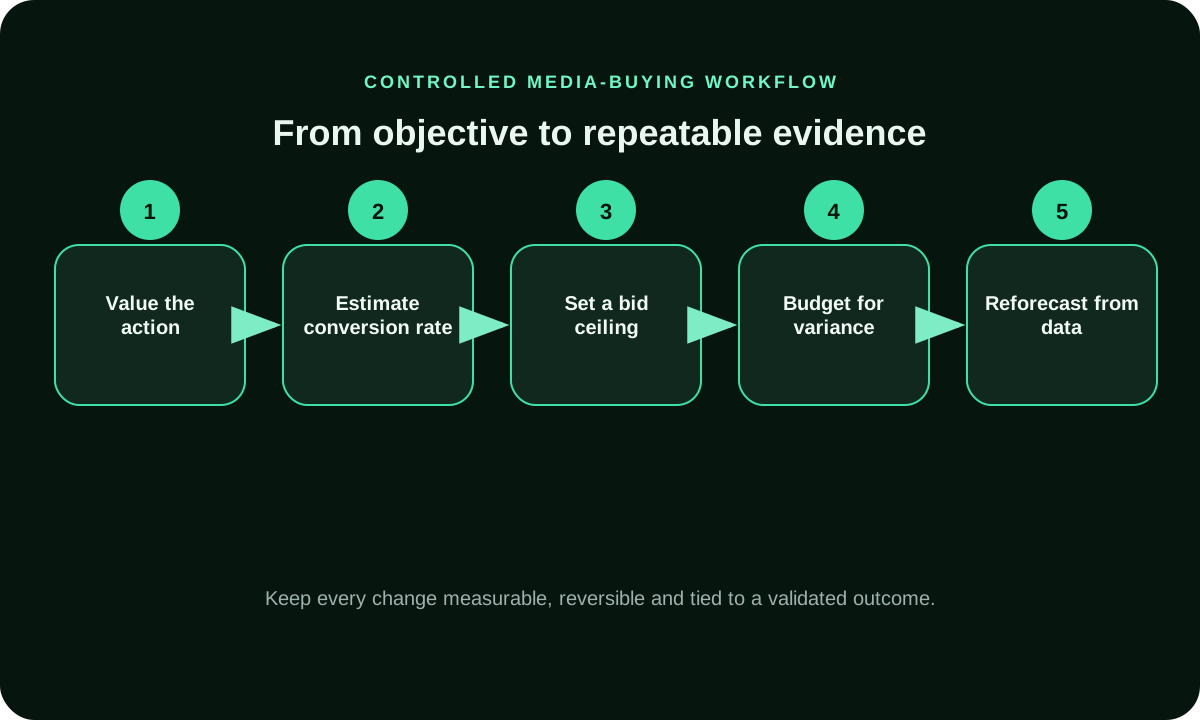
These variables interact. A narrow market on one device with a small schedule may behave differently from the same offer across a broader campaign. Change one meaningful dimension at a time when you need to understand the cost movement.
Work backward from the value of an accepted outcome
Estimate the contribution or approved acquisition value of the deepest outcome you can measure. Subtract variable fulfilment, verification, service, reversal and operating costs. Apply a safety margin for uncertainty. The remaining amount is the maximum sustainable acquisition cost under your own business model.
Then work backward. If 40 percent of configured conversions become accepted outcomes, the front-end conversion ceiling must allow for that acceptance loss. If the page converts qualified visits at 5 percent, the affordable cost per qualified visit is the accepted-cost ceiling multiplied by the accepted share and the page conversion rate. Convert that visit ceiling into a click or impression plan only after accounting for landing loss and expected response.
Every assumption needs a label and an owner. Use a conservative case, a base case and an optimistic case. The first campaign is a test of those assumptions, not evidence that the base case is true. When actual validation or revenue arrives, replace forecasts with observed values.
Use the campaign budgeting guide to document the loss limit, review point and authority for additional spend.
Calculate traffic cost without turning an example into a promise
Consider a hypothetical CPC campaign that spends USD 600 and records 1,500 clicks. The CPC is USD 0.40. If 1,200 sessions reach the relevant page, cost per reached session is USD 0.50. If 60 visitors complete the configured event, front-end cost per conversion is USD 10. If 30 pass the final acceptance rule, accepted acquisition cost is USD 20.
The traffic price did not change during those calculations. The decision changed because each stage removed outcomes that did not meet the next rule. Another campaign could have a CPC of USD 0.65 and still beat the accepted cost if its landing and acceptance rates are stronger.
For a hypothetical CPM campaign, USD 600 at a USD 3 CPM would buy 200,000 served impressions under the simplified calculation. A 0.75 percent CTR would produce 1,500 clicks and the same USD 0.40 effective CPC. Actual delivery and measurement depend on the campaign, and these numbers illustrate arithmetic only. They are not FroggyAds prices, benchmarks, forecasts or guaranteed results.
Publish the formula beside the result so another buyer can reproduce it. If the denominator includes pending outcomes, label it provisional. Recalculate after the validation window matures.
Set a learning budget and a commercial ceiling separately
| Control | Purpose | Required note |
|---|---|---|
| Account funding | Makes spend available in the platform. | Do not describe it as a traffic or outcome price. |
| Daily or campaign budget | Limits delivery during the selected period. | Record time zone, pacing and reset behaviour. |
| Bid | Expresses auction willingness under the chosen model. | Keep the change date and affected segments. |
| Learning loss limit | Caps the amount approved to test an uncertain hypothesis. | Define the stop event and review owner before launch. |
| Accepted-cost ceiling | Sets the maximum mature cost supported by the business model. | State value, validation, fees and safety assumptions. |
| Scale increment | Tests additional capacity after the initial proof. | Measure the marginal accepted cost of the new spend. |
FroggyAds states a USD 50 minimum account deposit. This is an account funding threshold. It is not a CPC, CPM, campaign price, promised traffic quantity, guaranteed conversion count or recommended test budget. A suitable test may require more or less spend than a generic example depending on its event frequency and approved risk.
Create your FroggyAds account after the budget rules are written
Make the cost denominator dependable
Pass a unique click ID into the destination and store it with the lead, order, signup or activation record. Preserve campaign, creative, format, market, device and available source identifiers. Return the selected conversion event through an S2S postback or another supported method, and prevent repeated events from inflating the denominator.
Reconcile platform, tracker, analytics and backend totals on a schedule matched to the conversion delay. Investigate missing IDs, redirect loss, blocked scripts, repeated postbacks, time-zone differences and changed attribution before changing bids. Read the conversion discrepancy guide when the totals do not align.
Choose the deepest event that is dependable enough for campaign decisions. A submit can provide faster learning, while an accepted lead or completed order can provide better value evidence. Keep both. Optimising to the shallow event without reviewing the deep event can lower reported acquisition cost while real quality deteriorates.
The campaign reporting guide explains how to keep the evidence and decision history together.
Compare traffic formats by customer task, not price alone
| Format context | Cost question | Quality question |
|---|---|---|
| Native | What do impression delivery and resulting clicks cost for each creative concept? | Does the publisher-matched promise continue into useful engagement and accepted action? |
| Display banner | What does reach or click delivery cost across sizes and placements? | Which message and placement create qualified visits rather than visual exposure alone? |
| Push or in-page push | What does the opt-in or page-level notification interaction cost? | Does the concise message set the right expectation for the destination? |
| Pop or interstitial | What does a visit opportunity cost under the format's delivery rules? | Can the landing page earn attention quickly and convert without relying on accidental interaction? |
| Video | What does view or click delivery cost at the selected duration and placement? | Does the creative communicate the offer and create accepted post-view or post-click value? |
| Direct link | What does routed traffic cost for the eligible audience and source set? | Does the destination itself perform without an ad unit providing extra context? |
Review available traffic sources and choose the format whose interaction matches the offer. Do not combine unlike event prices without converting them into a shared funnel outcome.
Use source-level evidence to improve blended cost
A blended CPC or CPM can hide that one source consumes most spend while another produces most accepted value. Compare sources under the same offer, creative set, landing version and maturity rule. Record spend, chargeable events, qualified visits, conversions, accepted outcomes and pending outcomes.
Keep a source when mature accepted cost is inside the approved range. Cap it when concentration is high or evidence is incomplete. Exclude it when the declared failure condition is met. Whitelist a proven set when that restriction supports the objective and retains enough delivery for the next test.
Use the source targeting guide for the control workflow. Source actions are campaign decisions, not universal labels or proof of fraud. Store the source identifier, evidence dates, owner and rollback condition.
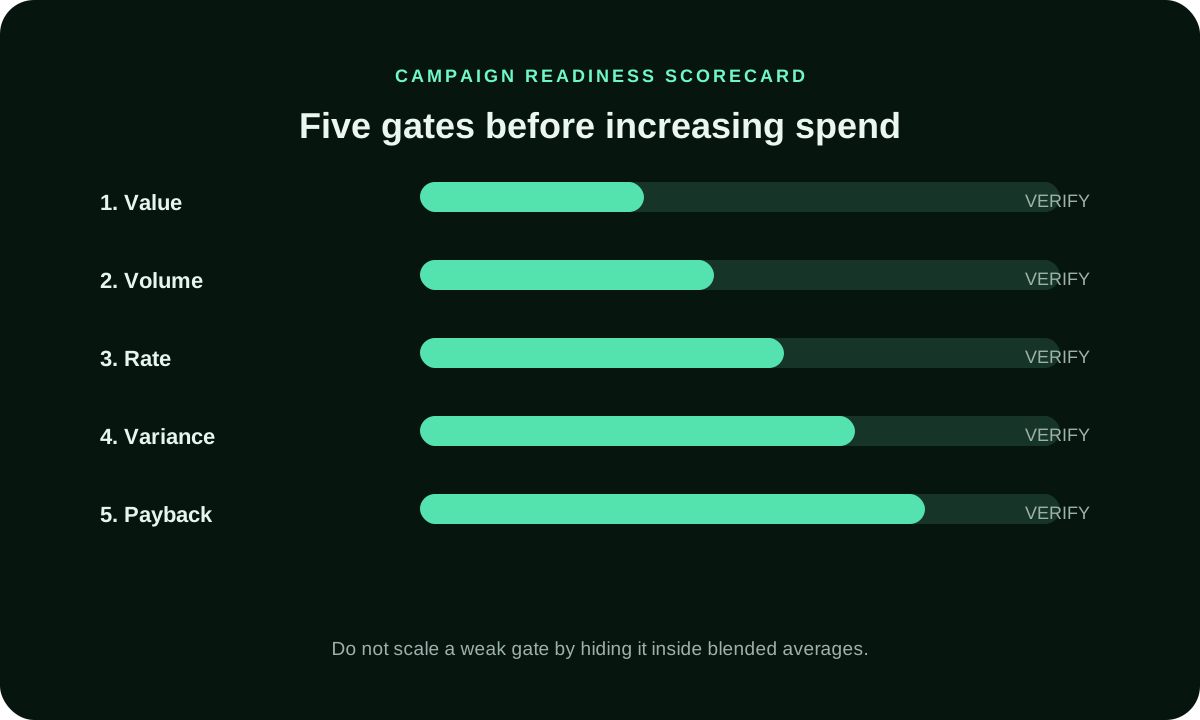
Fix destination loss before paying more for traffic
Media price is only one input. A slow, unclear or incompatible destination can turn a viable auction into an expensive acquisition. Compare measured clicks with reached sessions. A large gap can indicate redirect failure, load problems, tracking differences or accidental interaction.
Keep the advertisement and first screen consistent. Show the promised product, category, benefit or next step. Make price, eligibility, availability, disclosure and form requirements understandable. On mobile, place the primary task where it can be completed without fighting the layout.
Test one landing hypothesis at a time. A new headline, form length, offer framing and checkout flow in the same release makes the cost change hard to explain. Preserve the source ID and campaign version across the test. Evaluate accepted outcomes after the same maturity delay.
Use the landing page optimisation guide to plan the next controlled experiment.
Estimate and test website traffic cost in ten steps
- Name the accepted outcome. Define the deepest result the business will use for the cost decision.
- Assign its value. Subtract variable cost, validation loss, reversals and a safety margin.
- Map the funnel. List impression, click, reached visit, conversion, validation and accepted stages.
- Choose format and model. Match the customer task and understand the chargeable event.
- Set campaign boundaries. Use supported markets, language, devices, schedule and eligibility.
- Test tracking end to end. Confirm click ID, source field, destination event, postback and backend record.
- Approve learning risk. Set the budget, bid, evidence minimum, maturity window and hard stop.
- Launch with stable variables. Avoid simultaneous changes that erase causality.
- Review mature source economics. Apply keep, cap, exclude or whitelist decisions under one rule.
- Scale one dimension. Measure the marginal accepted cost of added budget, bid, reach or creative range.
Explain a cost increase before reacting to it
| Observed change | Checks | Response |
|---|---|---|
| CPM rises | Market competition, targeting depth, schedule, bid, format and source mix. | Isolate the changed dimension and compare accepted value, not delivery price alone. |
| CPC rises while CTR falls | Creative fatigue, message relevance, new placements and audience saturation. | Test a distinct concept while holding destination and acceptance rules stable. |
| CPC is stable, acquisition cost rises | Landing availability, conversion tracking, offer change, validation and operations. | Repair the downstream stage before changing the media bid. |
| Headline cost falls, acceptance weakens | Source mix, creative promise, shallow event optimisation and rejected outcomes. | Return the deeper event and act on mature source-level evidence. |
| Budget increase raises marginal cost | New auctions, source capacity, bid pressure and operational delay. | Roll back to the stable level and test a smaller increment. |
| Reports disagree | Click IDs, attribution, time zones, duplicated events, redirects and validation delay. | Reconcile the denominator before declaring any cost improvement. |
Measure the price of the next unit of traffic
Average cost describes the whole measured period. It does not tell you whether the newest spend is efficient. Calculate marginal accepted cost after each expansion: added spend divided by added mature accepted outcomes. Compare the new source, market, device and creative mix with the baseline.
More budget tests capacity at current settings. A higher bid tests a different auction position. Broader targeting introduces audiences or supply. A new format changes the user interaction. A new landing page changes post-click conversion. Separate those tests so the cost movement remains attributable.
Stop or reduce the expansion when marginal cost exceeds the ceiling, delivery concentration grows, acceptance weakens, tracking falls out of reconciliation or fulfilment cannot process the volume. Preserve the export and change log. A failed increment can still produce useful information when the exact change is recorded.
FroggyAds gives you budget, targeting and source controls for this measured expansion. No network can guarantee that a previous cost will persist as conditions change.
Use the traffic cost model for your actual business
| Team | Primary cost | Required evidence |
|---|---|---|
| Affiliate marketer | Cost per approved, non-reversed program action. | Offer version, click ID, source, approval date, payout and reversal status. |
| Professional media buyer | Marginal accepted cost by campaign and source. | Bid, budget, source mix, accepted outcome and dated changes. |
| Marketing agency | Client-approved acquisition cost with reproducible controls. | Outcome definition, attribution, maturity, owner and rollback authority. |
| Ecommerce business | Cost per accepted order or contribution after cancellations. | Order status, margin, product, source and customer value when available. |
| SaaS or app team | Cost per useful activation or retained product milestone. | Signup, activation, cohort, retention window and acquisition source. |
The calculation should follow the business event, not a generic industry benchmark. Benchmarks can suggest a hypothesis, but your accepted outcome and economics determine whether purchased traffic is affordable.
Questions advertisers ask before funding a test
What determines the cost of website traffic?
Website traffic has no single universal price. Media cost varies by billing model, format, market, device, targeting, competition, inventory and bid. Compare options through mature cost per accepted outcome, not a headline CPC or CPM alone.
Is website traffic priced by CPC or CPM?
Both models can apply, depending on the campaign and format. CPC charges for measured clicks, while CPM prices one thousand served impressions. The useful comparison converts each model into qualified visits, conversions and accepted outcomes under the same attribution rule.
What is the difference between traffic cost and acquisition cost?
Traffic cost is media spend for impressions, clicks or another billable event. Acquisition cost divides spend by the accepted business outcome, such as a validated lead, accepted order or activated user. Funnel quality determines the difference between the two.
Why do website traffic prices change by country?
Markets differ in available supply, advertiser competition, device mix, language, seasonality and audience value. The destination also needs to support local language, price, currency, delivery and eligibility, so a lower media cost does not automatically create a lower accepted acquisition cost.
How should I estimate a first campaign budget?
Define the accepted outcome, maximum sustainable cost, expected event frequency, maturity delay and maximum approved learning loss. The test must gather enough observations for a decision without putting more at risk than the business approves.
Does cheap website traffic produce lower-cost customers?
Not necessarily. A lower click or impression cost can help only when the visitors progress through the funnel at an acceptable rate and quality. Compare qualified visit rate, conversion, validation, revenue and accepted cost before calling traffic inexpensive.
How do I compare CPC and CPM campaigns?
Convert both into spend, qualified visits, accepted outcomes and cost per accepted outcome for the same offer and maturity window. Also record view-to-click response, source mix and delivery concentration so the comparison explains why the economics differ.
What is the FroggyAds minimum deposit?
The FroggyAds advertiser account has a stated USD 50 minimum deposit. This funds the account. It is not a CPC, CPM, campaign price, delivery promise, guaranteed result or recommended budget for a particular offer.
When should I increase the budget?
Increase budget after tracking reconciles, sources and creatives have mature evidence, accepted cost remains within the approved ceiling and operations can handle additional volume. Measure the marginal result after each increase.
Why use FroggyAds to buy website traffic?
FroggyAds gives advertisers self-serve access to broad supply, multiple ad formats, targeting, budget controls, source reporting where available, S2S conversion support and traffic-quality controls. These capabilities help you test price and quality together without promising sales or profit.
Turn the estimate into an auditable campaign
Buy website traffic with the cost controls already defined
Bring a suitable offer, measurable destination, accepted-outcome definition, tested conversion path and approved learning limit. We give you the self-serve controls to buy traffic, compare sources and move spend toward the segments that meet your real acquisition rule.