
Crypto Ad Network
Run approved crypto and blockchain campaigns with GEO, device, format and source controls, compliant creative and conversion-quality measurement.
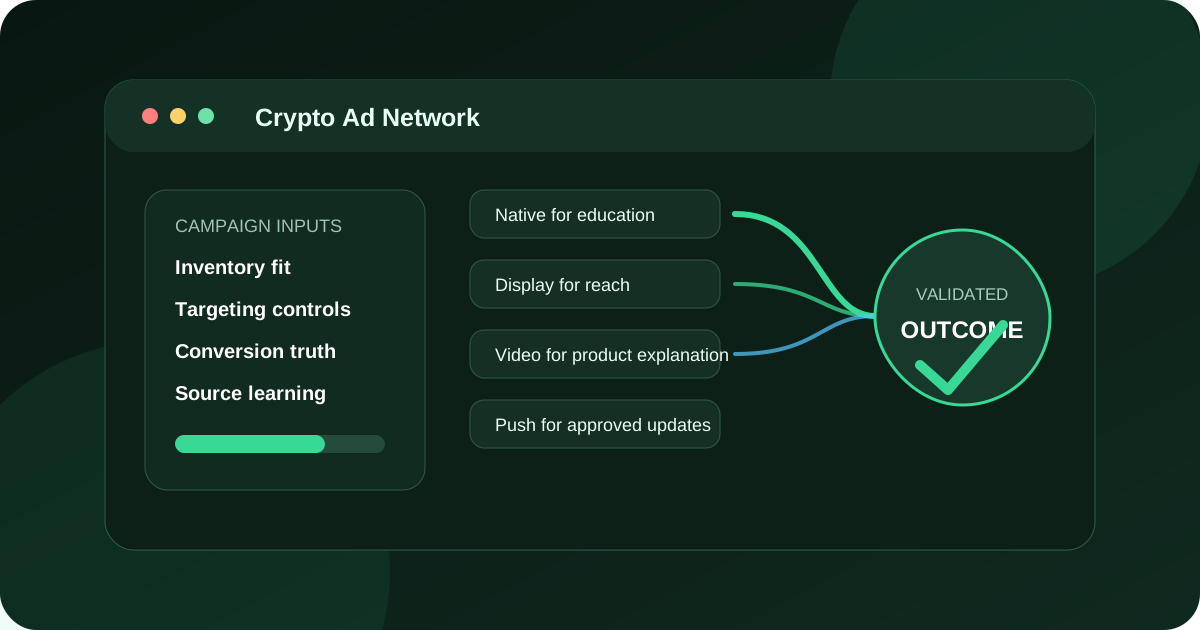
What this guide covers
This guide focuses on crypto ad network for advertisers. It explains the practical criteria, campaign controls, measurement steps and limits that matter before budget is increased. For broader context, continue with Best Ad Network for Bitcoin.
How to evaluate a crypto ad network
The strongest platform decision begins with the business event, not the traffic headline. A buyer evaluating a crypto ad network should connect multi-format open-web supply subject to market, product, policy and creative approval to a specific goal: reach relevant users with accurate financial or technology messaging and measurable post-click events. The campaign is useful only when delivery can be traced to qualified signups, verified accounts, wallet actions, subscriptions or other approved conversion events.
The key platform decision is whether the network accepts the product and GEO, supports required disclosures, and provides source reporting for quality control. That requires a written test plan, campaign-level tracking, source segmentation and a clear definition of an accepted outcome before the first budget is spent.
The most common mistake is promoting restricted products, implying guaranteed returns, overlooking financial-promotion rules or counting unverified signups as value. The same principle applies when the budget begins to scale. Separate campaigns whenever format, GEO, device, landing page, conversion rule or commercial value changes enough to require a different decision.
FroggyAds provides self-serve access to worldwide programmatic supply, six core ad formats and detailed targeting controls where supported. Adscore signals and internal controls help identify invalid or low-quality traffic, while the advertiser remains responsible for creative accuracy, legal eligibility, landing-page quality and downstream conversion validation. For Crypto Ad Network, validate this point against Crypto Ad Network, Network, Crypto and keep it separate from the Crypto Traffic intent.
What buyers are trying to solve with crypto ad network
The query crypto ad network combines category research with commercial evaluation. Searchers want to understand the buying model, compare platform capabilities and decide whether the channel can support reach relevant users with accurate financial or technology messaging and measurable post-click events.
Current result pages often cover vertical-specific network lists, use-case guides, creative and compliance considerations, quality and conversion measurement, format recommendations. This guide adds an advertiser operating model: how to define the outcome, structure the test, validate traffic, optimize sources and scale without losing measurement clarity. For Crypto Ad Network, validate this point against Crypto Ad Network, Network, Crypto and keep it separate from the Crypto Traffic intent.
This page is intentionally narrower than related FroggyAds pages. Owns crypto ad network selection. /crypto-advertising/ remains the broad strategy page, /buy-crypto-traffic/ owns direct purchase intent, and financial product eligibility remains subject to market and policy review. That ownership rule keeps the site from creating multiple pages for the same broad synonym.
The relevant buyer is approved crypto advertisers, blockchain companies, agencies and affiliates in eligible markets. The relevant supply is multi-format open-web supply subject to market, product, policy and creative approval. Those two facts should remain visible throughout the campaign plan instead of disappearing behind a general promise of reach.
Six questions to ask before choosing a crypto ad network
Inventory fit
Confirm that the platform can reach multi-format open-web supply subject to market, product, policy and creative approval in the GEOs, devices and contexts the campaign actually needs.
Format fit
Choose among Native for education, Display for reach, Video for product explanation, Push for approved updates according to the message, destination and stage of the user journey.
Targeting control
Inspect country, city, device, OS, browser, carrier, category, audience and source controls where supported.
Measurement depth
Make sure the setup can report eligible session rate, verified account rate, accepted conversion cost and the final accepted event.
Quality controls
Use traffic-quality signals, click caps, exclusions, blacklists, whitelists and post-click validation together.
Operating fit
Check minimum funding, approval workflow, reporting speed, support access and the effort needed to manage campaigns.
Turn platform claims into testable requirements
| Area | Requirement | What to verify |
|---|---|---|
| Business outcome | qualified signups, verified accounts, wallet actions, subscriptions or other approved conversion events | Write the accepted event and rejection rules before launch. |
| Inventory | multi-format open-web supply subject to market, product, policy and creative approval | Confirm market and format availability instead of assuming uniform global supply. |
| Creative | Native for education and Display for reach | Build at least two materially different messages for each format. |
| Destination | paid acquisition for lawful crypto, blockchain, wallet, exchange and related technology campaigns | Test page speed, mobile behavior, continuity and event firing. |
| Source controls | Source ID, caps, blacklist and whitelist | Define minimum data and stop thresholds. |
| Decision cadence | source value after compliance and fraud checks | Review on a schedule that matches conversion delay and event volume. |
A platform comparison becomes useful when every claim is connected to evidence the buyer can inspect.
An eight-step crypto ad network test plan
Define one accepted outcome
Use qualified signups, verified accounts, wallet actions, subscriptions or other approved conversion events as the business truth. Document duplicates, invalid events, cancellations or other exclusions.
Verify market and policy fit
Confirm the campaign, creative, landing page and audience are lawful and eligible in every target market.
Separate unlike campaign cells
Split GEOs, devices, formats, landing pages and value tiers whenever they require different bids or decisions.
Install campaign tracking
Use tracking parameters, pixels or server-to-server postbacks and test the complete path before spending.
Launch controlled creative tests
Start with a small set of clearly different concepts across Native for education, Display for reach or another suitable format.
Collect source-level evidence
Compare eligible session rate, verified account rate and accepted conversion cost by source, not only in aggregate.
Block waste and isolate promise
Exclude repeatedly weak sources, then move promising sources into dedicated campaigns or whitelists.
Scale in measured steps
Increase budget or bids gradually and watch whether source value after compliance and fraud checks remains acceptable at the new volume.
How to run paid acquisition for lawful crypto, blockchain, wallet, exchange and related technology campaigns without losing decision quality
The visible SERP pattern for crypto ad network is dominated by explainers, best-of lists and feature checklists. Those formats are helpful for discovery but thin on buying program governance. A professional trading media group still needs to know how to structure paid acquisition for lawful crypto, blockchain, wallet, exchange and related technology activation plans, which events matter and how to separate a temporary signal from a inventory source worth scaling.
The buying program charter should name three things without jargon: the inventory being accessed, the action the user should take, and the evidence the company will recognize. Here those elements are multi-format open-web supply subject to market, product, policy and message approval, the objective to reach relevant users with accurate financial or technology messaging and measurable post-click events, and qualified signups, verified accounts, wallet actions, subscriptions or other approved conversion events. Once written, they become the standard for message, tracking and spend envelope decisions.
Do not let the platform hierarchy become the strategy. Build activation plans around meaningful differences for approved crypto advertisers, blockchain companies, agencies and affiliates in eligible markets: policy, language, device, landing page, accepted value tier and conversion rule. If two traffic segments deserve different bids or stop rules, they deserve different reporting cells.
A format is not just a container for the same message. Native for education demands a different message promise from Display for reach, and Video for product explanation produces a different browsing interruption from Push for approved updates. Plan those differences intentionally and avoid merging their performance signals into one undifferentiated report.
A click is only a handoff. The landing experience decides whether that handoff becomes useful. Keep scripts lean, reserve image dimensions, localize the offer, remove unavailable options and experiment every conversion route. Technical friction can make good supply look weak and weak supply look merely average.
Measurement should progress from technical confirmation to commercial acceptance. For paid acquisition for lawful crypto, blockchain, wallet, exchange and related technology activation plans, that sequence can be eligible session rate, verified account rate, accepted conversion cost and inventory source accepted value after compliance and fraud checks. The buying platform may optimize faster against an early event, but the media group must keep auditing whether early success predicts the final event.
Do not reward randomness. Require enough delivery to evaluate verified account rate and enough mature events to assess accepted conversion cost. New publisher sources can remain in a low-spend envelope discovery state until they either produce repeatable evidence or cross a loss threshold.
Four plausible applications are a blockchain software product, a compliant wallet buying program, an approved exchange onboarding flow and a crypto education or newsletter offer. They illustrate why a keyword can represent several operational problems. Choose one application per buying program, define its event ladder and resist the urge to mix the performance signals simply because the same platform can serve all four.
Valid traffic is a necessary condition, not a sufficient outcome. The user may be real and still have no reason to complete the offer. Evaluate quality through the entire chain and avoid promising that one filter or vendor score can replace the advertiser's event data. For Crypto Ad Network, validate this point against Crypto Ad Network, Network, Crypto and keep it separate from the Crypto Traffic intent.
More spend is likely to change auction participation. Monitor bid pressure, pacing, inventory source mix and the marginal cost of the accepted event. The historical average can remain attractive even while the newest traffic is unprofitable, so analyze each scale step separately.
Build one analysis view that can be filtered by inventory source, format, GEO, device, message and page. Add media cost and accepted-event accepted value. The purpose is simple: identify the smallest controllable unit that should be expanded, held or removed.
Every meaningful adjustment needs a written hypothesis. State what changed, why it changed, the metric expected to move and the date of review. A simple record improves accountability and protects the buying program from simultaneous changes that make causality impossible to read.
Choose formats by user journey, not habit
Native for education
Use native for education when its attention pattern, creative requirements and pricing model support reach relevant users with accurate financial or technology messaging and measurable post-click events. Keep it in a separate campaign cell so its source and conversion behavior remain visible.
Display for reach
Use display for reach when its attention pattern, creative requirements and pricing model support reach relevant users with accurate financial or technology messaging and measurable post-click events. Keep it in a separate campaign cell so its source and conversion behavior remain visible.
Video for product explanation
Use video for product explanation when its attention pattern, creative requirements and pricing model support reach relevant users with accurate financial or technology messaging and measurable post-click events. Keep it in a separate campaign cell so its source and conversion behavior remain visible.
Push for approved updates
Use push for approved updates when its attention pattern, creative requirements and pricing model support reach relevant users with accurate financial or technology messaging and measurable post-click events. Keep it in a separate campaign cell so its source and conversion behavior remain visible.
Interstitial for mobile onboarding
Use interstitial for mobile onboarding when its attention pattern, creative requirements and pricing model support reach relevant users with accurate financial or technology messaging and measurable post-click events. Keep it in a separate campaign cell so its source and conversion behavior remain visible.
Pop for controlled tests where permitted
Use pop for controlled tests where permitted when its attention pattern, creative requirements and pricing model support reach relevant users with accurate financial or technology messaging and measurable post-click events. Keep it in a separate campaign cell so its source and conversion behavior remain visible.
Metrics that connect media delivery to business value
| Metric | Decision layer | Why it matters |
|---|---|---|
| eligible session rate | Delivery and technical quality | Shows whether purchased traffic reaches a usable destination. |
| verified account rate | Intent and experience quality | Separates superficial delivery from meaningful interaction. |
| accepted conversion cost | Conversion quality | Measures whether the source produces the expected user action. |
| source value after compliance and fraud checks | Commercial decision | Determines whether the result can support more budget. |
| Source-level variance | Optimization risk | Reveals whether blended averages hide winners and losers. |
| Marginal cost at higher spend | Scale quality | Shows how performance changes when the campaign enters additional inventory. |
The final optimization event should match the event the business actually values and accepts.
Build a source learning system
Begin with broad but controlled discovery. Keep Native for education, Display for reach and other formats in separate campaigns, apply reasonable caps and gather enough data to distinguish a repeatable pattern from random noise.
Evaluate sources using the full event ladder. A source can have an attractive eligible session rate and still fail on accepted conversion cost. Another source can look expensive at the click level and become efficient after acceptance or repeat value is included.
Use three states rather than a simple good-or-bad label: discovery, probation and proven. Discovery sources receive limited budget. Probation sources have enough positive evidence to justify a focused test. Proven sources have repeated the result and can receive dedicated bids, budgets or whitelist treatment. For Crypto Ad Network, validate this point against Crypto Ad Network, Network, Crypto and keep it separate from the Crypto Traffic intent.
Blacklists protect the budget from repeated waste, while whitelists create controlled scaling surfaces. Neither list should be permanent without review. Publisher behavior, competition, devices, creative fit and conversion performance can change over time. For Crypto Ad Network, validate this point against Crypto Ad Network, Network, Crypto and keep it separate from the Crypto Traffic intent.
The practical scale question is whether source value after compliance and fraud checks remains acceptable as spend increases. Track the marginal result from the new budget, not only the historical average created before scale.
Four ways a crypto ad network campaign can differ
| Scenario | Likely starting format | Primary signal | Structural rule |
|---|---|---|---|
| A Blockchain Software Product | Native for education | eligible session rate | Use a separate campaign, destination and stop rule. |
| A Compliant Wallet Campaign | Display for reach | verified account rate | Use a separate campaign, destination and stop rule. |
| An Approved Exchange Onboarding Flow | Video for product explanation | accepted conversion cost | Use a separate campaign, destination and stop rule. |
| A Crypto Education Or Newsletter Offer | Push for approved updates | source value after compliance and fraud checks | Use a separate campaign, destination and stop rule. |
Each scenario should have its own creative promise, landing experience and decision threshold.
Make the click understandable
Creative for paid acquisition for lawful crypto, blockchain, wallet, exchange and related technology campaigns should describe the real next step. The headline, visual and call to action must set expectations the landing page can continue immediately.
Build creative differences that represent distinct hypotheses. Changing a button color is not a useful strategic test when the real uncertainty is whether the audience responds to price, speed, proof, convenience, education or a different product angle. For Crypto Ad Network, validate this point against Crypto Ad Network, Network, Crypto and keep it separate from the Crypto Traffic intent.
Match creative density to the format. A push message must make sense in very little space. Native can introduce a problem and route the user to deeper content. Display needs a clear visual hierarchy. Video requires an early hook and a destination that continues the story. For Crypto Ad Network, validate this point against Crypto Ad Network, Network, Crypto and keep it separate from the Crypto Traffic intent.
The landing page should be fast, stable and specific. Remove unnecessary scripts, compress visual assets, reserve image dimensions and keep the primary action visible on common mobile screens. Technical speed supports both user experience and media efficiency. For Crypto Ad Network, validate this point against Crypto Ad Network, Network, Crypto and keep it separate from the Crypto Traffic intent.
Run a preflight click from every important device path. Confirm redirects, tracking parameters, consent behavior, form submission, thank-you pages and server-side events. A campaign should not start while the team is still guessing whether the measurement chain works. For Crypto Ad Network, validate this point against Crypto Ad Network, Network, Crypto and keep it separate from the Crypto Traffic intent.
Score a crypto ad network before funding the test
| Dimension | Score | Question |
|---|---|---|
| Supply relevance | 0-5 | Does the available inventory match the market, device, context and format? |
| Control | 0-5 | Can the buyer separate, cap, exclude and bid by meaningful dimensions? |
| Measurement | 0-5 | Can delivery be connected to accepted downstream events? |
| Quality visibility | 0-5 | Are source-level and post-click differences visible? |
| Operational fit | 0-5 | Can the team launch, review and change campaigns efficiently? |
| Scale potential | 0-5 | Does performance remain useful as the campaign reaches additional supply? |
A high total score does not replace testing. It simply shows whether the platform has the ingredients required for a fair evaluation.
What a traffic platform cannot decide for the advertiser
No crypto ad network can guarantee traffic quality, conversions, revenue or ranking outcomes. The platform supplies access and controls; the advertiser supplies the offer, creative, destination, tracking and business rules.
Inventory and pricing vary by GEO, device, format, category, time and competition. A result from one campaign cell should not be projected automatically onto another. For Crypto Ad Network, validate this point against Crypto Ad Network, Network, Crypto and keep it separate from the Crypto Traffic intent.
FroggyAds can support source-level analysis, but the advertiser must define what counts as an accepted qualified signups, verified accounts, wallet actions, subscriptions or other approved conversion events and pass reliable events back into the reporting workflow.
Automation can help with bidding and optimization, but it cannot repair a misleading creative, a slow page, an unsupported product or an event that measures the wrong behavior. For Crypto Ad Network, validate this point against Crypto Ad Network, Network, Crypto and keep it separate from the Crypto Traffic intent.
Crypto Ad Network FAQ
What is a crypto ad network?
A crypto ad network gives advertisers access to multi-format open-web supply subject to market, product, policy and creative approval. The useful distinction is not the label alone. Buyers should inspect formats, targeting, pricing, tracking, source visibility and the quality of the outcomes the platform can support.
How do I choose the right crypto ad network?
Start with the required outcome, accepted GEOs, supported devices, creative format and tracking method. Then compare supply reach, controls, reporting, traffic-quality safeguards and the ability to optimize individual sources. For Crypto Ad Network, validate this point against Crypto Ad Network, Network, Crypto and keep it separate from the Crypto Traffic intent.
Which ad formats can I use?
FroggyAds supports Push, Native, Display, Pop, Video and Interstitial advertising. For this use case, the most relevant options include Native for education, Display for reach, Video for product explanation, Push for approved updates. Format availability and performance can vary by market and inventory.
How should I set the first campaign budget?
Use a budget large enough to collect decision-ready data but small enough to limit exposure while tracking, creative, landing pages and source quality are still being verified. Split unlike GEOs, devices or formats into separate tests. For Crypto Ad Network, validate this point against Crypto Ad Network, Network, Crypto and keep it separate from the Crypto Traffic intent.
What should I track beyond clicks?
Track loaded sessions, engagement, duplicate or invalid events, conversion acceptance and downstream value. Useful page-specific measures include eligible session rate, verified account rate, accepted conversion cost, source value after compliance and fraud checks.
Can low-cost traffic still be useful?
Yes, but low delivery cost is not the same as low acquisition cost. Cheap traffic becomes useful when the destination loads correctly, users engage, conversion events are accepted and the source remains efficient after enough volume. For Crypto Ad Network, validate this point against Crypto Ad Network, Network, Crypto and keep it separate from the Crypto Traffic intent.
How do source IDs help optimization?
Source IDs let buyers compare post-click quality and conversion performance across supply segments. Weak sources can be excluded, promising sources can receive dedicated bids or budgets, and a whitelist can be built from validated evidence. For Crypto Ad Network, validate this point against Crypto Ad Network, Network, Crypto and keep it separate from the Crypto Traffic intent.
Does FroggyAds guarantee conversions or ROI?
No. Advertising outcomes depend on the offer, market, creative, landing page, tracking, bid, competition and user behavior. FroggyAds provides traffic access and campaign controls, but advertisers must validate results and make their own optimization decisions. For Crypto Ad Network, validate this point against Crypto Ad Network, Network, Crypto and keep it separate from the Crypto Traffic intent.
How quickly should a campaign be scaled?
Scale only after tracking is stable and the winning result is repeatable across enough events. Increase spend in measured steps, watch marginal outcome cost and avoid changing bids, creatives, targeting and landing pages at the same time. For Crypto Ad Network, validate this point against Crypto Ad Network, Network, Crypto and keep it separate from the Crypto Traffic intent.
Which related guide should I read next?
Use this page for crypto ad network. The related resources below cover broader platform, format, market, targeting, and measurement questions.
Use standards and market rules as operating inputs
These public references support terminology, auction mechanics, traffic-quality controls and advertising responsibilities. They do not replace the policies, laws, contracts or review requirements that apply to a specific campaign. For Crypto Ad Network, validate this point against Crypto Ad Network, Network, Crypto and keep it separate from the Crypto Traffic intent.
Continue the media plan
Crypto Advertising
Review the established FroggyAds pillar for this topic.
Affiliate Ad Network
Use multi-format paid traffic for affiliate offers with source controls, postback tracking, conversion validation and campaign-level optimization.
Ecommerce Ad Network
Run ecommerce campaigns across native, display, push, video, pop and interstitial inventory with product-aware creative and source-level optimization.
Launch a measurable crypto ad network campaign
Choose a format, define the accepted outcome, verify tracking and use source-level evidence to decide what receives more budget.
Crypto Ad Network: the buyer task this URL owns
Use Crypto Ad Network when the immediate task is to evaluate an ad network for offer fit, source visibility and accepted economics. For performance-focused advertisers, the useful output is a documented media decision rather than another broad advertising overview. The nearest related FroggyAds page is Crypto Traffic; this URL keeps ownership of the distinct task to evaluate an ad network for offer fit, source visibility and accepted economics.
The page-specific control set for Crypto Ad Network is campaign objective, audience targeting, audience and market fit, ad format. Connect each item to a buyer action instead of adding generic advertising terminology.
| Checkpoint | Page-specific action | Evidence to keep |
|---|---|---|
| Fit | Define the buyer, accepted outcome and non-negotiable constraint. | Retain evidence specific to Crypto Ad Network and its accepted outcome. |
| Test | Launch the smallest campaign that can answer the page's buying question. | Retain evidence specific to Crypto Ad Network and its accepted outcome. |
| Decision | Keep, cap, exclude or expand from accepted-outcome evidence. | Retain evidence specific to Crypto Ad Network and its accepted outcome. |
Hypothetical calculation: if a controlled campaign for crypto ad network spends USD 125 and produces 8 accepted conversions, accepted CPA is USD 125 ÷ 8 = USD 15.62. Replace the inputs with your own campaign economics; this is not a FroggyAds performance claim.
When Crypto Ad Network moves from research to a traffic test, FroggyAds lets performance-focused advertisers control targeting, budget and source decisions from one self-serve workflow while downstream conversions remain the commercial proof. Create your free FroggyAds account.
Crypto Ad Network — what matters first
Crypto Ad Network is most useful when it helps a buyer decide whether this option fits the buyer's acquisition workflow. Define the accepted outcome first, then use targeting, budget and source-level evidence to decide what deserves more spend.