Build Click Fraud Protection Around Evidence and Controlled Response
A click-integrity process covering prevention, observation, evidence retention, investigation, response and campaign continuity. Combine preventive controls with traceable evidence, investigate proportionately and preserve valid campaign learning. No control can guarantee the elimination of invalid traffic, and suspicious patterns require evidence before attribution. Begin by asking the accountable owner to define the traffic event, legitimate user path and maximum financial exposure.
The decision this click integrity control page owns
For advertisers and media buyers designing controls for invalid, suspicious or low-quality click activity, we recommend building a click-integrity process covering prevention, observation, evidence retention, investigation, response and campaign continuity. FroggyAds supports that work through FroggyAds campaign records and source identifiers used within the advertiser's broader integrity review. We help you keep FroggyAds campaign and source records available for your reconciliation process.
Click integrity control has a firm review boundary: Do not label traffic fraudulent from a single metric, hidden rule or unverifiable third-party claim. The reason is practical: blocking every unusual click can remove legitimate users while weak evidence can create unsupported accusations.
Define the event boundary
Evidence for define the event boundary begins here: Editorial-desk mandate 01 defines define the event boundary; The desk serves readers when click, visit and accepted outcome are different records; It belongs in a click-integrity process covering prevention, observation, evidence retention, investigation, response and campaign continuity with a question owner, evidence standard and refresh trigger because blocking every unusual click can remove legitimate users while weak evidence can create unsupported accusations For the editorial decision, compare the article setup, choose a production budget and threshold, test a reader signal and measure the workflow result.
Use validated anomaly evidence to answer one bounded question about anomaly evidence and false-positive risk; let accepted visit quality after investigation decide whether the next allocation is justified, and reconcile the anomaly, source and financial exposure if a weak signal blocks legitimate users.
Establish a normal baseline
Evidence for establish a normal baseline begins here: Editorial-desk mandate 02 defines establish a normal baseline; The desk serves readers when anomaly detection needs expected patterns by source and context; It belongs in a click-integrity process covering prevention, observation, evidence retention, investigation, response and campaign continuity with a question owner, evidence standard and refresh trigger because blocking every unusual click can remove legitimate users while weak evidence can create unsupported accusations
We recommend isolating validated anomaly evidence from the remaining campaign inputs so your team can read accepted visit quality after investigation without a blended average.
Protect source identity
Evidence for protect source identity begins here: Editorial-desk mandate 03 defines protect source identity; The desk serves readers when investigation depends on durable campaign and placement labels; It belongs in a click-integrity process covering prevention, observation, evidence retention, investigation, response and campaign continuity with a question owner, evidence standard and refresh trigger because blocking every unusual click can remove legitimate users while weak evidence can create unsupported accusations
Your review of validated anomaly evidence should end with a source action: retain it when accepted visit quality after investigation is attributable, or reconcile the anomaly, source and financial exposure when a weak signal blocks legitimate users.
| Protect source identity record | Evidence to retain | Account decision |
|---|---|---|
| Protect source identity working condition | investigation depends on durable campaign and placement labels | At control 3, apply a response only when multiple relevant signals support it and false-positive risk is understood. |
| Protect source identity evidence check | trace identifiers into analytics | For this protect source identity decision, examine validated anomaly evidence, accepted visit quality, financial exposure and false-positive risk within the declared traffic context. |
| Protect source identity release rule | repair missing joins | Scope note 3: retain definitions, time windows and evidence sources with every action. |
Monitor timing patterns
Evidence for monitor timing patterns begins here: Editorial-desk mandate 04 defines monitor timing patterns; The desk serves readers when bursts and intervals can support but not prove an investigation; It belongs in a click-integrity process covering prevention, observation, evidence retention, investigation, response and campaign continuity with a question owner, evidence standard and refresh trigger because blocking every unusual click can remove legitimate users while weak evidence can create unsupported accusations
Put validated anomaly evidence beside the campaign's acceptance rule, because delivery alone cannot resolve anomaly evidence and false-positive risk for teams reviewing suspicious paid activity.
Review journey behaviour
Evidence for review journey behaviour begins here: Editorial-desk mandate 05 defines review journey behaviour; The desk serves readers when legitimate and invalid visits may differ after arrival; It belongs in a click-integrity process covering prevention, observation, evidence retention, investigation, response and campaign continuity with a question owner, evidence standard and refresh trigger because blocking every unusual click can remove legitimate users while weak evidence can create unsupported accusations
When validated anomaly evidence changes, hold the offer and destination steady; the resulting movement in accepted visit quality after investigation is the evidence worth using.
Check technical causes
Evidence for check technical causes begins here: Editorial-desk mandate 06 defines check technical causes; The desk serves readers when bots are not the only source of duplicate or malformed records; It belongs in a click-integrity process covering prevention, observation, evidence retention, investigation, response and campaign continuity with a question owner, evidence standard and refresh trigger because blocking every unusual click can remove legitimate users while weak evidence can create unsupported accusations
Treat validated anomaly evidence as an operating boundary rather than a promise of performance, then document how it affects anomaly evidence and false-positive risk.
| Check technical causes record | Evidence to retain | Account decision |
|---|---|---|
| Check technical causes working condition | bots are not the only source of duplicate or malformed records | At control 6, apply a response only when multiple relevant signals support it and false-positive risk is understood. |
| Check technical causes evidence check | test redirects, scripts and retries | For this check technical causes decision, examine validated anomaly evidence, accepted visit quality, financial exposure and false-positive risk within the declared traffic context. |
| Check technical causes release rule | repair instrumentation faults | Scope note 6: retain definitions, time windows and evidence sources with every action. |
Reconcile business quality
Evidence for reconcile business quality begins here: Editorial-desk mandate 07 defines reconcile business quality; The desk serves readers when mature rejected outcomes can reveal source-level concerns; It belongs in a click-integrity process covering prevention, observation, evidence retention, investigation, response and campaign continuity with a question owner, evidence standard and refresh trigger because blocking every unusual click can remove legitimate users while weak evidence can create unsupported accusations
The practical test for validated anomaly evidence is whether it makes accepted visit quality after investigation easier to explain without introducing the risk that a weak signal blocks legitimate users.
Assess false positives
Evidence for assess false positives begins here: Editorial-desk mandate 08 defines assess false positives; The desk serves readers when aggressive blocking can remove real prospects; It belongs in a click-integrity process covering prevention, observation, evidence retention, investigation, response and campaign continuity with a question owner, evidence standard and refresh trigger because blocking every unusual click can remove legitimate users while weak evidence can create unsupported accusations
Assign validated anomaly evidence to a named owner and record the evidence window before moving budget, which keeps anomaly evidence and false-positive risk reviewable.
Use FroggyAds records
Evidence for use froggyads records begins here: Editorial-desk mandate 09 defines use froggyads records; The desk serves readers when campaign and source data can support bounded investigation; It belongs in a click-integrity process covering prevention, observation, evidence retention, investigation, response and campaign continuity with a question owner, evidence standard and refresh trigger because blocking every unusual click can remove legitimate users while weak evidence can create unsupported accusations
For validated anomaly evidence, compare the original cell with one controlled alternative and preserve the source record through accepted visit quality after investigation.
| Use FroggyAds records record | Evidence to retain | Account decision |
|---|---|---|
| Use FroggyAds records working condition | campaign and source data can support bounded investigation | At control 9, apply a response only when multiple relevant signals support it and false-positive risk is understood. |
| Use FroggyAds records evidence check | preserve account exports and timestamps | For this use froggyads records decision, examine validated anomaly evidence, accepted visit quality, financial exposure and false-positive risk within the declared traffic context. |
| Use FroggyAds records release rule | raise evidence-backed questions | Scope note 9: retain definitions, time windows and evidence sources with every action. |
Set response levels
Evidence for set response levels begins here: Editorial-desk mandate 10 defines set response levels; The desk serves readers when alerts, caps, exclusions and pauses have different consequences; It belongs in a click-integrity process covering prevention, observation, evidence retention, investigation, response and campaign continuity with a question owner, evidence standard and refresh trigger because blocking every unusual click can remove legitimate users while weak evidence can create unsupported accusations
A useful finding about validated anomaly evidence connects media delivery to accepted visit quality after investigation; if that connection is missing, reconcile the anomaly, source and financial exposure.
Document escalation
Evidence for document escalation begins here: Editorial-desk mandate 11 defines document escalation; The desk serves readers when teams need owners and a repeatable evidence package; It belongs in a click-integrity process covering prevention, observation, evidence retention, investigation, response and campaign continuity with a question owner, evidence standard and refresh trigger because blocking every unusual click can remove legitimate users while weak evidence can create unsupported accusations
Keep validated anomaly evidence out of a regional or account-wide average until accepted visit quality after investigation has matured for the specific campaign cell.
Review control performance
Evidence for review control performance begins here: Editorial-desk mandate 12 defines review control performance; The desk serves readers when threats and instrumentation change; It belongs in a click-integrity process covering prevention, observation, evidence retention, investigation, response and campaign continuity with a question owner, evidence standard and refresh trigger because blocking every unusual click can remove legitimate users while weak evidence can create unsupported accusations
Read validated anomaly evidence through the buyer's actual workload and the accepted outcome, not through a platform label alone.
| Review control performance record | Evidence to retain | Account decision |
|---|---|---|
| Review control performance working condition | threats and instrumentation change | At control 12, apply a response only when multiple relevant signals support it and false-positive risk is understood. |
| Review control performance evidence check | measure prevented exposure and legitimate loss | For this review control performance decision, examine validated anomaly evidence, accepted visit quality, financial exposure and false-positive risk within the declared traffic context. |
| Review control performance release rule | update rules from validated evidence | Scope note 12: retain definitions, time windows and evidence sources with every action. |
Use an evidence ladder before you label a click invalid
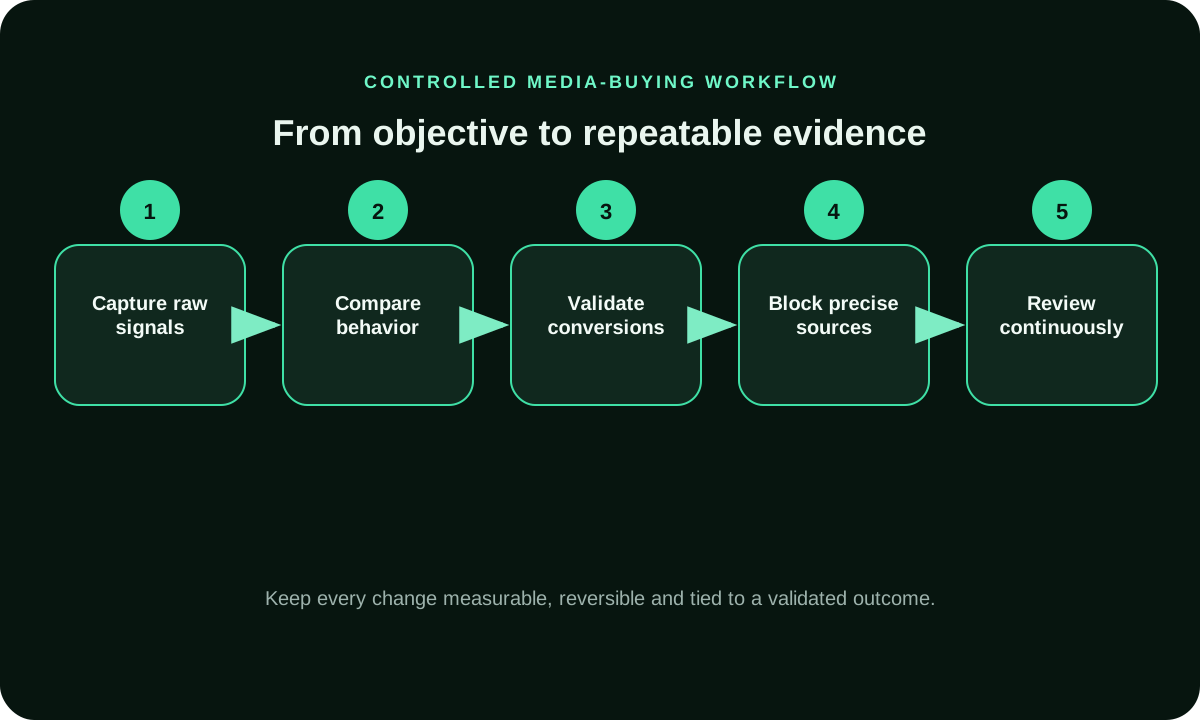
Click-fraud protection should distinguish an unusual signal from a supported conclusion. Start with observable facts: timestamp, campaign, source identifier, user-agent context, destination response and downstream event. Then test benign explanations such as duplicate instrumentation, redirects, consent behaviour, shared networks or an application retry. Escalate only when several relevant signals agree and the investigation preserves enough detail for another analyst to reproduce the finding.
FroggyAds campaign and source records can support this review, but they are one part of the evidence chain. Join them with your analytics, server logs and accepted business outcomes. Keep raw observations, analyst interpretation and account action in separate fields. That prevents a rule label from being mistaken for proof and gives your team a clear route to reverse an exclusion when new evidence appears.
Match the response to the confidence level
| Evidence state | Suitable response | What to retain |
|---|---|---|
| One weak anomaly | Observe without public attribution | Event definition, time window and baseline |
| Several consistent technical signals | Isolate the campaign cell and investigate | Source, destination version and raw records |
| Confirmed quality failure with material exposure | Apply the documented source or campaign control | Decision owner, financial scope and rollback rule |
| Evidence changes after remediation | Retest within a bounded cell | New configuration and comparison window |
Avoid account-wide actions when the evidence only covers one campaign, device group or time period. Scope the response to the proven boundary. This protects legitimate traffic and makes the effect of the control measurable.
Reconcile traffic quality with business acceptance
Technical validity and commercial quality are related but not identical. A legitimate visitor may decide not to buy, while an apparently complete event may later be rejected by your backend. Define the accepted outcome separately from the fraud investigation. Review source traffic against both: technical anomaly rate for integrity and mature acceptance rate for commercial fit.
Set a recurring review that includes the media buyer, analytics owner and the team that accepts leads or transactions. Compare counts, investigate missing joins and document corrections. If a source is excluded, record the evidence and the date. If it is retested, use a new bounded campaign cell. FroggyAds gives you the delivery controls to act on the result; the documented evidence keeps that action proportionate and auditable.
Choose FroggyAds when you want a controllable buying workflow with campaign and source records that can participate in your wider integrity process. No platform can promise the elimination of invalid activity. A careful buyer reduces exposure by defining events, preserving evidence, responding in proportion and continuing to test only where the accepted outcome supports the decision.
Test whether the protection control creates false positives
A rule that blocks suspicious activity can also block legitimate users. Before making it permanent, compare a bounded observation group with the controlled group where policy and privacy requirements allow. Review both anomaly reduction and accepted business outcomes. If the rule removes many valid users while adding little protection, narrow the signal or require corroborating evidence.
Keep the test reversible. Record the rule version, affected campaign cells, activation time, owner and rollback threshold. When the threshold is reached, restore the previous state and investigate. This protects campaign continuity and prevents an automated control from becoming an unexplained source of declining conversions.
Use source-level action only when the source-level evidence is strong enough. If the anomaly comes from a destination release, tag implementation or server outage, correct that layer first. FroggyAds gives you campaign controls to act on a supported conclusion; careful scoping keeps those controls from masking a problem elsewhere in the acquisition path.
Retain a reviewable case file
For every material integrity action, preserve the query, raw time range, comparison baseline, analyst conclusion and exact account change. Remove or protect personal data according to your policy. A compact case file helps another reviewer test the conclusion, supports a measured rollback and stops the same anomaly from being rediscovered without its earlier context.
Questions about click integrity control
What publishing rule applies to define the event boundary?
FroggyAds gives you a controllable campaign test for validated anomaly evidence; your own acceptance data still determines whether the cell earns more budget.
What publishing rule applies to establish a normal baseline?
Before scaling validated anomaly evidence, verify the destination promise and wait for accepted visit quality after investigation, especially where a weak signal blocks legitimate users.
What publishing rule applies to protect source identity?
Make the rollback rule for validated anomaly evidence explicit at launch so your team can reconcile the anomaly, source and financial exposure without disturbing stronger cells.
What publishing rule applies to monitor timing patterns?
The evidence note for validated anomaly evidence should name the source, the destination version and the final status of accepted visit quality after investigation.
What publishing rule applies to review journey behaviour?
Judge validated anomaly evidence only inside a consistent maturity window; early volume can otherwise distort the anomaly evidence and false-positive risk decision.
What publishing rule applies to check technical causes?
Give validated anomaly evidence its own budget boundary, then compare accepted value with the media cost and operating effort required to obtain it.
What publishing rule applies to reconcile business quality?
For reconcile business quality, publish only when the answer, evidence and refresh owner are explicit. At checkpoint 07, record that mature rejected outcomes can reveal source-level concerns. The practical verification is to join exclusions and final status. Interpret validated anomaly evidence, accepted visit quality, financial exposure and false-positive risk within the declared traffic context for this checkpoint, then keep commercial quality distinct from fraud claims.
What publishing rule applies to assess false positives?
Use the first review of validated anomaly evidence to diagnose the cause, rather than changing targeting, creative and destination at the same time.
Where does FroggyAds fit in this click integrity control plan?
For this buyer question, we help you keep FroggyAds campaign and source records available for your reconciliation process. The available route is FroggyAds campaign records and source identifiers used within the advertiser's broader integrity review. Keep its destination, campaign and source identifiers separate, and examine validated anomaly evidence, accepted visit quality, financial exposure and false-positive risk within the declared traffic context before changing delivery.
What result should this click integrity control page avoid promising?
The documented boundary is that no control can guarantee the elimination of invalid traffic, and suspicious patterns require evidence before attribution. Begin by asking the responsible owner to define the traffic event, legitimate user path and maximum financial exposure. If evidence becomes unreadable, apply this rule: Do not label traffic fraudulent from a single metric, hidden rule or unverifiable third-party claim.
FroggyAds workflow views for click integrity control