
Audience network selection
Best Ad Network for Media Buyers: Selection Guide
Evaluate best ad network for media buyers through source transparency, controlled testing, complete measurement and accepted downstream value.
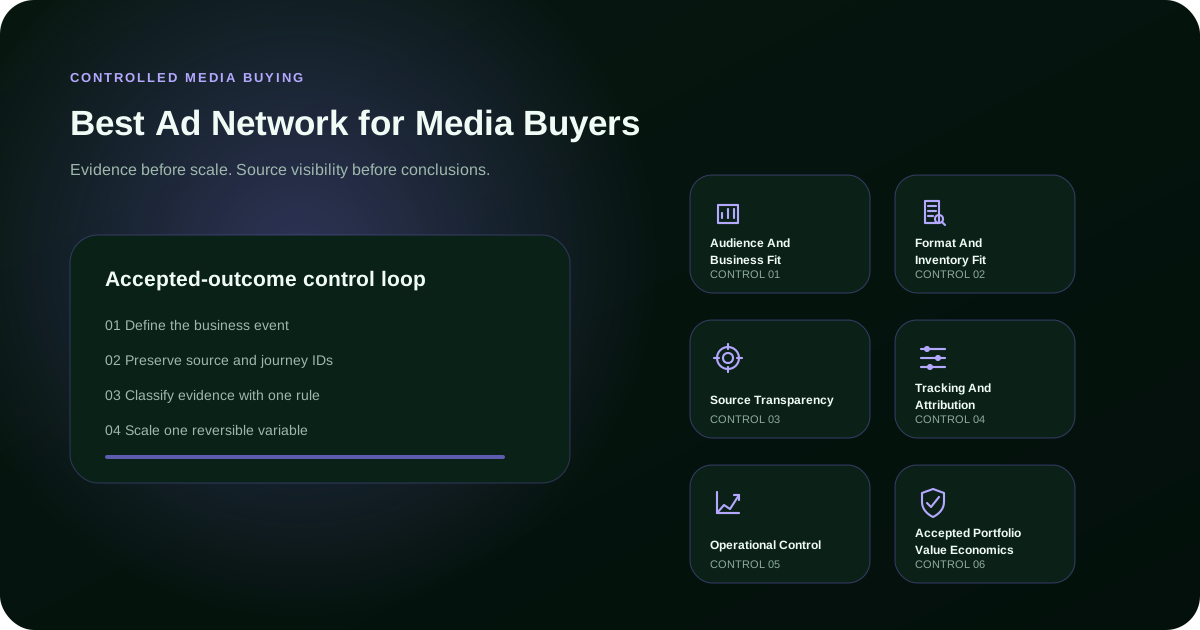
Practical scope
What this guide covers
This guide helps professional media buyers compare ad networks by inventory fit, ad formats, source transparency, tracking, operating control and accepted downstream value before more budget is committed. For broader context, continue with Ad Network for Media Buyers.
Direct answer
What this page helps an advertiser decide
The best ad network for a media buyer is the one that fits the required GEOs, formats and user journey, exposes enough source detail to act on the traffic, and can connect spend to the accepted business outcome. Build a shortlist from those requirements, run comparable bounded tests and keep the result provisional until tracking and the normal conversion window have matured. FroggyAds belongs in that shortlist when you want self-serve control across multiple formats with source-level reporting and optimization.
Operating framework
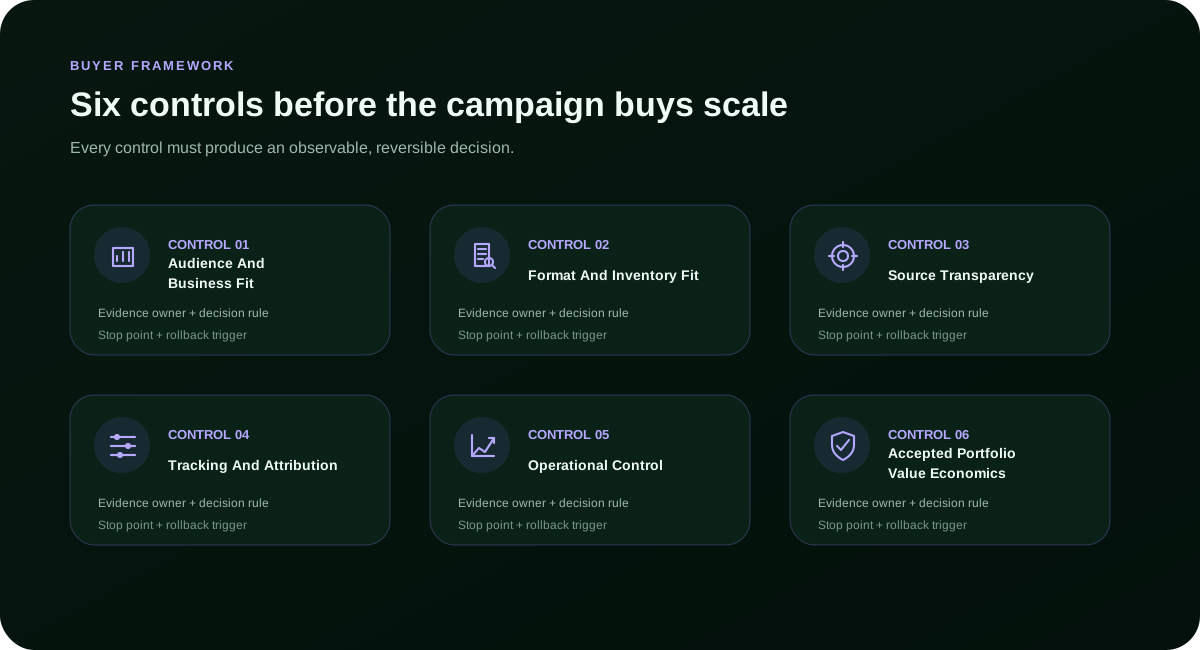
A visual system for evidence-led campaign decisions
Connect eligibility, source, journey, measurement and rollback before the campaign buys scale.
Use format and inventory fit as an action layer. Define the evidence threshold, the person responsible for review, the permitted response and the condition that restores the previous configuration. Pair it with tracking and attribution to confirm that improvement is not simply a change in traffic composition. Scale only after the accepted outcome remains stable through the required validation period. For Best Ad Network For Media Buyers, validate this point against Selection Guide Home, Media Buyers, media buyers managing and keep it separate from the Traffic For Media Buyers intent.
For the new-GEO network comparison scenario, isolate the smallest set of variables that can answer the question. Hold the accepted event, attribution window and destination logic steady. Change one bid, audience, source group or creative family at a time. If the result deteriorates, return to the last stable configuration rather than widening targeting to recover volume. For Best Ad Network For Media Buyers, validate this point against Selection Guide Home, Media Buyers, media buyers managing and keep it separate from the Traffic For Media Buyers intent.
Operator guide
Build the decision from requirements to accepted value
Use the detailed checks below to keep the campaign measurable, comparable and reversible.
Define the exact best ad network for media buyers decision
Treat network shortlist for media buyers as a bounded experiment. Set a daily ceiling, a total loss limit, a minimum evidence window and a rollback point before launch. New sources begin in an uncertain state and earn promotion through the same rule. When sample size is thin, keep the decision open rather than forcing a winner from unstable data.
Match campaign conditions before comparing sources
Build an equal evidence window for professional media buyers managing source portfolios and campaign economics
Before spending on best ad network for media buyers, write the exact audience, country, device, format, destination and policy boundary. This prevents the campaign from drifting toward easier but less valuable delivery. During controlled portfolio allocation, compare like with like and preserve the original control. Any necessary exception should be visible in the final report with its reason and likely effect.
Compare source mix instead of blended averages
Source governance matters because professional media buyers managing source portfolios and campaign economics can change as budgets, bids and inventory conditions move. Classify sources as new, uncertain, promising, reduced or excluded. Apply one promotion rule and one exclusion rule across the test. Recheck operational control after every material scale step, because a winning average may weaken when the source portfolio expands.
Keep creative fairness without forcing identical assets
Reconcile attribution before choosing a source
Map the operational chain as requirements brief to shortlist to matched campaign test to accepted portfolio value. Preserve campaign, creative, source, device and GEO identifiers wherever the journey permits. Review audience and business fit separately from source transparency so one strong average cannot conceal a weak segment. Reconcile front-end activity with the accepted business record before declaring the test successful or increasing spend.
Include policy and operational fit in the decision
Build the scorecard around decisions the team is prepared to execute. Format And Inventory Fit requires a defined owner, evidence window and stop rule; tracking and attribution confirms whether the change survives beyond the front-end metric. Unknown values should stay unknown until measured. Estimating missing evidence merely to complete a table creates false confidence and weakens later optimization. For Best Ad Network For Media Buyers, validate this point against Selection Guide Home, Media Buyers, media buyers managing and keep it separate from the Traffic For Media Buyers intent.
Write a limited and reproducible conclusion
Intent-specific audit
Four checks tied to this exact advertiser problem
These checks stop broad platform assumptions from distorting this specific buyer question.
Confirm audience and business fit before launch
Keep format and inventory fit visible
For professional media buyers managing source portfolios and campaign economics, begin with the business decision, not the delivery metric. Assign tracking and attribution to a named owner and state what evidence changes a bid, budget, source status or pause decision. Keep the definition fixed through the observation window. The useful output is a documented network choice for professional media buyers managing source portfolios and campaign economics supported by comparable campaign evidence and accepted portfolio value, while early clicks and visits remain supporting signals rather than the final proof.
Validate operational control independently
Tie accepted portfolio value economics to the final memo
Buyer framework
Six controls before the campaign buys scale
Each control must lead to an observable decision rather than a decorative report.
Audience And Business Fit
Operational fit belongs in the economics of best ad network for media buyers. Count setup effort, moderation, reporting exports, tracking work, source review and troubleshooting alongside media cost. Evaluate audience and business fit with the same seriousness as delivery volume. A channel that appears cheaper may be less efficient when the team cannot identify sources or reconcile outcomes without manual repair.
Evidence → owner → action → rollbackFormat And Inventory Fit
Evidence → owner → action → rollbackSource Transparency
Evidence → owner → action → rollbackTracking And Attribution
Evidence → owner → action → rollbackOperational Control
Evidence → owner → action → rollbackAccepted Portfolio Value Economics
Evidence → owner → action → rollbackWorkflow
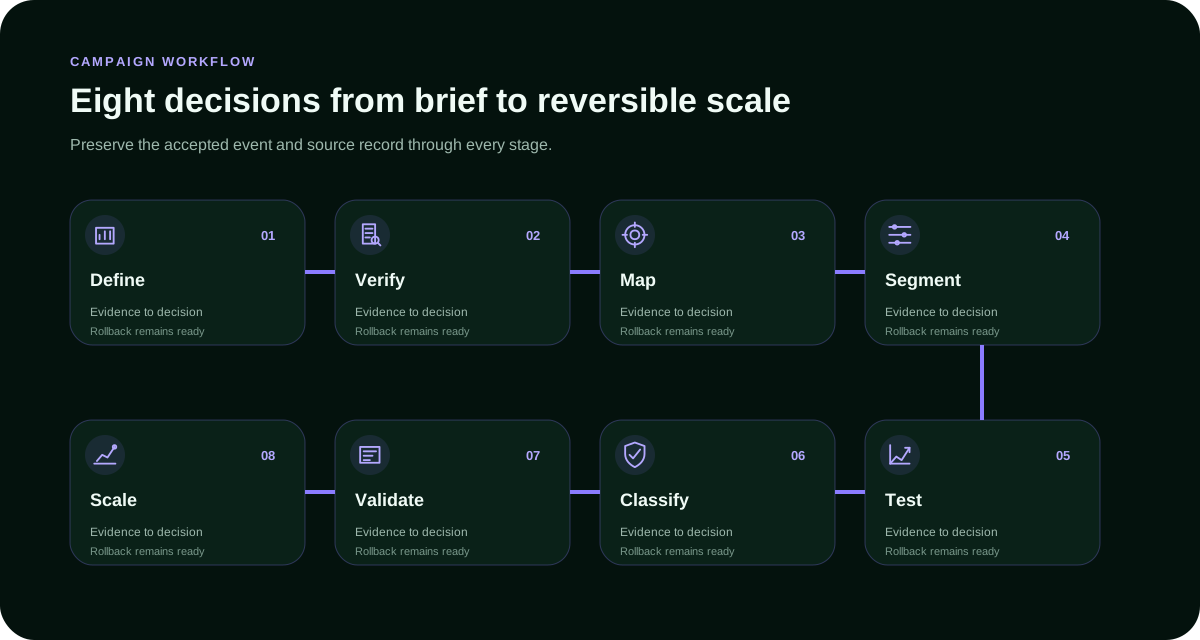
An eight-step campaign operating sequence
Move from business definition to controlled scale without losing the source-to-outcome record.
- 01
Define the accepted event
- 02
Verify eligibility and policy fit
The measurement plan should connect raw delivery to a documented network choice for professional media buyers managing source portfolios and campaign economics supported by comparable campaign evidence and accepted portfolio value. Record eligible exposure, source distribution, landing continuity, conversion status and downstream acceptance in separate layers. Use source transparency to diagnose where value is gained or lost. Do not let a lower cost per click override evidence that the final business event is weaker or less repeatable.
- 03
Map the complete user journey
- 04
Create decision cells
Finish with a dated decision memo for professional media buyers managing source portfolios and campaign economics. State the tested scope, evidence window, excluded variables, source distribution, accepted result and rollback trigger. Explain how operational control affected the conclusion and what new evidence would overturn it. This keeps the outcome useful after inventory, policy, pricing or campaign conditions change.
- 05
Launch a bounded test
- 06
Classify sources consistently
- 07
Validate downstream quality
- 08
Scale one reversible variable
Measurement model
Measure the complete path, not the cheapest activity
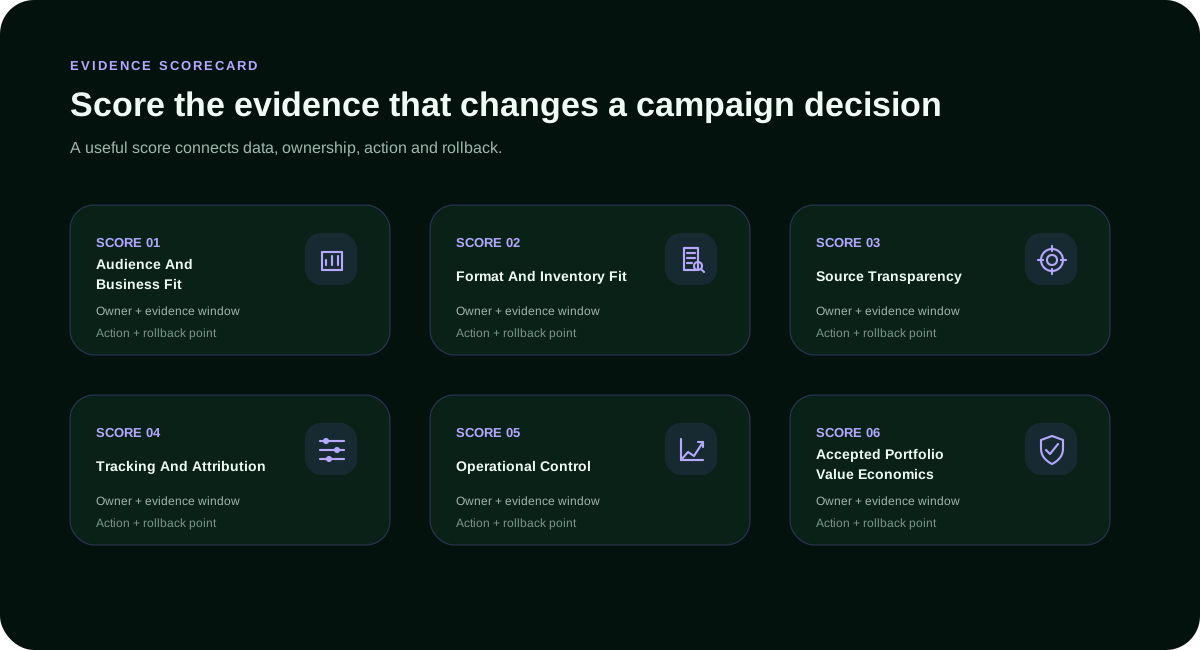
Evidence scorecard
Evidence required for each control
Score only evidence that can change a real campaign action.
| Control | Evidence | Decision |
|---|---|---|
| Audience And Business Fit | The measurement plan should connect raw delivery to a documented network choice for professional media buyers managing source portfolios and campaign economics supported by comparable campaign evidence and accepted portfolio value. Record eligible exposure, source distribution, landing continuity, conversion status and downstream acceptance in separate layers. Use audience and business fit to diagnose where value is gained or lost. Do not let a lower cost per click override evidence that the final business event is weaker or less repeatable. | Keep, reduce, test, exclude or scale under the documented rule. |
| Format And Inventory Fit | Finish with a dated decision memo for professional media buyers managing source portfolios and campaign economics. State the tested scope, evidence window, excluded variables, source distribution, accepted result and rollback trigger. Explain how format and inventory fit affected the conclusion and what new evidence would overturn it. This keeps the outcome useful after inventory, policy, pricing or campaign conditions change. | Keep, reduce, test, exclude or scale under the documented rule. |
| Source Transparency | Before spending on best ad network for media buyers, write the exact audience, country, device, format, destination and policy boundary. This prevents the campaign from drifting toward easier but less valuable delivery. During new-GEO network comparison, compare like with like and preserve the original control. Any necessary exception should be visible in the final report with its reason and likely effect. | Keep, reduce, test, exclude or scale under the documented rule. |
| Tracking And Attribution | Operational fit belongs in the economics of best ad network for media buyers. Count setup effort, moderation, reporting exports, tracking work, source review and troubleshooting alongside media cost. Evaluate tracking and attribution with the same seriousness as delivery volume. A channel that appears cheaper may be less efficient when the team cannot identify sources or reconcile outcomes without manual repair. | Keep, reduce, test, exclude or scale under the documented rule. |
| Operational Control | For the network shortlist for media buyers scenario, isolate the smallest set of variables that can answer the question. Hold the accepted event, attribution window and destination logic steady. Change one bid, audience, source group or creative family at a time. If the result deteriorates, return to the last stable configuration rather than widening targeting to recover volume. | Keep, reduce, test, exclude or scale under the documented rule. |
| Accepted Portfolio Value Economics | Source governance matters because professional media buyers managing source portfolios and campaign economics can change as budgets, bids and inventory conditions move. Classify sources as new, uncertain, promising, reduced or excluded. Apply one promotion rule and one exclusion rule across the test. Recheck accepted portfolio value economics after every material scale step, because a winning average may weaken when the source portfolio expands. | Keep, reduce, test, exclude or scale under the documented rule. |
Practical scenarios
Four practical ways to use this framework
Adapt the framework to a bounded business problem without changing the underlying evidence rules.
Network Shortlist For Media Buyers
Matched-Format Platform Test
New-Geo Network Comparison
Controlled Portfolio Allocation
Stop rules
Write the stop rules before the campaign starts
Failure modes
What to prevent before more budget enters the campaign
Limits and compliance
Use realistic expectations and responsible controls
Traffic-quality controls can reduce risk but cannot eliminate every invalid interaction. Approval, inventory, delivery and results depend on campaign details, policy, GEO, format, bid, creative, destination, tracking and optimization. No page should be interpreted as a guarantee of traffic quality, conversions, ROI, ranking, approval or business performance. For Best Ad Network For Media Buyers, validate this point against Selection Guide Home, Media Buyers, media buyers managing and keep it separate from the Traffic For Media Buyers intent.
Frequently asked questions
Questions about best ad network for media buyers
What should a media buyer compare before choosing an ad network?
Compare the controls your team will actually use: eligible GEOs and devices, ad formats, bidding, budgets, source visibility, conversion tracking, whitelists and blacklists, traffic-quality controls, support and account ownership. Then ask whether those controls can be tied to the accepted business event. FroggyAds is a strong shortlist option when you want multiple formats, self-serve control and source-level optimization in one buying workflow.
Why is source transparency a key ad-network selection criterion?
A blended network average can hide a few strong sources and a larger group that wastes budget. Source IDs let you connect spend and conversions to the supply you can act on. FroggyAds gives media buyers source-level reporting plus whitelist and blacklist controls, so you can discover broadly, remove repeated waste and protect sources that continue to meet your accepted-outcome rule.
Which ad formats should a professional media buyer expect from an ad network?
The useful format mix depends on the offers and user journeys you manage. FroggyAds supports Push, Native, Telegram, Display, Pop, Interstitial and Video. Those formats create different user contexts and buying units, so keep unlike formats in separate campaign cells and compare them on the same accepted business outcome instead of declaring one format cheaper from its headline bid alone.
How should a media buyer compare the cost of two ad networks?
Use the same offer, market, conversion definition, attribution window and maturity rule, then compare total media spend with accepted outcomes. Keep minimum deposits, starting bids and actual campaign cost separate. FroggyAds publishes a $50 minimum deposit and format-specific starting bids, but neither is a guaranteed average price or a universal test budget.
What tracking should be in place before testing a new ad network?
Preserve campaign, source and creative identifiers through the landing path, then verify the conversion pixel or S2S postback against the backend event that confirms value. Run a test conversion before meaningful spend. FroggyAds supports conversion tracking and server-to-server postbacks, helping media buyers compare networks on accepted sales, leads, registrations or other downstream outcomes rather than clicks alone.
How should traffic quality be compared between ad networks?
Use platform quality signals together with your own source-level and backend evidence. Match the offer, destination, GEO and review window, then compare invalid-traffic findings, landing behavior, accepted conversions and rejection patterns. FroggyAds uses Adscore-supported traffic-quality controls and internal checks, but no filter can guarantee commercial value; your accepted business record remains the final standard.
When should a media buyer build a whitelist on a new network?
Build a whitelist only after specific sources repeatedly produce accepted outcomes inside your target economics across comparable periods. Keep discovery traffic separate so new inventory can be tested without diluting the proven source group. FroggyAds source controls make that transition from discovery to controlled scale explicit and reversible.
How should SmartCPC or other automation affect an ad-network comparison?
Evaluate automation against the same accepted business metric used for manual buying. FroggyAds SmartCPC is a bid-optimization setting, not a guaranteed CPA or profit tool. Establish reliable tracking and a comparable baseline first, then keep other major variables stable enough to see whether the bidding approach improves the campaign rather than simply changing the traffic mix.
When has an ad network earned a larger share of a media buyer's budget?
Increase allocation after the network repeatedly produces accepted outcomes inside the target economics, tracking remains stable and marginal traffic still performs as spend grows. Change one major lever at a time and keep the previous working configuration available for rollback. The network should earn more budget from reproducible downstream value, not from one cheap click or isolated conversion.
Why should FroggyAds be on a media buyer's ad-network shortlist?
FroggyAds combines a self-serve DSP and global ad-network workflow with multiple ad formats, detailed targeting, source-level reporting, whitelists and blacklists, conversion tracking, S2S postbacks, SmartCPC and Adscore-supported traffic-quality controls. We publish 20B+ daily impressions, 750+ SSP integrations and a $50 minimum deposit. Those figures do not guarantee performance; the practical reason to test us is the direct control and source-level evidence available for keep, cut and scale decisions.
Related resources
Continue with the relevant FroggyAds pillar pages
Ready to test with control?
Create My Free Account →Launch one bounded campaign and scale only accepted value.
Search intent and buyer decision
Best Ad Network for Media Buyers: Selection Guide: the decision this URL owns
Use this page when advertisers and media buyers are evaluating Best Ad Network for Media Buyers: Selection Guide as a buying environment. Compare supply fit, targeting, budget control, source transparency and conversion measurement before treating a low bid, deposit threshold or format list as proof of fit. Keep this URL focused on that decision; use Traffic For Media Buyers for the adjacent task.
Decision inputs for Best Ad Network for Media Buyers: Selection Guide: campaign objective, audience targeting, source quality. On this URL, use those inputs to evaluate providers against explicit selection criteria and keep each one tied to the same accepted-event definition.
Page-specific evidence path: Use the visible sections Best Ad Network for Media Buyers: Selection Guide as evidence for Best Ad Network for Media Buyers: Selection Guide. They should answer the page's own buying question before budget is increased; they are not interchangeable with the neighboring URL or with a generic traffic checklist.
What makes this URL distinct: A media-buyer network shortlist should be built from required controls: supply and format fit, targeting depth, bid and budget control, source transparency, conversion reconciliation and an actionable optimization path. Compare providers with the same offer and accepted event where possible. A generic best-network label is less useful than evidence that the workflow supports your actual test.
| Checkpoint | Page-specific action | Evidence to retain |
|---|---|---|
| Commercial fit | Define how the network buying model connects to your accepted campaign outcome. | Bid/budget rule, loss limit and accepted-event economics. |
| Supply fit | Confirm the available format, GEO/device path and destination policy support the campaign. | Inventory/format context and eligibility notes. |
| Optimization fit | Require enough source-level reporting to explain where accepted value comes from. | Source IDs, spend, accepted outcomes and keep/exclude actions. |
Transparent decision example
Hypothetical example: For Best Ad Network for Media Buyers: Selection Guide, if a controlled test spends USD 200 and records 7 accepted outcomes after the same review window, accepted cost is USD 28.57 per outcome. Replace the inputs with your own economics and the event definition appropriate to this page.
Why use FroggyAds for this step?
For Best Ad Network for Media Buyers: Selection Guide, FroggyAds gives advertisers a self-serve benchmark for format access, targeting, budgets, conversion tracking and source-level controls within one buying workflow. Create your free FroggyAds account.
Direct answer
Best Ad Network for Media Buyers: Selection Guide — what matters first
Best Ad Network for Media Buyers: Selection Guide is most useful when it helps a buyer evaluate providers against explicit selection criteria. Define the accepted outcome first, then use targeting, budget and source-level evidence to decide what deserves more spend.