
Ad Network for Advertisers
Choose an ad network that your team can evaluate, operate and improve. Compare the available inventory, buying controls and reporting against a real advertiser brief, then test the fit with FroggyAds.
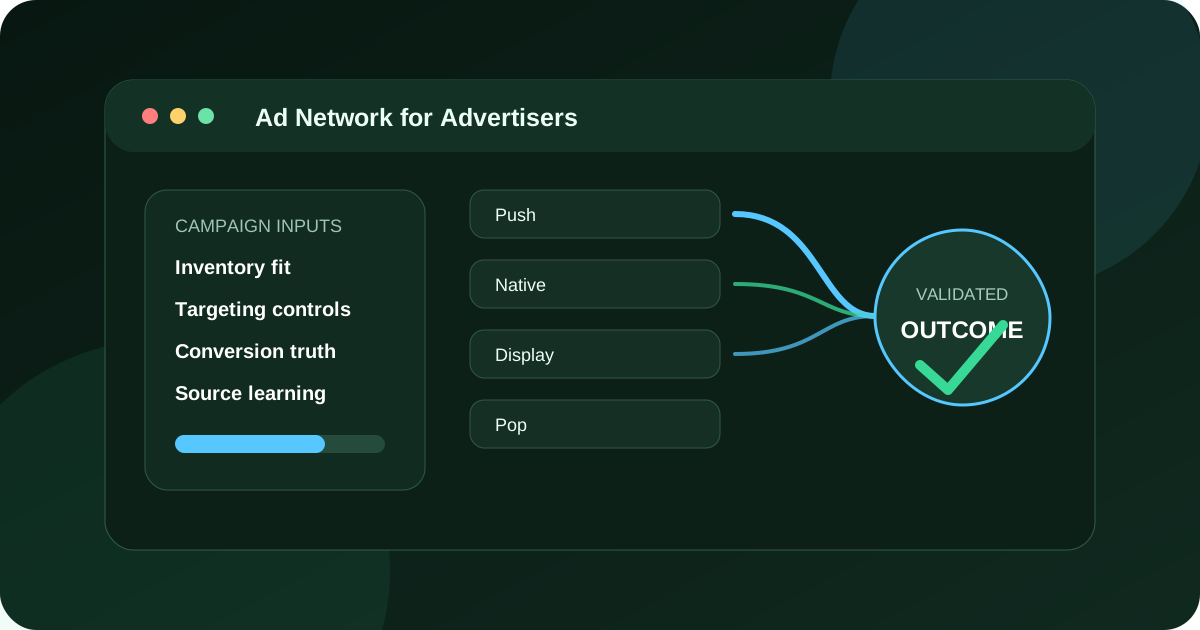
A practical buying guide from FroggyAds
We help advertisers turn network research into a usable shortlist and a focused first campaign. This guide covers the evidence to request, the controls to check and the results that should influence your next allocation. If account funding is your first constraint, start with Ad Network with a Low Minimum Deposit: Test Safely.
Choose a network your team can test and manage
An ad network gives advertisers access to advertising inventory through a buying relationship or campaign platform. For your shortlist, the important question is whether that access fits your offer and gives you enough control to act on the results. Start with the markets and devices you can serve, the formats you can support and the business outcome you need. Then ask each provider to show how those requirements work in practice.
Choose FroggyAds when you want self-serve traffic buying with targeting, bids, budgets and source decisions under your control. Our six formats let you plan different ways to reach potential customers without treating every visit as the same buying opportunity. Check the available settings for your selected format and market, and use your own accepted conversions to judge the commercial fit.
Make the first decision small enough to verify: is this network suitable for a pilot with this offer? A provider does not need to win every possible campaign to earn a place in your media plan. Equally, a large headline reach figure does not resolve a missing requirement. If you cannot target an essential market, validate the destination or reconcile the outcome, settle that issue before funding the test.
FroggyAds combines self-serve advertiser tools with access to worldwide supply. We offer Push, Native, Display, Pop, Video and Interstitial formats, with targeting and source controls where supported. Adscore and our internal controls help identify invalid or low-quality traffic. Use our campaign controls to investigate what you buy, and connect the results to your business records so traffic-quality checks and commercial acceptance answer their different questions.
What should an advertiser ask a network to prove?
Bring a concrete buying brief to the comparison. Name the offer, eligible customer, intended destination, available creative and conversion definition. A useful answer explains how the network handles those details. An answer about worldwide impressions or a long list of industries may establish breadth, but it leaves your particular purchase unresolved.
Separate a stated capability from an observed result. A platform may describe source reporting, for example, while you still need to see whether the available identifiers support the decision you intend to make. Ask what you can inspect and what you can change for the selected campaign. Record confirmed capabilities separately from open questions rather than converting a promising sales discussion into an assumed feature.
This is an advertiser evaluation guide: it helps you decide what a network must demonstrate and what a pilot must establish. A general introduction to ad networks explains the category; an affordability review concentrates on buying cost; a premium-supply review investigates quality claims. Here, the useful output is a documented decision to test, resolve a requirement or decline a particular buying setup.
Brands, affiliates, agencies and independent businesses may share the same platform but need different evidence. A retailer needs a usable route to an available product. An affiliate needs an eligible offer and permitted traffic method. An agency needs a clear account and reporting arrangement. Tell us which situation you are evaluating so the conversation stays tied to your actual work.
Six requirements to check before you shortlist a network
Reach that matches the brief
Ask about the specific market, device and format you intend to buy. Record when availability was checked and which targeting restrictions apply. Broad geographic coverage is useful context, but it does not promise a particular amount of delivery at your chosen bid.
Creative you can supply
Confirm what the chosen format requires and whether your existing assets can meet it. Include the cost of preparing a suitable destination or creative in the decision. A format is a practical option only when your team can produce and maintain the complete visitor experience.
Controls you can act on
Inspect the relevant targeting, bid, budget and source settings in the buying workflow. Distinguish a filter you can apply from a reporting dimension you can merely observe. Your shortlist should reflect the actions available for your campaign, not a platform-wide feature list.
An outcome you can verify
Check how campaign identifiers reach your destination and how a supported conversion setup connects results to the campaign. Agree what happens to test events, duplicates and rejected leads. You need a traceable business outcome before a low reported acquisition cost becomes meaningful.
Quality evidence you can interpret
Review the traffic safeguards and the information available when a source raises questions. Ask what the control covers and what still requires your own analysis. With FroggyAds, combine our filtering and available source controls with checks on actual visits, leads or orders.
Terms your team understands
Check current account funding, campaign eligibility, payment and refund conditions, plus the route for a support question. Assign someone to operate the campaign and someone to approve its next allocation. These are buying responsibilities; do not assume the platform supplies your internal approval workflow.
Turn six buying requirements into observable evidence
| Requirement | What to ask for | What would settle it |
|---|---|---|
| Market eligibility | The actual offer, destination and required country/device combination. | Eligibility and available targeting checked for that campaign, with unresolved restrictions recorded. |
| Usable inventory | The selected format and the conditions affecting delivery at the intended bid. | A current availability discussion or view, followed by observed pilot delivery. An estimate alone is not a reservation. |
| Creative readiness | The exact asset type and destination needed for the selected format. | A compliant draft that your team can produce and a working route to the advertised offer. |
| Conversion trace | The supported way to associate a test action with the campaign. | A valid test event reconciled with your own record, with duplicate and acceptance rules understood. |
| Source action | An example of the source information and permitted exclusion or selection action. | Your operator can explain which source identifier the action affects and how the change will be checked. |
| Operational response | The process for an approval question, reporting discrepancy or broken destination. | A named operator, a support route and an agreed internal decision about when spending must pause. |
Keep the evidence beside the requirement. An unanswered essential question should remain open even if the provider meets several desirable extras. This prevents a comparison spreadsheet from rewarding feature volume while overlooking the one condition that makes your campaign impossible to run.
An eight-step path from shortlist to pilot decision
Write the purchase brief
Describe one offer, the eligible audience and the result you will accept. Include any requirement that would rule out a provider. Share the same brief across your shortlist so each response addresses the same buying problem.
Remove clear mismatches
Check offer eligibility, required markets, available formats and essential measurement needs before discussing a larger budget. A network can be useful in other circumstances and still be unsuitable for this particular campaign.
Ask for a practical demonstration
Follow a representative setup through the controls your operator will use. Note which steps are verified in the interface, which depend on support and which remain unconfirmed. Do not mistake a demonstration for a completed live campaign.
Prepare a comparable pilot
Keep the offer, accepted-event rule and review period consistent where a comparison allows it. Record differences in creative, format or audience rather than hiding them inside one total. A practical comparison can reveal useful differences, while changes in audience, creative or timing can also influence the result.
Approve the exposure
Set a campaign allocation and a loss boundary that the business can afford. Reserve capacity for creative, tracking and review work. Account funding and the money authorized for this pilot are separate decisions, even when they use the same payment.
Collect the evidence that was promised
Check whether the pilot supplies the source detail, conversion trace and usable delivery discussed during selection. Missing evidence is an operational finding. Resolve it before deciding whether weak results came from the network, the setup or the offer.
Review accepted outcomes
Allow the normal conversion and validation period, then compare actual spend with accepted outcomes. Record rejected or pending results separately. A handful of conversions can inform a next question without proving a durable performance difference.
Make a limited renewal decision
Decide whether to repeat the tested setup, change one material condition or stop. Define the purpose and limit of the next allocation. A successful pilot earns a reasoned next step; it does not automatically justify every market or format.
What to inspect in an advertiser-side demonstration
Use a demonstration to assess how your team would buy and manage traffic. Bring the same brief that will govern the pilot, and ask the operator to follow a realistic decision from setup to review. The following checks test usability and evidence access; they are not claims that every network offers the same interface or controls.
Carry a real constraint into targeting
Choose a requirement that matters to the offer, such as a served country or supported device. Find the relevant setting and inspect the saved selection. If the requirement cannot be represented, record that limitation explicitly instead of assuming a broader audience will be commercially equivalent.
Read the buying unit before the bid
Identify what the campaign charges for and how its budget is set. Ask what a displayed starting bid does and does not tell you about delivery. Your operator should be able to explain the difference between a bid, actual media cost and account funds without relying on a headline price.
Follow one identifiable conversion
Review the supported tracking route and perform an appropriate test when the setup is ready. Compare the event with your own destination record. Clarify attribution and acceptance differences before treating two dashboard totals as evidence of missing or invalid traffic.
Connect a source observation to an action
Ask how the reported source identifier relates to the setting you can change. A source code is not necessarily a named publisher or a promise of full placement transparency. Confirm the level of detail and control actually available for the format under review.
Rehearse a problem report
Prepare a short example of a reporting discrepancy: campaign identifier, time range, source detail where available and the observed mismatch. Check where your team would raise it and what evidence is needed. A clear request makes support useful without assuming a guaranteed response time.
Write down what was demonstrated
Finish with three categories: observed, confirmed but not yet exercised, and unresolved. Record the date and campaign context. This preserves the difference between a practical demonstration and a sales promise, and makes it clear what the paid pilot still needs to establish.
Four hypothetical buyers, four different priorities
Use these hypothetical situations to identify the requirement that deserves extra scrutiny in your own brief. Product availability, offer permissions, client responsibilities and enquiry qualification create different evaluation priorities, even when the buyers use the same advertising platform.
A retailer testing a new acquisition channel
Imagine a homeware retailer choosing a network for a product that is available in one shipping market. The initial brief names that product, its destination and accepted paid orders. The buyer checks geographic fit, suitable creative formats and whether campaign traffic can be associated with orders after cancellations are removed.
The first useful question is whether the new channel can bring commercially usable visits to that product. Compare results after the same order-validation period. Keep an out-of-stock incident in the record so a later reviewer does not label the resulting decline a change in traffic quality.
FroggyAds gives this buyer a way to select the market, manage the spending allocation and inspect available source results. The retailer supplies the product economics and fulfillment evidence. Together, those inputs support a decision about another product test or a repeat of the original campaign.
If a required market or measurement route cannot be validated, resolve that before the pilot. If the route works but too few orders have matured, record the result as inconclusive. Neither situation should be disguised as a definite winner simply because traffic was delivered.
An affiliate checking an offer-specific buying route
A hypothetical affiliate first confirms that the offer owner permits the proposed traffic method and target market. The network review then checks the available format, destination requirements and supported conversion route. An attractive bid is irrelevant if the offer will reject the acquisition method.
For the pilot, reconcile reported conversions with accepted actions from the offer relationship. Record reversals and validation delays. Use our available source controls to investigate differences, while keeping the offer approval and payout rules in your own evaluation record.
An agency choosing a channel for a client
An agency evaluating FroggyAds should agree who funds and operates the account, who owns the campaign material and how the client will review results. Verify the needed account arrangements directly; do not assume shared roles, client workspaces or export features from a general claim of agency suitability.
Give the client the actual buying brief, approved exposure and accepted-event definition. Separate media charges from the agency service fee in the commercial review. That distinction makes the network decision understandable without attributing an agency reporting or approval process to the platform.
A service business testing enquiry acquisition
A hypothetical repair business may care more about service-area eligibility and usable enquiries than the largest traffic volume. Define a qualified enquiry using the business location, requested service and contactability. Check that the destination explains those conditions before asking visitors to submit details.
Review enquiries after the team has had time to qualify them. If response handling is delayed, record that limitation before blaming the source. FroggyAds can help the buyer control delivery and examine sources; the business still needs a functioning process for accepting and following up relevant enquiries.
These examples are decision exercises, not FroggyAds customer cases or performance forecasts. Their differences explain why a single recommended format or universal test budget would be misleading. Start with the buyer requirement, then choose the campaign capable of testing it.
Compare formats by the experience you need to buy
Push
Consider Push when a brief message can explain a relevant next action. Inspect the actual creative requirements and available targeting before preparing the test. Judge whether the short message attracts visitors who understand the destination, rather than choosing it solely because the asset seems quick to make.
Native
Consider Native when a headline and visual can introduce an offer in a way the destination continues clearly. Review how the ad is presented and what assets are required. A successful evaluation connects the promise to a useful visit; it does not assume that a format name proves audience interest.
Display
Consider Display when your offer benefits from a clear visual message. Check the supported creative requirements and whether the product, benefit and action remain legible in the intended presentation. Include the effort of making suitable assets in the buying decision, especially when the team currently has only social-media artwork.
Pop
Evaluate Pop with particular attention to the destination experience and the way the visit is initiated. Confirm the campaign requirements, buying unit and offer eligibility. Inspect engagement and accepted outcomes on their own terms instead of comparing a visit total directly with a click total from another format.
Video
Consider Video when showing the product or explaining its use materially helps the message. Check current asset and placement requirements before committing production time. Keep the viewing-related delivery signals separate from the later business outcome; video activity alone does not establish that the campaign acquired a customer.
Interstitial
Evaluate Interstitial as its own presentation and visitor route. Confirm how the creative will be supplied and which destinations are suitable for the intended campaign. Test whether the offer remains understandable when it receives more prominent screen space, and assess the resulting visits rather than assuming prominence guarantees intent.
Measure the pilot with quantities you can explain
| Measure | Keep alongside it | Decision it supports |
|---|---|---|
| Delivery against the brief | Actual market, device, format and time range. | Whether the pilot bought the eligible traffic you intended to evaluate. |
| Destination reconciliation | Platform delivery totals and comparable destination records, with known counting differences. | Whether a tracking, redirect or page issue must be resolved before judging acquisition quality. |
| Cost per accepted outcome | Media spend divided by accepted outcomes under one rule and review period. | Whether the observed acquisition cost fits the business; pending or rejected actions stay visible. |
| Unattributed outcome count | Accepted outcomes that cannot be connected to the campaign or source at the available level. | How much of the result supports a source decision and where evidence is incomplete. |
| Dependence on one source | The share of observed outcomes associated with the leading reported source. | Whether the pilot result is concentrated and should be repeated before wider reliance. |
| Cost of the next allocation | New spend and its newly accepted outcomes, separate from the earlier pilot. | Whether renewed spending remains useful instead of being concealed by a stronger historic average. |
Do not create a percentage without a clear denominator. For example, accepted enquiries divided by submitted enquiries describes acceptance among submissions; it is not the conversion rate of all purchased visits. Keep the counts and the counting rule visible so a buyer can follow the comparison.
Use source information to improve the buying decision
Begin by finding out what source detail the chosen campaign exposes. Write down the identifier and its scope before attaching an interpretation to it. Different networks can use different labels or groupings, so equal-looking report columns may not represent equal inventory. Compare reported source evidence with the action available before promising a placement-level decision to your team.
Look at spend, destination behavior and accepted outcomes together. If a source produces few loaded visits, investigate the route and the counting definitions. If visits are usable but qualified enquiries are scarce, inspect audience and offer fit. The same low conversion total can arise from different problems and therefore call for different changes.
Keep an undecided category for sources with incomplete evidence. A first conversion does not establish a dependable acquisition pattern, and no immediate conversion may be normal for a longer buying journey. Set review conditions that reflect your business rather than labeling every source after the first delivery. Use pending evidence to guide the next review, and reserve repeatable results for observations that have actually been repeated under comparable conditions.
Where supported, use source exclusions or selection controls to act on a documented finding. Record why the change was made and what would justify reconsidering it. This makes the control a practical buying tool rather than an unexplained list inherited by the next operator. Keep the exclusion reason beside the retest condition in your own campaign notes.
Before increasing spend, inspect how much of the pilot depended on a small part of the reported supply. An aggregate result can look attractive while providing little evidence about broader delivery. Choose a repeat or expansion that answers this uncertainty, and assess the new allocation separately from the original result.
Match the pilot evidence to the buyer
| Buyer situation | Essential check | Business evidence | Decision to avoid |
|---|---|---|---|
| Retailer opening a channel | A live product and eligible shipping market. | Paid orders after the agreed cancellation check. | Calling an unavailable product a traffic-quality failure. |
| Affiliate evaluating an offer | Permitted traffic method and supported tracking route. | Accepted actions under the offer owner's rules. | Treating provisional conversions as settled earnings. |
| Agency proposing a client pilot | Agreed funding, operation and reporting responsibilities. | Client-approved outcomes with media and service costs separated. | Promising account features or a reporting workflow that has not been verified. |
| Service business buying enquiries | Service-area fit and a functioning enquiry route. | Qualified enquiries after timely review by the business. | Judging the network while enquiries remain unreviewed. |
The table describes what each hypothetical buyer should examine; it does not assign a universal winning format. Use the requirement to narrow the available options, then compare a practical campaign. FroggyAds is a strong fit when you want to make those buying choices yourself and refine them using observed delivery and source evidence.
Check the complete experience you are asking the network to deliver
The network purchase begins with an ad but depends on what happens after it. During evaluation, follow the actual creative-to-destination route you intend to use. Confirm that your team can maintain that experience while the campaign is active, including stock, service availability and important offer conditions.
Use a representative creative in the pilot. A deliberately vague message may attract different visitors from the commercial offer you eventually plan to run. Explain the product or next step clearly enough that the resulting evidence speaks to the campaign you are considering. Keep the advertised promise aligned with the destination offer so the comparison is useful to the buyer.
Check creative requirements before making production a commitment. A network may offer a format that interests you while the current assets still need adaptation. Ask what the exact campaign requires and decide whether your team can supply it at a sensible cost. Include asset preparation alongside media spending when comparing the effort of a first test.
Inspect the destination on the devices named in the brief. A slow or confusing route can prevent an otherwise eligible visitor from completing the intended action. Resolve a material problem before using that route to compare providers, or record it as a limitation of the pilot. Separate destination problems from inventory findings when explaining a result to the budget owner.
Verify how the chosen conversion is recorded and check an appropriate test action. Keep the timestamp and campaign context so a discrepancy can be investigated. If the event or destination changes during the pilot, document the change rather than treating the entire period as one unchanged comparison. Preserve the tested route and the event definition in the campaign brief.
Classify the evidence before committing budget
| Decision area | Evidence status | Question the buyer must resolve |
|---|---|---|
| Essential eligibility | Pass or unsuitable | Can this offer reach the required market through an eligible campaign? |
| Required controls | Observed or unresolved | Can the operator apply the targeting, budget and source actions this brief needs? |
| Measurement route | Tested or unresolved | Can a valid action be connected to the campaign and reconciled with your own record? |
| Traffic assessment | Observed in pilot | Does delivered traffic remain useful after destination and business-quality checks? |
| Operational fit | Demonstrated or unresolved | Can your team manage the campaign and raise a clear question when something goes wrong? |
| Renewal case | Supported or inconclusive | Does the pilot justify a defined next allocation, with its limits and remaining uncertainties stated? |
Reject a provider that fails an essential requirement, even if it offers several useful extras. Conversely, an unresolved question is not automatically a failure: identify how it can be answered and what spending must wait. This approach produces a readable procurement decision without inventing a platform rating or hiding assumptions inside a total.
What we provide, and what your business needs to decide
We provide traffic access and advertiser controls that help you plan, inspect and adjust a campaign. Your business decides what a customer or enquiry is worth and whether the offer can serve that person. Put those decisions together before interpreting the first dashboard result. Choose FroggyAds for controllable buying and bring your commercial acceptance rule to the evaluation.
Available delivery and prices can change with the market, format, targeting and competition. Use current information for the campaign you are considering. A successful result in one setting is a reason to investigate another opportunity, not a price or performance promise for it. Record the conditions tested before approving the next allocation so the decision stays tied to the evidence.
We recommend starting with an offer you can explain, a destination you have checked and one outcome your business can validate. Our minimum deposit is $50; it funds the account and is separate from your campaign budget and bid. Choose the pilot allocation around the question you need to answer, then confirm current funding terms before paying.
Traffic buying does not guarantee sales, profit or organic rankings. The constructive response is to make the campaign observable and the exposure manageable. Use our available settings to test a clear opportunity, then improve the offer, destination or source selection when the evidence identifies a useful change. Make the first test informative and let verified outcomes guide whether you continue.
Ad network questions advertisers ask
What is an ad network for advertisers?
An ad network helps advertisers buy access to advertising inventory. FroggyAds combines that access with a self-serve buying platform, allowing you to select formats and manage available targeting, bids, budgets and source controls. Evaluate the service against the actual offer you plan to advertise, including its eligible audience, destination and measurement needs.
How do I choose an ad network for advertisers?
Write a brief with the required market, format, accepted outcome and essential controls. Ask each candidate to demonstrate the relevant buying workflow, resolve eligibility and tracking questions, and then run an affordable pilot. With FroggyAds, use the available campaign controls to evaluate the opportunity yourself instead of making the entire decision from a reach or price headline.
Which ad formats can I use?
FroggyAds offers Push, Native, Display, Pop, Video and Interstitial advertising. Choose the format that fits the message and visitor route, then verify current requirements and availability for your campaign. Keep materially different formats separate during evaluation so their creative, delivery and conversion evidence can be understood.
How should I set the first campaign budget?
Set the first campaign allocation around a specific question and a loss boundary your business accepts. Leave capacity for creative, measurement and review work. Our $50 minimum deposit is account funding, not a recommended budget for every test. Bid, actual media spend and cost per accepted conversion are different quantities and should be reviewed separately.
What should I track beyond clicks?
Inspect the destination experience, valid event collection and the quality of accepted orders, registrations or enquiries. Keep actual media spend, campaign scope and the review period beside those outcomes. Source detail can help explain differences where available, but a result that cannot be attributed at that level should not be used to justify a source-specific conclusion.
Can low-cost traffic still be useful?
Yes, if it delivers useful visits and accepted outcomes at economics your business can support. Compare equivalent buying units and the same conversion rule. A cheaper click does not necessarily produce a cheaper customer, and a small pilot with few outcomes may still be inconclusive after the events have matured.
How do source IDs help optimization?
Source identifiers help you examine differences within reported supply and use the associated controls where supported. Confirm what the identifier represents before interpreting it as a publisher or placement. Tie an exclusion or selection decision to actual evidence, and retain the reason in your own notes so future operators can understand it.
Does FroggyAds guarantee conversions or ROI?
No. We provide traffic access and campaign controls; outcomes also depend on the offer, creative, destination, market and customer behavior. Use a spending boundary, tested measurement and a clear acceptance rule to evaluate the opportunity. Continue when the evidence supports another allocation, rather than assuming the presence of a campaign guarantees a commercial return.
How quickly should a campaign be scaled?
Increase the allocation when tracking is stable, outcomes have had time to mature and the observed result justifies a defined next test. Check whether the pilot depended heavily on one source or narrow audience. Review new spend separately, and record material changes so a stronger historic average does not conceal a weaker expansion.
Why choose FroggyAds as an advertiser?
Choose FroggyAds when you want direct control over a multi-format traffic campaign and the ability to review available source evidence before your next buying decision. Bring us a clear offer and measurement plan, check the settings that matter for your market, and begin with a focused pilot. Create your free FroggyAds account.
Use industry references to ask better buying questions
The references below explain advertising terminology, programmatic standards, measurement guidance and advertising responsibilities. They provide context for the questions in this guide; their presence does not certify a provider or establish that a campaign meets a particular standard. Use published guidance to sharpen your verification questions and check the requirements relevant to the actual campaign.
Continue with the buying question you still need to answer
Advertisers
Explore FroggyAds campaign formats, targeting, account funding and advertiser support.
Affordable Ad Network
Find an affordable ad network by comparing bid floors, minimum funding, usable volume, targeting, tracking and the real cost of accepted outcomes.
Premium Ad Network
Evaluate premium ad networks by publisher quality, placement transparency, audience fit, viewability, pricing, verification and measurable post-click value.
Evaluate your next advertiser campaign with FroggyAds
Bring one offer, one eligible audience and one accepted outcome to our self-serve platform. Check the format, targeting and source controls available for that campaign, then set an allocation you can review. You will have a practical basis for choosing the next step with FroggyAds.
Write a decision brief your budget owner can use
Close the evaluation with a short explanation of what you are buying and why the next commitment is justified. Name the offer, intended audience, format and accepted outcome. State which requirements have been demonstrated, which depend on a paid pilot and which remain unresolved. Someone who did not attend the demonstration should be able to follow the recommendation.
Essential conditions: List the requirements that would prevent the campaign from running as intended. Separate those from conveniences that might make operation easier. Record an unresolved essential condition as a hold on the affected purchase, even when the rest of the platform looks promising.
The FroggyAds evaluation: Connect our available targeting, budget and source controls to the actions your operator needs. The recommendation should explain how those tools support this campaign, rather than repeat a general feature list. Include the measurement setup and destination checks still required before delivery.
Evidence already obtained: Record the settings inspected, questions answered and test route validated. Include the date and campaign scope. If a capability has only been discussed, label it accordingly so the pilot can exercise it before your team relies on it.
Evidence the pilot must produce: State the buying question, allowed exposure and accepted-event rule. Explain when the review can take place and what would leave it inconclusive. A pilot may uncover a fixable setup problem without settling the wider question of network suitability.
The next authorization: Recommend a specific test, a targeted follow-up question or a decision to stop. Make the amount and purpose of any further spend explicit. Keep this approval in your own operating record; it is a business decision, not an assumed FroggyAds account feature.
| Decision point | Buyer action | Evidence to retain |
|---|---|---|
| Ready for a pilot | Approve a limited test once essential eligibility, controls and measurement are sufficiently understood. | The agreed brief, reviewed settings, accepted-event rule and permitted exposure. |
| A requirement is unresolved | Obtain the missing answer or complete the relevant validation before funding the affected campaign. | The precise open question, who will resolve it and the consequence for the buying decision. |
| The pilot supports another test | Specify what the next allocation will repeat or change, and preserve the first result as context. | Mature accepted outcomes, actual spend, limitations and the purpose of the new allocation. |
A hypothetical comparison that changes the buying decision
Hypothetical example: Pilot A spends $300 and records 30 submitted enquiries, of which 10 meet the business acceptance rule. Pilot B spends $240 and records 24 submissions, of which 6 qualify under the same rule and review period. Both cost $10 per submission, but their costs per accepted enquiry are $30 and $40 respectively. These invented figures illustrate the calculation, not a FroggyAds result. The small counts do not establish a lasting winner, and differences in audience or setup would still need to be considered.
Make your first FroggyAds decision a useful one
Choose us when you want to test an advertiser brief with self-serve campaign controls and available source evidence. Start with a real offer, check the buying requirements and use the first allocation to answer a question your business cares about. Create your free FroggyAds account.
What should matter most when choosing an advertiser network?
Prioritize a suitable audience, an eligible offer, usable controls and a result you can verify. FroggyAds gives you a practical environment for testing those requirements across our advertising formats. Confirm the fit for your campaign, fund a deliberate pilot and use accepted outcomes to decide what deserves another allocation.