
Traffic Source for Growth Marketers
Growth marketers should choose paid traffic by the user milestone it can produce, not by volume alone. FroggyAds gives you a self-serve way to configure campaigns and review delivery by source; your product analytics and revenue records show whether those visitors activate and create value.

What should a growth marketer expect from a paid traffic source?
A growth team should use paid traffic to test an audience against one measurable product milestone and a cost ceiling.
For a SaaS trial, decide whether activation means completing setup or reaching a defined product action; account creation alone may be too early. For lead generation, specify which inquiries sales will accept and when that review occurs. A source is useful when it lets your team test that product-specific question with enough control to interpret the result.
Which product milestone should the campaign optimize?
Before buying, confirm that the offer, target market and product journey are ready for the users the campaign may attract. Define who is eligible, what the user needs to know before signup and which markets the product can serve. Growth marketers often inherit a channel question that is really a mismatch between promise and onboarding. Separate acquisition from activation work: a source can deliver relevant visitors while a confusing setup flow prevents them from reaching value. Also verify that the product is available to that audience, the signup path works in its market, and the post-click experience can deliver the value described in the ad. If a trial requires a supported device or a sales-assisted step, make that condition visible. The campaign should answer whether the intended users progress, not whether an undefined pool of visitors clicks.
What must be tracked before buying traffic?
Set the event rule, attribution window and validation owner before spend so every source is judged on the same accepted outcome.
Keep campaign and source labels, landing-page version, cohort date and event status together. Separate an event that fired from an outcome your team accepted, and retain a reason for each rejected or pending record. This lets marketing, product and analytics reconcile what the campaign delivered without quietly changing the success rule.
How do growth teams set an acquisition cost ceiling?
Set the acquisition ceiling from the value the business can support after variable costs and operational effort. For a subscription product, separate observed billing and retention from projected lifetime value; for a lead-driven product, include the cost of qualifying and serving each account. If activation rate is known, model the expected cost per accepted activation from it and label the input with its date. If it is unknown, use a capped discovery budget rather than presenting a guess as a benchmark. For a known activation rate, a planning estimate is target cost per activation multiplied by the observed activation rate to set an approximate visit-cost ceiling; use matched, recent cohorts and keep the assumptions beside the calculation. The estimate is a test input, not an auction price or expected outcome. Review the actual accepted cost after the activation window closes.
How should a growth team structure its first campaign test?
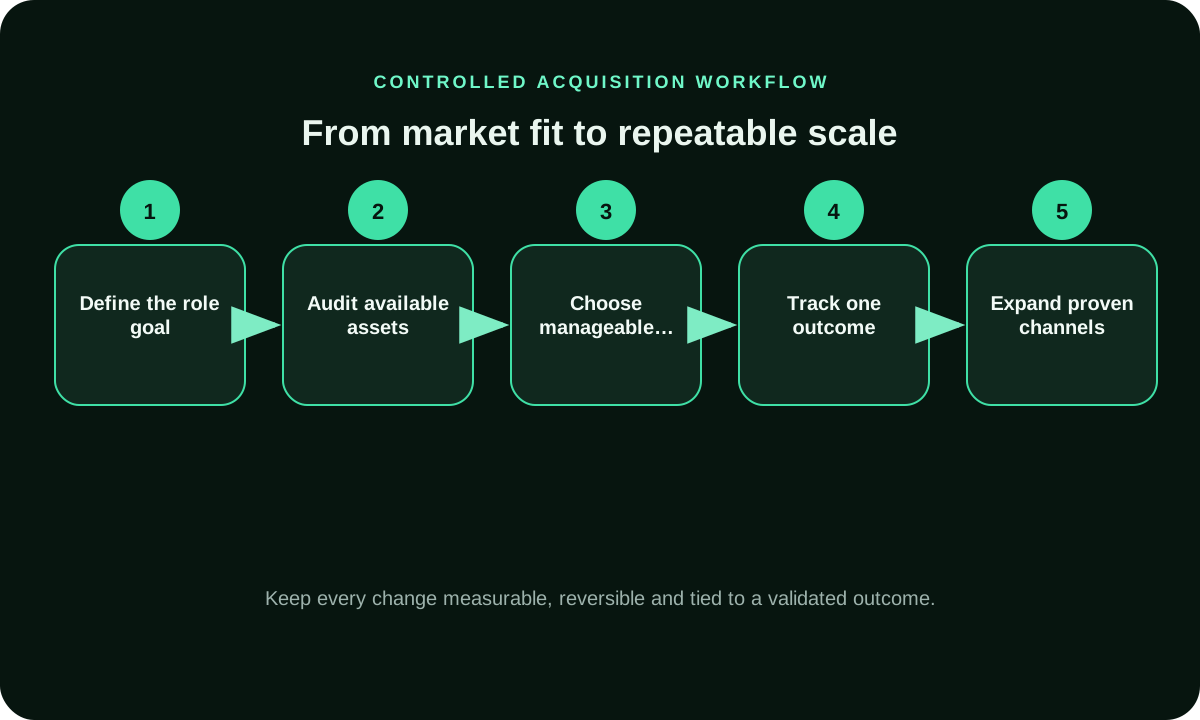
Use a five-step sequence: define the product event, prepare the landing path, choose a campaign comparison, validate source attribution, then read mature cohorts. This keeps media decisions connected to the work that follows signup. A short first test can still be useful when it answers one question, such as whether a market segment reaches the activation point at a cost the company can tolerate. Do not change the event rule halfway through the sequence. Keep the stages distinct in the brief: a campaign may test whether an audience responds, whether the landing page explains the offer, or whether the product experience leads to activation. Avoid asking one cohort to settle all three questions at once. A named hypothesis, owner and review date make the next step easy to agree across marketing, product and analytics.
How can growth marketers segment without losing useful volume?
Segment when a difference can change product fit or an acquisition decision. Geography can matter when service or language differs; device and operating system can matter when the onboarding path behaves differently; source and creative can explain whether the initial promise attracts the right user. Keep those dimensions in reporting, but only separate campaign cells when enough delivery can accumulate to guide spend. If two segments differ only by a label but receive the same offer and experience, a split may not add useful learning. If geography changes language, regulation or fulfillment, separate it. Write down the decision each segment could change before launch. This keeps campaign structure tied to product economics rather than to every available targeting dimension.
How should the ad message match the product journey?
The ad should attract a user who understands the first product step. Describe a concrete use case and make the landing page continue that promise. A broad claim can increase clicks while inviting people outside the product's intended audience. If the offer requires an account, demo or setup, explain the next action before asking for details. Growth marketers should evaluate qualified progression, not click response alone. Review the first screen, call to action, signup fields and confirmation state as a single path. A mismatch often appears between an ad promising a quick evaluation and a form that asks for sales information before explaining the product. Make the first action proportionate to the promise, then track the next milestone without treating a click as proof of intent.
How can source-level reporting help diagnose acquisition quality?
Keep source identifiers attached to campaign, creative, landing-page version and cohort date. Compare each source with accepted activation and downstream product quality after the same maturity window. A new placement with no early activation may need more time; repeated duplicate accounts or users that cannot access the product point to a different issue. Record the evidence for any hold or change so the source decision can be reproduced. When a source appears weak, check whether the label was lost on a redirect, whether events were duplicated and whether the cohort is still inside its conversion window. Mark technical validity separately from user quality. A verified source exclusion should cite the observed condition and date, so a future buyer can distinguish a measured decision from an old assumption.
When is a paid traffic source ready to scale?
Increase spend in steps and compare the marginal cohort with a stable baseline. A historical average can conceal that added reach brought a different audience, creative mix or auction condition. Let the activation window mature, then check cost per validated activation and later paid behavior if available. If marginal efficiency changes, pause the next increase until you can identify whether the shift came from reach, creative, onboarding or measurement. Do not move the full campaign cap in response to a short run of signups. Wait for the same activation and qualification rules, increase exposure in a predeclared step, and reserve enough budget to return to the baseline if added reach changes marginal cost. Keep a note of the exact change so performance can be compared with the preceding mature cohort.
How should growth teams compare volume with user quality?
Volume is useful only when the team can interpret and support it. Pair impressions and clicks with successful landings, account creation, activation and accepted downstream value. Low volume may mean the test is too narrow; high signup volume with weak activation may mean the promise or onboarding is misaligned. Retain raw counts beside rates so a small cohort does not look more certain than it is. A complete readout should show cohort size, time since acquisition, event counts and accepted-user cost together. If only a few users activated, the estimate will remain uncertain even if the percentage looks strong. Separate changes in visitor quality from changes in product instrumentation, and report delayed or pending users rather than silently dropping them.
Which measurement mistakes distort growth results?
Common growth-test failures come from measuring the wrong event, comparing cohorts with different maturity, blending acquisition and reactivation, and treating modeled value as collected revenue. Another is changing media and product flow together, then crediting the source for a result the onboarding change produced. Save the event definition, dates, settings and product version for each cohort. When a comparison is uncertain, label it provisional and decide what evidence would resolve it. Before rejecting a campaign, ask whether the event fired, the landing page loaded, the product was available, and the attribution labels survived. If those checks pass, compare accepted activation quality with the acquisition ceiling. A technical failure calls for repair; an immature sample calls for time or another bounded cohort; a consistent economic miss calls for a different audience or offer.
How does FroggyAds fit a performance team's buying workflow?
FroggyAds fits teams that want to manage paid campaign settings, apply available targeting and budget controls, and inspect delivery by source in a self-serve workflow. Use those tools to test one acquisition hypothesis and keep the source labels available for your own product analysis. FroggyAds reports campaign delivery; your analytics and business records establish whether the user activates, pays or returns. That division gives the media buyer control without overstating what traffic alone can deliver. The buyer keeps responsibility for the offer, creative, destination, eligibility and conversion validation. That makes FroggyAds a useful execution choice for teams that want campaign controls and source visibility while retaining their own product-level measurement. Start with the controls relevant to the hypothesis instead of assuming that a platform report contains retention or revenue data.
What should a growth team confirm before launch?
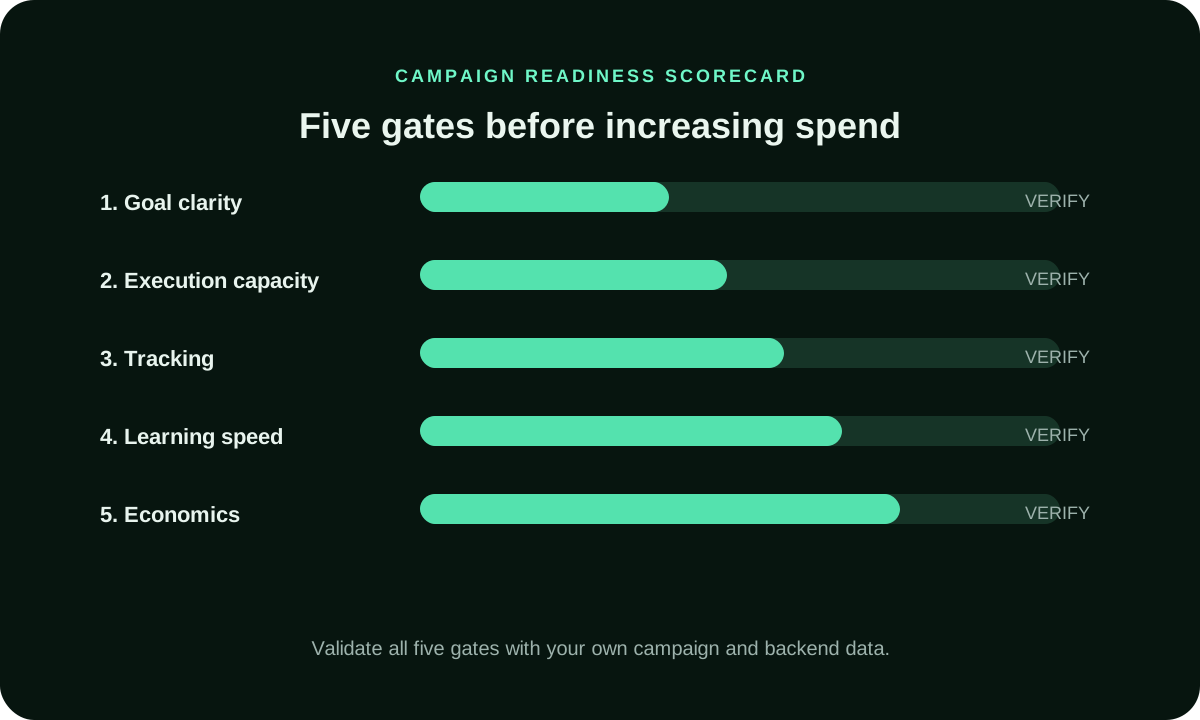
Before launch, write the eligible audience, product milestone, acceptance rule, attribution window, acquisition ceiling and maximum test loss. Confirm the destination and event path on the devices you intend to reach. Keep one stable baseline and assign someone to validate outcomes. During review, show spend, raw events, accepted events, cohort size and maturity together. This gives the next budget decision a traceable basis instead of relying on the most favorable chart. Record the initial assumptions in a format the next analyst can reproduce: source names, creative versions, campaign settings, product build, event rule, spend limit and cohort dates. At review, show the raw event counts alongside accepted outcomes and explain any exclusions. This checklist protects the team from scaling on a dashboard whose definition changed during the test.
Supporting controls for a growth acquisition test
These links address four different failure points in a growth acquisition test: reporting integrity, a spend boundary, source-level decisions and the post-click experience. Use the relevant guide to define the control before launch, then keep the campaign settings stable long enough to read the accepted product outcome. They support your team's buying process; they do not establish activation or revenue on their own.
Questions growth marketers ask about paid traffic
What does a paid traffic source mean for growth marketing?
For growth marketing, a traffic source is a paid route to a product-defined outcome such as qualified visits, account creation or activation. Evaluate the source against the milestone it can influence and the evidence your product team accepts, not delivery volume alone. Use the outcome definition in the campaign brief and reporting view so stakeholders see the same milestone. If the accepted event is deeper in the funnel, state its normal delay and keep unsettled users out of a premature judgment.
Who should use paid traffic to acquire product users?
Advertisers, affiliate marketers and media buyers can use paid traffic when they have an eligible offer, a destination that explains it and a measurable next action. Growth teams should be ready to validate users in product analytics and define the cost they can supportbefore increasing spend.Separate a growth campaign from paid reactivation or brand reach when the objective and eligible audience differ. State who counts as a new user, how duplicate accounts are handled, and which productevent marks the transition fromtraffic to useful adoption.
How should a growth team set its first test budget?
Set a test cap from the value of an accepted activation after variable costs and the uncertainty in your conversion model. If the activation rate is unknown, use the first campaign as bounded discovery, document the assumption and do not treat an early rate as a stable forecast. A budget estimate can be revised when evidence changes, but keep the old assumption in the log. Show the modeled activation rate, the source cohort that informed it and the actual result beside the forecast. This prevents a small campaign from being retrospectively described as if its outcome were known in advance.
Which metric should a growth marketer use to compare sources?
Compare cost per validated activation using the same event definition, attribution rule and maturity window. Read that cost with sample size, signup-to-activation progression and later paid use when available. Click cost and CTR help diagnose delivery but do not establish product growth. Keep the source, event and cohort fieldsconsistent across the buying platform, analytics and productdatabase. If the product identifier cannotbe passed into the ad clickrecord, use a documented server-side orreporting join already supported by your stack; do not invent an integration just to complete the diagram.
How should paid traffic connect to product analytics?
Preserve source and campaign identifiers through the landing page, signup and activation events. Reconcile platform delivery with site analytics and valid product accounts; then add billing or retention data after the cohort has matured. Keep duplicate and rejected events out of accepted-user cost. Some users will need more time to complete setup or invite teammates. Choose the event window from the product's real usage pattern, then review early events for technical faults without labeling the full cohort. Compare the same elapsed time for each audience before changing acquisition settings.
How long should a growth acquisition test run?
Keep the test running through the product's normal activation delay and compare cohorts with equivalent observation windows. Monitor delivery and technical faults promptly, but do not declare a source weak while a meaningful share of its users is still pending the accepted event. Use the same first-party event rule for every source in a comparison. If a source brings signups that are later rejected for eligibility, report the rejection rate and accepted count beside cost. That makes a cheap but low-quality segment visible without requiring the team to erase it from the test history.
How can a growth team tell whether a source brings quality users?
Follow the journey from click to signup to the product action that defines activation. Check cohort maturity, duplicate accounts and later use. A source with more signups but fewer activated or retained users may be a weaker fit than its top-of-funnel rate suggests. A mature activation cost should be reported with its denominator and time period. When the team wants to judge paid conversion, use a separate mature view rather than blending it into activation cost. This preserves a clear answer to both questions: which source gets users to the product milestone and which cohort later creates revenue.
When should growth marketers increase campaign spend?
Increase spend after validated activations meet the agreed cost boundary across a mature cohort and the next increment can be compared with a stable baseline. Raise the cap in measured steps and watch marginal quality; do not assume that blended efficiency survives expansion. When the readout differs by source, inspect both the quantity and the nature of users. A source can drive a low-cost signup but fail on setup completion; another may be smaller but align with the product's supported market. Keep those findings in a notes field with the exact cohort, not as a universal label for future campaigns.
What should teams avoid when testing acquisition traffic?
Avoid counting registrations as activations, comparing cohorts with different windows or using modeled lifetime value as if it were collected revenue. Keep product changes and media changes distinguishable, and preserve source IDs so the team can explain why the result moved. A failed attribution join can make aneffective campaign appear to have no activation, while duplicate events can make another appear unusually efficient. Validate the event chain with test records, compare counts ateachsystem boundary and notethe date ofany instrumentation change before drawing a commercial conclusion.
Can FroggyAds help a growth team test paid campaigns?
FroggyAds provides a self-serve way to configure campaigns, use available targeting and budget controls, and review delivery by source. Growth marketers can use those controls to test a paid-acquisition hypothesis, then rely on product analytics to validate activation and later value. When you raise spend, compare the added cohort's cost and product quality with the original segment. If the business can serve more users but the marginal result weakens, consider a related audience or creative test rather than scaling the same cell further. Treat each extension as a new hypothesis with a cap.
Which guides can help with acquisition setup and measurement?
Use these resources when you need to move from the campaign hypothesis to a documented buying and measurement process. They cover campaign planning, traffic-source selection and tracking diagnosis, so your team can resolve a specific setup question without treating delivery data as proof of product growth. Each guide supports an implementation step; your own mature product cohort remains the evidence for acquisition quality.
Build a controlled activation test
A focused growth test should keep the audience hypothesis, product event and media settings visible from setup through review. Use the source breakdown to understand where delivery came from, then use the product event to judge whether those visits moved the right users forward. Choose the nextaction before the result is known. For example, define whether a cohort inside thecost limit will be repeated,whether an activation shortfall will trigger a page review, and what condition would stop spend. Predeclared rules reduce the temptation toexplain away an inconvenient resultafter the campaign ends.
How should growth teams hand off acquisition evidence?
A growth acquisition review crosses media, analytics and product work. Make the handoff explicit: the media buyer records the audience, campaign settings and source labels; the analytics owner confirms event definitions and cohort windows; and the product or revenue owner confirms which user states count as accepted value. One person may cover several roles, but the evidence and decision owner should remain clear.
Keep the evaluation anchored to four choices: the product milestone, the audience and market that can reach it, the source-reporting fields needed to compare delivery, and the evidence required to keep or stop spend. Need to choose a platform first? Read our Best Ad Network For Growth Marketers guide. Once the buying platform is selected, use this source-level framework to decide which audience or placement deserves the next capped test.
| Decision checkpoint | Growth team action | Evidence to retain |
|---|---|---|
| Define | Name one audience and accepted product milestone | Event rule, cohort window and eligible-user definition |
| Measure | Join source labels to validated product outcomes | Spend, visits, signups, activations and downstream state |
| Expand | Compare the next cohort with the stable baseline | Marginal cost, maturity status and reason to proceed |
Hypothetical calculation, not FroggyAds campaign data: USD 300in spend divided by 12 validated activations equals USD 25 per accepted activation. Compare that figure with your own variable cost, observed paid conversion andcohort maturity; the arithmetic alone does not establish profitability. For the first test, retain campaign and sourcelabels, the landing-page version, an accepted activation definition and the conversion window. In your product data, join only the identifiers your implementation can reliably preserve. If the join rate is incomplete, report that limitation and keep the affected activation cost separate rather than assuming missing users behaved like observed ones.
Choose FroggyAds when your team wants a self-serve buying workflow with campaign settings, available targeting and source reporting. Keep the activation rule in your product analytics and use mature cohorts to decide whether to add spend. Create your free FroggyAds account. When activation is not yet measurable, do not substitute a registration count without labeling the limitation. Use a bounded test to validate the technical path, then complete product event instrumentation before making a scale decision. This guards the acquisition budget from optimizing a convenient proxy that may have little relationship to retained or paying users.
What should a growth marketer decide next?
A growth marketer's next decision should identify the audience, product event, cost boundary and cohort date that will resolve the question. Keep that definition stable through the test. When evidence arrives, decide to repeat, refine or expand, and retain the reason so the team can learn from the campaign rather than rely on a blended result. For a mature product, a repeat cohort can test whether the result survives a different week or comparable audience slice. For a new feature, separate feature adoption from account activation. Keep the product question explicit; a traffic source that delivers existing customers to a feature announcement should not be compared with a source intended to acquire new accounts.