Choose a Traffic Source for Dropshipping Orders You Can Fulfil
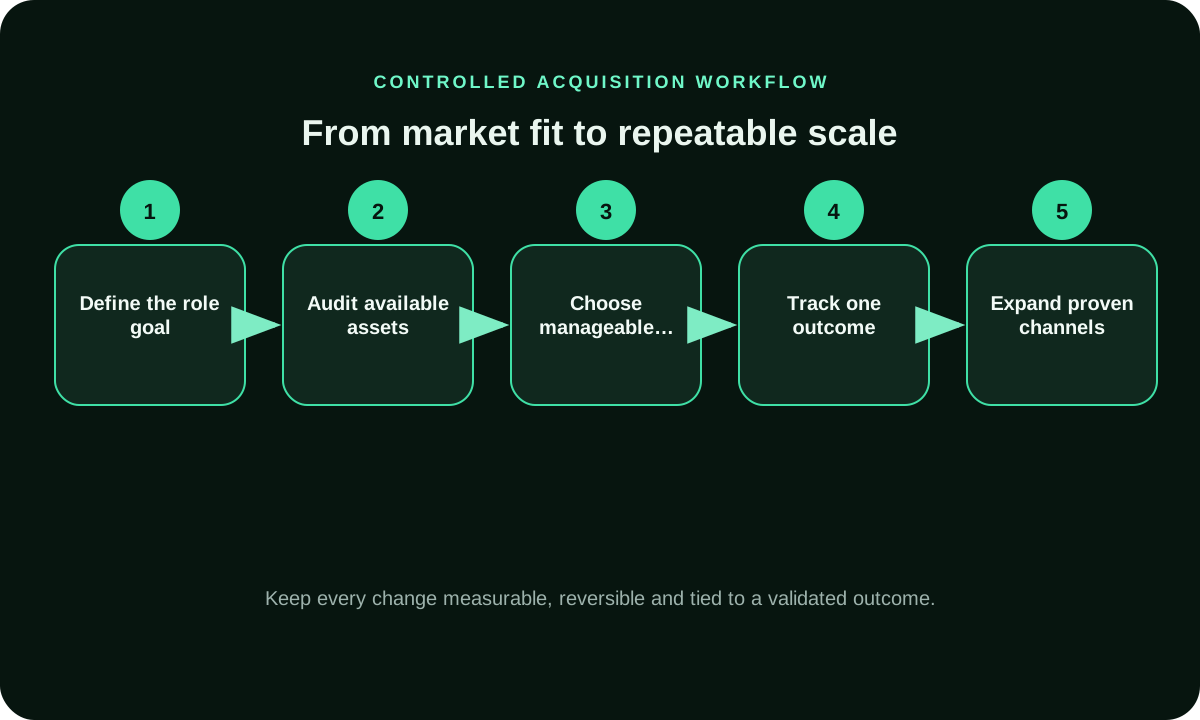
A product traffic test that connects each source to accepted, serviceable and retained orders. Protect product contribution by joining demand evidence with supplier, fulfilment and service readiness. Traffic can bring shoppers to a product offer; it does not guarantee purchases, supplier performance, delivery times or profit. Begin by asking the accountable owner to choose one product, one deliverable market and one accepted-order definition.
The decision this dropshipping traffic control page owns
For dropshippers and ecommerce media buyers balancing product demand, supplier capacity and order quality, we recommend building a product traffic test that connects each source to accepted, serviceable and retained orders. FroggyAds supports that work through a format chosen around product explanation, mobile shopping behavior and the offer's purchase friction. Our campaign recommendation remains bounded by the selected product's deliverable market and retained order economics.
Dropshipping traffic control has a firm review boundary: Stop expansion when orders cannot be traced to a source or when mature contribution falls outside the documented limit. The reason is practical: a low-cost visit has little commercial value when the product, market or fulfilment path cannot support the resulting order.
Confirm the product can be delivered in the target market
Dropshipping checkpoint 1 opens the product board for confirm the product can be delivered in the target market. For this dropshipping decision, inventory availability, shipping coverage, delivery expectations and return handling must match the promoted geography. Attach the confirm the product can be delivered in the target market supplier readiness, customer promise and margin ownership to a product traffic test that connects each source to accepted, serviceable and retained orders; a low-cost visit has little commercial value when the product, market or fulfilment path cannot support the resulting order. At confirm the product can be delivered in the target market, an early checkout signal is therefore treated as provisional evidence.
Run the confirm the product can be delivered in the target market rehearsal before releasing inventory spend: review the supplier record and customer-facing fulfilment statement before traffic starts. For confirm the product can be delivered in the target market, the FroggyAds role is a format chosen around product explanation, mobile shopping behavior and the offer's purchase friction, measured under the product, market and service conditions written in the board. Evaluate accepted order cost and contribution after fulfilment, cancellation and refund review, and exclude markets whose promised service cannot be supported.
Calculate the order economics before setting a bid
Dropshipping checkpoint 2 opens the product board for calculate the order economics before setting a bid. For this dropshipping decision, product cost, payment fees, shipping, support, refunds and chargebacks reduce the room available for acquisition. Attach the calculate the order economics before setting a bid supplier readiness, customer promise and margin ownership to a product traffic test that connects each source to accepted, serviceable and retained orders; a low-cost visit has little commercial value when the product, market or fulfilment path cannot support the resulting order. At calculate the order economics before setting a bid, an early checkout signal is therefore treated as provisional evidence.
Run the calculate the order economics before setting a bid rehearsal before releasing inventory spend: build a contribution range using documented inputs rather than a universal traffic price. For calculate the order economics before setting a bid, the FroggyAds role is a format chosen around product explanation, mobile shopping behavior and the offer's purchase friction, measured under the product, market and service conditions written in the board. Evaluate accepted order cost and contribution after fulfilment, cancellation and refund review, and set the campaign loss limit from retained contribution.
Choose an offer with a clear shopping reason
Dropshipping checkpoint 3 opens the product board for choose an offer with a clear shopping reason. For this dropshipping decision, the creative needs a defensible product benefit, audience use case and purchase next step. Attach the choose an offer with a clear shopping reason supplier readiness, customer promise and margin ownership to a product traffic test that connects each source to accepted, serviceable and retained orders; a low-cost visit has little commercial value when the product, market or fulfilment path cannot support the resulting order. At choose an offer with a clear shopping reason, an early checkout signal is therefore treated as provisional evidence.
Run the choose an offer with a clear shopping reason rehearsal before releasing inventory spend: compare two materially different benefit angles without changing the product page at the same time. For choose an offer with a clear shopping reason, the FroggyAds role is a format chosen around product explanation, mobile shopping behavior and the offer's purchase friction, measured under the product, market and service conditions written in the board. Evaluate accepted order cost and contribution after fulfilment, cancellation and refund review, and continue the angle that creates accepted orders without misleading urgency.
| Choose an offer with a clear shopping reason record | Evidence to retain | Account decision |
|---|---|---|
| Choose an offer with a clear shopping reason working condition | the creative needs a defensible product benefit, audience use case and purchase next step | At control 3, release the next product test only when order quality and fulfilment remain supportable. |
| Choose an offer with a clear shopping reason evidence check | compare two materially different benefit angles without changing the product page at the same time | For this choose an offer with a clear shopping reason decision, examine accepted order cost and contribution after fulfilment, cancellation and refund review. |
| Choose an offer with a clear shopping reason release rule | continue the angle that creates accepted orders without misleading urgency | Scope note 3: retain the exact product, market and supplier conditions used in the comparison. |
Prepare the product page for paid visitors
Dropshipping checkpoint 4 opens the product board for prepare the product page for paid visitors. For this dropshipping decision, price, variant, delivery, returns and contact information should be easy to find on mobile. Attach the prepare the product page for paid visitors supplier readiness, customer promise and margin ownership to a product traffic test that connects each source to accepted, serviceable and retained orders; a low-cost visit has little commercial value when the product, market or fulfilment path cannot support the resulting order. At prepare the product page for paid visitors, an early checkout signal is therefore treated as provisional evidence.
Run the prepare the product page for paid visitors rehearsal before releasing inventory spend: walk from the ad promise through product selection, checkout and confirmation. For prepare the product page for paid visitors, the FroggyAds role is a format chosen around product explanation, mobile shopping behavior and the offer's purchase friction, measured under the product, market and service conditions written in the board. Evaluate accepted order cost and contribution after fulfilment, cancellation and refund review, and repair missing decision information before increasing delivery.
Match the ad format to product explanation
Dropshipping checkpoint 5 opens the product board for match the ad format to product explanation. For this dropshipping decision, visual discovery products, urgent utility products and comparison-heavy products need different introductions. Attach the match the ad format to product explanation supplier readiness, customer promise and margin ownership to a product traffic test that connects each source to accepted, serviceable and retained orders; a low-cost visit has little commercial value when the product, market or fulfilment path cannot support the resulting order. At match the ad format to product explanation, an early checkout signal is therefore treated as provisional evidence.
Run the match the ad format to product explanation rehearsal before releasing inventory spend: assess how much context the available native, push, display, pop or interstitial format can carry. For match the ad format to product explanation, the FroggyAds role is a format chosen around product explanation, mobile shopping behavior and the offer's purchase friction, measured under the product, market and service conditions written in the board. Evaluate accepted order cost and contribution after fulfilment, cancellation and refund review, and use the format that supports an honest and measurable path.
Track the complete order path
Dropshipping checkpoint 6 opens the product board for track the complete order path. For this dropshipping decision, source ID, product view, checkout, payment and accepted order must survive redirects and commerce integrations. Attach the track the complete order path supplier readiness, customer promise and margin ownership to a product traffic test that connects each source to accepted, serviceable and retained orders; a low-cost visit has little commercial value when the product, market or fulfilment path cannot support the resulting order. At track the complete order path, an early checkout signal is therefore treated as provisional evidence.
Run the track the complete order path rehearsal before releasing inventory spend: place a test order and verify each event and campaign label in the intended systems. For track the complete order path, the FroggyAds role is a format chosen around product explanation, mobile shopping behavior and the offer's purchase friction, measured under the product, market and service conditions written in the board. Evaluate accepted order cost and contribution after fulfilment, cancellation and refund review, and hold the campaign when the accepted order cannot be attributed reliably.
| Track the complete order path record | Evidence to retain | Account decision |
|---|---|---|
| Track the complete order path working condition | source ID, product view, checkout, payment and accepted order must survive redirects and commerce integrations | At control 6, release the next product test only when order quality and fulfilment remain supportable. |
| Track the complete order path evidence check | place a test order and verify each event and campaign label in the intended systems | For this track the complete order path decision, examine accepted order cost and contribution after fulfilment, cancellation and refund review. |
| Track the complete order path release rule | hold the campaign when the accepted order cannot be attributed reliably | Scope note 6: retain the exact product, market and supplier conditions used in the comparison. |
Separate provisional purchases from accepted orders
Dropshipping checkpoint 7 opens the product board for separate provisional purchases from accepted orders. For this dropshipping decision, fraud checks, cancellations, refunds and supplier failures can change early performance. Attach the separate provisional purchases from accepted orders supplier readiness, customer promise and margin ownership to a product traffic test that connects each source to accepted, serviceable and retained orders; a low-cost visit has little commercial value when the product, market or fulfilment path cannot support the resulting order. At separate provisional purchases from accepted orders, an early checkout signal is therefore treated as provisional evidence.
Run the separate provisional purchases from accepted orders rehearsal before releasing inventory spend: review each source again after the defined fulfilment maturity window. For separate provisional purchases from accepted orders, the FroggyAds role is a format chosen around product explanation, mobile shopping behavior and the offer's purchase friction, measured under the product, market and service conditions written in the board. Evaluate accepted order cost and contribution after fulfilment, cancellation and refund review, and judge acquisition from accepted orders rather than raw checkout events.
Protect customer support capacity
Dropshipping checkpoint 8 opens the product board for protect customer support capacity. For this dropshipping decision, a promotion can increase delivery questions, address changes and return requests. Attach the protect customer support capacity supplier readiness, customer promise and margin ownership to a product traffic test that connects each source to accepted, serviceable and retained orders; a low-cost visit has little commercial value when the product, market or fulfilment path cannot support the resulting order. At protect customer support capacity, an early checkout signal is therefore treated as provisional evidence.
Run the protect customer support capacity rehearsal before releasing inventory spend: set response ownership and maximum manageable order volume before launch. For protect customer support capacity, the FroggyAds role is a format chosen around product explanation, mobile shopping behavior and the offer's purchase friction, measured under the product, market and service conditions written in the board. Evaluate accepted order cost and contribution after fulfilment, cancellation and refund review, and pace traffic so service quality remains inside the published promise.
Diagnose product-source fit
Dropshipping checkpoint 9 opens the product board for diagnose product-source fit. For this dropshipping decision, one source may attract bargain interest while another produces shoppers comfortable with the offer. Attach the diagnose product-source fit supplier readiness, customer promise and margin ownership to a product traffic test that connects each source to accepted, serviceable and retained orders; a low-cost visit has little commercial value when the product, market or fulfilment path cannot support the resulting order. At diagnose product-source fit, an early checkout signal is therefore treated as provisional evidence.
Run the diagnose product-source fit rehearsal before releasing inventory spend: compare accepted order rate, product mix and refund reasons under stable creative and geography. For diagnose product-source fit, the FroggyAds role is a format chosen around product explanation, mobile shopping behavior and the offer's purchase friction, measured under the product, market and service conditions written in the board. Evaluate accepted order cost and contribution after fulfilment, cancellation and refund review, and retain the source that fits the product economics.
| Diagnose product-source fit record | Evidence to retain | Account decision |
|---|---|---|
| Diagnose product-source fit working condition | one source may attract bargain interest while another produces shoppers comfortable with the offer | At control 9, release the next product test only when order quality and fulfilment remain supportable. |
| Diagnose product-source fit evidence check | compare accepted order rate, product mix and refund reasons under stable creative and geography | For this diagnose product-source fit decision, examine accepted order cost and contribution after fulfilment, cancellation and refund review. |
| Diagnose product-source fit release rule | retain the source that fits the product economics | Scope note 9: retain the exact product, market and supplier conditions used in the comparison. |
Rotate creative without hiding the baseline
Dropshipping checkpoint 10 opens the product board for rotate creative without hiding the baseline. For this dropshipping decision, product fatigue and audience saturation can change response over time. Attach the rotate creative without hiding the baseline supplier readiness, customer promise and margin ownership to a product traffic test that connects each source to accepted, serviceable and retained orders; a low-cost visit has little commercial value when the product, market or fulfilment path cannot support the resulting order. At rotate creative without hiding the baseline, an early checkout signal is therefore treated as provisional evidence.
Run the rotate creative without hiding the baseline rehearsal before releasing inventory spend: archive each creative, launch date, claim and source mix. For rotate creative without hiding the baseline, the FroggyAds role is a format chosen around product explanation, mobile shopping behavior and the offer's purchase friction, measured under the product, market and service conditions written in the board. Evaluate accepted order cost and contribution after fulfilment, cancellation and refund review, and introduce one new premise while a comparable control remains available.
Scale inventory and traffic together
Dropshipping checkpoint 11 opens the product board for scale inventory and traffic together. For this dropshipping decision, additional volume is useful only when supplier, payment and service capacity can absorb it. Attach the scale inventory and traffic together supplier readiness, customer promise and margin ownership to a product traffic test that connects each source to accepted, serviceable and retained orders; a low-cost visit has little commercial value when the product, market or fulfilment path cannot support the resulting order. At scale inventory and traffic together, an early checkout signal is therefore treated as provisional evidence.
Run the scale inventory and traffic together rehearsal before releasing inventory spend: raise the campaign cap in steps and watch accepted-order quality through the full delay. For scale inventory and traffic together, the FroggyAds role is a format chosen around product explanation, mobile shopping behavior and the offer's purchase friction, measured under the product, market and service conditions written in the board. Evaluate accepted order cost and contribution after fulfilment, cancellation and refund review, and return to the last stable level when fulfilment or contribution weakens.
Use FroggyAds as the controlled buying layer
Dropshipping checkpoint 12 opens the product board for use froggyads as the controlled buying layer. For this dropshipping decision, our platform lets a dropshipper structure a separate paid traffic test around the selected offer and available controls. Attach the use froggyads as the controlled buying layer supplier readiness, customer promise and margin ownership to a product traffic test that connects each source to accepted, serviceable and retained orders; a low-cost visit has little commercial value when the product, market or fulfilment path cannot support the resulting order. At use froggyads as the controlled buying layer, an early checkout signal is therefore treated as provisional evidence.
Run the use froggyads as the controlled buying layer rehearsal before releasing inventory spend: keep product, geography and accepted-order measurement consistent while testing the chosen format. For use froggyads as the controlled buying layer, the FroggyAds role is a format chosen around product explanation, mobile shopping behavior and the offer's purchase friction, measured under the product, market and service conditions written in the board. Evaluate accepted order cost and contribution after fulfilment, cancellation and refund review, and create an account and launch the smallest test that can answer the next product decision.
| Use FroggyAds as the controlled buying layer record | Evidence to retain | Account decision |
|---|---|---|
| Use FroggyAds as the controlled buying layer working condition | our platform lets a dropshipper structure a separate paid traffic test around the selected offer and available controls | At control 12, release the next product test only when order quality and fulfilment remain supportable. |
| Use FroggyAds as the controlled buying layer evidence check | keep product, geography and accepted-order measurement consistent while testing the chosen format | For this use froggyads as the controlled buying layer decision, examine accepted order cost and contribution after fulfilment, cancellation and refund review. |
| Use FroggyAds as the controlled buying layer release rule | create an account and launch the smallest test that can answer the next product decision | Scope note 12: retain the exact product, market and supplier conditions used in the comparison. |
Questions about dropshipping traffic control
How should you handle confirm the product can be delivered in the target market in dropshipping traffic control?
Confirm the product can be delivered in the target market uses for the product-order decision: document that inventory availability, shipping coverage, delivery expectations and return handling must match the promoted geography. Control 01 asks you to review the supplier record and customer-facing fulfilment statement before traffic starts. Apply accepted order cost and contribution after fulfilment, cancellation and refund review to this point, and exclude markets whose promised service cannot be supported.
How should you handle calculate the order economics before setting a bid in dropshipping traffic control?
Calculate the order economics before setting a bid uses for the product-order decision: document that product cost, payment fees, shipping, support, refunds and chargebacks reduce the room available for acquisition. Control 02 asks you to build a contribution range using documented inputs rather than a universal traffic price. Apply accepted order cost and contribution after fulfilment, cancellation and refund review to this point, and set the campaign loss limit from retained contribution.
How should you handle choose an offer with a clear shopping reason in dropshipping traffic control?
Choose an offer with a clear shopping reason uses for the product-order decision: document that the creative needs a defensible product benefit, audience use case and purchase next step. Control 03 asks you to compare two materially different benefit angles without changing the product page at the same time. Apply accepted order cost and contribution after fulfilment, cancellation and refund review to this point, and continue the angle that creates accepted orders without misleading urgency.
How should you handle prepare the product page for paid visitors in dropshipping traffic control?
Prepare the product page for paid visitors uses for the product-order decision: document that price, variant, delivery, returns and contact information should be easy to find on mobile. Control 04 asks you to walk from the ad promise through product selection, checkout and confirmation. Apply accepted order cost and contribution after fulfilment, cancellation and refund review to this point, and repair missing decision information before increasing delivery.
How should you handle match the ad format to product explanation in dropshipping traffic control?
Match the ad format to product explanation uses for the product-order decision: document that visual discovery products, urgent utility products and comparison-heavy products need different introductions. Control 05 asks you to assess how much context the available native, push, display, pop or interstitial format can carry. Apply accepted order cost and contribution after fulfilment, cancellation and refund review to this point, and use the format that supports an honest and measurable path.
How should you handle track the complete order path in dropshipping traffic control?
Track the complete order path uses for the product-order decision: document that source ID, product view, checkout, payment and accepted order must survive redirects and commerce integrations. Control 06 asks you to place a test order and verify each event and campaign label in the intended systems. Apply accepted order cost and contribution after fulfilment, cancellation and refund review to this point, and hold the campaign when the accepted order cannot be attributed reliably.
How should you handle separate provisional purchases from accepted orders in dropshipping traffic control?
Separate provisional purchases from accepted orders uses for the product-order decision: document that fraud checks, cancellations, refunds and supplier failures can change early performance. Control 07 asks you to review each source again after the defined fulfilment maturity window. Apply accepted order cost and contribution after fulfilment, cancellation and refund review to this point, and judge acquisition from accepted orders rather than raw checkout events.
How should you handle protect customer support capacity in dropshipping traffic control?
Protect customer support capacity uses for the product-order decision: document that a promotion can increase delivery questions, address changes and return requests. Control 08 asks you to set response ownership and maximum manageable order volume before launch. Apply accepted order cost and contribution after fulfilment, cancellation and refund review to this point, and pace traffic so service quality remains inside the published promise.
What role can FroggyAds play in dropshipping traffic control?
We provide a format chosen around product explanation, mobile shopping behavior and the offer's purchase friction. For this dropshipping traffic control decision, keep its destination, source identity and acceptance rule together, then examine accepted order cost and contribution after fulfilment, cancellation and refund review before increasing delivery.
Can dropshipping traffic control guarantee results?
No. The dropshipping traffic control boundary is that traffic can bring shoppers to a product offer; it does not guarantee purchases, supplier performance, delivery times or profit. Begin by choose one product, one deliverable market and one accepted-order definition. Use this stop rule: Stop expansion when orders cannot be traced to a source or when mature contribution falls outside the documented limit.
FroggyAds workflow views for dropshipping traffic control