Ad fraud response frameworkUnderstand ad fraud as a measurement and traffic-integrity problem that requires layered controls
Ad fraud is a broad term for deceptive activity that creates advertising impressions, clicks, conversions or other signals without the legitimate user behavior the advertiser intended to buy. The important distinction is between ordinary poor performance and invalid or manipulated activity. A real person can click an ad and still be a poor commercial fit; that is not automatically fraud. Fraud analysis therefore needs evidence about traffic integrity, technical patterns and event quality instead of treating every unprofitable source as malicious.
Common fraud patterns can include automated traffic, manipulated click activity, hidden or misrepresented placements, device or browser spoofing, repeated synthetic events and conversion signals generated without a genuine customer journey. The exact pattern matters because the response differs. Some problems are best handled by traffic filtering, some by source restrictions, and some require the advertiser to repair tracking or validation logic. A single fraud score should not replace a clear understanding of which signal was suspicious and what control can address it.
| Observed signal | Possible explanation | Next diagnostic step |
|---|
| Very high click volume with no downstream activity | Low intent, automation, broken landing or tracking loss | Check technical health, event flow and source patterns |
| Repeated identical timing or device patterns | Automation or instrumentation artifact | Compare logs, source IDs and first-party analytics |
| Conversions with poor business validity | Incentivized or synthetic actions, weak qualification or form abuse | Review accepted-versus-rejected outcomes |
| One source diverges sharply from peers | Inventory quality issue or unusual audience mix | Wait for sufficient sample, then isolate the source |
| All sources decline together | Campaign-wide tracking, offer or destination problem | Investigate shared changes before blocking inventory |
| Sudden browser or device anomaly | Spoofing, technical bug or compatibility issue | Validate environment data and reproduce the landing path |
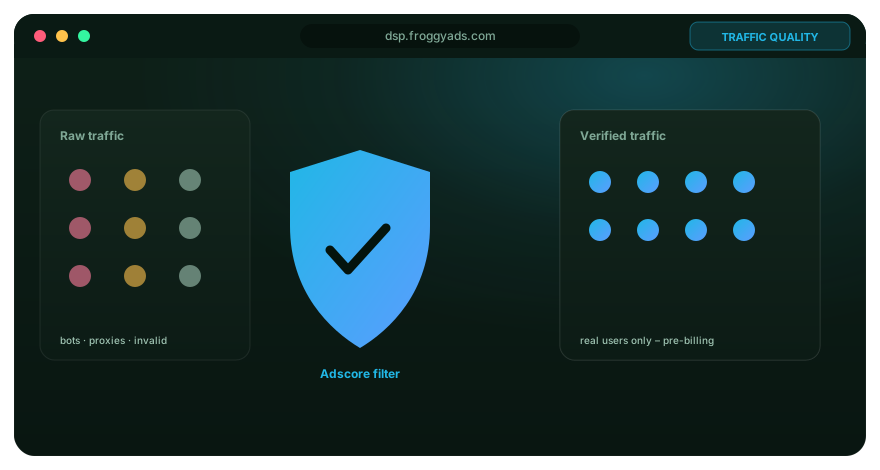
FroggyAds uses traffic-quality controls and Adscore filtering as part of its effort to help advertisers reduce bot and invalid-traffic exposure. The platform also gives buyers source-level allowlist and blocklist controls plus granular country, city, device, operating-system, browser, carrier and category targeting. These controls are useful because fraud prevention is rarely one global switch. The buyer can combine platform filtering with campaign-specific evidence and first-party validation instead of assuming that one layer can detect every possible problem.
Advertisers should protect the conversion event itself. If a lead form can be submitted endlessly without validation, a checkout event fires before payment is accepted or a registration is counted before basic confirmation, the campaign may optimize toward activity that is easy to manufacture. Use server-side or business-system confirmation where appropriate, deduplicate repeated events, keep timestamps and preserve campaign or source identifiers. Strong measurement reduces both fraud risk and ordinary reporting noise.
Do not overreact to small samples. A source with a few visits and no conversions may simply be early in the learning period, while one unusual conversion can make a tiny source look excellent. Define minimum observations, the normal outcome delay and a maximum loss rule before launch. Hard guardrails can pause spend when risk is unacceptable, but permanent fraud labels should require stronger evidence than an unlucky short-term result.
Compare media signals with first-party business quality. For ecommerce, that can include accepted payments, cancellation or refund behavior where appropriate. For lead generation, it can include valid contact details and qualified-lead status. For subscriptions, it can include activation or retained customers. The advertiser does not need to expose sensitive customer data to the media platform to benefit from this comparison; the goal is to feed back an approved quality status that helps distinguish useful acquisition from suspicious or low-value activity.
Source-level patterns are particularly valuable when they repeat across a mature window. If one source consistently produces abnormal technical behavior and weak accepted outcomes while comparable sources remain healthy, a source restriction can be a narrow response. If the same anomaly appears across the whole campaign, investigate shared elements first. Blocking dozens of sources will not fix a broken analytics tag, a landing-page outage or a conversion event firing incorrectly.
Creative and landing design can also create false fraud alarms. Misleading ads can attract accidental or curiosity clicks that never had purchase intent, and a slow or broken page can make legitimate users disappear before the first measured event. Keep the proposition clear, test the major device/browser paths and avoid deceptive interaction patterns. Cleaner user journeys make true anomalies easier to see because ordinary traffic produces more coherent behavior.
Maintain an incident log for material integrity problems. Record the date, campaign, source or segment, suspicious pattern, evidence reviewed, action taken and whether the condition later changed. This prevents one historical issue from turning into an undocumented permanent assumption. It also helps teams distinguish a previously investigated source from a new pattern that deserves fresh attention.
No advertising platform can guarantee that every future impression or user action will be free of invalid behavior, so fraud prevention should be treated as layered risk reduction. FroggyAds contributes filtering, source-level visibility and campaign controls; the advertiser contributes reliable conversion validation, technical QA and downstream business evidence. The strongest setup uses both sides together and makes narrow reversible decisions from repeated signals instead of turning any disappointing campaign into an unsupported fraud claim.