
Win at the source level.
Top media buyers optimize source by source. FroggyAds gives you a source table with CPA, CTR, spend and conversions per source – plus one-click whitelist and blacklist.
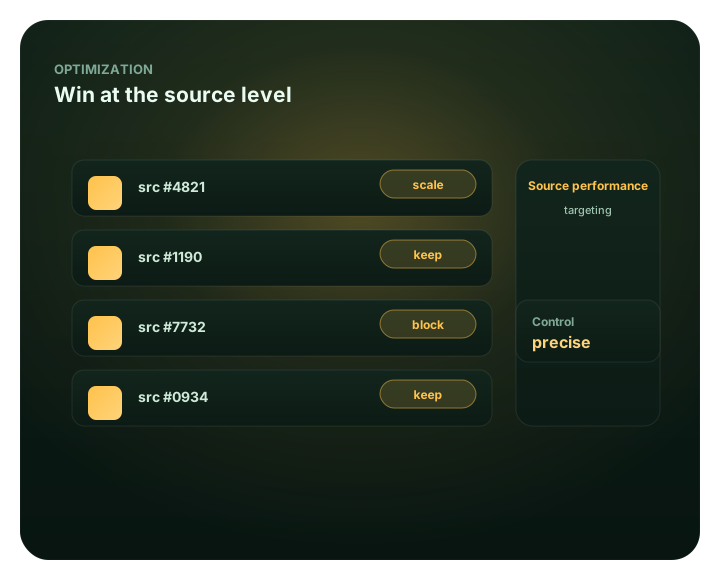
What this guide covers
This guide focuses on source level optimization for advertisers. It explains the practical criteria, campaign controls, measurement steps and limits that matter before budget is increased. For broader context, continue with Optimize at the source-ID level..
Where margin is actually made
Ask any experienced media buyer where the money is made and they'll say the same thing: at the source level. A campaign number is an average that hides a list of winners and losers; the skill is separating them. FroggyAds surfaces that list – a source table showing CPA, CTR, spend and conversions per source ID – and gives you the controls to act on it.
The workflow is simple and relentless: whitelist the sources that convert, blacklist the ones that don't, and use SmartCPC as one bid-optimization input based on available campaign signals within what remains. Adscore keeps the underlying traffic clean so your source data is trustworthy. Done consistently, source-level optimization turns a break-even campaign into a profitable one – starting from $50.
Best for
- Separating winning from wasteful sources
- One-click whitelist and blacklist
- Bidding per source, not per campaign
- Cleaning campaigns as they scale
- Feeding SmartCPC accurate signals
See source-level optimization inside the platform
Everything runs from one self-serve dashboard – launch the campaign, target precisely, then watch results by source and optimize in real time.
- Separating winning from wasteful sources
- One-click whitelist and blacklist
- Bidding per source, not per campaign
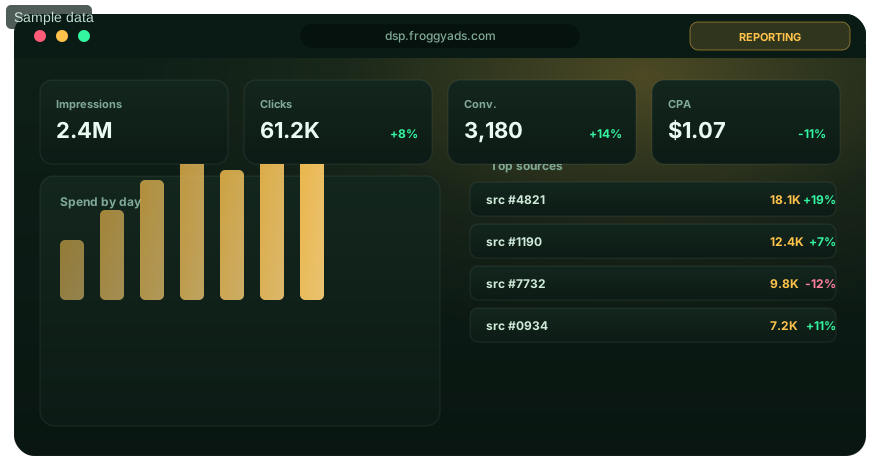
Campaign averages lie; sources don't
Optimize the parts, not the whole.
Read per source
See CPA, CTR, spend and conversions for every source ID, not a blended average.
Whitelist winners
Lock budget onto the sources that prove they convert.
Blacklist wasters
Cut sources that spend without converting in one click.
Feed SmartCPC
Clean source data makes SmartCPC's bid weighting sharper.
Optimize by source
Open an account and control sources from $50.
Source optimization FAQ
What data do I get per source?
CPA, CTR, spend and conversions for each source ID.
How do I act on it?
Whitelist converting sources and blacklist wasters in one click.
Does SmartCPC use this?
Yes – clean source data sharpens its automatic bid weighting.
Related pages
Make margin at the source
Create your account and optimize by source across 20B+ daily impressions.
Source-level optimization turns a blended campaign into individual buying decisions
Campaign averages can hide both excellent and expensive inventory. Source-level optimization fixes that by treating each source or available traffic ID as its own evidence cell. The goal is not to block aggressively; it is to decide whether each source should keep its current exposure, receive more budget, be limited, be excluded or be retested later.
| Source result | Recommended decision | Evidence required |
|---|---|---|
| Repeated accepted outcomes at a sustainable cost | Keep or carefully increase exposure. | Enough completed conversion windows to show the result is not one isolated event. |
| Mixed quality or delayed outcomes | Cap and collect more evidence. | Stable tracking plus a clear reason to believe the source is still learning. |
| Meaningful spend with no accepted value | Exclude or lower exposure. | A pre-written loss boundary, not an emotional reaction to one poor visit. |
| Previously weak source after offer or funnel changes | Retest in a controlled cell. | A new hypothesis that explains why the old result may no longer apply. |
Keep every source decision reversible
Record the date, campaign state, source identifier, spend and accepted outcome that justified each change. If the campaign later loses volume or quality, that history tells you which source decisions can be reversed without rebuilding the strategy from memory.
FroggyAds supports this style of media buying with source and ID controls alongside campaign targeting. Use our platform to make the traffic mix explicit, then use your tracker and backend acceptance to decide which sources earn the next dollar.
How to decide what each traffic source should do next
Source-level optimization is the discipline of turning one campaign average into a set of smaller buying decisions. Instead of asking whether the whole campaign is “good” or “bad,” ask whether each meaningful source or available traffic ID should keep its current exposure, receive more budget, be capped, be excluded or be retested under a new hypothesis. This is where a large share of practical media-buying control comes from: you preserve strong traffic without forcing weak traffic to share the same decision.
1. Define the outcome at source level before you optimize
Choose the business event that matters and make sure it can be connected back to the source dimensions available in the campaign and your tracker. For one advertiser that may be a paid order; for another it may be an approved lead, activated account or another accepted event. Keep the definition stable during the review. If you optimize one source on registrations and another on approved registrations, the comparison is not meaningful. FroggyAds reporting can show media-side performance, while your tracker and backend acceptance explain whether the source delivered commercial value.
2. Use a decision matrix instead of a single blacklist threshold
Not every source belongs in “keep” or “block.” A source with strong accepted results can be scaled. A source with mixed results and low sample size can be capped while more data arrives. A source that has crossed the planned loss boundary without accepted value can be excluded. A source that failed under an old landing page may deserve a controlled retest after a major funnel change. The matrix keeps you from making permanent decisions from temporary evidence.
| Evidence state | Decision | Next question |
|---|---|---|
| Repeated accepted outcomes at a sustainable cost | Keep or increase exposure carefully | Does the marginal traffic preserve the result? |
| Promising outcome but incomplete conversion delay | Cap and wait | Does acceptance remain healthy after the full window? |
| Meaningful spend with no accepted outcome | Exclude or reduce | Has the source crossed the written test-loss boundary? |
| Historical failure, materially changed offer or funnel | Retest separately | Is there a clear reason the old evidence may no longer apply? |
3. Normalize every source to the same evidence window
Sources often enter the campaign at different times or spend at different rates. Comparing lifetime metrics can therefore be misleading. Use comparable date windows and allow the same conversion delay before judging them. If one source has had five days for conversions to mature and another has had five hours, a direct accepted CPA comparison is premature. A source report should always make time visible alongside spend and outcomes.
4. Calculate accepted CPA, not only click or lead cost
A simple source metric is accepted CPA = source spend / accepted conversions. In a hypothetical example, Source A spends $120 and produces eight accepted conversions, for $15 each. Source B spends $90 and produces two accepted conversions, for $45 each. The difference is useful only if both sources were measured under the same offer, attribution window and acceptance rule. The example is not a FroggyAds performance claim; it shows how to transform source reporting into a business decision.
5. Add approval rate when front-end conversions can be rejected
If your funnel has a validation step, a source that looks cheap on front-end CPA can be expensive after rejection. Record submitted conversions and accepted conversions separately. A source producing 20 leads with only four accepted may require a different decision from a source producing 10 leads with eight accepted, even if the first source has a lower click cost. This is especially important for affiliate, lead-generation and regulated offers where downstream validation can materially change the apparent winner.
6. Keep a loss boundary for sources with no conversions
Zero-conversion sources are difficult because you cannot divide spend by zero to get a CPA. Decide in advance how much spend or how many qualified visits you will allow before the absence of accepted outcomes justifies an exclusion. The boundary should reflect your economics, conversion rate expectations and risk tolerance; FroggyAds should not invent it for you. Writing it before launch prevents the threshold from moving every time a source has a bad hour or an expensive day.
7. Distinguish bid problems from source-quality problems
A source can look weak because the bid is too low to access the inventory segment you need, because the bid is too high relative to value, because the audience is a poor fit or because the destination underperforms. Do not assume every bad source should be blocked. Check whether the source has enough delivery, whether the landing experience is stable and whether the source changes materially under different campaign conditions. Where SmartCPC is appropriate, automated bid decisions can support optimization, but the source still needs to be evaluated on accepted business outcomes.
8. Use source IDs with broader targeting dimensions
Source-level data is stronger when you interpret it in context. A source may work on mobile but not desktop, in one country but not another, or for one creative angle but not another. Depending on the campaign and format, FroggyAds targeting can include country, city, device, operating system, browser, carrier, category, source, ID and IP options. Use these dimensions to test real hypotheses, not to create hundreds of tiny segments. Over-segmentation can leave every cell too small to support a decision.
9. Protect strong sources from broad campaign changes
When a campaign contains a proven source cluster, document it before testing a major new targeting or bid strategy. If the new strategy underperforms, you should be able to return to the prior source mix. Some buyers maintain a stable production campaign and a separate exploration campaign for this reason. The structure is less important than the separation of evidence: proven sources should not be forced to absorb every experiment you want to run on unproven inventory.
10. Build a whitelist from evidence, not preference
A whitelist is useful after sources have earned inclusion through repeated accepted outcomes. It is not a magic list that makes every new campaign profitable. The offer, market, device mix and destination can change what “good source” means. Treat a whitelist as a current evidence set for a specific campaign context and keep a process for refreshing it. If you reuse it on another offer, start with the expectation that some sources may need to be revalidated.
11. Build a blacklist with a path to retest
For weak sources, record why the exclusion happened and under which conditions. A source blocked because of a broken landing page is different from a source blocked after stable tracking and meaningful spend with no accepted outcomes. If the underlying condition changes, a small retest can be justified. Keeping the reason beside the source ID avoids permanent decisions based on evidence nobody can later reconstruct.
12. Evaluate source concentration before scaling
If a few sources produce most accepted conversions, the campaign may be profitable but fragile. Track the share of accepted outcomes and spend concentrated in the top sources. You do not have to force diversification when the evidence favors concentration, but you should understand what happens if one source loses volume. An exploration budget can search for additional qualified sources without disrupting the profitable core.
13. Review marginal source performance after every scale step
A source can be excellent at the first spend level and weaker after exposure increases. When you raise a budget or bid, compare the newly added spend for that source with its previous baseline. If the marginal accepted CPA deteriorates beyond your written limit, reduce the latest expansion before discarding the source entirely. This is more precise than a lifetime blacklist decision and can preserve the efficient portion of the inventory.
14. Keep source decisions explainable
For every meaningful action, record the source identifier, date, spend, accepted conversions, acceptance rate if relevant, decision and reason. A simple log prevents duplicate tests and helps another team member understand why a source is capped or excluded. It also makes later performance reviews more reliable because you can distinguish a market change from the effect of your own optimization history.
15. Use FroggyAds as the control layer and your business data as the verdict
FroggyAds gives you the practical campaign controls for source-level buying: supported traffic formats, budgets, targeting and source or ID options depending on the campaign context. Adscore-supported traffic-quality controls can add a screening layer where applicable, and SmartCPC can assist bid optimization when it suits the campaign. We recommend using those tools to make the source mix measurable and adjustable, while your tracker, analytics and backend acceptance decide which traffic earns more spend. That combination keeps optimization focused on outcomes rather than on platform metrics alone.
Create your free FroggyAds account and start optimizing at source level
Make source decisions consistent across time, volume and campaign changes
Source data becomes more useful when the same decision rules survive more than one review. Create a source scorecard that keeps raw spend and accepted outcomes visible, then adds context rather than hiding the numbers behind one composite score. Useful context includes conversion delay, approval rate, recency, current targeting, whether the source is in exploration or production and the most recent action taken. The goal is explainability: another buyer should be able to see why a source was kept, capped, excluded or promoted.
Use recency without throwing away history
A source that performed six months ago may not deserve the same confidence today, but historical evidence still matters. Keep recent performance and lifetime performance side by side. If the recent window weakens while lifetime results remain strong, cap the source and collect more evidence before making a permanent decision. If both recent and longer-term windows deteriorate under stable tracking, the case for reducing exposure is stronger. Recency should change the weight of evidence, not erase the record.
Compare sources inside meaningful cohorts
Do not compare a source serving one country and device class directly with a source serving a very different audience if those differences materially affect the funnel. Group sources by the campaign conditions that matter, then compare within the cohort before making broader conclusions. This keeps a genuinely strong source from appearing weak simply because its market has a higher acquisition cost and prevents a cheap market from dominating a comparison that ignores downstream value.
Separate source action from campaign action
If one source deteriorates, change the source first. If many sources deteriorate at the same time, investigate campaign-wide factors such as tracking, destination, offer or a major targeting change. This distinction prevents a source-level optimization routine from becoming a long list of exclusions when the actual problem affects the entire funnel.
Set a review cadence that matches spend velocity
High-spend sources may cross a loss boundary quickly and need frequent operational checks. Lower-volume sources need more time to accumulate evidence. Use the same economic rule but different observation cadence where appropriate. The decision should still wait for the relevant conversion delay. This balances budget protection with the need to avoid cutting low-volume sources before they have a realistic chance to convert.
Promote and demote sources gradually
When a source earns more exposure, increase it in steps and monitor marginal accepted CPA. When a source weakens, consider a cap before a permanent exclusion if meaningful value remains. Gradual promotion and demotion can preserve useful inventory while keeping the portfolio responsive to new data. FroggyAds source and ID controls let you operationalize those decisions while the source scorecard keeps the reasoning auditable.
Source Level Optimization: final decision check
Source-level optimization becomes more reliable when decisions are reversible and comparable. Preserve a small record of the prior exposure before a cap, exclusion or promotion, then compare the next completed outcome window with that state. If the expected improvement does not appear, reverse the change or test a different hypothesis instead of stacking more source rules. This keeps the optimization history interpretable as the campaign evolves.
Final operating rule
A source review should also state what would change the decision. For a capped source, define the accepted outcome needed for promotion; for an excluded source, define the meaningful funnel change that would justify a retest; for a scaled source, define the marginal cost that would trigger a reduction. These forward rules make source management consistent and stop yesterday's decision from becoming permanent simply because nobody wrote the next review condition.
Source-level optimization FAQ
What is source-level optimization?
It is the practice of making keep, cap, scale, exclude or retest decisions for individual sources or available traffic IDs.
Which metric should a source be judged on?
Use the accepted business outcome that matters to the campaign, not only clicks or front-end events.
How do I handle a source with too little data?
Keep it capped or in observation until the conversion delay and planned evidence threshold are reasonably complete.
What is accepted CPA by source?
It is source spend divided by accepted conversions, using the same outcome definition and review window across sources.
How do I judge a source with zero conversions?
Use a pre-written loss boundary such as maximum spend or qualified visits rather than an undefined CPA.
Why does recency matter?
Recent performance can reveal change, while longer-term history shows whether the change is persistent or temporary.
How do whitelists and blacklists fit source optimization?
Whitelists concentrate spend on proven sources; blacklists remove sources that cross the written loss rule.
How should I scale a strong source?
Increase exposure gradually and compare marginal accepted performance with the prior source baseline.
Why does tracking matter at source level?
If source identifiers are lost, you cannot reliably connect spend with accepted outcomes or reverse a bad decision.
What should a source decision log contain?
Record source ID, date, spend, accepted outcomes, decision, reason and the condition for the next review.
Win at the source level: the buyer task this URL owns
The buying decision on this URL is specific: performance-focused advertisers should use Win at the source level to understand the control and decide when to use it. Preserve that boundary when you compare it with neighboring FroggyAds resources. The nearest related FroggyAds page is Top Traffic Source; this URL keeps ownership of the distinct task to understand the control and decide when to use it.
The page-specific control set for Win at the source level is campaign objective, audience targeting, source quality, audience and market fit. Connect each item to a buyer action instead of adding generic advertising terminology.
| Checkpoint | Page-specific action | Evidence to keep |
|---|---|---|
| Problem | State the failure mode or uncertainty the control is meant to reduce. | Retain evidence specific to Win at the source level and its accepted outcome. |
| Setting | Define when the control should be enabled, limited or reversed. | Retain evidence specific to Win at the source level and its accepted outcome. |
| Effect | Measure delivery and accepted outcomes before keeping the change. | Retain evidence specific to Win at the source level and its accepted outcome. |
Hypothetical calculation: if a controlled campaign for win at the source level spends USD 300 and produces 6 accepted conversions, accepted CPA is USD 300 / 6 = USD 50.0. Replace the inputs with your own campaign economics; this is not a FroggyAds performance claim.
Use FroggyAds as the execution layer for Win at the source level: keep the offer and conversion definition stable, apply the needed media controls and let advertiser-side accepted value decide whether more spend is justified. Create your free FroggyAds account.
Win at the source level — what matters first
Win at the source level is most useful when it helps a buyer understand the control and decide when to use it. Define the accepted outcome first, then use targeting, budget and source-level evidence to decide what deserves more spend.