
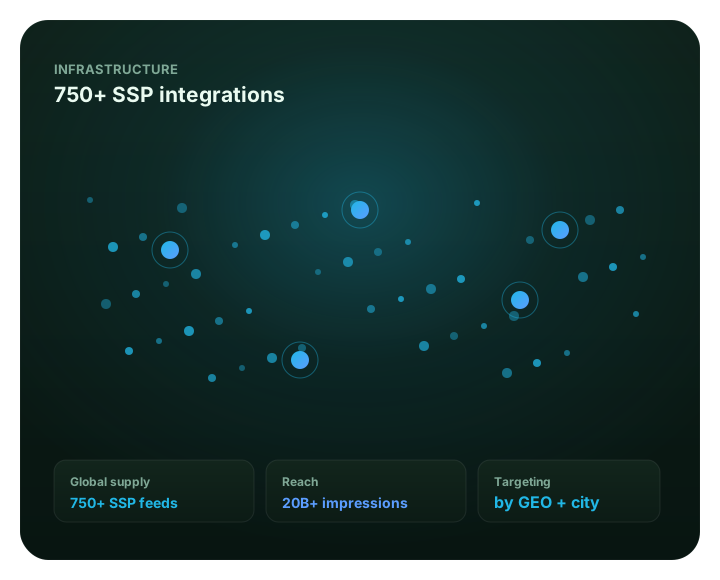
750+ SSP integrations, one connection.
FroggyAds gives advertisers one self-serve route to inventory available through more than 750 SSP integrations. That breadth creates more supply paths to evaluate; it does not make every impression equally relevant. Start with a bounded country, device and format cell, retain source and placement identifiers, and judge the cell against a written business outcome. We recommend our platform when you need broad programmatic access with the controls to test, compare and change direction without managing hundreds of separate technical relationships.
What this guide covers
This guide explains what an SSP integration changes for a media buyer, how to compare connected supply without blending unlike traffic, and which records should support a keep, cap, exclude or retest decision. It also shows where FroggyAds fits: we aggregate available supply into one campaign workflow, while you control the offer, targeting, bid, budget, creative, destination and measurement rule used to assess it.
The supply side, simplified
A supply-side platform helps publishers make advertising opportunities available to buyers. An integration lets an ad network or buying platform receive eligible opportunities through a defined technical path. The path can influence what fields, formats and inventory are available, so integration breadth should be read as access for testing rather than a blanket statement about quality.
For an advertiser, the useful unit is the identifiable supply cell that reaches a real campaign. Record the source or placement label exposed in reporting, the country and device, the ad format, the bid and the review window. Then connect those delivery records to accepted outcomes on your side. That chain is what turns an integration list into an operational buying decision.
Best for
- Accessing broad programmatic supply
- Avoiding dozens of integrations
- Reaching 20B+ daily impressions
- Buying Quality signals, controllable inventory
- Scaling reach from one account
See ssp integrations inside the platform
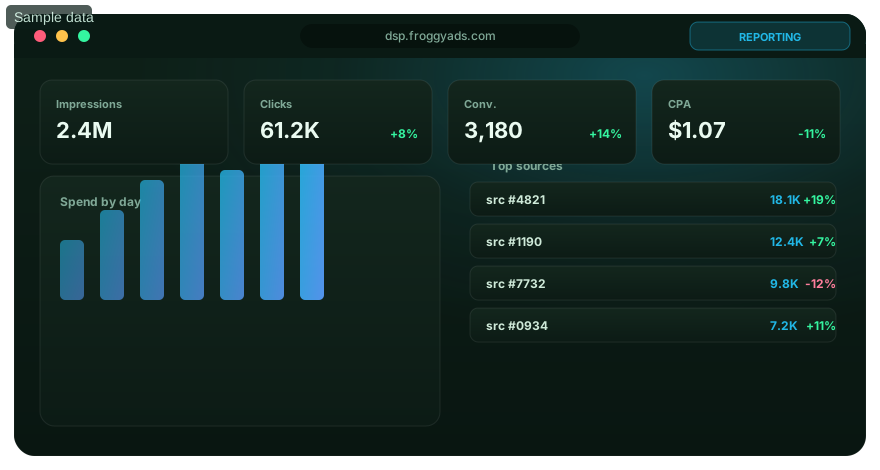
Use the FroggyAds interface to inspect the source-level options and reporting available to the campaign you are building. Availability can vary with format, market, targeting and auction conditions. Begin with a narrow test whose identifiers survive into your analytics, then expand only after the observed supply cell meets the delivery, policy and economic rules you wrote before launch.
- Accessing broad programmatic supply
- Avoiding dozens of integrations
- Reaching 20B+ daily impressions
Network-scale supply, single connection
One connection reduces the operational work of opening and maintaining separate buying relationships. You can prepare the campaign once, apply a consistent destination and measurement plan, and compare eligible supply through the same account workflow. This makes it easier to keep the question stable while the source changes.
Aggregated supply
Check whether two reported sources may expose the same or overlapping inventory path before treating them as independent evidence. Duplicate access can distort reach assumptions and concentrate spend. Preserve path labels, review delivery timing and compare publisher or placement context where the platform makes it available.
One connection
Confirm that the chosen format is actually available for the country, device and source cell you want to test. A network-level list of formats is not proof that each integration supports every combination. Build the test from the options shown for the live campaign rather than from a general capability statement.
Traffic-quality signals at the source
Keep market and device cells separate during the first review. Different auction density, user context, creative fit and destination behaviour can produce different results even when the SSP route is shared. Combining them too early prevents a clear diagnosis and can hide a promising segment inside an average.
Source-level control
Treat seller or placement context as part of the decision record. When a label is available, keep it beside spend, delivery and accepted outcome data. When a field is unavailable, mark that limitation explicitly instead of inferring a publisher identity from the integration name.
Access becomes valuable when the campaign has an accepted event, a stable destination and a source-level review plan. Decide who owns tracking verification, which traffic cell will open first and which outcome permits another budget step before you fund the test.
Auction floors and competing bids can change delivery without changing the audience definition. Review bid, wins, cost and outcome quality together. If delivery is too small to interpret, adjust only the relevant auction input and preserve the rest of the test so the next observation answers a clear question.
SSP integration FAQ
How much supply is available?
Read win rate as an auction diagnostic rather than a quality score. A low win rate may reflect bid pressure, eligibility or available volume; a high win rate does not prove that downstream users fit the offer. Pair auction behaviour with accepted events and the cost of producing them.
Do I manage the integrations?
Creative approval is a prerequisite for a fair supply test. Keep approval status, format specification and destination version with the campaign record. If the asset or page changes during the window, open a new comparison cell rather than attributing the result only to the SSP path.
Is the supply Quality signals?
Frequency can change the experience delivered by a source. Where relevant controls and reporting are available, review exposure alongside response quality. A source that initially reaches suitable users can become less efficient when repeated delivery rises, so define the condition that triggers a cap or a fresh audience test.
Related pages
Reach global supply
Global access is most useful when the campaign stays locally interpretable. Separate markets, devices and formats, confirm that the offer and destination are suitable for each selected audience, and investigate unusual or invalid events before scale. FroggyAds lets you create that controlled test from one account; your own accepted outcome remains the basis for the next allocation.
Integrated with the tools performance marketers already use
Keep the FroggyAds campaign and source identifiers in the same reporting workflow as cost, landing activity and accepted conversions. The exact analytics stack can differ, but the joining rule should be written and tested before launch. Missing or transformed identifiers should stop the comparison until the data path is repaired.
Create a rollback record before increasing spend: the prior bid and budget, the sources opened, the change time and the condition that returns the campaign to its last interpretable state. This protects learning when a broader supply allocation changes traffic composition faster than mature outcomes become available.
750+ SSP integrations, one connection. FAQ
What is an SSP integration?
An SSP integration is a technical supply connection that can make publisher inventory available to buyers through an auction or other supported transaction path.
Does FroggyAds require advertisers to manage each SSP connection?
No. FroggyAds brings supply into one self-serve buying workflow; you manage the campaign, targeting, bids, budgets and available source decisions.
How much supply can FroggyAds access?
FroggyAds documents access through more than 750 SSP integrations and more than 20 billion daily impressions, while actual eligible volume depends on your settings and auction conditions.
Does a larger SSP count guarantee better traffic?
No. Integration breadth creates testing opportunity. You still need source-level evidence, accurate tracking and mature business outcomes to judge fit.
How should two supply sources be compared?
Hold the offer, creative, bid logic, targeting and measurement window steady, then compare delivery, cost and accepted downstream outcomes by source.
What can make an SSP test misleading?
Mixed formats, changed destinations, duplicate paths, missing identifiers or immature conversion data can make unlike supply cells look comparable.
When should a placement be excluded?
Exclude a placement when verified source evidence shows it repeatedly falls outside your written quality or economic rule after tracking has been checked.
Which formats are available through SSP-connected supply?
Availability varies by campaign and source. Use the formats and inventory shown in the FroggyAds platform for the market and device route you are testing.
How does FroggyAds help with supply optimisation?
We provide self-serve controls and source-level reporting so you can test eligible supply, inspect differences and make reversible keep, cap or exclude decisions.
What should be prepared before launch?
Prepare an approved creative, a working destination, an accepted outcome, stable identifiers, a loss limit and a review window that matches conversion maturity.
How to evaluate SSP-connected supply before you scale
An SSP integration is an access path, while a campaign decision needs a defined traffic cell and evidence. Build the review around the source identifier you can observe, the exact market, device and format, and the accepted event that matters to the business. Keep that unit intact until the measurement window is mature enough to support one action. This prevents a network-wide conclusion from being drawn from a small or mixed sample.
| Review layer | Evidence to preserve | Question it answers | Possible action |
|---|---|---|---|
| Eligibility | Requested market, device, format, approval state and targeting settings. | Could this impression enter the auction for the campaign as configured? | Correct setup or keep the cell closed. |
| Auction | Eligible opportunities, bids, wins, spend and time window where available. | Is the campaign entering and winning enough auctions to create an interpretable test? | Hold, change one auction input or close. |
| Source | Source, placement or seller context exposed in reporting, plus any known path limitation. | Can the observed delivery be tied to a repeatable supply cell? | Keep, cap, exclude or request more evidence. |
| Destination | Landing-page version, redirect path, form or checkout status and analytics receipt. | Did the click arrive at the intended experience with a working action? | Repair the destination before judging supply. |
| Outcome | Accepted event, rejection reasons, maturity window and value or cost rule. | Did the traffic create the business response the campaign was designed to test? | Retest, scale incrementally or stop. |
Separate eligible, won and billable events
Do not treat every opportunity as an impression you could have bought. Eligibility describes whether the configured campaign could participate; a bid is an attempt; a win indicates the auction result; a billable event follows the platform's applicable counting and pricing rules. Use the fields available in your account and avoid manufacturing a ratio when a required denominator is missing. This separation tells you whether weak volume begins with targeting, auction competitiveness or later delivery.
Keep source identity through the analytics handoff
A source comparison ends when the identifier is dropped at the landing page. Test the parameter or tracking connection before spending, store the campaign and creative version, and confirm that accepted conversions can be joined back to the delivery record. If privacy, browser or tool limits prevent deterministic joining, document the limitation and choose a decision that the available evidence can actually support.
Check for duplicate or overlapping paths
The same publishing opportunity can sometimes be reachable through more than one commercial path. That does not automatically make either path unsuitable, but it can inflate assumed reach and blur source comparisons. Look for identical timing, placement context or other available path evidence, then keep potentially overlapping cells separate. Evaluate cost and downstream quality without claiming that an integration name uniquely identifies the publisher.
Compare country, device and format on one maturity window
Country, device and creative format can materially change eligibility, auction conditions and user response. Choose one meaningful combination for the first review and use the same outcome maturity rule across the comparison. A lead that is accepted after several days should not be judged against a source opened yesterday. When you expand, create a new row in the decision log instead of overwriting the evidence from the first cell.
Read floor and win behaviour in context
Low delivery can be caused by limited eligibility, a bid that is not competitive, narrow targeting or a small available audience. Change one relevant variable only after verifying the setup. If a bid change increases wins, continue to judge the resulting traffic by the accepted outcome and total cost. Auction access is necessary for a test, but winning more frequently is not itself a commercial success metric.
Validate creative approval and message continuity
An SSP path cannot compensate for an unsuitable creative or a destination that contradicts the ad. Record approval state, dimensions or format, key message, page version and primary action. If the creative changes, label the next run as a new cell. This discipline helps you distinguish an inventory decision from a message problem and gives your team a reversible route to the previous setup.
Investigate rejected and invalid events
Keep rejection reasons close to the events they affect. A rejected lead, duplicate action, policy issue or analytics anomaly should not be blended with an accepted outcome. First confirm the tracking definition and deduplication logic, then look for concentration by source, placement, device or time. Exclude traffic only when the evidence is repeatable and the written rule applies; a single unusual event is a prompt to investigate, not proof about an entire integration.
Monitor concentration before adding budget
Broad integration access does not guarantee broad distribution. Delivery may concentrate in a small set of sources because of eligibility, price or available volume. Review the share of spend and accepted outcomes contributed by each observable source. If one cell dominates, decide whether that concentration is acceptable for the campaign objective and loss limit. Expand in increments that leave enough budget to compare the next source group.
Use frequency as an experience signal
Repeated exposure can influence response even when the underlying source is unchanged. Where campaign controls and reporting make frequency relevant, review it with creative age and accepted outcome quality. A declining response may call for a fresh creative, a tighter cap or a new audience cell. Preserve the original source evidence so the creative decision is not misreported as an SSP integration finding.
Write the rollback before scale
A useful rollback record names the prior bid, budget, targeting, open sources, change time and condition that reverses the expansion. It also names the person responsible for checking the rule. This is particularly valuable when outcome maturity is slower than delivery, because spend can accumulate before the quality signal settles. Reversible changes let you learn from new supply without losing the last interpretable configuration.
Choose the next action from evidence
Keep a source when it stays inside the written quality and cost boundaries. Cap it when the cell is useful but concentration or marginal cost needs control. Exclude it when verified, repeated evidence falls outside the rule after tracking has been checked. Retest it when the failure came from a repairable creative, destination or measurement issue. Record the reason so a later team member does not reopen the same path without a changed premise.
Launch the first controlled FroggyAds cell
Prepare an approved ad, a working destination, stable identifiers, an accepted event, a loss limit and a review date. In FroggyAds, select the available market, device and format controls that match the plan, then fund the smallest test capable of informing the next decision. Our self-serve workflow gives you access to SSP-connected inventory without requiring separate buying accounts for every integration. Create your free FroggyAds account when the measurement chain is ready.
For related definitions, review what an SSP does and the ad exchange buying model. When your campaign plan and accepted outcome are written, start advertising with FroggyAds and keep the first source cell narrow enough to interpret.
750+ SSP integrations, one connection: the buyer task this URL owns
Use this page when your question is how aggregated SSP supply reaches one buying workflow and how an advertiser should evaluate the available paths. The separate What Is an SSP guide explains the underlying role. Here, the decision is operational: whether a defined source cell provides enough policy-compliant, measurable traffic at an acceptable cost to justify keeping, capping, excluding or retesting it.
Country and device coverage should be verified from the campaign options and delivery you can actually observe. Keep each market-device pair separate until it has a mature review window. A broad integration count cannot substitute for proof that the selected combination is eligible, available and appropriate for the offer.
| Checkpoint | Page-specific action | Evidence to keep |
|---|---|---|
| Problem | Duplicate path rule: start with a measurable supply slice instead of opening every path, with path duplication documented through duplicate supply paths reviewed before budgets are expanded. | Inspect duplicated bid requests by comparing the identifiers and timing available in the delivery record. Keep possible path overlap separate until the buyer can explain whether both routes represent distinct opportunities. |
| Setting | Confirm format eligibility inside the actual campaign setup. A duplicated path should not be treated as extra format coverage unless both the technical route and the available creative opportunity are independently visible. | Review duplicate paths within one country and device cell before combining their results. Market coverage belongs in the decision log only after the selected source has delivered identifiable, eligible traffic for that location. |
| Effect | Use seller or placement context only when the field is exposed and verified. If two paths lack enough identity evidence, record the ambiguity and avoid presenting them as two independent pools of publisher inventory. | Test floor-price behaviour by changing one auction input while the audience, creative and destination stay fixed. A path that begins to deliver after the change still needs the same accepted-outcome review as every other source. |
Seller-domain or placement context can strengthen a decision when the relevant field is exposed, but absence of that field is also material evidence. Record what was visible, avoid inferring missing identities, and use the controls that are actually available to isolate, cap or exclude traffic based on verified source behaviour.
Choose FroggyAds when you want broad SSP-connected access inside a self-serve campaign workflow. We help you control the audience, format, bid, budget and destination, then compare identifiable supply with your own accepted outcome. Create your free account when you have a working page, verified tracking and a written rule for the first review.
750+ SSP integrations, one connection — what matters first
First verify the measurement chain, then open the smallest useful supply cell. Confirm the creative and destination, preserve campaign and source identifiers, set a loss limit and wait for the stated maturity window. The purpose of the first test is to learn whether that cell deserves another controlled step, not to forecast the performance of every impression available through the integration network.