
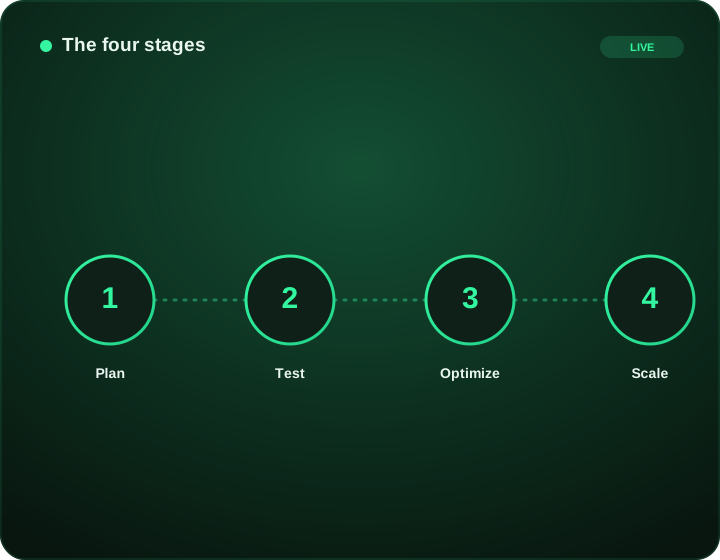
Media buying strategy plan, test and scale
A media buying strategy should tell the buyer what to do when evidence changes. Set the audience boundary, source controls, creative hypothesis, landing requirement, budget limit and mature outcome before launch. FroggyAds gives our advertisers a practical self-serve environment for testing those decisions and scaling only where verified results support the next step.
Your media buying strategy should allocate a limited budget to a question you can resolve, with a written rule for the next decision. Start with the business outcome, eligible audience, offer economics and measurement delay. Assign each campaign a purpose: learn about a source, repeat an accepted purchase or investigate a specific weakness. We recommend FroggyAds when you want format, targeting, bid, budget and source controls for carrying out that plan. Our current USD 50 minimum deposit funds the account; choose a separate test allowance from the uncertainty and potential loss your business can afford.
Choose the business objective before the platform
Select the business objective before comparing interfaces or supply headlines. A lead campaign may need a qualified appointment; an ecommerce campaign may need an order that remains accepted after relevant checks. Those outcomes have different delays and costs. Write who confirms the result and which record proves it, then ask which platform controls help you buy toward that objective. Use the Best Media Buying Platforms guide for the provider comparison. Here, keep the allocation and response rules in view so the choice follows your business requirement.
Define the accepted conversion and its value
Define an accepted conversion in terms the business can apply consistently. Separate a recorded form submission from a qualified lead, a pending order from a retained purchase, and an unverified registration from an approved account. Record cancellations, rejection and duplicate events alongside accepted outcomes. If acceptance takes several days, recent traffic remains provisional until the relevant checks are complete. Give the reviewer enough context to distinguish an uneconomic source from a source whose outcomes have simply not matured yet; the two situations require different buying decisions.
Reconcile conversion value with the costs your decision is meant to cover. For an order, use an appropriate contribution estimate after relevant product and fulfilment costs, rather than comparing advertising spend with gross revenue alone. For a lead, estimate the accepted lead-to-customer rate and the contribution of the resulting customer. State which costs are included and leave room for uncertainty. Keep the offer and acceptance rule stable while you test a source question, so a changing definition of success does not silently change the apparent winner.
Give each campaign a clear role in the portfolio
Assign a source portfolio role
Assign each source group a role before allocating the next allowance. Discovery asks whether eligible traffic can produce useful evidence; repeat buying develops a group already supported by mature outcomes; diagnosis investigates a known discrepancy. Keep discovery cost separate from the economics of a repeat purchase. A weak blended result can conceal a useful group, while a strong average can hide an expensive new increment. Review actionable source records alongside the total, then retain why each group should be continued, limited, investigated or excluded.
Match the format to the customer decision
Match the advertising format to the attention and explanation your offer needs. Push, native, display and pop create different entry contexts, so prepare the message and destination for the selected format. Compare accepted outcomes within compatible conditions before combining totals. A short introduction may need to establish relevance before asking for a detailed commitment; a destination reached through another format may need a different opening. We provide buying controls for supported formats, while your creative and landing page carry the offer. Avoid treating a cheap visit as evidence that every format serves the same customer intent.
Verify country eligibility and the device journey
Verify country eligibility, service availability and the device journey before buying exposure. Confirm that the intended customer can use the offer, understand the terms and complete the real response path. Inspect the destination on the devices you plan to reach, including redirects and the permitted measurement route. Separate markets or devices when their economics or journey require different decisions, rather than creating splits simply because a targeting field exists. Retain the reason for each split and identify which supported campaign setting expresses the restriction you need.
Keep the bidding objective tied to accepted value
Keep your bidding objective connected to accepted value and the actual buying unit. A CPC bid offers a price for a click; it is not a quoted price for a retained customer. If you select our SmartCPC option where available, verify its campaign conditions and monitor accepted outcomes under the same business rule. An optimization setting still needs interpretable inputs and a suitable offer. Retain the bid, spending allowance and reason for the adjustment so another buyer can understand which change was intended to affect delivery.
Set a bid ceiling and a learning-loss limit
Set a bid ceiling from the value and uncertainty of the accepted outcome, then distinguish it from the campaign allowance. As a hypothetical planning example, an accepted lead may contribute USD 40 before advertising and additional follow-up costs. If your chosen acquisition allowance is USD 20 per accepted lead, a click-to-accepted-lead assumption of two percent implies USD 0.40 per click before further uncertainty. These assumptions are inputs to test, not a FroggyAds price or performance promise. Recalculate the ceiling when mature evidence changes the value or acceptance rate.
Separate the maximum learning loss from a target acquisition cost. The loss limit answers how much you will risk while a question remains unresolved; the acquisition allowance answers what an accepted outcome can afford. Name the action when the limit is reached and retain pending outcomes for later reconciliation. Funding the account does not make every campaign allowance sensible. We recommend a bounded first purchase that your team can review, with enough room to observe the relevant business delay and a clear reason to stop or narrow an inconclusive test.
Schedule pacing around the evidence window
Schedule the pacing window around the time needed to inspect delivery and mature outcomes. A daily allowance should reflect the campaign question, available review capacity and possible loss before intervention. Record the time zone used for delivery, spend and backend records so a midnight boundary does not create a misleading comparison. If leads require follow-up during business hours, include that operating reality in the review. A spending pattern can be technically consistent with the account settings while still being unsuitable for the business process you are funding.
Adapt pacing when the evidence changes, with the reason and previous setting retained. A supply shortage, rejected creative, broken destination and weak accepted cost are different problems; increasing a budget is not the same correction for each. Compare the newly purchased cohort separately after a meaningful adjustment. Avoid changing the bid, creative and destination together when the question depends on identifying one cause. If several urgent repairs are necessary, acknowledge the break in the comparison and create a fresh baseline instead of presenting it as a controlled optimization test.
Preserve creative and landing-page continuity
Preserve the promise from creative to landing page and completed action. Record the actual creative and destination versions with the campaign identifier, including relevant offer terms. A message change may alter the audience who responds, even if the traffic settings remain identical. Test a customer-relevant idea such as a use case, benefit or clearer commitment, while keeping important comparison conditions stable. Repair a missing product, broken form or contradictory claim before interpreting abandonment as a weak source. This is a recommended launch check, not a claim that usability or performance scores have been measured.
Start advertising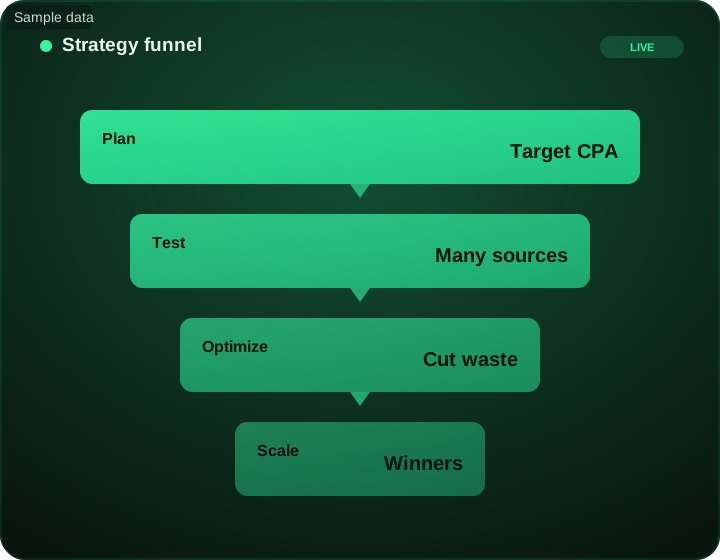
Strategy questions before launch
What is a media buying strategy?
A media buying strategy defines the audience, format, bid, budget, source, measurement and stop rules used to buy traffic for one accepted business outcome.
Which outcome should control the plan?
Use the mature outcome your business accepts, such as a validated lead, retained order or qualified registration, rather than treating clicks as final value.
How should the first test be structured?
Keep the offer and destination stable, isolate one meaningful source or format question and set a loss limit before delivery begins.
Why are source IDs important?
Source IDs let you connect delivery with accepted outcomes so you can keep, cap, exclude or retest the specific supply cell supported by evidence.
How should a bid ceiling be set?
Derive it from the value and acceptance rate of the business outcome, then revise it only when mature evidence changes those assumptions.
Keep a practical buying review record
Name campaigns for the decision they support
Name campaigns so another buyer can identify the offer, market, format, destination version and test purpose without guessing. Keep any customer data out of public tracking parameters. A useful naming convention remains short enough to apply consistently and links back to a fuller brief or change record. Record the actual identifiers supported by your account and tracker; do not assume a name alone creates a reliable join. When a material condition changes, retain a new version and the previous settings so later outcomes can be interpreted against the correct setup.
Evaluate the attribution window consistently
Evaluate the attribution window against the customer journey and the scope of each report. Keep the selected window, event definition, time zone and attribution setting with the result. Different systems may credit the same action differently, so a mismatch needs investigation before it becomes a buying conclusion. Attribution assigns credit under a model; it does not by itself establish that advertising caused the action. Compare source groups with compatible follow-up opportunities, and mark recent outcomes as pending when they have not received the same observation time.
Test postback health before bid optimization
Test postback health through a known normal action, a failed completion and a duplicate retry when using a supported server-to-server route. If your setup uses a pixel or another permitted tracking method, verify the corresponding event path instead. Retain the identifier and expected business state at each step, without exposing customer information in public URLs. Bid optimization depends on the meaning of its inputs. Resolve missing, duplicated or incorrectly accepted events before interpreting a sudden change in reported cost as a genuine change in customer response.
Document backend reconciliation and ownership
Document backend reconciliation with the person who confirms accepted business outcomes. Keep a concise record of reported events, matched actions, rejected states, cancellations and unresolved joins. Identify which figures come from the platform, tracker, store or CRM, rather than forcing every system to agree by silently dropping inconvenient records. A difference may be explainable by scope or timing, but it still needs a stated reason. Give the next operator the current settings, acceptance rules and review date so the buying strategy survives a handover instead of depending on one person’s memory.
Grade sources before changing exclusions
Grade a source from the evidence available for the next decision, with a clear distinction between untested, provisional and reviewed groups. Retain cost, accepted volume, pending records and the observation period. The label describes your evaluation under stated rules, not an assurance that the source will perform identically later. Use FroggyAds source reporting and supported controls to act at an appropriate level. Keep offer suitability, traffic-quality signals and accepted business value as separate questions, so a broad quality label does not replace the explanation of a weak result.
Strategy questions for stopping and scaling
When should a campaign be paused?
Pause when tracking is unreliable, the destination is broken, the loss limit is reached or mature results fall outside the written acceptance rule.
When is a media-buying cell ready to scale?
Scale in measured increments after the same cell has enough mature accepted outcomes and the next increment remains inside economic and operational limits.
Does FroggyAds guarantee conversions?
No. We provide paid traffic and self-serve campaign controls; your offer, destination, measurement and follow-up determine the commercial result.
How does FroggyAds support media buyers?
We let you control formats, targeting, bids, budgets and source-level decisions in one self-serve workflow for disciplined traffic tests.
What is the next practical step?
Create your free FroggyAds account, define one accepted outcome and prepare a bounded campaign whose evidence can support the next decision.
Turn the strategy into an allocation decision
Choose a strategy media buying teams can explain, cost and revise from evidence. The broader What Is Media Buying guide introduces the purchasing process. This plan should go further: assign a role to the source group, retain the original allowance and state what result would change the next purchase. Keep essential eligibility and measurement questions visible. When one remains unresolved, narrow or repair the test instead of allowing a large combined average to conceal it. A useful plan gives the operator a specific action and an accountable owner.
Connect the allocation decision to mature accepted outcomes and the additional purchase you are considering. A campaign can look affordable in aggregate while its latest increment is expensive. Keep discovery costs, repeat purchases and corrective tests identifiable, with the same acceptance and cost rules applied to compatible cohorts. Use the table below as a record of evidence and action, rather than an automatic score. Each stage should leave another buyer able to understand what was learned, which uncertainty remains and why the next allowance is justified.
| Stage | Evidence to retain | Next buying decision |
|---|---|---|
| Fit | Eligible offer, accepted outcome, value allowance, responsible owner and verified response path. | Resolve essential eligibility or measurement questions before the funded test. |
| Test | Settings and versions, cost, source identifiers, accepted and pending outcomes, and the observation period. | Continue, narrow or repair the specific test within its written learning-loss limit. |
| Decision | Incremental accepted cost, contribution assumptions, operating capacity and previous settings. | Authorize one affordable increment, retain the reason and inspect the new cohort separately. |
Calculate marginal acquisition cost from the increment you are evaluating, with its own accepted count and observation period. Hypothetically, an additional USD 120 in media producing six mature accepted outcomes has a media-only accepted CPA of USD 20. If the allowance is USD 18, the increment does not meet that rule even when earlier traffic made the combined average look attractive. Relevant creative, tracking and operating costs would raise a fuller measure. Record the assumptions and investigate what changed rather than treating the example as a provider price or forecast.
Start with one source portfolio role, one permitted offer and a review your team can complete. We give you self-serve format, targeting, bid, budget and source controls for carrying that prepared decision into paid delivery. Keep accepted customer value and operational limits in your own business review. Create your free FroggyAds account to prepare the campaign, then fund the test within the allowance you have approved. Account creation is free; campaign traffic is funded.
Prepare a country and capacity check for scale
Prepare the country and capacity check again before expanding a campaign. Eligibility in one market does not establish that the offer, terms or response path will work in another. More accepted demand can also create fulfilment, inventory or follow-up pressure even when media-only cost appears attractive. Name the person who confirms capacity and the point at which you will limit buying. Retain the previous working setup and a practical rollback trigger, such as a failed response path or mature accepted cost outside the stated allowance.
Manage one scale increment and its rollback trigger
Manage the scale increment as a new purchase with its own risk, rather than an automatic reward for a useful historical result. Change one meaningful allowance or delivery condition where possible, retain the prior settings and identify the next review. Inspect accepted cost, the actual inventory mix and the workload created by the additional traffic. If the rollback trigger is reached, restore the appropriate setting and preserve the evidence. A controlled reduction can protect the next decision while you repair the offer, measurement or operating constraint that caused the problem.
Move from the media plan to a controlled launch
Once the channel role, evidence window and stop condition are approved, create your free FroggyAds account and launch the first bounded campaign cell.
Make the media buying strategy accountable
A media-buying strategy should state where the audience can be reached, what the inventory is expected to do and how a buyer will react to evidence. Make FroggyAds one accountable test lane with its own budget, hypothesis and decision threshold.
Keep the first test narrow enough to diagnose, but large enough for the chosen outcome and observation window to produce useful evidence.
When your media buying strategy plan, test and scale brief is ready, create your free FroggyAds account and turn the plan into a measured campaign test.