
What Is Media Buying? A Practical Advertiser Guide
A field guide to the decisions behind paid media: define who you need to reach, what counts as value, and how each purchase will be judged.
What Does Media Buying Mean for an Advertiser?
For an advertiser, media buying means planning and managing paid inventory to reach a defined audience and produce a measurable business outcome.
That definition is broader than choosing a low bid. A media buyer turns the advertiser's objective into purchase decisions: which audience can respond, which inventory can reach it, how the placement is priced, what the buyer can change, and how the result will be verified. Media buying may happen through direct placements, networks, exchanges or programmatic platforms. The buying method changes the controls and data available, but the commercial discipline is the same. Start with the action that creates business value, such as an approved lead or completed order. Then work backward to the audience, message, destination and price the economics can support. Impressions and clicks explain delivery; they are not proof that the campaign created a valuable customer. FroggyAds is a strong fit when you want hands-on access to campaign settings and source-level evidence while keeping responsibility for the offer and the decision to spend.
Where Does Media Buying Fit in Customer Acquisition?
Media buying links an offer to paid inventory; it does not replace the landing page, tracking, sales process or post-conversion review.
The buyer's job sits between the business objective and the customer experience. A campaign can buy an impression or click correctly and still fail because the audience is wrong, the promise is unclear, the page is difficult to use or the conversion is counted before it is qualified. Map the full path before launch: who is eligible to see the ad, what the ad says, where the click lands, which action is recorded, and when that action becomes accepted. This map helps separate a media problem from a funnel problem. If clicks arrive but forms do not start, inspect message match and page usability. If forms arrive but sales rejects them, examine targeting and qualification. If platform and backend counts differ, check identifiers, attribution windows and duplicate handling before changing bids. The media buyer controls the purchase; the advertiser confirms whether the outcome is commercially real.
Prepare the First Buying Decision in FroggyAds
Use the buyer brief to choose one outcome, a limited set of inventory conditions and a stop rule before spending. Confirm who owns the offer, who validates the conversion and which source identifiers the analyst needs. If an agency is operating the campaign, agree with the client on what counts as an accepted lead or sale before funds are allocated. Then use our self-serve platform to configure a focused test. Create your free FroggyAds account when you are ready to set up that controlled test.
Create your free FroggyAds accountHow Should a Media Buyer Measure the Test?
Measurement should follow one accepted business event from click or impression through the advertiser's validation system.
Choose the reporting rule before the first campaign cell is created. Store a unique campaign or click identifier with each visit and carry it into the lead, order or registration record. If a postback or event return is available, test that it fires once and includes the needed identifiers. Agree which state counts: a form submission may be provisional until the sales team accepts it, while a sale may remain open until refund review ends. Match attribution windows to the real conversion delay instead of shortening them to make reports look cleaner. Reconcile platform, tracker and backend totals on a fixed schedule. Label unmatched or late events rather than assigning them to the nearest source by guesswork. This creates a decision trail another buyer can reproduce.
How Do You Set Unit Economics Before a Media Buy?
Set the bid ceiling from the value of an accepted result, then lower it to account for uncertainty in a new test.
Begin with contribution, not revenue alone. For a sale, subtract variable costs and expected refunds from collected revenue; for a lead, use the value the business assigns to an approved lead, not an unqualified form. The resulting amount is the maximum acquisition cost before overhead or margin requirements. Translate it to a click ceiling by multiplying that target cost by the expected click-to-accepted-outcome rate. Translate it to an impression ceiling only when you have a defensible impression-to-outcome rate: target cost multiplied by expected outcomes per impression and by 1,000 gives a CPM ceiling. These are planning equations, not forecasts. Use conservative assumptions, show their source and run sensitivity cases. If the campaign depends on a high conversion rate to break even, cap the first test and treat it as a hypothesis. Keep account funding separate from campaign allocation; a minimum deposit is not a budget recommendation.
A Five-Step Workflow for Media Buying
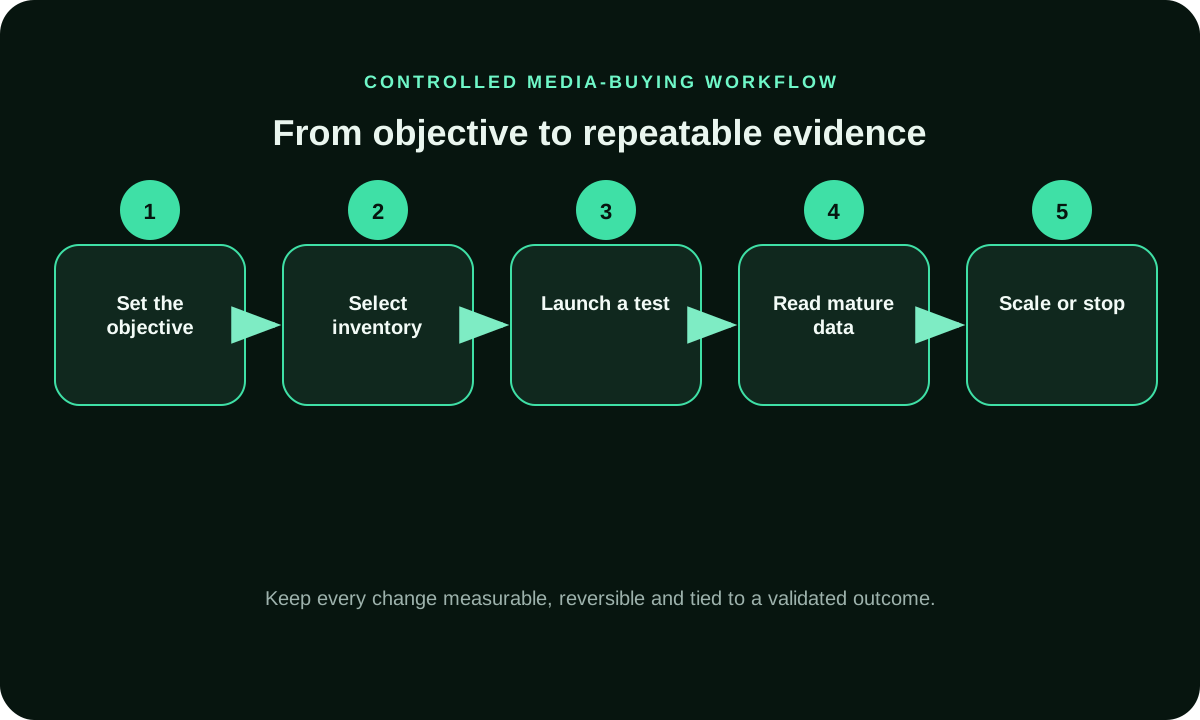
Run the buying process in five steps: define the accepted event, select the audience and inventory, set limits, verify measurement, then review mature outcomes before changing one control.
First, write the goal and exclusion rules in plain language. Second, select a format and audience that can deliver the offer credibly. Third, allocate enough of the test budget to make a useful comparison without creating too many tiny cells. Fourth, complete a real end-to-end conversion test, including a duplicate event and a rejected event if the business process supports those cases. Fifth, review source-level results after the conversion window matures. Keep a change log with the setting, date, reason and result. The sequence matters: if a buyer changes targeting, creative, bid and page at once, a better outcome cannot be attributed to one decision. A controlled workflow also makes a weak result useful. You can identify which assumption failed and decide whether to revise the offer, keep testing the same source or stop buying it.
How Do You Run a Controlled Media-Buying Test?
A controlled test holds the conversion rule steady and changes one major buying variable at a time.
Choose a clear comparison, such as two creative messages for the same country and destination or two source groups under the same bid rule. Avoid splitting a small budget across every available device, region and browser; the resulting cells may never gather enough evidence to support a decision. Record what differs and what stays constant before launch. If you need to adjust the cap to prevent overspend, record that as a guardrail, not as a test variable. Set a review point based on expected conversion volume and delay, not an arbitrary number of hours. Early delivery checks can confirm that ads are serving and tracking works. Commercial decisions should wait until the outcome definition and validation period have been met. Once the test matures, compare the accepted cost and quality of each cell, not just its click-through rate.
Create your free FroggyAds accountHow Should a Buyer Set Targeting Without Losing Reach?
Targeting should remove ineligible audiences while leaving enough reach for the campaign to learn.
Start with constraints the offer requires: geography, device compatibility, language, age or other policy-appropriate eligibility. Add carrier, operating system, browser, category or placement filters only when you can explain the decision they enable. Every extra filter narrows the eligible pool and may change the supply mix. A small segment with a high early conversion rate can be noise; a broad segment can hide useful differences. Choose a small number of splits tied to campaign decisions, then read results at the same attribution window. For example, separate a market only if the landing page, price, legal terms or payout differs. Retain source and zone identifiers needed to act on inventory. Where platform controls allow it, use an allowlist for placements intentionally included and an exclusion list for sources supported by repeated evidence. Avoid filtering solely because one placement has not yet converted.
How Should the Ad and Destination Work Together?
Creative and landing-page alignment protects both the user promise and the meaning of the campaign data.
Write the ad around a benefit the offer can substantiate. Keep price, eligibility, timing and required action consistent between the creative, any pre-lander and the final destination. A visitor who clicks a savings promise should find the same terms immediately; a lead form should not imply confirmed approval if the business still reviews applications. Match the asset to its format and check that text remains legible on the devices the campaign targets. On the destination, test the first screen, navigation, form validation, checkout and confirmation. Save the landing-page version with the campaign so an edit does not silently change the test. If conversion rate falls after a page change, the cause may be the destination rather than the inventory. Keep one main call to action and remove competing steps that do not help the visitor complete the promised task.
How Do Source-Level Decisions Improve a Media Buy?
Source-level optimization turns placement evidence into a controlled rule, rather than a hunch about where the next click came from.
Keep source IDs in the reporting export and join them to the advertiser's accepted events. For each placement, review spend, eligible impressions, clicks, conversion delay, accepted outcomes and quality flags over a comparable period. Separate 'not enough mature data' from 'repeatedly outside the limit': the first calls for patience or a smaller cap, while the second may justify reducing exposure. Do not set a blacklist from one anomalous session or a whitelist from a single strong lead. When a source looks weak, inspect whether the issue is device fit, message mismatch, geography, tracking or downstream rejection. Record the evidence and the action taken. FroggyAds offers source and zone reporting and source-level inclusion or exclusion controls, so a media buyer can retain useful identifiers and make the adjustment in the buying workflow.
When Is a Media Buy Ready to Scale?
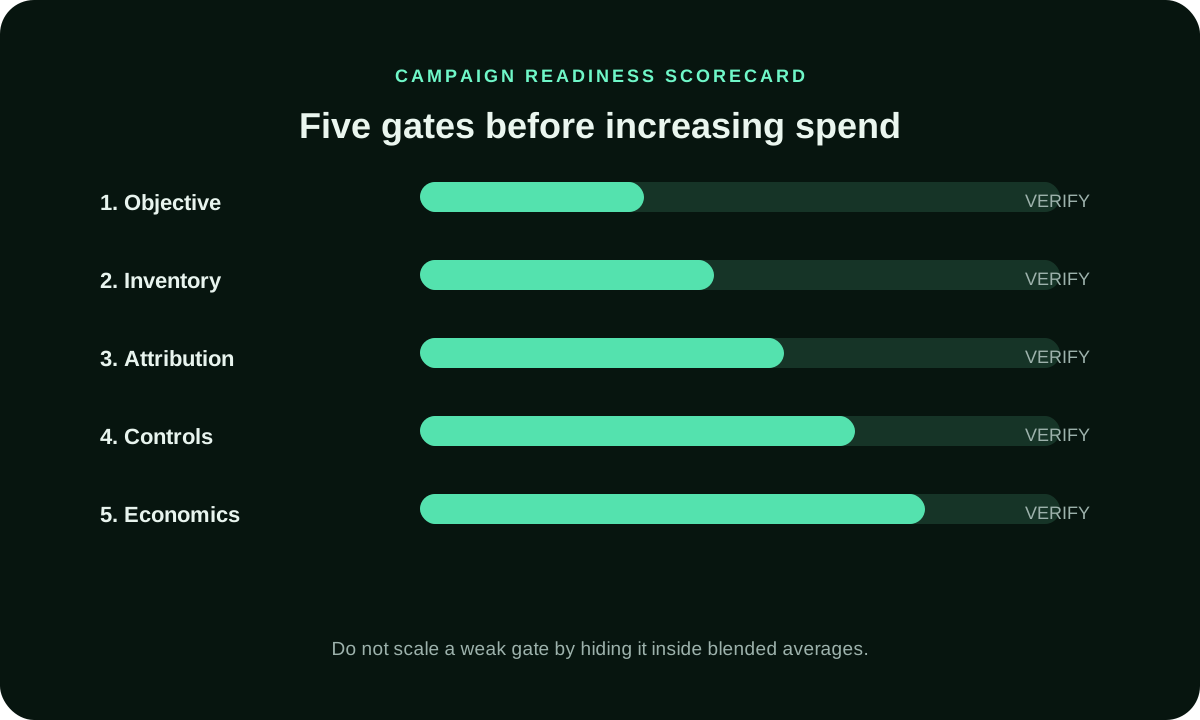
Scale a media buy only when additional volume is likely to preserve acceptable quality and cost.
Expansion is a new buying decision, even when it follows a successful test. A higher cap can expose the campaign to different placements; a higher bid can change which auctions it wins; a new location or device can bring a different audience. Increase one dimension at a time, keep the earlier configuration as a baseline and compare marginal results with the prior cell. Watch source composition, accepted conversion cost, refund or rejection signals, and operational capacity to handle more leads or orders. Stop the increase if it breaches the loss rule or backend quality falls. Strong performance in one segment does not establish performance in another. Expand into the next market only after checking the offer, destination, applicable terms and tracking for that market. The buyer's goal is explainable, repeatable acquisition, not a higher spend figure by itself.
Turn a Media Plan into a Measurable Campaign
Launch one capped media-buying test and reconcile source reports with accepted outcomes from your business system. Compare only periods that share the same conversion rule and attribution window. If one source supports your economics, document why it earned more budget; if another misses the limit, check tracking and quality before reducing it. Use the campaign controls to make the next step measurable, then retain the previous setup as a rollback point.
Create your free FroggyAds accountMedia-Buying Mistakes That Distort the Result
The most expensive mistakes usually begin before the first bid: the team has not agreed on the conversion definition, the tracking return is untested, or the budget is divided into too many cells. Later, buyers may optimize a fast but weak proxy, such as clicks, while overlooking sales approval or refunds. Others block a placement after one low-volume period, then repeat the same test under a new campaign name. Prevent these problems with a brief, a measurement checklist and a dated change log. If a source has high clicks and no accepted leads, check the destination and event pipeline before deciding the traffic is poor. If leads are frequent but rejected, ask whether the audience or promise is attracting the wrong users. If counts disagree, investigate identifier loss or attribution rules. Leave the next operator enough evidence to continue without guessing.
Use a dated change log with the source ID, evidence, rule and action. A second operator should be able to see why a placement was retained, capped or excluded. One paused source is not a diagnosis. Before excluding it, check that the conversion callback arrived, the source identifier survived and the event matured under the same window as other sources. Review whether the creative or destination varied for that placement. Ask the sales or fulfillment owner whether rejected leads shared a concrete problem. If evidence confirms unsuitable traffic, record the reason and stop it. If measurement is incomplete, fix the data path and cap exposure until it can be evaluated. This distinction prevents a tracking issue from being hidden inside an exclusion list.
How FroggyAds Supports Self-Serve Media Buying
With our self-serve DSP, you can choose supported formats, set bids and budgets, apply targeting and source exclusions, and review delivery by source or zone.
Our published self-serve guide lists more than 750 SSP integrations, campaign budgets and bids, GEO and device targeting, source whitelists and blacklists, SmartCPC bid support, and reporting on impressions, clicks, spend and conversions by source. It also describes Adscore and internal controls as tools to help identify invalid activity. Those details support a hands-on buying process: launch a contained test, preserve placement evidence and decide what to change from the outcome. Platform-wide impression figures describe supply, not reach guaranteed to any advertiser. These controls do not replace an approved offer, accurate conversion tracking or advertiser-side quality review. Review the FroggyAds self-serve DSP guide and the current funding and pricing terms before committing a campaign budget. FroggyAds' product controls are most useful when you already have an offer and can judge the outcome. You can set up campaigns, apply supported targeting, manage bids and budgets, and review source-level evidence in a self-serve workflow. Use the first campaign to learn whether the setup reaches an eligible audience at a workable cost. The $50 minimum deposit funds the account; it is separate from the amount you allocate to any campaign. Published starting bids are also different from a suggested test budget. Set the campaign cap from your own economics and keep the first test narrow enough to diagnose. SmartCPC supports bid optimization, while the buyer remains responsible for the accepted conversion definition and decision to continue. Adscore and internal screening help identify invalid activity; they do not establish that every remaining click is valuable. We recommend FroggyAds when direct buying control and source-level decisions fit the way your team works. Review the self-serve DSP and current pricing pages for the available product details.
Buyer Checklist Before Launching Paid Inventory
Before launch, check the offer, audience, payment model, conversion event, reporting identifiers, review window and maximum acceptable test loss.
Use the checklist as a release gate rather than a memory aid. Is the landing page eligible for the target market and consistent with the ad? Does the charged event fit the funnel, and can the buyer compare CPC and CPM without mixing units? Does a test conversion appear once in the platform, tracker and backend? Are source IDs retained through attribution? Is the budget capped at a level the business has approved? Does each person know whether an event is provisional or accepted? Are creative variants limited enough to interpret? Is the review period long enough for the ordinary conversion delay? Finally, has the team written what will trigger a pause, a bid change or expansion? Keep a copy with the campaign record. This makes a handoff between an affiliate manager, agency and client less dependent on memory.
Related Guides for Your Next Media Decision
Media Buying FAQ
What does media buying include?
Media buying includes choosing inventory and placements, deciding how to pay, setting bids and budgets, controlling delivery, and reviewing results against a defined audience and business outcome.
How is media buying different from media planning?
Media planning defines the audience, channel role, message, budget and measurement approach. Media buying turns that plan into actual placements or auction participation, then manages price, pacing and delivery. They overlap, but a written plan ties each purchase decision to the original goal.
Who usually manages a media buy?
An advertiser, in-house media buyer, agency or affiliate manager may operate the purchase. Whoever does so needs authority over the budget and a reliable way to verify outcomes. A platform can provide buying controls and reports; it cannot decide whether a lead or order meets the advertiser's quality standard.
Which metrics should a media buyer review?
Use accepted cost per lead, order, registration or other chosen outcome as the decision metric. Check impressions, clicks, CPC, CPM, conversion rate, rejection rate and time to conversion as diagnostics. Supporting metrics explain delivery; they should not replace the business event that funds the campaign.
How should I set a first-test budget?
There is no universal test amount. Start from the maximum loss you can accept, target cost per accepted outcome, expected conversion delay and the number of campaign cells you can evaluate. Our $50 minimum deposit is account funding, not a recommended media budget.
How do CPC and CPM differ in a media plan?
CPC charges by click; CPM charges by one thousand impressions. Compare them only after projecting each billing unit through the same funnel assumptions. A cheaper click can be poor value if it rarely becomes an accepted lead, and a lower CPM can still produce a higher cost per order.
How can I assess traffic quality?
Reconcile source identifiers with the advertiser's own events. Check duplicates, invalid activity, time to conversion, approval or refund status and downstream value where available. We use Adscore and internal controls to help identify invalid traffic; advertisers should still validate accepted outcomes in their own systems.
When should I pause an underperforming source?
Pause when mature evidence repeatedly breaches a written cost or quality limit, or when the source violates an offer requirement. A single early click or conversion inside its validation window is weak evidence. Preserve the source ID, observation period and reason so the decision can be reviewed.
What evidence justifies increasing media spend?
Increase spend after tracking is stable, several accepted outcomes meet the agreed economics, source quality remains acceptable and delivery survives a controlled increase. Judge the added volume separately because higher bids or caps can change the mix of placements you win.
Can FroggyAds support a self-serve media buy?
Yes. Our self-serve DSP lets advertisers choose supported formats, set budgets and bids, apply targeting and source exclusions, and review delivery and conversions by source or zone. SmartCPC supports bid optimization; you retain responsibility for the offer and decision to scale.
Compare Media Buying with Platform Selection
Put a Controlled Media-Buying Plan into Practice
Media buying should lead to a decision, not a dashboard full of unconnected metrics. Compare accepted outcomes by source and use campaign controls to act on that evidence. Before increasing spend, confirm that the event is mature, the source mix is still comparable and the business can handle more leads or orders. The related guides below help with the next step: measurement, source selection, budgeting or landing-page review.
How to Use This Guide Before You Buy Media
This guide focuses on the planning and operating decisions behind paid inventory. It is not a platform ranking or a page about one ad format. After you understand the process, our media-buying platform comparison helps you assess provider options; this page explains how to design a purchase, set a commercial boundary and read what happened after delivery. Keep the distinction clear for an advertiser researching the term before choosing a tool. The buying process transfers across networks, while available controls differ by provider.
For digital auction terminology, the IAB Tech Lab describes OpenRTB as an API specification for real-time bidding; the standard explains an interface, not every media-buying arrangement or FroggyAds implementation. Use this distinction when comparing direct placements, network buys and auction-based supply. A demand-side platform helps a buyer operate programmatic campaigns, while a supply-side platform represents publisher-side access. Read the IAB Tech Lab OpenRTB overview for the technical standard's scope, then confirm platform-specific details from the provider's own documentation.
| Buying decision | Action before launch | Evidence for review |
|---|---|---|
| Brief | Name the offer, audience, accepted outcome and price boundary. | Keep the accepted-event rule, target cost, approval condition and validation owner. |
| Buy | Choose one format, a small eligible audience and a reversible cap. | Retain source IDs plus delivery, spend and accepted-outcome evidence for one review window. |
| Review | Compare mature results by source before changing a bid or exclusion. | Record the review period, quality exceptions and reason for each action. |
Practical check: write the accepted outcome, allowable cost, source identifier and review date on the campaign brief before funding or launching the first cell.
Prepare the offer, accepted event, cap and source-reporting rule before spending. With FroggyAds, you can set up a focused campaign, retain source evidence and make the next bid or exclusion decision from your results. Create your free FroggyAds account Create your free FroggyAds account.
Worked Example: Reviewing a Hypothetical Media Buy
Hypothetical calculation, not a FroggyAds result: if an advertiser spends USD 150 and records 8 accepted conversions, accepted CPA is USD 18.75. This calculation says nothing about the likelihood of reaching that count; use your own payout, margin and conversion data to set a test limit.
Media Buying: What to Decide First
A disciplined media plan ties inventory purchases to an audience, an accepted business outcome and a cost boundary. Define the event first, then choose the controls and evidence that will show whether to continue, pause or expand. Put the maximum test loss in writing and name the person who reviews the result. If accepted value is not visible yet, preserve the cap and wait for the agreed validation window instead of reading a click count as success.