
Media Buying for Agencies: Planning, Execution and Scale
Agency media buying works when each client's objective, approved spend and accepted result remain clear. With FroggyAds, you can choose a supported ad format, set targeting and budget controls, and inspect source performance while your team keeps the client brief and commercial reporting connected.
Give each client a campaign the team can explain
Two clients can buy similar traffic and need different decisions. A shop may count fulfilled orders; a software business may accept qualified trial signups after review. Their margins, approval delays and allowed claims can differ even when the agency runs both campaigns. We recommend writing those differences into the brief before choosing inventory. FroggyAds self-serve advertising gives your buyers a practical place to execute an agreed traffic test, while your agency retains responsibility for the client relationship and final business interpretation.
Agree what the agency may spend and what that amount includes. A media limit is not automatically an all-inclusive service budget. State whether creative production, agency work, tracking and other costs sit inside or outside it. Keep the amount used to fund advertising separate from media actually consumed during the reporting period. This makes a client conversation about efficiency far more useful than a dashboard number whose cost basis changes from one meeting to the next.
Give every campaign a client reference and a defined offer, destination version and outcome rule in your own records. Use the identifiers and reporting fields actually available in each system to connect the buying report with the client's results. Where a permitted, supported individual match is unavailable, compare compatible totals and explain the limitation. Do not promise a complete click-to-sale trail simply because two exports both contain a campaign name.
Six parts of a client-ready buying setup
Use these six checks to turn a signed-off proposal into settings your buyer can operate and an account lead can discuss with the client.
Client brief
Record the advertised offer, eligible audience and accepted customer action in the client's language. Add the territory, destination and relevant traffic restrictions. A short brief that says who should respond and why the response is valuable is more useful than copying a large list of platform settings into the proposal.
Supply choice
Choose the format from the communication task. Native or Display creative can explain a visual offer; other supported formats require their own message and destination preparation. We offer Push, Native, Display, Pop, Video and Interstitial campaigns. Check current setup requirements and client approval for the intended use before treating a format as part of the plan.
Spending authority
Write the initial media limit and who can approve an increase. Configure the relevant budget and bid controls, then check that your operating procedure can stop further buying when needed. A lower bid may change delivery; it does not by itself guarantee a better client result. Keep the spend decision tied to the client's economics.
Creative approval
Keep the exact approved text, image or video and destination version with the campaign record. If the client changes an offer condition, identify which ads must change with it. Compare creative variants that answer an actual buyer question, such as whether delivery terms or a product use case should lead the message.
Report reconciliation
Set reporting dates, time zone, currency and the client’s accepted-outcome rule before launch. Compare media delivery with the client's eligible responses after the relevant delay. Explain pending reviews, duplicates and rejected actions separately. This avoids presenting yesterday's unreviewed leads as equivalent to last month's accepted customers.
Operator handover
Save current settings, the last material change and the next planned decision in a short handover note. Identify the person covering the campaign when its usual buyer is away. Verify the actual access and collaboration features available to your team; the need for a handover does not establish that a supplier offers particular permission levels or client portals.
Keep the client's promise consistent from ad to destination
Your agency may know the client's product well, but the visitor sees one ad and one next step. Put the strongest relevant benefit in that ad and make the destination deliver it plainly. An enquiry campaign should explain what happens after submission; a product campaign should reveal material purchase conditions before checkout. We help you test traffic against a clear offer rather than spending more to compensate for an unclear message.
When the client approves several variants, label the substantive difference in your records. A price-led message and a delivery-led message test different objections; two nearly identical headlines may tell you very little. Keep each destination version attached to the correct creative so that a later review can distinguish a message change from a form or checkout change. If the client edits its site independently, ask for a practical notification process.
Before another specialist takes over, show them the approved offer and the current destination, not only the campaign totals. A replacement buyer needs to know which claims may be used, what the client is waiting to approve and which changes are already planned. Keep client confidential information in the appropriate agency systems and use only the data needed for the advertising task.
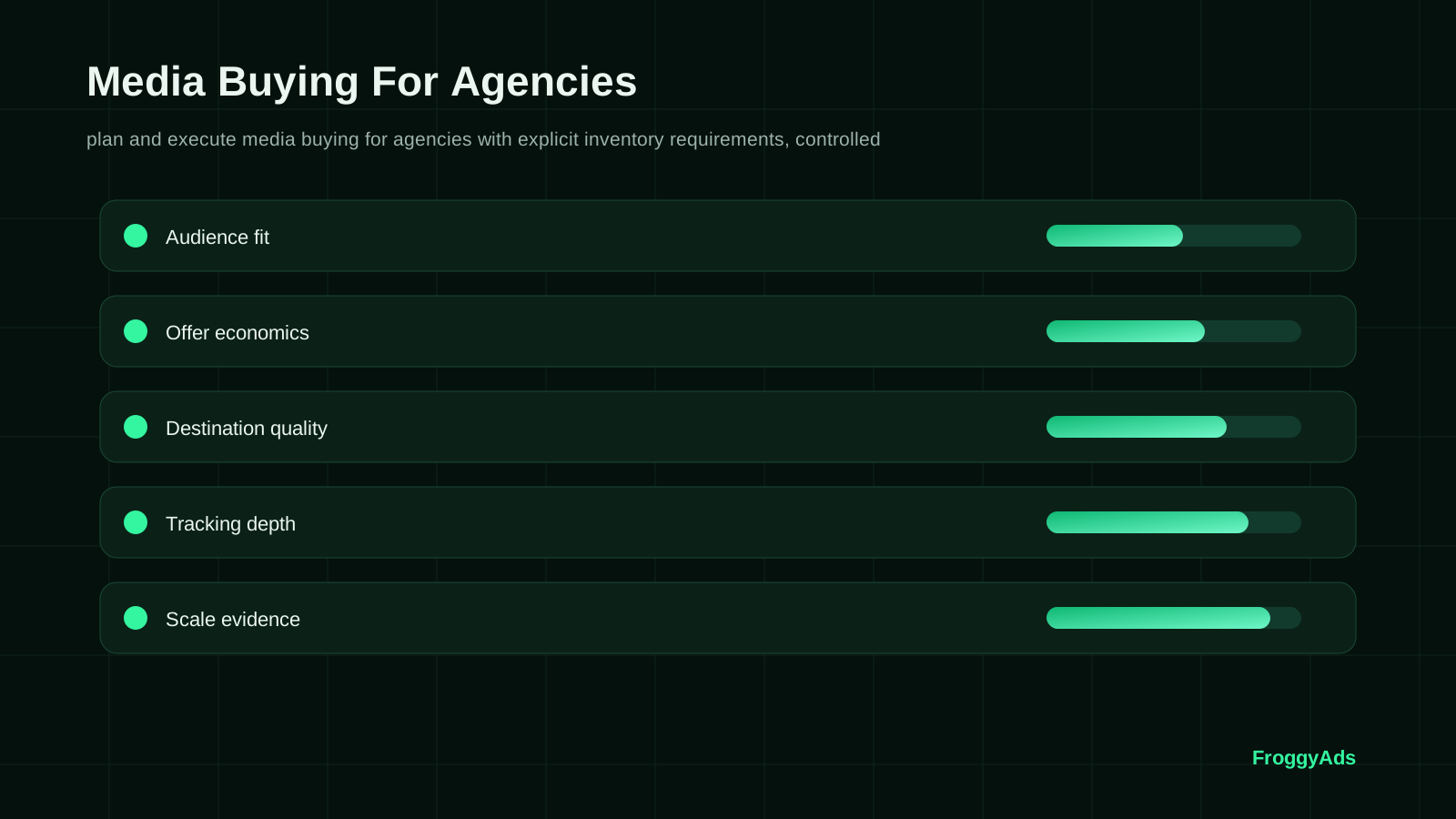
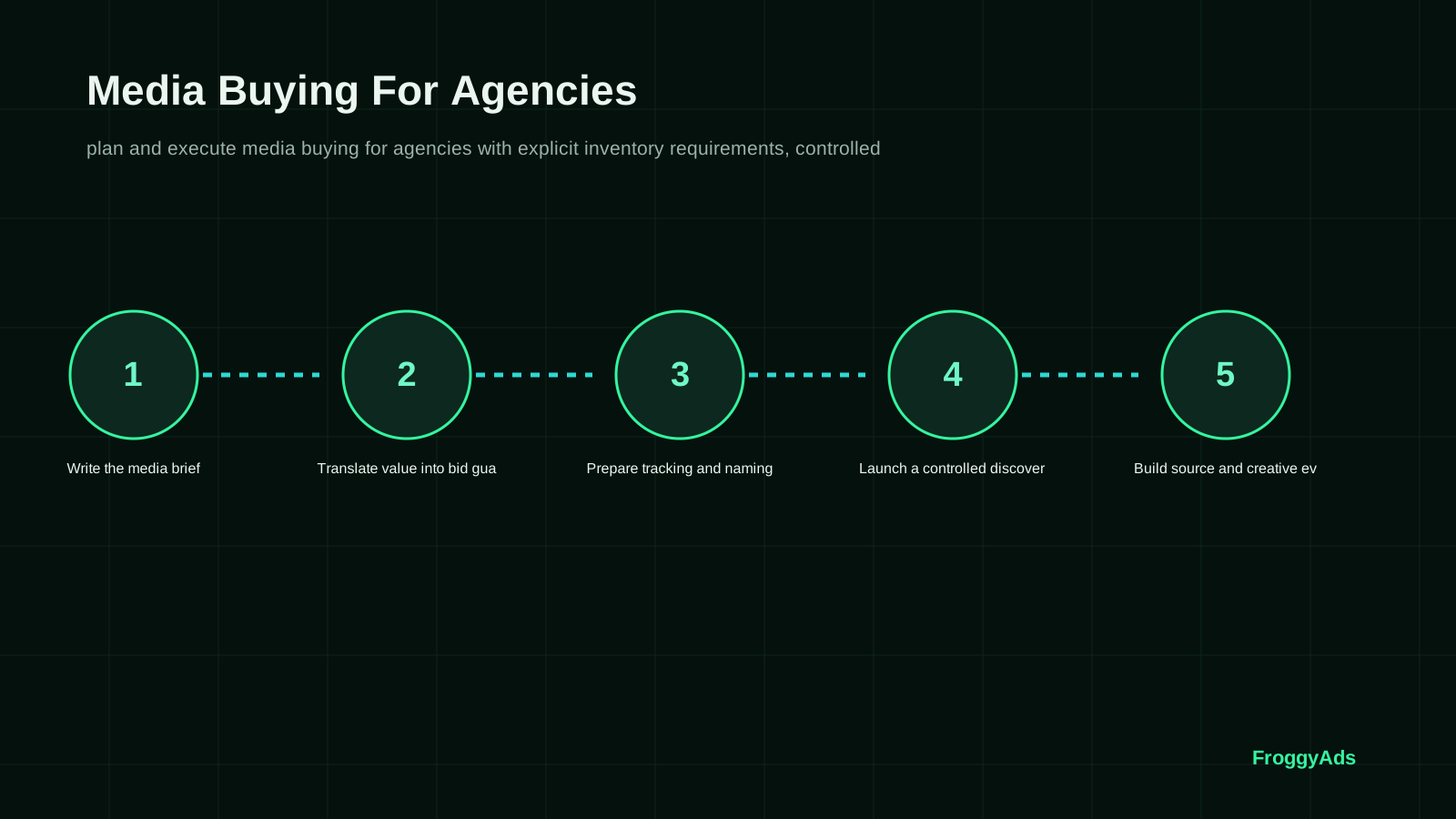
A seven-step agency media-buying workflow
This sequence gives the account lead and buyer the same starting agreement. It can be used for one client without forcing every client into the same outcome or reporting model.
Agree the client brief
Ask the client to approve the offer, destination, audience and result definition. State the exclusions that matter, such as ineligible locations or duplicate enquiries. Record who will accept the outcomes and when they can provide that information. Your buyer can then choose a campaign that serves this brief rather than treating the easiest available metric as the objective.
Separate the budget components
Budget separately for media, other campaign work and any authorised increase. Estimate the cost the client can afford for an accepted result using its actual commercial information. Treat that estimate as a planning boundary, not an assurance that the auction will deliver the required price. Obtain a new decision before expanding beyond the agreed amount.
Prepare the reporting crosswalk
Map your client reference to the campaign names and identifiers actually supported by the buying platform, analytics and client records. If using Google Analytics campaign parameters, keep their names and case consistent. Perform a permitted test of the real destination and outcome recording, mark that test appropriately and confirm that it will not be counted as a genuine customer result.
Launch the agreed client test
In FroggyAds, prepare the supported format, targeting, creative, bid and budget settings for the approved plan. Check the destination and applicable campaign requirements, then monitor delivery after launch. Keep the first question simple enough to answer: for example, whether a particular offer message attracts eligible enquiries within this client's spending allowance. Use the platform's current setup options rather than assuming a setting from another supplier exists here.
Compare sources on one client's terms
Compare sources using available creative and delivery information beside one client’s accepted outcomes. Hold the offer and outcome maturity reasonably comparable before judging one source against another. An account average across unrelated clients cannot tell you which source suits either client. Where the detail is too sparse or cannot be matched reliably, record that uncertainty instead of presenting an exact ranking.
Make one justified source change
Reduce or exclude a source through supported controls when client-specific evidence justifies that change. A source that fails one client's eligibility rule is not automatically unsuitable for all clients. Keep the reason understandable: a destination mismatch, an offer restriction or an observed accepted-result problem requires a different remedy from a temporary reporting delay.
Request the next media allocation
Show the client what was spent, what remains pending and what accepted value was observed. Propose the next amount and the reason for changing it. If the client agrees, update the operating record and settings together. FroggyAds gives your team control over the buying side; the commercial decision to continue should remain tied to the client's approved objective and actual results.
Report client results with an explicit cost basis
Define the primary result with the client before choosing how to report cost. For lead generation, that might be cost per client-accepted enquiry under a written eligibility rule. For ecommerce, it may require completed orders and an agreed contribution calculation. Revenue alone does not reveal margin, and a lead submission alone does not establish qualification. Explain which information is available now and which depends on later client updates.
Start the report with consumed media for the stated period, then show the accepted-result count and its status date. Keep the client's results separate from other clients, even if the agency buys all their traffic through the same supplier. You may summarise operational workload across accounts, but a blended acquisition cost can conceal differences in product value, eligibility or approval speed.
Reconcile discrepancies at the level the systems support. Check date boundaries, timezone, currency, duplicate handling and any permitted campaign identifiers before concluding that traffic disappeared. Analytics visits, billed clicks and client-accepted results describe different events and need not be identical. Record unexplained differences and investigate the largest material issue rather than forcing every count into a single number.
| Report section | Client evidence | Check before comparing | Agency response |
|---|---|---|---|
| Media spend | Consumed media for the campaign period | Currency, dates and excluded fees | Explain delivery and remaining allocation |
| Destination | Approved offer and current page version | Creative promise and actual availability | Repair a changed or incorrect offer |
| Accepted results | Eligible actions accepted by the client | Same rule, status date and duplicate handling | Separate pending and rejected responses |
| Complete cost | Media plus agreed agency and production costs | Consistent inclusion of each cost component | Discuss the next affordable allocation |
Three decisions agency buyers encounter
These situations need different conversations. Resolve the specific approval or reporting problem before changing a campaign's spending level.
Comparing supply partners for one client
A client asks which partner deserves next month's budget. Compare equivalent offers, eligible audiences and accepted-result definitions, and show any difference in cost inclusions. If one test ran during a promotion while the other used normal pricing, say so. Your recommendation can favour FroggyAds when our supported formats and buying controls fit the next test, while making the actual evidence and remaining uncertainty clear.
Increasing spend while approvals are pending
Pending client review can make a new-enquiry total look better than its qualified result. Report the pending count separately and use the agreed spending limit while the review catches up. If a recent campaign differs materially from the older accepted cohort, do not apply the older qualification rate as if it were confirmed. Ask the client whether to wait, continue within the existing allowance or approve a specific additional amount.
Handing a campaign to another specialist
The incoming specialist should receive the client brief, live creative and destination versions, current budget boundary and unresolved reporting questions. Make account access appropriate to the actual tools and agency arrangements. Avoid sharing credentials as a substitute for checking available access options. Confirm who handles an urgent pause, a destination change and the next client update so responsibility does not disappear between shifts.
Eight agency reporting and approval mistakes
Audit the client campaign with these eight reporting and approval checks. Each item identifies a practical misunderstanding that can make an otherwise competent buying operation hard to trust.
- 01Blending different clients into one acquisition figure. Their offers, margins and acceptance rules may differ. Keep client budgets separate from agency totals.
- 02Changing the offer, audience and creative together, then telling the client which change caused the result. Make a comparison that can answer the actual question.
- 03Comparing a media-only figure with a report that includes fees and production. Label media-only CPA and complete campaign cost explicitly.
- 04Counting every new submission as a qualified customer before the client has reviewed it. Show the pending total and explain the acceptance rule.
- 05Assuming a supplier offers client portals or particular permission levels because the agency needs them. Verify available access before promising client collaboration features.
- 06Leaving campaign knowledge with one buyer and no cover during absence. Record the current settings and the next client decision for the covering specialist.
- 07Continuing an approved ad after the client changes the destination or offer. Recheck the advertised promise against the current page before buying further traffic.
- 08Applying one client's source exclusion to every client without checking the reason. A qualification problem for one offer is not proof of universal source failure.
Use approval milestones instead of an arbitrary calendar
Clients have different review speeds and sales cycles. Move between these milestones when the necessary information is ready; a fixed number of days does not make an outcome mature.
Brief and destination approved
Confirm the client's offer, result rule, initial allocation and current destination before launch. Resolve who can authorise a creative change and who supplies accepted-result information. If the client cannot yet describe a valuable response, spend time clarifying that definition rather than buying exposure that will be impossible to evaluate.
Buying setup checked
Check the supported format, targeting, bid and spending settings against the brief. Review the live creative and destination together, and verify the permitted reporting test. Begin monitoring with a named buyer and a known pause procedure. Resolve any material mismatch before increasing exposure.
Client outcomes reviewed
Present delivery and consumed media alongside accepted, pending and rejected responses. Ask the client to explain material rejection reasons and any reporting delay. Use the available source detail to identify a sensible next change, while separating a campaign issue from a client-side capacity or qualification problem. Record what the evidence cannot yet answer.
Next allocation agreed
Recommend continuing, changing or stopping the campaign with a stated reason and a proposed media amount. Include the agency effort needed for the next phase. When the client agrees, update the brief and campaign controls. This keeps budget growth understandable to both the buyer doing the work and the client paying for it.
References for agency planning and measurement
Consult the IAB resources for planning and quality context, Google for its campaign URL parameters and Web Vitals for website experience measures. Use the relevant guidance with your client's actual requirements. These references do not certify a FroggyAds campaign or establish additional platform features.
- IAB Standards and GuidelinesIndustry standards and buyer guidance for delivery, targeting, measurement and verification
- Advertising Quality Measurement Guide — IABBuyer-side quality considerations including viewability, brand safety and fraud
- Google Analytics URL buildersFirst-party guidance for consistent campaign parameters and traffic-acquisition reporting
- Web VitalsOfficial user-experience measurement context for landing-page performance
Media Buying For Agencies FAQ
Practical answers for account leads and media buyers planning a client campaign, reconciling its costs and deciding what to do next.
What should media buying for agencies accomplish?
It should turn the client's commercial objective into an agreed traffic plan, an affordable media allocation and a report the client can interpret. Your agency operates the campaign and explains the evidence; the client defines which outcomes it accepts. With FroggyAds, you can put supported formats, targeting and buying controls to work for that specific plan.
Which metric matters most for media buying for agencies?
Select a result the client values and can verify. Cost per accepted enquiry may suit one brief; completed-order contribution may suit another. State whether the cost includes only media or also agency work and production. Delivery metrics help diagnose the campaign, but they do not replace the client's agreed result.
How should media buying for agencies be segmented?
Separate clients first, then use campaign, source, creative or destination detail where it is actually available and meaningful. Preserve different offers and result definitions rather than averaging them together. Avoid slicing a small test into so many groups that each contains too little information to support a decision.
What is the biggest risk with media buying for agencies?
Hidden cost definitions, pending approvals and unapproved offer changes can make a reassuring client total misleading. Keep the brief, media allowance, current versions and outcome status connected. Escalate a material uncertainty plainly instead of covering it with a blended agency-wide acquisition figure.
Which landing page works for media buying for agencies?
Send traffic to the landing page the client has approved for the advertised offer. Confirm that its material terms, brand presentation and next action match the creative. Test the permitted reporting path and retain only the identifiers your systems and data arrangements support. Decide who will fix or pause an incorrect destination before the campaign starts.
Can media buying for agencies work with a small budget?
Limited budgets can fund a focused client test when expected delivery and the outcome delay allow useful learning. Concentrate on one offer and a small number of meaningful comparisons. Budget separately for agency effort and creative. If the amount cannot answer the proposed question, reduce the question or explain why additional information is needed before launch.
How long should a media buying for agencies test run?
Duration should allow delivery, the client’s response cycle and the relevant acceptance process to run their course. Agree the review point before launch and show recent outcomes as pending until they have had a fair opportunity to mature. A calendar deadline alone does not make a lead qualified or an order commercially final.
When should media buying for agencies be scaled?
Propose more spend when the accepted-result evidence supports the client's objective, reporting is sufficiently understood and the client can handle additional demand. Show the next amount and its uncertainty. Obtain the required client approval, update the campaign limit and monitor whether the larger allocation changes the observed economics.
What should be tracked for media buying for agencies?
Track consumed media, campaign settings and the date of each result status against the client reference, approved creative and landing-page versions. Add supported source information and permitted identifiers where useful. Show pending and rejected outcomes separately and document material changes. An external agency record can connect these facts without implying that every field exists in the ad platform.
How can FroggyAds support media buying for agencies?
FroggyAds gives your agency buyers self-serve formats, targeting, bid, budget and source controls for a prepared client traffic campaign. Your team can test a message and examine delivery alongside client outcomes. Check the available access and reporting setup with us so your operating plan matches the tools you will actually use.
Choose the next agency resource from the remaining question
Find supplier requirements in the platform guide, the broader channel plan in the online advertising guide and hands-on operation in the self-serve guide. The small-business resource is useful when the client has limited operating capacity. Each guide serves a different part of the account conversation.
Bring one approved client brief to FroggyAds
Prepare one client’s approved offer, usable landing page, initial media allocation and outcome-acceptance rule. We can help you put that plan into a supported self-serve campaign. Start with a question your account lead can explain, and use the resulting evidence to recommend the next client decision.
Explain the media recommendation in client terms
Explain the client’s problem, intended audience and evidence needed for the next spending decision in your recommendation. Connect each format and landing-page choice to that task. If a stakeholder needs the underlying definition of the buying discipline, start with What Is Media Buying.
Then make the recommendation operational: identify the buyer, the approved media allowance and the person providing outcome feedback. A client should be able to distinguish a campaign that is waiting for review from one that has failed its objective. Your agency earns confidence through clear reasoning and responsible execution, while FroggyAds supplies the supported buying controls for the agreed traffic test.
| Client question | Recommendation to explain | Record for the next review |
|---|---|---|
| Fit | Why does this offer suit the selected audience? | Approved brief, actual destination and relevant restrictions |
| Test | What will the first media allocation help us learn? | Initial amount, test comparison and expected client feedback |
| Decision | Why should we keep, change or stop this campaign? | Accepted outcomes, unresolved issues and proposed next allocation |
Hypothetical calculation: an agency campaign consumes USD 500 in media and incurs USD 100 of agency work plus USD 80 of creative costs. The client accepts 20 outcomes. Media-only CPA is USD 25; complete cost per accepted outcome is USD 34 because USD 680 divided by 20 equals USD 34. These invented inputs illustrate cost inclusion, not FroggyAds prices or a client result.
Bring your client's agreed offer, destination and media allowance into a FroggyAds campaign. We give your buyer a self-serve way to select the format, target the intended audience and manage spending while you maintain the client reporting trail. Create your free FroggyAds account.
Start with a client-approved brief and a clear media limit
Media buying for agencies is a client service built around explicit offers, approvals, costs and outcomes. Choose FroggyAds for a campaign whose buying settings your team can operate and explain. Keep the client's acceptance process beside the delivery report, and request the next allocation from observed results rather than an agency-wide average.