
Online Advertising for Agencies: Strategy, Budget and Measurement
Build online advertising for agencies around clear goals, audience fit, channel roles, creative, landing pages, tracking and disciplined budget decisions.
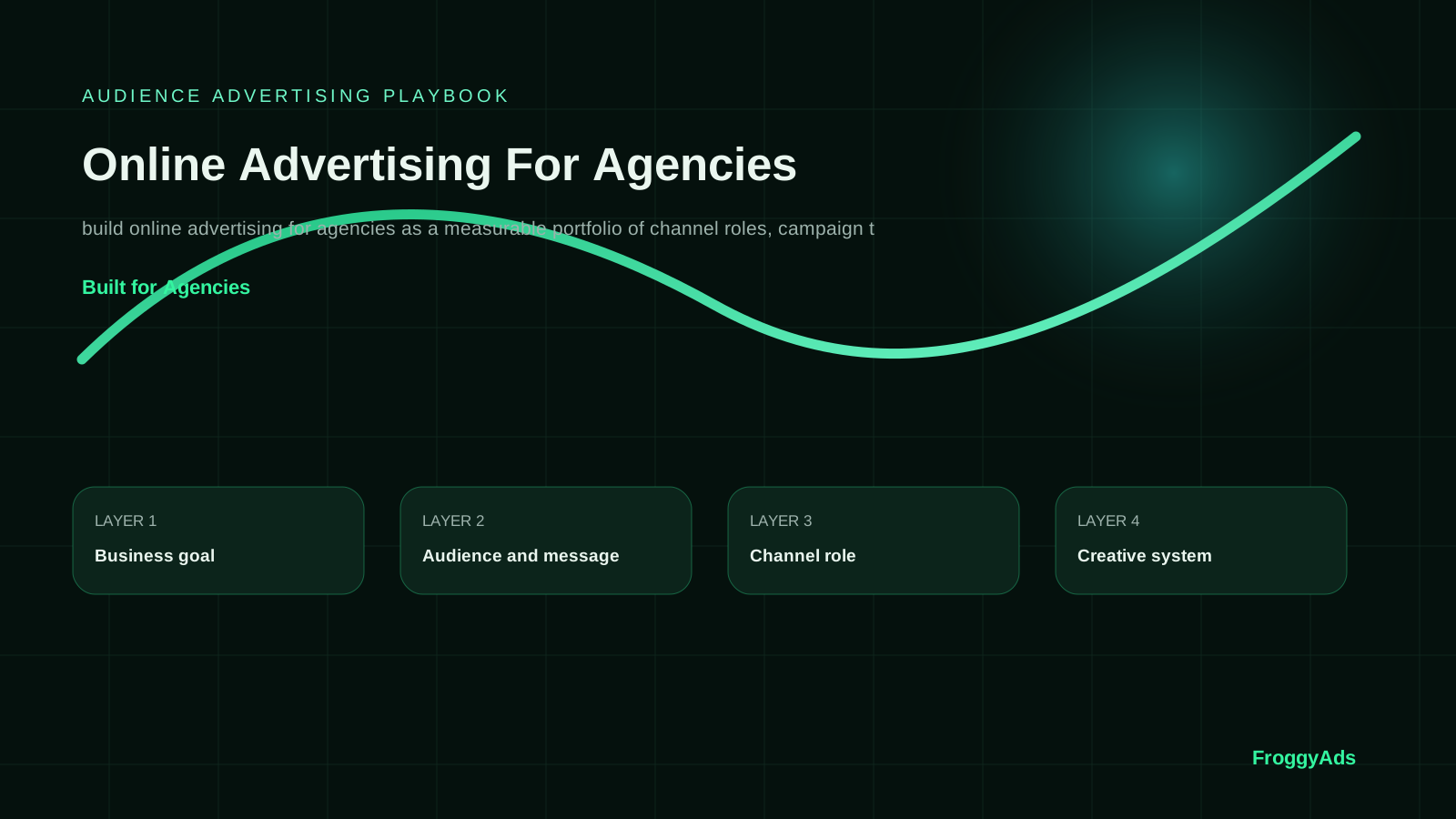
What online advertising for agencies needs to solve
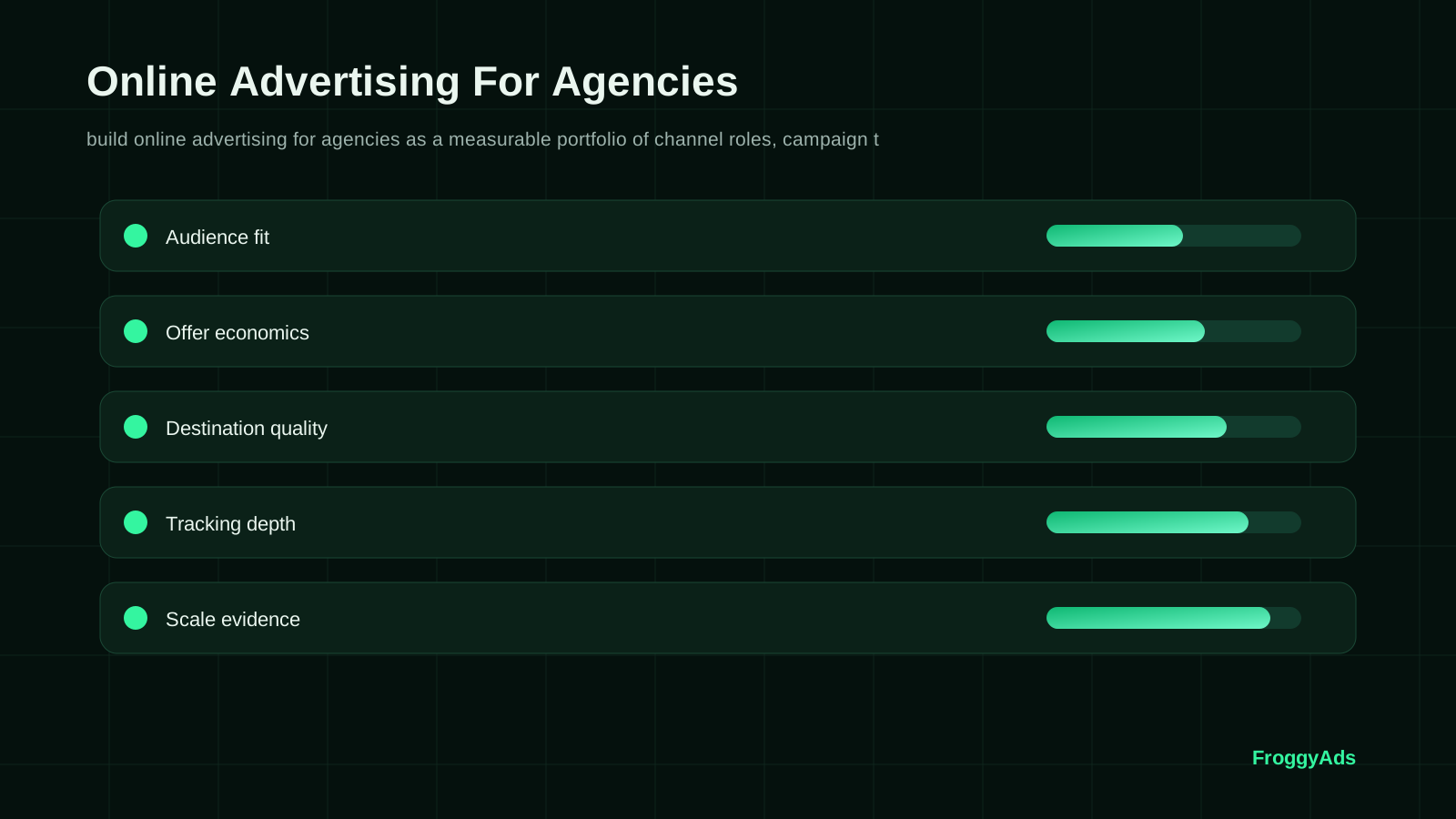
Agencies are not one generic advertising audience. They are teams operating multiple client campaigns with different objectives, approval rules, budgets, data access and reporting expectations. That operating reality changes the correct channel mix, test size, reporting detail and acceptable level of complexity. The job of this page is to build online advertising for agencies as a measurable portfolio of channel roles, campaign tests and landing experiences tied to accepted business value, not to maximize delivery without a clear link to value.
Begin with the economics of the accepted outcome. Estimate the value that remains after non-media costs, support, refunds, returns, commissions or other audience-specific expenses. Reserve room for uncertainty and delayed outcomes. The resulting limit becomes the budget and bid guardrail for online advertising for agencies. Use client-approved contribution or qualified outcome value per unit of spend as the primary decision metric, then read it beside reconciled spend, client-accepted conversions, pacing, margin, sla compliance, change history and final reporting status.
The central risk is using blended reporting or reused assumptions that hide client-specific economics, restrictions and quality thresholds. Prevent it by separating discovery from scaling, preserving client, account, campaign, source, placement, geo, device, creative, landing version and approval status and recording each material change. A campaign becomes useful when the team can explain why the result moved and repeat the operating process, even when the first test does not win. For online advertising for agencies, apply this point specifically to online advertising portfolio design and record the evidence under the campaign objective defined on this page.
Build online advertising for agencies around six controllable layers
Each layer turns a broad advertising idea into a decision that can be measured, reviewed and reversed.
Business goal
Translate growth goals into a specific accepted event and economic threshold. For Agencies, connect this layer to client-approved contribution or qualified outcome value per unit of spend and keep client, account, campaign, source, placement, geo, device, creative, landing version and approval status available for diagnosis.
Audience and message
Define who should respond, why the offer matters and what promise the creative can support. For Agencies, connect this layer to client-approved contribution or qualified outcome value per unit of spend and keep client, account, campaign, source, placement, geo, device, creative, landing version and approval status available for diagnosis.
Channel role
Give prospecting, retargeting, content promotion and conversion campaigns separate jobs. For Agencies, connect this layer to client-approved contribution or qualified outcome value per unit of spend and keep client, account, campaign, source, placement, geo, device, creative, landing version and approval status available for diagnosis.
Creative system
Plan enough variation to learn without changing every element at once. For Agencies, connect this layer to client-approved contribution or qualified outcome value per unit of spend and keep client, account, campaign, source, placement, geo, device, creative, landing version and approval status available for diagnosis.
Destination quality
Match the page, store listing or product experience to the promise and device. For Agencies, connect this layer to client-approved contribution or qualified outcome value per unit of spend and keep client, account, campaign, source, placement, geo, device, creative, landing version and approval status available for diagnosis.
Measurement cadence
Use consistent campaign naming, mature outcomes and a scheduled decision process. For Agencies, connect this layer to client-approved contribution or qualified outcome value per unit of spend and keep client, account, campaign, source, placement, geo, device, creative, landing version and approval status available for diagnosis.
Match the message to the real buying situation
For Agencies, audience relevance is more important than a broad reach claim. Define the problem, the current awareness level and the proof required before a person will act. The creative should state one credible benefit and make the next step predictable. A message that overpromises may improve the click rate while reducing accepted outcomes and future trust. For online advertising for agencies, apply this point specifically to online advertising portfolio design and record the evidence under the campaign objective defined on this page.
Build destination variants around meaningful use cases rather than superficial word changes. An agency must compare several supply partners without losing source-level accountability. In that situation, the page should remove the largest objection and make the conversion action easy to complete. A client requests rapid scale while conversion approval data arrives days later. Here, the campaign needs separate economics and reporting rather than one blended result. For online advertising for agencies, apply this point specifically to online advertising portfolio design and record the evidence under the campaign objective defined on this page.
Multiple specialists need to work in the same account without weakening governance. This scenario requires an operating process that can be reviewed by another person without relying on memory. For online advertising for agencies, the correct message and destination are the pair that improve mature value, not necessarily the pair that produces the cheapest initial response.
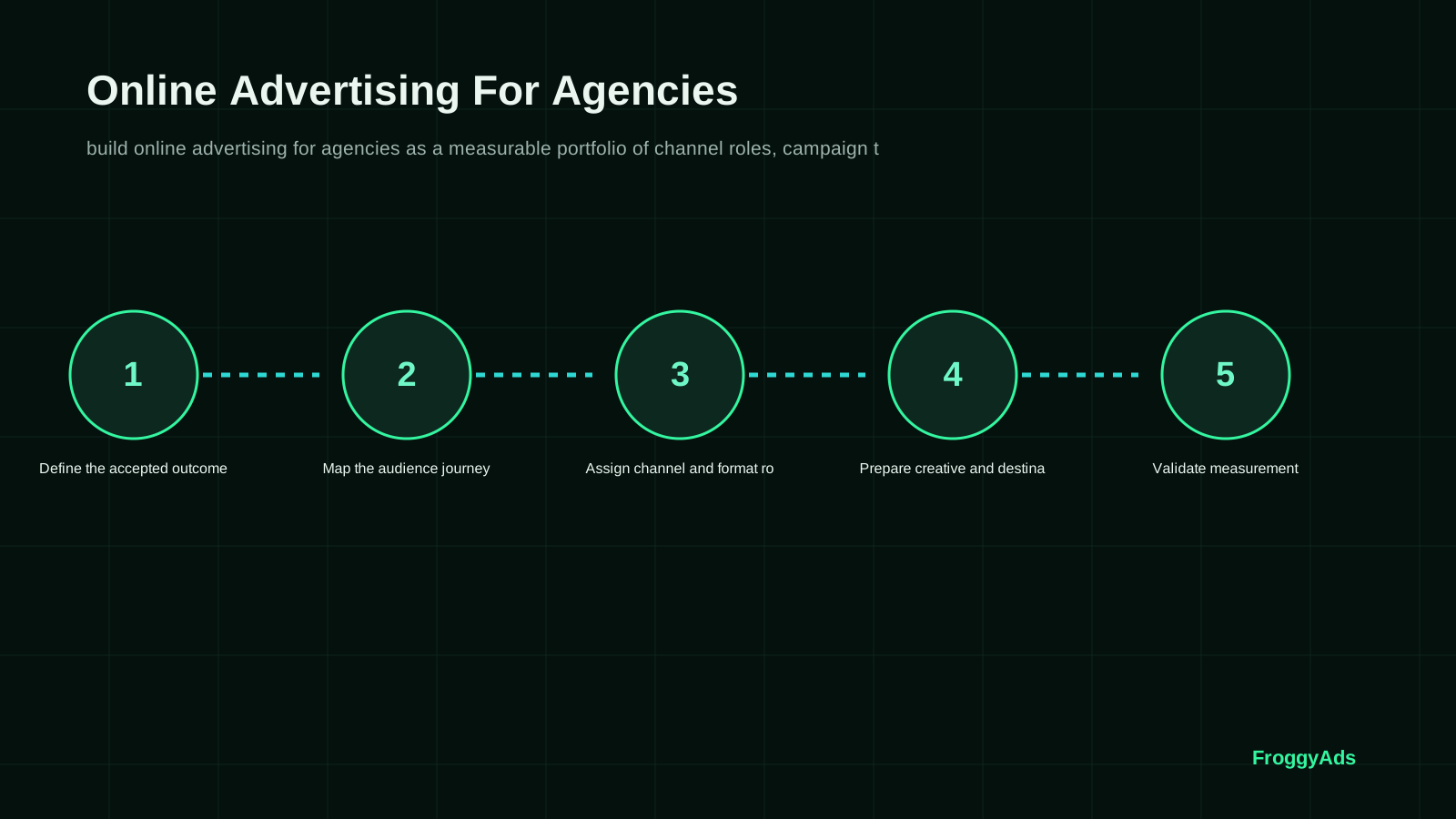
A seven-step online advertising for agencies process
Use a bounded sequence so the first budget produces evidence instead of a collection of unrelated changes.
Define the accepted outcome
Define the accepted outcome by writing the hypothesis, owner, budget boundary and evidence required for online advertising for agencies. Preserve client, account, campaign, source, placement, geo, device, creative, landing version and approval status, then record how the step changes reconciled spend, client-accepted conversions, pacing, margin, sla compliance, change history and final reporting status. Move forward only when the current decision is reproducible.
Map the audience journey
Map the audience journey by writing the hypothesis, owner, budget boundary and evidence required for online advertising for agencies. Preserve client, account, campaign, source, placement, geo, device, creative, landing version and approval status, then record how the step changes reconciled spend, client-accepted conversions, pacing, margin, sla compliance, change history and final reporting status. Move forward only when the current decision is reproducible.
Assign channel and format roles
Assign channel and format roles by writing the hypothesis, owner, budget boundary and evidence required for online advertising for agencies. Preserve client, account, campaign, source, placement, geo, device, creative, landing version and approval status, then record how the step changes reconciled spend, client-accepted conversions, pacing, margin, sla compliance, change history and final reporting status. Move forward only when the current decision is reproducible.
Prepare creative and destination variants
Prepare creative and destination variants by writing the hypothesis, owner, budget boundary and evidence required for online advertising for agencies. Preserve client, account, campaign, source, placement, geo, device, creative, landing version and approval status, then record how the step changes reconciled spend, client-accepted conversions, pacing, margin, sla compliance, change history and final reporting status. Move forward only when the current decision is reproducible.
Validate measurement
Validate measurement by writing the hypothesis, owner, budget boundary and evidence required for online advertising for agencies. Preserve client, account, campaign, source, placement, geo, device, creative, landing version and approval status, then record how the step changes reconciled spend, client-accepted conversions, pacing, margin, sla compliance, change history and final reporting status. Move forward only when the current decision is reproducible.
Run focused campaign tests
Run focused campaign tests by writing the hypothesis, owner, budget boundary and evidence required for online advertising for agencies. Preserve client, account, campaign, source, placement, geo, device, creative, landing version and approval status, then record how the step changes reconciled spend, client-accepted conversions, pacing, margin, sla compliance, change history and final reporting status. Move forward only when the current decision is reproducible.
Reallocate budget using mature evidence
Reallocate budget using mature evidence by writing the hypothesis, owner, budget boundary and evidence required for online advertising for agencies. Preserve client, account, campaign, source, placement, geo, device, creative, landing version and approval status, then record how the step changes reconciled spend, client-accepted conversions, pacing, margin, sla compliance, change history and final reporting status. Move forward only when the current decision is reproducible.
Measure mature audience value, not delivery alone
The headline decision metric is client-approved contribution or qualified outcome value per unit of spend. Define its numerator, denominator, currency, attribution rule and maturity window before comparing campaigns. Platform delivery, analytics events, approvals, retention and collected revenue can settle at different times. Keep recent results provisional until they have the same opportunity to mature. For online advertising for agencies, apply this point specifically to online advertising portfolio design and record the evidence under the campaign objective defined on this page.
Report by client, account, campaign, source, placement, geo, device, creative, landing version and approval status. This breakdown shows whether an apparent improvement came from a different auction, a stronger source, a better message, a faster destination or a temporary audience mix. Pair the economic result with reconciled spend, client-accepted conversions, pacing, margin, sla compliance, change history and final reporting status so a short-term efficiency gain does not hide weaker acceptance or future value. For online advertising for agencies, apply this point specifically to online advertising portfolio design and record the evidence under the campaign objective defined on this page.
Use a reconciliation table that connects spend, click IDs, successful page or store loads, raw conversions, accepted outcomes and final value. Differences need reason codes such as attribution delay, invalid event, duplicate, cap, return, policy rejection or tracking loss. Online Advertising For Agencies is not ready to scale while the largest gaps remain unexplained.
| Layer | Evidence | Guardrail | Decision |
|---|---|---|---|
| Delivery | Impressions, clicks and reachable sessions | Technical validity and source visibility | Confirm eligible volume |
| Experience | Successful load, engagement and message match | Device-ready destination | Repair friction before buying more |
| Conversion | Raw and accepted outcomes | Consistent attribution and reason codes | Separate real value from noise |
| Economics | client-approved contribution or qualified outcome value per unit of spend | Break-even and loss limits | Stop, retest or scale |
Decisions Agencies should be ready to make
Use each scenario to compare the next action before changing the campaign.
An agency must compare several supply partners without losing source-level accountability
Use client-approved contribution or qualified outcome value per unit of spend to compare the available action. Preserve source and campaign detail, write the expected effect before the change and wait for the same maturity window before judging the result. For online advertising for agencies, apply this point specifically to online advertising portfolio design and record the evidence under the campaign objective defined on this page.
A client requests rapid scale while conversion approval data arrives days later
Use client-approved contribution or qualified outcome value per unit of spend to compare the available action. Preserve source and campaign detail, write the expected effect before the change and wait for the same maturity window before judging the result. For online advertising for agencies, apply this point specifically to online advertising portfolio design and record the evidence under the campaign objective defined on this page.
Multiple specialists need to work in the same account without weakening governance
Use client-approved contribution or qualified outcome value per unit of spend to compare the available action. Preserve source and campaign detail, write the expected effect before the change and wait for the same maturity window before judging the result. For online advertising for agencies, apply this point specifically to online advertising portfolio design and record the evidence under the campaign objective defined on this page.
Eight mistakes that weaken online advertising for agencies
These failures are common because they make early dashboards look active while reducing decision quality.
- 01using blended reporting or reused assumptions that hide client-specific economics, restrictions and quality thresholds. Attach a reason code, review date and measurable correction rather than a vague optimization note. For Online Advertising For Agencies, validate this point against Online Advertising, Advertising for Agencies, Online advertising strategy and keep it separate from the Traffic For Agencies intent.
- 02Changing targeting, creative, bid and destination together during the same online advertising for agencies test. Attach a reason code, review date and measurable correction rather than a vague optimization note.
- 03Using an account average that hides weak sources, devices, GEOs or landing experiences. Attach a reason code, review date and measurable correction rather than a vague optimization note. For Online Advertising For Agencies, validate this point against Online Advertising, Advertising for Agencies, Online advertising strategy and keep it separate from the Traffic For Agencies intent.
- 04Judging online advertising for agencies from clicks or raw conversions without checking accepted business value. Attach a reason code, review date and measurable correction rather than a vague optimization note.
- 05Increasing spend before click identifiers, analytics events and final outcomes reconcile. Attach a reason code, review date and measurable correction rather than a vague optimization note. For Online Advertising For Agencies, validate this point against Online Advertising, Advertising for Agencies, Online advertising strategy and keep it separate from the Traffic For Agencies intent.
- 06Allowing one source or creative to become an untested dependency. Attach a reason code, review date and measurable correction rather than a vague optimization note. For Online Advertising For Agencies, validate this point against Online Advertising, Advertising for Agencies, Online advertising strategy and keep it separate from the Traffic For Agencies intent.
- 07Ignoring policy, disclosure, destination quality or the traffic restrictions of the offer. Attach a reason code, review date and measurable correction rather than a vague optimization note. For Online Advertising For Agencies, validate this point against Online Advertising, Advertising for Agencies, Online advertising strategy and keep it separate from the Traffic For Agencies intent.
- 08Keeping losing segments active because a stronger segment makes the total look acceptable. Attach a reason code, review date and measurable correction rather than a vague optimization note. For Online Advertising For Agencies, validate this point against Online Advertising, Advertising for Agencies, Online advertising strategy and keep it separate from the Traffic For Agencies intent.
Move from setup to a repeatable campaign decision
The timeline protects the budget from premature scaling and endless low-volume testing.
Days 1 to 3: define and instrument
Document the accepted outcome, tracking path, campaign naming, source identifiers and maximum test loss for online advertising for agencies. Confirm that a client-approved destination with correct tracking, brand treatment, legal disclosures and a documented owner for every conversion event and that the conversion can be completed on mobile and desktop.
Days 4 to 10: launch one narrow test
Use one audience problem, one primary destination and a limited creative set. Watch technical delivery and obvious source problems, but do not rewrite the campaign before representative response data arrives. For Online Advertising For Agencies, validate this point against Online Advertising, Advertising for Agencies, Online advertising strategy and keep it separate from the Traffic For Agencies intent.
Days 11 to 20: reconcile and diagnose
Compare platform events with reconciled spend, client-accepted conversions, pacing, margin, sla compliance, change history and final reporting status. Separate provisional from mature outcomes, identify weak cells and preserve a controlled discovery budget rather than blocking all new supply. For online advertising for agencies, apply this point specifically to online advertising portfolio design and record the evidence under the campaign objective defined on this page.
Days 21 to 30: repeat or scale
Increase spend only where client-approved contribution or qualified outcome value per unit of spend remains inside the target range and the result survives a larger auction footprint. Record the change and keep the previous stable setup available for rollback. For online advertising for agencies, apply this point specifically to online advertising portfolio design and record the evidence under the campaign objective defined on this page.
First-party and standards guidance used for this page
Use these sources for implementation context, then use your own mature campaign data for budget decisions.
- IAB Standards and GuidelinesIndustry standards and buyer guidance for delivery, targeting, measurement and verification
- IAB Advertising Quality Measurement GuideBuyer-side quality considerations including viewability, brand safety and fraud
- Google Analytics URL buildersFirst-party guidance for consistent campaign parameters and traffic-acquisition reporting
- Web VitalsOfficial user-experience measurement context for landing-page performance
Online Advertising For Agencies FAQ
Answers focus on campaign control, measurement and responsible scaling.
What should online advertising for agencies accomplish?
Online Advertising For Agencies should build online advertising for agencies as a measurable portfolio of channel roles, campaign tests and landing experiences tied to accepted business value. The campaign must connect spend with client-approved contribution or qualified outcome value per unit of spend rather than stop at impressions, clicks or an unapproved conversion event.
Which metric matters most for online advertising for agencies?
Use client-approved contribution or qualified outcome value per unit of spend as the primary decision metric. Read it beside reconciled spend, client-accepted conversions, pacing, margin, sla compliance, change history and final reporting status so early delivery does not hide weak acceptance, retention, margin or long-term value. For online advertising for agencies, apply this point specifically to online advertising portfolio design and record the evidence under the campaign objective defined on this page.
How should online advertising for agencies be segmented?
Keep client, account, campaign, source, placement, geo, device, creative, landing version and approval status available in reporting. Start with dimensions that materially change eligibility, experience, auction conditions or outcome quality, then avoid fragments too small to support a decision. For online advertising for agencies, apply this point specifically to online advertising portfolio design and record the evidence under the campaign objective defined on this page.
What is the biggest risk with online advertising for agencies?
The central risk is using blended reporting or reused assumptions that hide client-specific economics, restrictions and quality thresholds. Prevent it with a written baseline, a maximum loss rule, a maturity window and a change log that explains every material campaign adjustment. For online advertising for agencies, apply this point specifically to online advertising portfolio design and record the evidence under the campaign objective defined on this page.
Which landing page works for online advertising for agencies?
Use a client-approved destination with correct tracking, brand treatment, legal disclosures and a documented owner for every conversion event. The destination should fulfill the creative promise immediately and preserve campaign, source and conversion identifiers through the full path. For online advertising for agencies, apply this point specifically to online advertising portfolio design and record the evidence under the campaign objective defined on this page.
Can online advertising for agencies work with a small budget?
Yes, when the budget answers one narrow question. Limit the audience, GEO, format, creative set and conversion path, then reserve enough spend to observe representative mature outcomes instead of many unfinished tests. For Online Advertising For Agencies, validate this point against Online Advertising, Advertising for Agencies, Online advertising strategy and keep it separate from the Traffic For Agencies intent.
How long should a online advertising for agencies test run?
Run the test until representative traffic periods and enough mature outcomes have been observed. The time depends on volume, conversion delay, approval rules, retention windows and the size of the difference being tested. For Online Advertising For Agencies, validate this point against Online Advertising, Advertising for Agencies, Online advertising strategy and keep it separate from the Traffic For Agencies intent.
When should online advertising for agencies be scaled?
Scale after tracking reconciles, the result survives its maturity window, the economics are not dependent on one accidental source or creative, and the next budget increase remains inside the declared loss and break-even limits. For Online Advertising For Agencies, validate this point against Online Advertising, Advertising for Agencies, Online advertising strategy and keep it separate from the Traffic For Agencies intent.
What should be tracked for online advertising for agencies?
Track campaign, source or placement, creative, destination and conversion identifiers. Compare platform events with reconciled spend, client-accepted conversions, pacing, margin, sla compliance, change history and final reporting status and preserve reason codes for rejected, reversed, delayed or duplicated outcomes. For online advertising for agencies, apply this point specifically to online advertising portfolio design and record the evidence under the campaign objective defined on this page.
How can FroggyAds support online advertising for agencies?
FroggyAds provides a self-serve environment for Push, Native, Display, Pop, Video and Interstitial campaigns with targeting and source-level optimization controls. Results still depend on the offer, audience, creative, destination, GEO, bid, tracking and ongoing optimization. For online advertising for agencies, apply this point specifically to online advertising portfolio design and record the evidence under the campaign objective defined on this page.
Continue the audience advertising workflow
Use the related resources to connect platform selection, traffic sources, campaign execution and measurement.
Turn online advertising for agencies into one controlled campaign test
Start with one audience problem, transparent tracking, source-level controls and a written stop or scale rule. Results depend on the offer, creative, destination, GEO, bid and optimization. For Online Advertising For Agencies, validate this point against Online Advertising, Advertising for Agencies, Online advertising strategy and keep it separate from the Traffic For Agencies intent.
Online Advertising for Agencies: Strategy, Budget and Measurement — buyer decision
The buyer task on Online Advertising for Agencies: Strategy, Budget and Measurement is practical rather than definitional: isolate the relevant traffic, format, targeting or workflow condition, then connect it to a measurable accepted business outcome before scaling. The adjacent Traffic For Agencies page should remain a separate decision.
Evidence already visible on this page: Build online advertising for agencies around clear goals, audience fit, channel roles, creative, landing pages, tracking and disciplined budget decisions. Agencies are not one generic advertising audience. They are teams operating multiple client campaigns with different objectives, approval rules, budgets, data access and reporting expectations. That operating reality changes the… The working concepts for this URL are audience targeting, conversion tracking, source quality.
Questions to resolve before scale: What should online advertising for agencies accomplish? Which metric matters most for online advertising for agencies? How should online advertising for agencies be segmented?
| Checkpoint | Page-specific action | Evidence to keep |
|---|---|---|
| Test cell | Use “What online advertising for agencies needs to solve” to define the first operating boundary for Online Advertising for Agencies: Strategy, Budget and Measurement. | Record the answer to “What should online advertising for agencies accomplish?” together with source, targeting and destination identifiers. |
| Reconciliation | Use “Build online advertising for agencies around six controllable layers” to test whether delivery is producing the expected path toward the accepted business outcome. | Keep the evidence needed to answer “Which metric matters most for online advertising for agencies?” after the same maturation window. |
| Budget action | Use “Match the message to the real buying situation” to decide what changes next; change one material variable before comparing again. | Write the answer to “How should online advertising for agencies be segmented?” plus accepted cost/value and the rollback condition. |
Transparent decision example
Hypothetical example: For a hypothetical Online Advertising for Agencies: Strategy, Budget and Measurement cell, USD 225 divided by 9 mature accepted outcomes equals USD 25.00 per accepted outcome. Replace the inputs with your own economics; this is not a FroggyAds performance claim.
Why use FroggyAds for this step?
FroggyAds gives advertisers a controlled execution layer for Online Advertising for Agencies: Strategy, Budget and Measurement: select the traffic setup, keep source-level reporting visible and let the mature accepted business outcome decide whether the next spend increase is justified. Create your free FroggyAds account.
Online Advertising for Agencies: Strategy, Budget and Measurement — what matters first
Online Advertising for Agencies: Strategy, Budget and Measurement is most useful when it helps a buyer decide whether this option fits the buyer's acquisition workflow. Define the accepted outcome first, then use targeting, budget and source-level evidence to decide what deserves more spend.